How to Compare Financial Products Properly
Choosing a financial product can look deceptively simple. A credit card advertises a low introductory rate. A savings account promises an attractive yield. A loan offers a seemingly affordable monthly payment. An investment platform promotes low or even zero commissions.
But the most visible number is rarely the whole story.
A financial product should be evaluated based on its total cost, benefits, risks, restrictions and suitability for your circumstances. Comparing products this way can prevent a low advertised price from turning into an expensive financial decision.
For a broader framework covering the tools and systems used to manage different areas of personal finances, see this complete guide to money management tools.
For a broader overview of the calculators and financial tools that can support these comparisons, see the complete guide to financial tools and calculators.
Here’s how to compare financial products more intelligently.
What Does It Mean to Compare Financial Products?
Comparing financial products means evaluating competing products using the same set of criteria rather than choosing whichever advertisement looks most attractive.
Financial products can include:
- Credit cards
- Personal loans
- Auto loans
- Mortgages
- Checking accounts
- Savings accounts
- Certificates of deposit
- Brokerage accounts
- Investment funds
- Insurance products
- Retirement accounts
- Financial advisory services
Each category has different characteristics, so there is no single number that determines which product is best.
For borrowing, APR, fees, repayment period and total borrowing cost can be especially important.
For savings products, you might examine APY, fees, minimum balances and access to your money.
For investments, expense ratios, transaction costs, account fees, services and investment risk may matter more.
The fundamental principle remains the same:
Compare products based on the complete financial outcome, not the headline number.
Start With Your Financial Goal
Before comparing two financial products, determine what you’re actually trying to accomplish.
This step is frequently overlooked.
A product isn’t automatically good because it has the lowest fee or highest advertised return. It needs to make sense for the purpose for which you’re using it.
For example:
| Goal | Products You Might Compare |
|---|---|
| Borrow for a car | Auto loans |
| Finance a home | Mortgage products |
| Build emergency savings | Savings accounts |
| Manage everyday spending | Checking accounts |
| Earn rewards | Credit cards |
| Invest for retirement | Investment accounts |
| Build a diversified portfolio | ETFs, mutual funds and other investments |
Your objective determines which features deserve the most attention.
A higher-fee product might provide services you actually need. Conversely, a product with an attractive promotional rate might become expensive once the introductory period ends.
1. Compare the Same Type of Product
The first rule of meaningful comparison is to compare like with like.
Comparing a 15-year mortgage with a 30-year mortgage solely by monthly payment can produce a misleading result.
Likewise, comparing a savings account paying interest with a checking account isn’t useful unless you also consider access, fees and account requirements.
For investments, comparing a broad-market ETF with a highly specialized fund requires consideration of differences in objectives and risk—not simply expense ratios.
Create an “apples-to-apples” comparison before looking at individual features.
For loans, compare factors such as loan amount, term, interest rate, payment and other costs.
For a deeper look at how to evaluate financial products across fees, features, security and overall value, see how to compare financial products based on fees, features, security and value.
2. Look Beyond the Advertised Interest Rate
One of the most common mistakes is treating the interest rate as the total cost of borrowing.
It isn’t.
The interest rate represents the cost of borrowing expressed as a percentage.
The annual percentage rate (APR) provides a broader measure that can incorporate the interest rate and certain fees associated with the loan.
APR can therefore be a useful tool for comparing the costs of different loan products.
For example, a loan with a slightly lower interest rate could potentially be more expensive overall if it comes with substantial fees.
This is why you should compare:
- Interest rate
- APR
- Origination fees
- Application fees
- Annual fees
- Closing costs
- Late-payment fees
- Prepayment penalties
- Other applicable charges
Don’t compare one lender’s interest rate with another lender’s APR.
Compare the same measurement against the same measurement.
3. Calculate the Total Cost
Monthly payment is useful, but it can hide the actual price of a financial product.
Consider two hypothetical loans:
| Loan A | Loan B | |
|---|---|---|
| Amount borrowed | $20,000 | $20,000 |
| Monthly payment | $450 | $390 |
| Term | 48 months | 60 months |
| Approximate payments | $21,600 | $23,400 |
Loan B appears cheaper because the monthly payment is lower.
But the longer repayment period could result in a higher total amount paid.
This is why consumers comparing loans should consider the loan amount, APR, interest rate, term, monthly payment and total financing implications rather than focusing exclusively on the monthly payment.
The question to ask
Instead of asking:
“How much is the monthly payment?”
also ask:
“How much will I pay altogether?”
That single change can dramatically improve financial comparisons.
4. Examine Every Fee
Fees can quietly change the economics of a financial product.
Depending on the product, look for:
- Monthly maintenance fees
- Annual fees
- Origination fees
- Application fees
- Transfer fees
- Withdrawal fees
- ATM fees
- Foreign transaction fees
- Late-payment fees
- Account closure fees
- Inactivity fees
- Trading fees
- Advisory fees
- Expense ratios
Don’t assume a product is free because it advertises no commission.
Even investments advertised with zero commissions can involve other fees and charges.
The same principle applies across financial services.
Ask two questions
What does this product charge?
and
Under what circumstances do those charges apply?
The second question is particularly important.
A checking account, for example, might waive a monthly fee if you maintain a particular balance or receive qualifying direct deposits.
When evaluating products, compare account fees and requirements rather than focusing solely on interest paid.
5. Understand Promotional Rates
Promotional rates can make products look significantly cheaper than they may be over the long term.
A credit card might offer a temporary 0% introductory APR.
A savings account might advertise a promotional yield.
A lender might offer special introductory terms.
The key question is:
What happens when the promotion ends?
Find out:
- How long the promotion lasts
- What rate applies afterward
- Whether fees change
- Whether eligibility requirements apply
- Whether the promotional rate applies to the entire balance
- What happens if you miss a payment or violate the terms
Promotional balance-transfer rates, for example, typically last for a limited period and can later change.
A temporary discount should therefore be treated as one part of the comparison—not the entire comparison.
6. Compare Flexibility and Restrictions
Two products can have similar prices but very different levels of flexibility.
Consider questions such as:
- Can you cancel easily?
- Can you repay early?
- Are there withdrawal restrictions?
- Can fees change?
- Is the interest rate fixed or variable?
- Can you change the payment date?
- Are there minimum balance requirements?
- Are there transaction limits?
- Can you transfer your account?
- Are there penalties for certain actions?
For adjustable-rate loans, examine whether interest rates and payments can change and what caps apply.
A product with slightly better pricing may not be the better choice if its restrictions don’t fit your financial situation.
7. Examine Risk Carefully
Cost isn’t the only thing that matters.
Investment products, in particular, need to be evaluated according to risk.
Before investing, consider:
- What can cause the investment to lose value?
- How volatile can it be?
- How diversified is it?
- How quickly can you sell it?
- Are there guarantees?
- What fees apply?
- What happens under unfavorable market conditions?
Investors should understand a fund’s fees and risks and should not treat past performance as an indication of future results.
A product promising higher potential returns may also expose you to greater risk.
The right comparison therefore isn’t:
Which product makes the most money?
It’s:
Which product offers an appropriate balance of potential benefit, cost and risk for my objective?
8. Compare Features You Will Actually Use
Financial products often come with long lists of features.
That doesn’t mean every feature has value to you.
A credit card might offer:
- Travel rewards
- Cash back
- Purchase protection
- Extended warranties
- Airport benefits
- Insurance-related benefits
But if you rarely travel, paying a substantial annual fee for travel-oriented benefits may not make sense.
Similarly, an investment account might provide sophisticated research tools that you never use.
A checking account might pay a higher interest rate but require a balance you don’t normally maintain.
The best product is often the one whose features match your actual behavior.
Your existing spending patterns can also help reveal which products and features genuinely fit into your financial system. For example, expense tracking and cash flow tools can make it easier to see how you actually use accounts, cards and other financial products.
9. Calculate the Value of Rewards
Rewards deserve special attention because they can make an expensive product appear attractive.
Suppose a hypothetical credit card offers:
- 2% cash back
- $150 annual fee
If you spend $10,000 per year, the rewards would equal $200 before considering other benefits.
Subtract the $150 annual fee and the basic cash-back value becomes $50.
If another card offers 1.5% cash back with no annual fee, it would provide $150 on the same spending.
In that simplified example, the “higher rewards” card isn’t necessarily the better deal.
The lesson is to calculate net value.
A useful formula
Net benefit = Rewards + Valuable benefits − Fees
Don’t assign a value to benefits simply because a company lists them.
Value them according to what they’re actually worth to you.
10. Compare Investment Fees Carefully
Investment costs can look tiny because they are often expressed as percentages.
But small recurring costs can matter over long periods.
Common investment costs include:
- Expense ratios
- Advisory fees
- Account fees
- Trading costs
- Fund transaction fees
- Sales charges
- Other account-related expenses
Mutual funds and ETFs can charge operating expenses, and investors should understand both investment and account-level fees before opening an account.
When comparing investment products, don’t ask only:
“What’s the expense ratio?”
Also ask:
“What am I receiving in exchange for these costs?”
A low-cost product may be attractive, but the cheapest option isn’t automatically appropriate for every investor.
11. Compare Insurance by Coverage, Not Just Premium
Insurance products require a different comparison strategy.
A cheaper policy isn’t necessarily better if it provides substantially less protection.
Compare:
- Premium
- Deductible
- Coverage limits
- Exclusions
- Copayments or coinsurance where applicable
- Out-of-pocket maximums where applicable
- Claims process
- Policy conditions
- Optional coverage
- Renewal terms
Two policies costing different amounts may provide very different levels of protection.
For insurance, the correct question isn’t simply:
“Which policy costs less?”
It’s:
“Which policy provides the protection I need at a reasonable total cost?”
12. Read the Fine Print
Important terms are often buried in documents consumers don’t want to read.
But these documents can contain the information that determines whether a product is actually suitable.
Look for:
- Definitions
- Fees
- Interest-rate provisions
- Penalties
- Renewal conditions
- Cancellation rules
- Eligibility requirements
- Rate changes
- Promotional terms
- Dispute procedures
- Limitations and exclusions
When shopping for financial products, compare written offers and ask detailed questions rather than relying only on verbal descriptions.
If a salesperson’s explanation differs from the written agreement, investigate the discrepancy before signing.
13. Compare Multiple Providers
Comparing two products is better than comparing one.
But when practical, getting several quotes or offers can provide a much clearer picture.
For mortgages, for example, requesting loan estimates from multiple lenders can make it easier to compare offers.
You can use the same general principle for other products.
Compare:
- Your existing provider
- One major competitor
- Another reputable competitor
- A specialized provider where appropriate
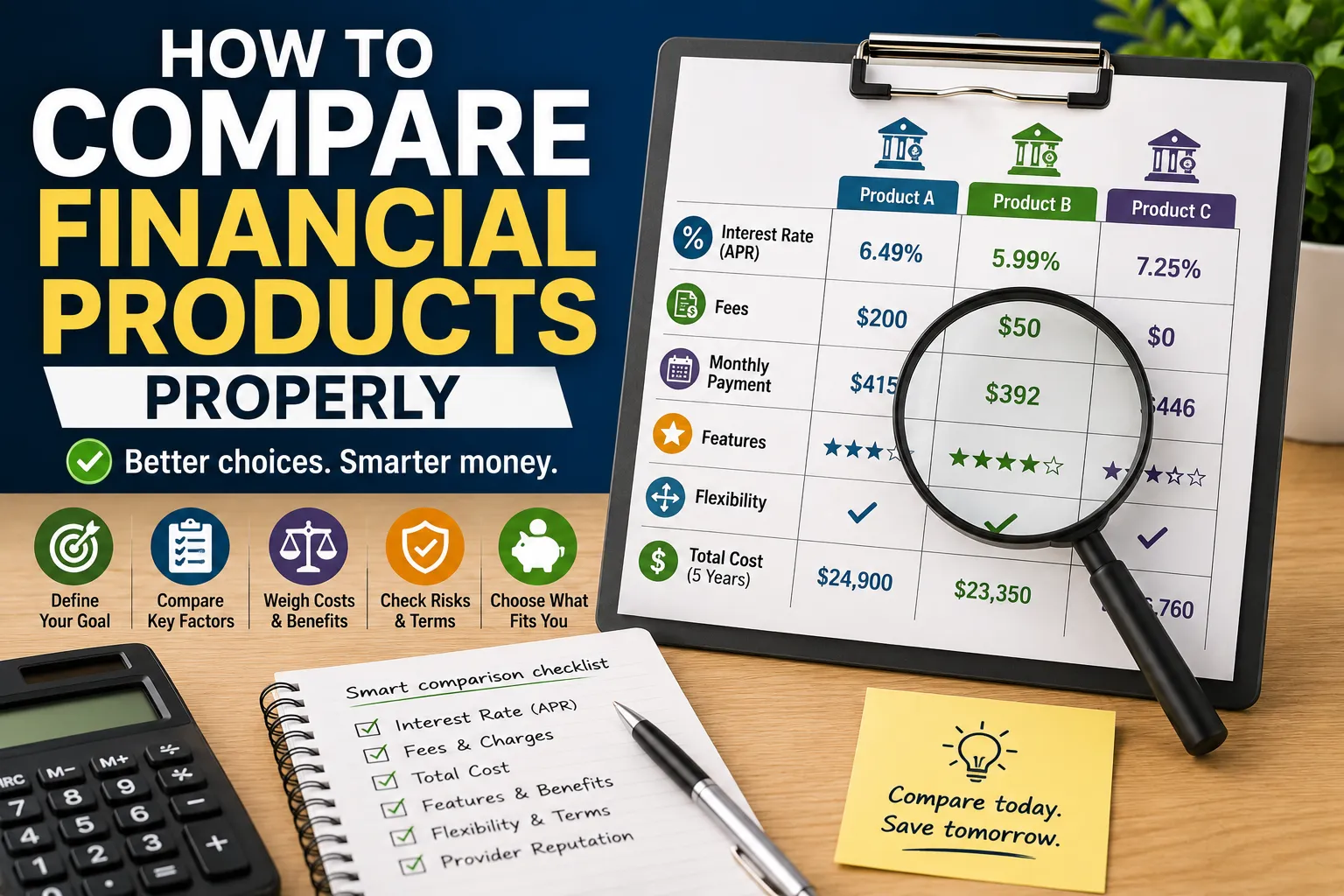
Then place the information in one table.
Build a Financial Product Comparison Table
A spreadsheet can make financial comparisons much easier.
Here’s a general template:
| Category | Product A | Product B | Product C |
|---|---|---|---|
| Provider | |||
| Primary cost | |||
| APR/APY where applicable | |||
| Monthly fee | |||
| Annual fee | |||
| Transaction fees | |||
| Promotional period | |||
| Rate after promotion | |||
| Minimum balance | |||
| Term | |||
| Early-exit restrictions | |||
| Key benefits | |||
| Major risks | |||
| Important exclusions | |||
| Customer support | |||
| Best suited for | |||
| Total estimated cost/value |
The final row is particularly important.
Try to convert complicated pricing into an estimated total dollar cost or net value over the period you expect to use the product.
Don’t Compare Products Using One Number
One of the biggest mistakes in financial comparisons is reducing a complicated decision to a single metric.
For example:
- Lowest APR doesn’t necessarily mean lowest total cost.
- Highest APY doesn’t necessarily mean best savings account.
- Lowest expense ratio doesn’t necessarily mean best investment.
- Highest rewards rate doesn’t necessarily mean best credit card.
- Lowest premium doesn’t necessarily mean best insurance.
- Lowest monthly payment doesn’t necessarily mean cheapest loan.
A financial product is a bundle of:
Cost + benefits + risk + restrictions + flexibility + suitability.
Your comparison should reflect all six.
Use a Weighted Scoring System
For complicated decisions, you can assign weights to the factors that matter most.
For example:
| Factor | Weight |
|---|---|
| Total cost | 30% |
| Risk | 20% |
| Flexibility | 15% |
| Benefits | 15% |
| Fees | 10% |
| Customer service | 10% |
Then score each product from 1 to 10.
This isn’t a scientific measure of quality. It’s a decision-making framework.
The advantage is that it forces you to identify what actually matters.
For someone primarily concerned with minimizing borrowing costs, total cost might receive a much larger weight.
For someone choosing an investment platform, fees, investment options, usability and services may receive different weights.
Watch for Apples-to-Oranges Comparisons
A comparison can look detailed while still being fundamentally flawed.
Common examples include:
Fixed Rate vs. Variable Rate
The products may behave very differently when market conditions change.
Short-Term vs. Long-Term Loan
A shorter term may have a higher monthly payment but lower total interest.
Promotional Rate vs. Standard Rate
The initial price may not represent the long-term cost.
Basic Insurance vs. Comprehensive Coverage
The lower premium may reflect significantly less protection.
DIY Investment Account vs. Advisory Service
One may have lower direct fees because it provides fewer services.
High-Yield Account With Requirements vs. Simple Account
A higher advertised rate may require conditions that don’t fit your financial behavior.
The solution is to compare products under the same assumptions.
Consider Your Time Horizon
The period you expect to use a financial product can completely change which option makes sense.
Suppose one mortgage option has higher upfront costs but a lower interest rate.
If you keep the mortgage for many years, those upfront costs may potentially be offset by interest savings.
If you move or refinance quickly, they may not be.
When evaluating mortgage points or similar tradeoffs, consider different time horizons rather than assuming the lowest rate is automatically the best choice.
Always ask:
How long am I realistically going to use this product?
Then compare costs over that period.
Calculate Break-Even Points
Break-even analysis is particularly useful when comparing products with different upfront and ongoing costs.
A simple example:
- Product A costs $500 upfront and $50 per month.
- Product B costs $100 upfront and $75 per month.
Product B is initially cheaper.
But after enough months, Product A becomes cheaper overall.
The break-even calculation tells you when that happens.
This approach can be useful when comparing:
- Mortgage points
- Insurance policies
- Investment services
- Subscription-based financial tools
- Account fees
- Refinancing options
It turns an abstract pricing difference into a practical decision.
Check Provider Reputation and Protections
Price isn’t enough.
Before choosing a financial provider, investigate:
- Regulatory status
- Licensing where applicable
- Deposit or investor protections where applicable
- Complaint history
- Security practices
- Customer support
- Financial stability where relevant
- Transparency of fees
- Quality of documentation
For investment services, review information about the firm’s services and costs and examine relevant disclosures such as Form CRS where applicable.
The exact protections depend on the type of product and provider, so verify the relevant regulatory framework rather than assuming that all financial products have the same safeguards.
Beware of Financial Product Comparison Traps
The Lowest Monthly Payment
A lower payment may simply mean a longer repayment period.
The Highest Advertised Rate
The rate may be promotional or subject to conditions.
Zero Fees
“Zero commission” doesn’t necessarily mean zero total costs.
Huge Rewards
Rewards can be offset by annual fees, higher rates or spending requirements.
Limited-Time Offers
A temporary benefit shouldn’t outweigh long-term costs.
Star Ratings Alone
Ratings don’t necessarily account for your personal financial circumstances.
One-Size-Fits-All Recommendations
A product that works for one household may be inappropriate for another.
Questions to Ask Before Choosing a Financial Product
Before signing up, ask:
- What will this product cost me in total?
- What fees can I be charged?
- Can the rate change?
- What happens after any promotional period?
- What restrictions apply?
- What happens if I need to exit early?
- What risks am I taking?
- What benefits will I realistically use?
- How long do I expect to use the product?
- Is there a cheaper alternative that provides what I actually need?
- What protections apply to my money?
- Can I get the terms in writing?
If you can’t clearly answer these questions, you’re probably not ready to make the comparison.
A Better Way to Compare Financial Products
The strongest financial comparisons follow a consistent process:
Step 1: Define the Goal
Know what you want the product to accomplish.
Step 2: Gather Multiple Options
Don’t evaluate a single offer in isolation.
Step 3: Standardize the Information
Compare the same metrics across every option.
Step 4: Calculate Total Cost
Include interest, fees and other charges.
Step 5: Evaluate Benefits
Determine which features have genuine value to you.
Step 6: Assess Risk
Understand what could go wrong and how much it could cost.
Step 7: Examine Restrictions
Check rate changes, penalties, minimums and cancellation rules.
Step 8: Consider Your Time Horizon
Calculate costs over the period you expect to use the product.
Step 9: Investigate the Provider
Look beyond the advertisement.
Step 10: Make the Decision Based on Fit
Choose the product that best matches your financial objective—not necessarily the one with the most attractive headline.
Smart Comparisons Start With the Total Picture
Financial products are designed to solve different problems, and their advertisements naturally emphasize their most attractive features.
That means consumers have to look beyond the headline.
A low interest rate can be undermined by fees. A low monthly payment can conceal a longer loan term. A high investment return can come with substantially greater risk. A generous rewards program can become less valuable once annual fees and spending requirements are considered.
The better approach is to compare total cost, actual benefits, risk, flexibility, restrictions and provider quality using the same assumptions.
When you make that process a habit, financial-product shopping becomes less about chasing the most impressive advertisement and more about identifying the option that genuinely fits your financial goals.
For savings decisions in particular, the comparison should also account for how much accessible cash your household actually needs; understanding how much emergency savings families should have can help put savings-account choices into the right context.
This article is intended for general educational purposes and does not constitute personalized financial, investment, tax, legal or insurance advice. Financial products and regulations vary by jurisdiction and individual circumstances. Always review the current terms and disclosures before making a financial decision.