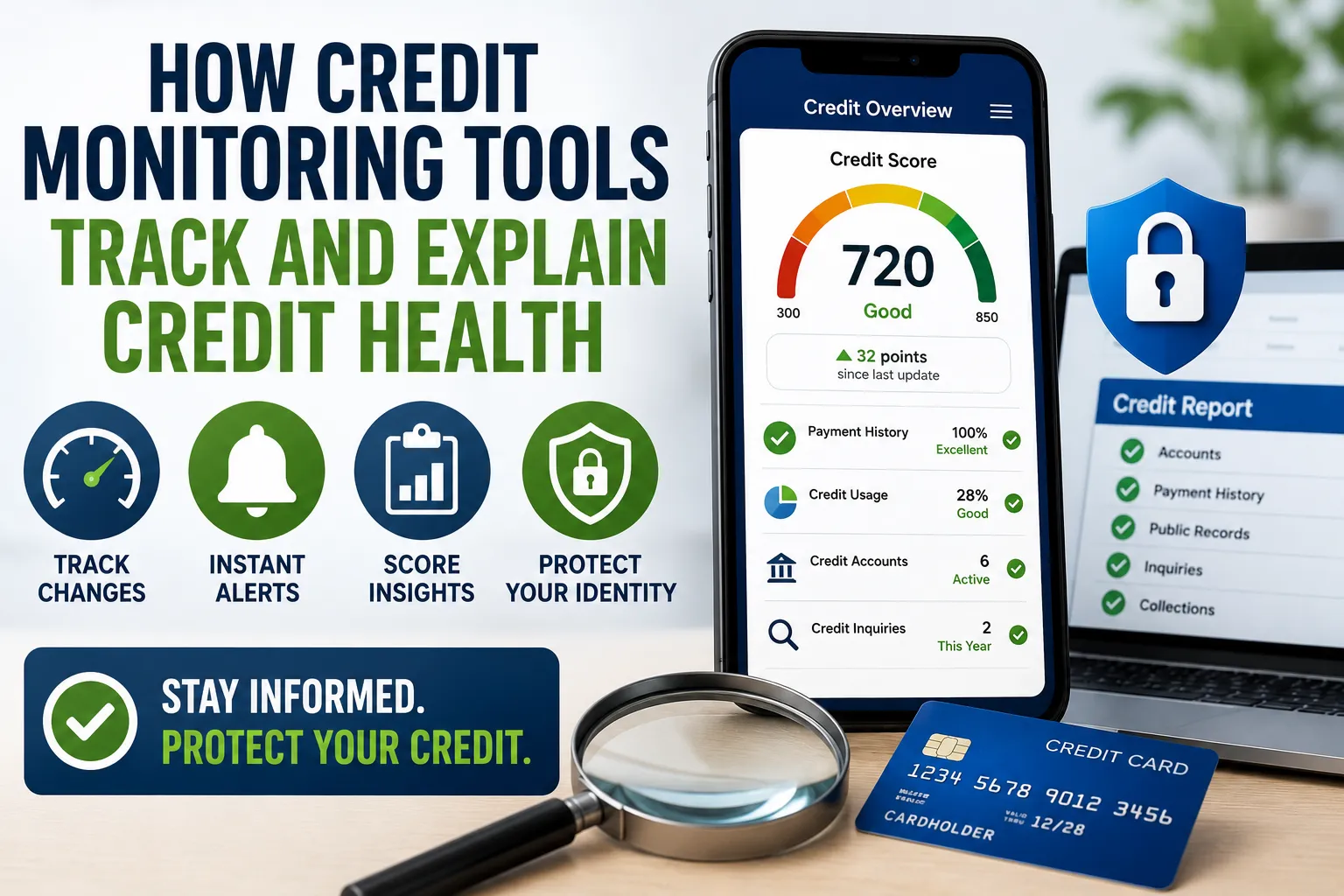
How Credit Monitoring Tools Track and Explain Credit Health
Credit can influence some of the biggest financial decisions people make, from applying for a loan or credit card to renting a home or qualifying for certain services. Yet credit information can be difficult to understand when it is spread across different accounts, payment histories and credit reports.
Credit monitoring tools are designed to make that information easier to follow.
These services can track changes in credit reports, provide alerts when certain activity occurs and translate complicated credit information into scores, summaries and explanations. They can help consumers identify potential problems earlier, understand what is affecting their credit and develop better financial habits.
However, credit monitoring tools have limitations. They do not all provide the same information, and monitoring a credit report is not the same thing as preventing identity theft or guaranteeing a particular credit score.
Understanding how these tools work can help consumers use them more effectively. They are also one part of the broader collection of resources covered in the Complete Guide to Credit Tools.
What Is Credit Monitoring?
Credit monitoring is a service that watches for changes to information contained in a consumer’s credit file and alerts the user when certain activity occurs.
Depending on the provider and plan, alerts may be triggered by events such as:
- A new credit account appearing
- A new inquiry on a credit report
- A reported late payment
- Changes to account information
- A significant change in a credit score
- A collection account appearing
- Certain public-record or identity-related activity
The exact features vary significantly between services.
The primary benefit is awareness.
Instead of discovering an unfamiliar account or credit inquiry months later, a consumer may receive an alert soon after the information is reported.
How Credit Monitoring Tools Work
Credit monitoring services generally obtain information from one or more credit bureaus or other data sources.
The service establishes a baseline of information associated with a user’s credit profile.
When new information is reported, the monitoring system compares it with previous information.
If a monitored change matches one of the service’s alert criteria, the user receives a notification.
The process can be summarized as:
Credit information is reported → monitoring service checks for changes → change is identified → user receives an alert → user investigates if necessary
The service does not necessarily control the information being reported.
Credit bureaus collect and maintain credit-file information, while lenders and other businesses provide information to the bureaus.
What Is a Credit Report?
To understand monitoring, it helps to understand the underlying credit report.
A credit report is a record of information related to a person’s borrowing and repayment history.
Depending on the reporting system and jurisdiction, it can contain information such as:
- Credit accounts
- Payment history
- Account balances
- Credit limits
- Account opening dates
- Credit inquiries
- Collections
- Other information relevant to the individual’s credit history
Credit reports are different from credit scores.
A report contains the underlying information.
A credit score is a numerical calculation based on information in a credit report and the particular scoring model being used.
For a more detailed explanation of how reports and scores relate to one another, see the Complete Guide to Credit Scores and Credit Reports.
Credit Scores Are Calculations, Not Permanent Ratings
A credit score can change when information in a credit file changes.
For example, changes in reported balances, payment history or new credit activity can affect a score.
Importantly, there is not necessarily one universal credit score for every consumer.
Different scoring models can produce different numbers from similar credit-report information.
Lenders may also use their own criteria in addition to a consumer’s credit score.
This means a monitoring app’s displayed score may not be exactly the same score a lender uses when evaluating an application.
Why Credit Scores Can Differ Between Services
Consumers sometimes become confused when two credit-monitoring services show different scores.
There are several possible reasons.
Different Credit Bureaus
Credit information can differ between credit bureaus.
One bureau might have received an updated account balance while another has not.
One report might contain an account that has not yet appeared on another report.
Different Scoring Models
Different scoring formulas can produce different results from the same underlying data.
A score designed for one type of lending decision may weigh information differently from another scoring model.
Different Update Schedules
Information does not necessarily reach every system at exactly the same time.
A credit score can therefore vary temporarily depending on when the underlying information was updated.
What Credit Monitoring Alerts Can Reveal
One of the most useful features of monitoring tools is the ability to highlight changes that might otherwise go unnoticed.
A notification about a new credit inquiry, for example, can prompt the consumer to ask whether they recently applied for credit.
An unfamiliar account may require more immediate investigation.
A reported late payment can alert someone to a potential reporting error or missed obligation.
The value of an alert comes from what happens afterward.
Receiving a notification is only the first step.
New Account Alerts
A new account appearing on a credit report can be completely legitimate.
Perhaps the consumer recently applied for a credit card, auto loan or other form of financing.
But an unfamiliar account can also indicate potential identity theft or an error in the credit report.
That makes new-account alerts particularly useful.
Consumers should verify unfamiliar activity rather than automatically assuming that every alert represents fraud.
Credit Inquiry Alerts
A hard inquiry can occur when a lender or other business checks a consumer’s credit as part of a credit application.
An unexpected inquiry may warrant investigation.
However, not every credit-related check has the same effect or is necessarily visible in the same way.
Some inquiries may be associated with applications, while other types of credit checks are treated differently.
Monitoring tools may explain the type of inquiry reported, but consumers should consult the underlying credit report when something appears unfamiliar.
Balance and Utilization Information
Credit monitoring tools often show credit-card balances and credit utilization.
Credit utilization generally refers to the amount of revolving credit being used relative to the available credit limits.
For example, someone with $2,000 in credit-card balances and $10,000 in total limits has a 20% utilization ratio.
Credit utilization can be an important factor in some credit scoring models.
A monitoring tool can make changes easier to notice by showing whether balances have increased or decreased.
However, consumers should avoid treating a particular utilization percentage as a universal rule that guarantees a specific score.
Credit scoring models consider multiple factors.
Payment History Is Especially Important
Payment history is one of the most significant categories in many widely used credit-scoring models.
Credit monitoring tools can help consumers keep track of reported payment information.
A missed payment can potentially damage credit, particularly when it becomes a reported delinquency.
Monitoring can therefore serve as an additional layer of awareness.
But it should not replace the most important habit: making required payments on time.
Consumers should rely on their account statements and payment systems for actual payment obligations rather than waiting for a monitoring alert.
Monitoring Can Help Explain Why a Score Changed
Some credit-monitoring services provide explanations when a credit score rises or falls.
For example, a tool might identify changes such as:
- A higher reported balance
- A newly opened account
- A new inquiry
- A change in payment history
- An account becoming older
- Changes in the overall credit profile
These explanations can make credit scoring feel less mysterious.
However, they should be viewed as educational guidance rather than a guarantee that a particular action will produce a specific score increase.
Score Simulators Can Be Useful but Limited
Some credit tools offer score simulators.
A simulator may ask what could happen if a consumer:
- Pays down a balance
- Opens a new account
- Closes an account
- Takes out a loan
- Misses a payment
The tool then estimates how the score might change.
These simulations can be useful for understanding general relationships between financial behavior and credit scores.
They are not predictions.
The actual outcome can differ because scoring depends on the specific information in the consumer’s credit file and the scoring model being used.
Credit Monitoring Does Not Prevent Identity Theft
This distinction is important.
A monitoring service can alert you to certain changes after information has been reported.
It does not necessarily stop someone from attempting to open an account using stolen personal information.
It also cannot guarantee that every fraudulent activity will generate an alert.
For this reason, credit monitoring should be viewed as one part of a broader identity-protection strategy rather than a complete security solution.
Monitoring Is Different From a Credit Freeze
A credit freeze is a separate tool.
Generally, a freeze restricts access to a consumer’s credit file, subject to applicable rules and exceptions.
Credit monitoring, by contrast, primarily provides visibility into changes.
The two approaches serve different purposes.
Someone concerned about identity theft may want to understand both options and determine which protections are appropriate under the rules applicable to their location.
Free and Paid Credit Monitoring Services
Credit monitoring is available through a range of free and paid services.
Free services may offer features such as:
- Credit-score access
- Basic alerts
- Credit-report summaries
- Educational explanations
Paid plans may add features such as:
- Monitoring across multiple credit bureaus
- More extensive identity monitoring
- Additional alerts
- Identity-theft assistance
- Insurance or restoration services, depending on the provider
Consumers should compare the actual features rather than assuming that a more expensive service is automatically better.
Read the Fine Print Before Paying
A paid credit-monitoring subscription can become a recurring household expense.
Before signing up, check:
- Monthly price
- Promotional pricing
- Renewal price
- Cancellation requirements
- Number of bureaus monitored
- Types of alerts included
- Identity-theft services
- Insurance limitations
- Data-sharing practices
A service that provides only information you can obtain elsewhere may not justify its recurring cost.
Credit Monitoring Can Help Find Reporting Errors
Not every unexpected credit-report change is fraud.
Credit reports can contain inaccurate or outdated information.
For example, a consumer might see:
- An account that does not belong to them
- An incorrect balance
- A payment incorrectly reported as late
- Duplicate information
- Incorrect personal information
Monitoring tools can make these problems easier to notice.
Once an error is identified, consumers can investigate the underlying credit report and follow the appropriate dispute process.
Check the Actual Credit Report
A score summary is convenient, but it does not tell the whole story.
If a monitoring tool reports an unexpected change, reviewing the underlying credit report can provide much more detail.
Look at:
- Account names
- Account balances
- Payment history
- Credit limits
- Inquiry history
- Account status
- Personal information
This can help determine whether an alert is legitimate, an error or potentially fraudulent activity.
Why Monitoring All Available Reports Can Matter
Credit information may not be identical across different credit bureaus.
If a consumer checks only one source, they may not see an issue appearing elsewhere.
Services that monitor multiple bureaus can therefore provide broader visibility.
However, consumers should understand exactly which bureaus a service monitors and how frequently information is updated.
How Often Should You Check Your Credit?
There is no single required schedule.
People preparing for a major financial decision may want to review their credit information more closely.
Others may find that periodic checks combined with automatic alerts provide enough awareness.
The important point is consistency.
Checking occasionally can help consumers become familiar with their normal credit profile, making unusual activity easier to recognize.
Credit Monitoring Can Support Better Financial Habits
The educational side of monitoring can be just as valuable as the security alerts.
Seeing how balances, payment history and new applications relate to credit can encourage consumers to pay closer attention to their financial behavior.
For example, someone who notices that carrying large revolving balances affects their credit profile may become more motivated to reduce those balances.
Someone who sees how quickly multiple credit applications accumulate may become more selective when applying for new accounts.
Don’t Chase Every Small Score Movement
Credit scores can fluctuate.
A small change does not necessarily indicate a serious financial problem.
Consumers should avoid becoming obsessed with every point gained or lost.
Instead, focus on the underlying behaviors that generally support healthy credit:
- Paying bills on time
- Managing debt responsibly
- Keeping track of credit accounts
- Reviewing reports for errors
- Applying for credit thoughtfully
- Avoiding unnecessary debt
Long-term financial habits matter more than day-to-day score fluctuations.
Credit Health Is Bigger Than a Three-Digit Number
A credit score is useful, but it is only one measure of financial health.
Someone can have a strong credit score while carrying substantial debt.
Another person might have a limited credit history but otherwise have strong savings and manageable expenses.
A healthy financial position also involves:
- Emergency savings
- Manageable debt
- Sustainable spending
- Reliable income
- Appropriate insurance
- Long-term financial planning
Credit monitoring should therefore be treated as one component of personal financial management.
What to Do When an Alert Looks Suspicious
If a monitoring service identifies activity you do not recognize, do not ignore it.
Start by reviewing the underlying credit report and account information.
If the activity appears fraudulent, take appropriate steps to protect your identity and financial accounts.
Depending on the circumstances, this may involve:
- Contacting the relevant lender
- Disputing inaccurate information
- Securing affected accounts
- Changing passwords
- Reviewing bank and card statements
- Considering additional credit protections
- Reporting suspected identity theft through the appropriate official channels
The sooner suspicious activity is investigated, the more quickly potential problems can be addressed.
Protect the Monitoring Account Itself
A credit-monitoring account contains sensitive financial information.
Consumers should protect access to it just as carefully as they protect banking accounts.
Good practices include:
- Using a unique password
- Enabling multi-factor authentication when available
- Avoiding password reuse
- Keeping devices updated
- Being cautious with unexpected emails and messages
- Using secure networks when accessing sensitive accounts
A monitoring service can provide alerts, but account security still depends partly on the user.
Avoid Unnecessary Credit Applications
Monitoring tools can help consumers see how new credit activity affects their profiles.
That can encourage more thoughtful borrowing decisions.
Before applying for a new card or loan, consider whether the credit is genuinely needed and whether the associated payments fit comfortably into the household budget.
A credit application should be part of a financial decision, not simply a way to chase a promotional offer.
Monitoring Tools Are Especially Useful Before Major Financial Decisions
Consumers preparing to apply for a mortgage, auto loan or other major financing may benefit from reviewing their credit information in advance.
Doing so provides an opportunity to identify potential errors or unfamiliar activity before submitting an application.
It also gives consumers a clearer understanding of their current financial position.
However, lenders may use their own scoring models and underwriting criteria, so the score shown by a monitoring service should not be treated as a guarantee of approval or a specific interest rate.
What Makes a Good Credit Monitoring Tool?
A useful service should make important information easy to understand without creating unnecessary confusion.
Features worth evaluating include:
Clear Alerts
Notifications should explain what changed and when.
Transparent Score Information
The service should identify which score or scoring model is being displayed when that information is available.
Useful Explanations
A score change should ideally come with understandable context.
Credit Report Access
Being able to review underlying information is more useful than seeing a score alone.
Multiple-Bureau Coverage
Broader monitoring can provide a more complete picture.
Strong Security
The service should provide appropriate safeguards for sensitive financial information.
Transparent Pricing
Consumers should understand exactly what they are paying for.
Don’t Let Marketing Create Unnecessary Fear
Credit and identity theft are serious issues, but some monitoring services market their products using fear.
Consumers should carefully distinguish between useful protection and unnecessary add-ons.
A service does not become better simply because it sends more notifications.
The goal is to receive meaningful information that helps you make decisions or identify potential problems.
Too many low-value alerts can eventually cause users to ignore notifications altogether.
A Simple Way to Use Credit Monitoring
A practical routine might look like this:
1. Set up appropriate alerts.
Choose notifications for meaningful changes.
2. Review alerts when they arrive.
Determine whether the activity is familiar.
3. Check the underlying credit report when necessary.
Don’t rely solely on a summary score.
4. Investigate unfamiliar information.
Contact the appropriate company or reporting organization if something appears incorrect.
5. Track broader credit habits.
Pay attention to payment history, balances and new applications.
6. Review the service periodically.
Make sure the monitoring features still justify the cost, particularly if you are paying for a subscription.
Common Mistakes to Avoid
Several misunderstandings can reduce the value of credit monitoring.
Assuming One Score Is Universal
Different scoring models can produce different numbers.
Ignoring the Credit Report
A score cannot explain every detail contained in a credit file.
Treating Alerts as Proof of Fraud
An unfamiliar change deserves investigation, but it may also be an error or legitimate activity.
Believing Monitoring Prevents Identity Theft
Monitoring primarily provides visibility; it does not guarantee prevention.
Paying for Features You Don’t Use
A premium plan may not be worthwhile if its additional services are unnecessary.
Obsessing Over Small Score Changes
Long-term financial behavior matters more than minor fluctuations.
Credit Monitoring Works Best as an Early-Warning System
The real value of credit monitoring is not that it makes credit simple.
It makes changes more visible.
A credit report can contain information accumulated over years, and a credit score compresses some of that information into a number. Monitoring tools add another layer by notifying consumers when selected elements change.
That can provide an important early-warning system.
But consumers still need to understand what the alert means, review the underlying information and take appropriate action when something is wrong.
Turning Credit Data Into Better Financial Decisions
Credit monitoring tools can make an otherwise complicated part of personal finance easier to follow. By tracking changes, providing alerts and explaining some of the factors that influence credit scores, they can help consumers become more aware of their financial profiles.
The most effective approach is to use these tools as information systems rather than score-chasing machines.
Check the underlying credit information, investigate unexpected changes, understand the limitations of different scoring models and focus on consistent financial habits.
A healthy credit profile is built over time through responsible borrowing, timely payments, manageable debt and regular attention to the information lenders may see. Credit monitoring can make that process easier to understand, but the real benefit comes when the information it provides leads to better financial decisions.