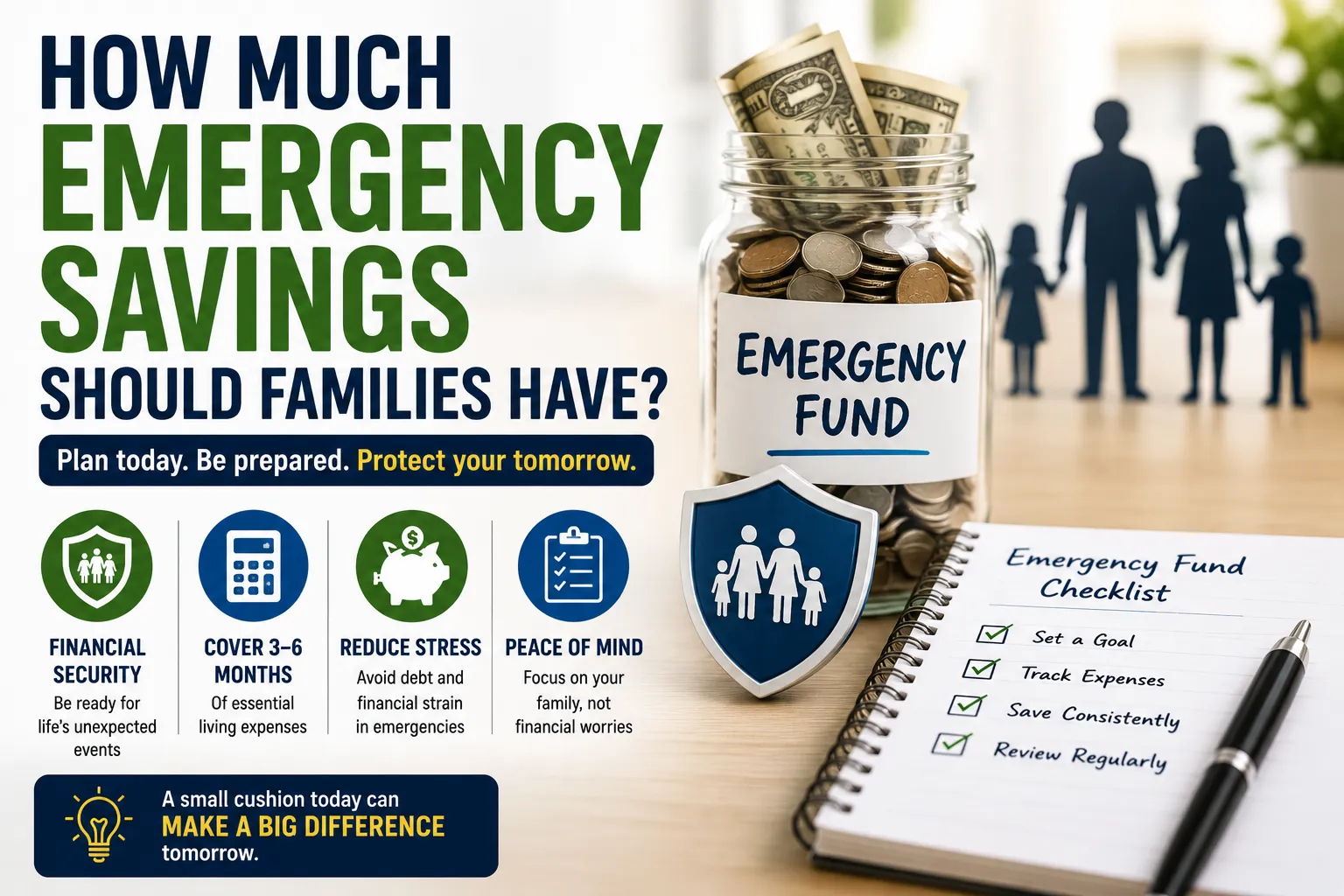
How Much Emergency Savings Should Families Have?
For families, an emergency fund is more than a financial cushion. It is a way to create breathing room when life does not go according to plan.
A broken car, unexpected medical bill, job loss, urgent home repair or sudden family expense can quickly disrupt a household budget. Without savings, families may have to rely on credit cards, expensive loans, borrowed money or investments that were intended for long-term goals.
But how much should a family actually keep in emergency savings?
The often-repeated advice of having three to six months of essential expenses is a useful starting point, but it is not a universal rule. A household with one stable income and several dependents may need a larger reserve than a dual-income household with fewer financial responsibilities. A freelancer with unpredictable income may also need more cash than someone with highly stable employment.
The right emergency fund is ultimately the amount that gives your household reasonable protection without unnecessarily keeping too much money sitting in cash.
A well-designed money management system can help families monitor their savings, expenses and financial priorities so the emergency fund remains aligned with the rest of the household’s financial plan.
What Is an Emergency Fund?
An emergency fund is money set aside specifically for unexpected and necessary expenses.
It is different from ordinary savings.
Money for a holiday, new television, school shopping or a planned home renovation is generally goal-based savings. Emergency savings are reserved for situations you did not reasonably plan for.
Common emergency expenses include:
- Job loss
- Major home repairs
- Urgent vehicle repairs
- Unexpected medical expenses
- Essential family travel
- Emergency relocation
- Sudden loss of income
- Essential appliance replacement
- Other significant, unplanned expenses
The purpose is not to make emergencies painless.
It is to prevent an emergency from becoming a financial crisis.
Why Families Need Emergency Savings
A household budget works reasonably well when income and expenses behave predictably.
Real life rarely does.
A family may spend months carefully managing its finances and then suddenly face a major expense.
Without savings, the family may have to:
- Use a credit card
- Take out a personal loan
- Borrow from relatives
- Sell investments
- Delay important bills
- Reduce essential spending
- Use money intended for another financial goal
Emergency savings provide another option: use cash that was specifically set aside for unexpected circumstances.
That flexibility can be particularly valuable when several people depend on the household’s income.
The Three-to-Six-Month Rule
One of the most common guidelines is to save enough to cover three to six months of essential living expenses.
This is different from saving three to six months of your salary.
Suppose a household earns $6,000 per month but only needs $4,000 to cover essential expenses.
A three-month emergency fund would be:
$4,000 × 3 = $12,000
A six-month emergency fund would be:
$4,000 × 6 = $24,000
The goal is to estimate how much the family would actually need to maintain essential living expenses if normal income were temporarily disrupted.
What Counts as an Essential Expense?
This is one of the most important parts of calculating an emergency fund.
Start with expenses the household would have difficulty eliminating during a financial emergency.
These may include:
- Housing
- Basic utilities
- Groceries
- Transportation
- Insurance
- Essential healthcare
- Minimum debt payments
- Childcare required to maintain employment
- Essential school-related costs
- Basic communication services
Then separate expenses that could potentially be reduced or paused.
These might include:
- Restaurant meals
- Entertainment
- Vacations
- Luxury purchases
- Subscription services
- Nonessential shopping
- Certain recreational activities
Your emergency fund should be based on the expenses necessary to keep the household functioning.
A Simple Emergency Fund Calculation
Start with your monthly essential expenses.
For example:
| Expense | Monthly amount |
|---|---|
| Housing | $1,500 |
| Utilities | $300 |
| Groceries | $700 |
| Transportation | $400 |
| Insurance | $250 |
| Healthcare | $150 |
| Minimum debt payments | $300 |
| Essential childcare | $400 |
| Total | $4,000 |
If the family chooses a six-month target:
$4,000 × 6 = $24,000
The household would therefore aim for approximately $24,000 in emergency savings.
This is an illustrative example, not a recommended amount for every family.
How Much Emergency Savings Does a Family of Four Need?
There is no fixed amount based solely on the number of people in the household.
A family of four with very low essential expenses could need less emergency savings than a family of three with a mortgage, childcare expenses and unstable income.
Instead of asking:
“How much should a family of four have?”
Ask:
“How much would our household need each month to keep operating if our income dropped significantly?”
That figure provides a much more useful starting point.
Families With One Income May Need More
Households that depend heavily on one income source may face greater financial risk if that income disappears.
Consider a family where one parent provides nearly all household earnings.
If that person loses their job, the entire household’s income could be affected simultaneously.
A larger emergency fund may therefore provide valuable protection.
The appropriate target depends on:
- Job stability
- Industry conditions
- Household expenses
- Insurance coverage
- Availability of other income
- Access to family support
- Ease of finding replacement employment
Dual-Income Families Still Need Emergency Savings
Having two incomes can reduce the risk of a complete loss of household income, but it does not eliminate financial risk.
Both partners could face:
- Job losses
- Reduced hours
- Illness
- Unexpected expenses
- Family emergencies
In addition, some households have expenses that rise significantly when circumstances change.
A dual-income household may therefore choose a smaller emergency fund than a single-income family, but it should still have a meaningful reserve.
Families With Children May Need a Larger Cushion
Children can make household expenses less predictable.
Unexpected costs can include:
- Medical care
- School expenses
- Childcare
- Transportation
- Essential clothing
- Family travel during emergencies
- Household repairs
Parents should consider these obligations when setting their emergency-fund target.
A household with young children and limited income flexibility may benefit from a larger cash reserve than a household with fewer dependents.
Families With Special Financial Responsibilities
Some households have additional responsibilities that can justify a larger emergency reserve.
For example:
- Supporting elderly relatives
- Caring for family members with additional needs
- Paying private school fees
- Managing multiple properties
- Supporting relatives in another location
- Maintaining a business
- Covering significant recurring medical costs
The more obligations that cannot easily be paused, the more valuable a larger emergency reserve can become.
Self-Employed Families May Need More
Self-employment can provide greater flexibility and earning potential, but income may also be less predictable.
A business owner or freelancer may experience:
- Seasonal income
- Delayed client payments
- Lost contracts
- Unexpected business expenses
- Changes in demand
For these households, an emergency fund may need to cover both personal living expenses and periods of reduced income.
However, personal emergency savings and business cash reserves should generally be considered separately.
A business account should not automatically be treated as a family’s personal emergency fund.
Families With Highly Stable Income May Need Less
Not every household needs to target the upper end of the three-to-six-month range.
A family may have relatively predictable income if:
- Employment is highly stable.
- Multiple adults earn income.
- Essential expenses are low.
- The household has strong insurance coverage.
- Other liquid savings are available.
- Replacement employment would likely be easy to find.
These factors can reduce the amount of emergency cash the household may need.
That does not mean an emergency fund is unnecessary.
It simply means the appropriate target may be different.
Consider Job Security
Your emergency fund should reflect the stability of your income.
Someone working in a highly volatile industry may need a larger reserve than someone with extremely predictable employment.
Ask:
- How difficult would it be to find another job?
- How long might replacing my income take?
- Is my industry cyclical?
- Could my hours be reduced?
- Is my income dependent on commissions?
- Do I have more than one income source?
The greater the uncertainty, the more valuable additional cash reserves become.
Consider How Quickly You Could Replace Your Income
The three-to-six-month guideline is partly about time.
If you could reasonably find replacement income within a few weeks, you may need less emergency savings than someone who could spend many months searching.
Consider:
Income replacement time + household obligations = emergency-fund pressure
This is not a mathematical formula for determining an exact target, but it is a useful way to think about the problem.
Emergency Savings Should Be Accessible
Emergency money is supposed to be available when you need it.
That means accessibility should be one of your highest priorities.
Depending on your country and financial system, appropriate locations may include:
- A dedicated savings account
- An interest-bearing deposit account
- Another relatively low-risk, liquid savings product
The exact product depends on local banking regulations, deposit protections and available rates.
The emergency fund is generally not the place to chase high investment returns.
Why Emergency Money Usually Shouldn’t Be in Stocks
Stocks can potentially provide higher long-term returns, but their value can fluctuate significantly.
Imagine your family needs $10,000 for an emergency at exactly the moment financial markets have fallen sharply.
You could be forced to sell investments at a loss.
An emergency fund exists precisely to avoid that kind of situation.
The priority is generally:
Liquidity + stability + accessibility
rather than maximum investment growth.
What About Keeping Emergency Cash at Home?
Keeping a small amount of physical cash at home can be useful for certain short-term situations, such as temporary payment-system disruptions.
However, keeping an entire emergency fund as physical cash introduces risks such as:
- Theft
- Loss
- Fire
- Lack of interest
- Difficulty replacing the money
A household should consider local circumstances and security when deciding how much physical cash, if any, to keep.
Build Your Emergency Fund in Stages
Saving several months of expenses can feel overwhelming.
Instead of focusing immediately on a large final number, use milestones.
Stage 1: Starter Emergency Fund
Aim for a small initial reserve that can cover a common unexpected expense.
Stage 2: One Month of Essential Expenses
This creates a stronger buffer against short-term disruptions.
Stage 3: Three Months
This provides a more substantial reserve.
Stage 4: Six Months
This can provide greater protection against longer periods of income disruption.
Stage 5: Beyond Six Months
Some households may reasonably choose a larger reserve because of their income, responsibilities or risk profile.
Start With Your First $500 or $1,000
For a family starting from zero, the full emergency-fund target can look intimidating.
Break it down.
If your eventual goal is $12,000, don’t make that number the only milestone.
Start with:
$500
Then:
$1,000
Then:
$2,500
Then:
One month of expenses
Each milestone creates greater financial resilience.
How to Build an Emergency Fund on a Tight Budget
Not every family has significant money left over after paying monthly expenses.
In that situation, focus on consistency rather than speed.
You might:
- Automate a small transfer after payday.
- Save unexpected income.
- Redirect part of a bonus.
- Reduce one recurring expense.
- Sell unused items.
- Save part of tax refunds where applicable.
- Deposit occasional cash gifts.
- Increase savings whenever income rises.
Even a small recurring contribution can gradually build a meaningful reserve.
Automate Your Emergency Savings
Automation removes one decision from your monthly routine.
For example, you could arrange for $100 to move automatically into a dedicated savings account whenever you receive your income.
At that rate:
$100 × 12 months = $1,200
Increasing the contribution to $200 would produce:
$200 × 12 months = $2,400
The exact amount matters less than establishing a repeatable system that fits your budget.
Save Before You Spend
One common approach is to treat emergency savings as a planned expense.
Instead of:
Income → spending → save whatever remains
Try:
Income → emergency savings → essential spending → discretionary spending
This approach can make saving more consistent.
It also reduces the chance that emergency savings will disappear into ordinary spending.
Use Windfalls Strategically
Unexpected money can accelerate emergency savings.
Examples may include:
- Bonuses
- Tax refunds
- Gifts
- Commissions
- Freelance payments
- Proceeds from selling unused items
You don’t have to put all unexpected income into your emergency fund.
Even allocating a portion can significantly accelerate progress.
Should You Pay Off Debt or Build Emergency Savings First?
This is one of the most common personal-finance questions.
The answer depends on the type of debt, interest rate, household stability and emergency-fund size.
For many households, maintaining at least a basic emergency reserve while aggressively paying down high-interest debt can be a reasonable approach.
Why?
Because paying every available dollar toward debt can leave you with no cash if something goes wrong.
You may then have to borrow again.
A balanced approach can be:
- Build a starter emergency fund.
- Attack expensive debt.
- Increase emergency savings.
- Continue long-term investing and other goals.
The appropriate sequence depends on individual circumstances.
Don’t Use Emergency Savings for Predictable Expenses
An emergency fund can become ineffective if it is constantly used for expenses that were actually predictable.
For example, if you know you will need money for:
- Annual insurance
- School fees
- Holiday travel
- Property taxes
- Vehicle maintenance
- Home maintenance
consider creating separate sinking funds.
A sinking fund is money saved gradually for an expected future expense.
This keeps your emergency fund reserved for genuine surprises.
Emergency Fund vs. Sinking Fund
The distinction is simple.
Emergency Fund
For unexpected and necessary expenses.
Sinking Fund
For expected but irregular expenses.
For example:
Emergency fund: Broken water heater
Sinking fund: Annual vehicle insurance
Emergency fund: Sudden loss of income
Sinking fund: School expenses due next term
Both are useful, but they serve different purposes.
What If You Have a Large Emergency?
Your emergency fund does not have to cover every imaginable disaster.
Insurance can play an important role.
Depending on your circumstances, insurance may help cover risks involving:
- Health
- Vehicles
- Home
- Disability
- Life
- Property
- Other significant risks
Emergency savings can then cover deductibles, gaps in coverage and smaller unexpected costs.
The combination of insurance + cash savings can provide stronger protection than either one alone.
Rebuild Your Emergency Fund After Using It
Using emergency savings is not a failure.
That is what the money is there for.
Suppose your family has $15,000 saved and needs $4,000 for an unexpected emergency.
The balance becomes:
$15,000 − $4,000 = $11,000
Once the emergency is resolved, make rebuilding the fund a priority.
Don’t assume you have “failed” because the balance declined.
A successful emergency fund is one that is available when you actually need it.
Review Your Emergency Fund After Major Life Changes
Your target should not remain unchanged forever.
Recalculate it after events such as:
- Marriage
- Divorce
- Having children
- Buying a home
- Losing an income
- Starting a business
- Changing careers
- Taking on new debt
- Moving to a more expensive area
- Retirement
For households navigating these transitions, managing household finances during major life changes can provide a useful framework for reassessing the budget and emergency reserve.
If essential monthly expenses rise from $3,000 to $4,500, your previous emergency-fund target may no longer provide the same level of protection.
What If Your Family Has Too Much Cash?
Emergency savings are important, but holding excessive amounts of cash can have an opportunity cost.
Money sitting in a low-interest account may lose purchasing power over time because of inflation.
Once your emergency fund is adequately funded, additional money may be better directed toward goals such as:
- Retirement
- Debt reduction
- Education
- Homeownership
- Long-term investments
- Other financial priorities
The objective is not to maximize your emergency savings forever.
It is to reach an appropriate level and then put additional money to productive use.
A Family Emergency Fund Example
Consider a household with two adults and two children.
Their monthly essential expenses are:
- Housing: $1,800
- Utilities: $300
- Food: $700
- Transportation: $450
- Insurance: $300
- Healthcare: $200
- Debt minimums: $350
- Childcare: $500
Total:
$4,600 per month
Three-month target
$4,600 × 3 = $13,800
Six-month target
$4,600 × 6 = $27,600
If the family’s income is highly stable, it might choose a target closer to the lower end.
If one income supports the entire household or employment is unpredictable, the family might prefer the higher end or more.
How to Decide Between Three and Six Months
Consider the following questions.
How stable is your income?
More stability may support a smaller reserve.
How many people depend on your income?
More dependents may increase the need for cash reserves.
How easy would it be to find new income?
Longer job searches can justify a larger fund.
How high are your fixed expenses?
A family with large unavoidable monthly bills may need more savings.
Do you have other resources?
Accessible savings, reliable secondary income and appropriate insurance can influence the amount needed.
How much financial risk are you comfortable accepting?
A larger emergency fund generally provides a larger financial buffer.
When Six Months May Not Be Enough
Some households may reasonably want more than six months of essential expenses.
This could include:
- Self-employed households
- Commission-based workers
- Seasonal workers
- Families with one income
- People approaching retirement
- Households with substantial financial obligations
- Families in industries with unstable employment
- People with limited access to alternative income
The correct amount is ultimately a risk-management decision.
When Three Months May Be Reasonable
A smaller emergency fund may be sufficient for households with:
- Two stable incomes
- Low fixed expenses
- Strong job security
- Good insurance coverage
- Additional accessible savings
- Strong family or social support
- Highly transferable professional skills
Again, these are considerations rather than strict rules.
Emergency Savings for Single Parents
Single-parent households can face a particular challenge because there may be less income redundancy.
A sudden job loss or inability to work can affect the household’s finances immediately.
Single parents should consider:
- Income stability
- Childcare costs
- Housing costs
- Insurance
- Support networks
- Government or employer benefits where applicable
- How quickly replacement income could be found
A larger emergency reserve may provide additional protection where the budget allows.
Emergency Savings for Families With Variable Income
If household income changes significantly from month to month, calculate the emergency fund based on essential expenses, not your average income.
For example, if monthly income fluctuates between $3,500 and $7,000, focus first on what the household needs to survive during a low-income period.
You can then consider keeping additional cash reserves to account for the variability itself.
Where Should Families Keep Emergency Savings?
The ideal location should generally balance:
Safety + accessibility + reasonable interest
Depending on the country, options may include:
- Savings accounts
- High-interest deposit accounts
- Money-market deposit products
- Other low-risk liquid savings products
Before choosing an institution, check applicable deposit-protection arrangements and withdrawal rules.
Don’t put emergency money somewhere you cannot access when an emergency occurs.
Don’t Chase the Highest Possible Return
An emergency fund has a different job from a retirement portfolio.
If a particular account offers a slightly higher return but makes withdrawals difficult, it may not be appropriate.
Similarly, investing emergency money in volatile assets can expose your household to losses at exactly the wrong time.
For emergency savings, certainty and accessibility generally matter more than maximizing returns.
Keep Your Emergency Fund Separate
A dedicated emergency savings account can make it easier to avoid spending the money casually.
You could label it:
Family Emergency Fund
or
Emergency Savings — Do Not Spend
The psychological separation can be useful.
When the money sits beside everyday spending funds, it can be tempting to treat it as available for ordinary purchases.
How to Prevent Emergency Savings From Being Raided
Create clear rules.
Use the fund only when:
- The expense was unexpected.
- The expense is necessary.
- The expense cannot reasonably be covered by your normal monthly budget.
For example:
Broken refrigerator: potentially appropriate.
Last-minute holiday upgrade: probably not.
Job loss: appropriate.
New phone because the current model is old: not an emergency.
Clear rules help preserve the fund for situations where it actually matters.
A Family Emergency Fund Checklist
Use this checklist to evaluate your household.
Calculate
- Monthly essential expenses
- Minimum debt payments
- Essential childcare
- Insurance
- Healthcare costs
- Transportation needs
Assess Risk
- Number of household income earners
- Job stability
- Income variability
- Number of dependents
- Insurance coverage
- Access to other financial resources
Set a Target
- Starter emergency fund
- One-month target
- Three-month target
- Six-month target
- Larger reserve if circumstances justify it
Protect the Fund
- Keep it accessible
- Keep it separate from everyday spending
- Avoid unnecessary withdrawals
- Rebuild it after use
- Review the target after major life changes
What Families Should Aim for First
If your family currently has no emergency savings, don’t become discouraged by the size of the final goal.
The first objective is simply to start building a buffer.
Even a modest reserve can be useful.
Then gradually move through milestones:
$500 → $1,000 → one month → three months → six months
The exact numbers can be adjusted to your household.
What matters is moving from financial vulnerability toward financial resilience.
Build the Cushion Before You Need It
There is no universal emergency-fund number that works for every family.
Three to six months of essential expenses is a useful starting framework, but the right target depends on household income, job stability, dependents, debt, insurance, monthly obligations and how quickly income could be replaced.
A family with two stable incomes and relatively low expenses may be comfortable closer to the lower end of the range. A single-income household, self-employed family or household with substantial fixed obligations may reasonably want a larger reserve.
The most important step is to calculate your actual essential monthly expenses and build from there.
Keep emergency savings accessible, separate it from money intended for everyday spending, and replenish it after an emergency. As your family grows or your financial circumstances change, revisit the target rather than assuming the original number will always be enough.
An emergency fund is not money that sits around waiting for something to go wrong. It is money that gives your family choices when something does go wrong—and that financial breathing room can be one of the most valuable forms of security a household can build.