How Debt Repayment Tools Help Plan Debt Payoff
Paying off debt can feel overwhelming when balances, interest rates and monthly payments are spread across several accounts. Without a clear plan, it can be difficult to know which debt should receive extra money first or how long becoming debt-free might take.
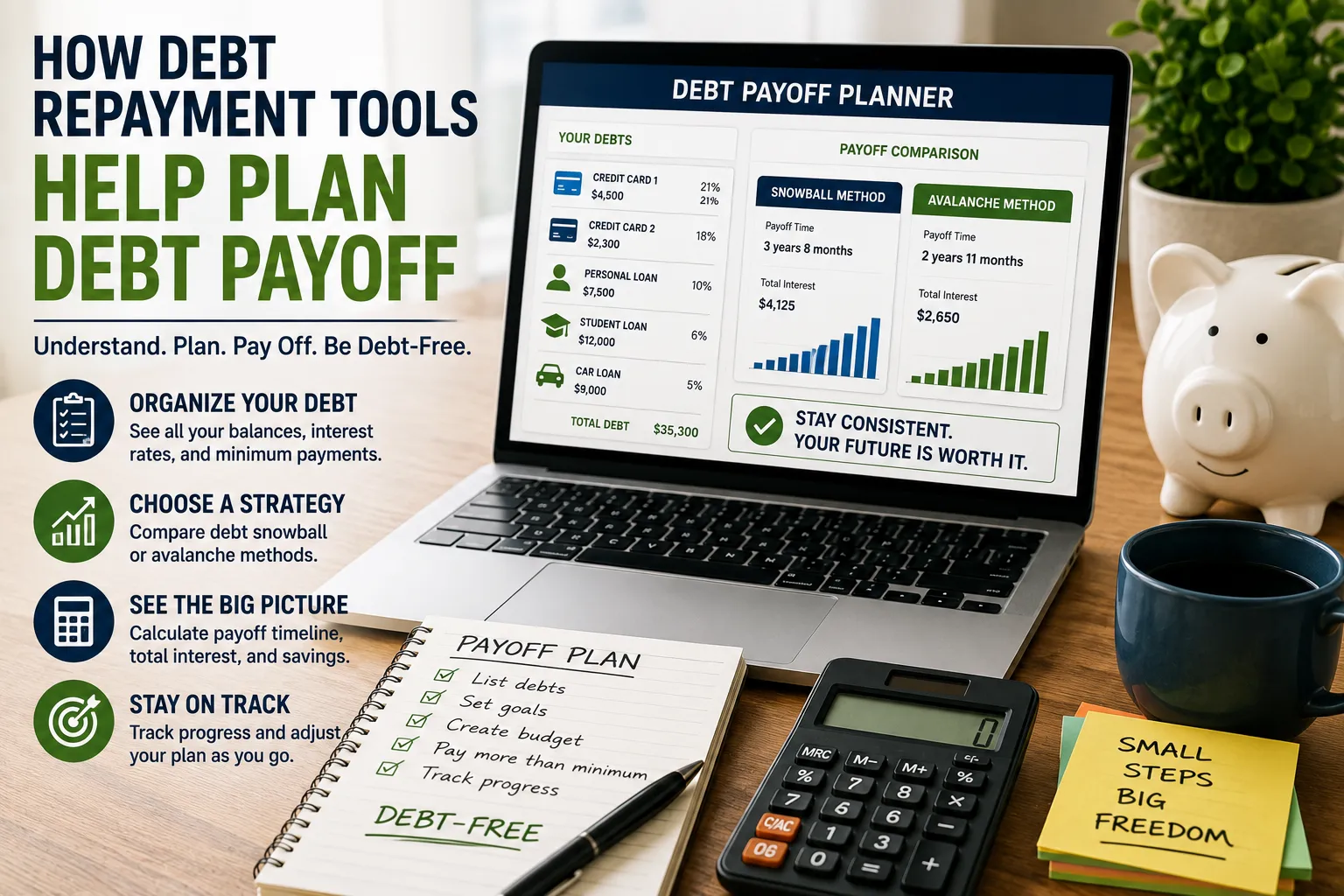
Debt repayment tools are designed to make that process easier. From simple spreadsheets and calculators to budgeting apps and debt-management platforms, these tools can help borrowers organize what they owe, compare repayment strategies and track progress over time.
They do not eliminate debt on their own, but they can turn an unclear financial problem into a structured repayment plan.
For a broader overview of credit, borrowing and debt-management resources, see the Complete Guide to Credit Tools.
What Is a Debt Repayment Tool?
A debt repayment tool is a calculator, spreadsheet, app or online service that helps someone organize and manage outstanding debt.
Depending on the tool, it may allow users to enter information such as:
- Outstanding balance
- Interest rate
- Minimum monthly payment
- Due date
- Additional payment amount
- Loan term
- Credit-card balance
- Personal loan information
The tool can then estimate how different payment strategies could affect the repayment timeline and total interest cost.
Some tools are extremely simple. Others provide detailed schedules showing how every payment could affect the balance.
Why Debt Can Be Difficult to Manage Without a Plan
Debt becomes particularly complicated when a household has multiple balances.
For example, someone might have:
- Two credit cards
- A personal loan
- A car loan
- A student loan
Each account may have a different interest rate, minimum payment and due date.
Making the minimum payment on every account can keep the accounts current, but it does not necessarily provide the most efficient path toward becoming debt-free.
A repayment tool can put all of this information in one place.
When several different balances are involved, it can also help to understand the broader process described in How to Manage Household Debt and Pay Off Multiple Debts.
Start by Listing Every Debt
The first step in using a debt repayment tool is creating an accurate inventory.
For each debt, record:
| Information | Example |
|---|---|
| Debt type | Credit card |
| Balance | $4,500 |
| Interest rate | 21% |
| Minimum payment | $120 |
| Due date | 15th |
| Additional payment | $80 |
The numbers will vary from person to person.
The important thing is accuracy.
An incorrect balance or interest rate can make the repayment projections misleading.
The Debt Snowball Method
One of the best-known repayment strategies is the debt snowball method.
With this approach, you make the minimum required payments on all debts while directing extra money toward the smallest balance.
Once that debt is eliminated, the money previously used for its payment is redirected toward the next-smallest balance.
For example:
- Credit card A — $500
- Credit card B — $1,500
- Personal loan — $5,000
- Car loan — $12,000
The borrower would focus extra payments on the $500 balance first.
Why the Snowball Can Work
The main advantage is psychological.
Paying off a small balance quickly creates a visible success.
That can provide motivation to continue.
The snowball method does not necessarily minimize total interest costs, but the behavioral benefit can be valuable for people who struggle to maintain long-term repayment plans.
The Debt Avalanche Method
Another common strategy is the debt avalanche method.
Instead of prioritizing the smallest balance, the borrower focuses extra payments on the debt with the highest interest rate.
For example:
- Credit card A — 25%
- Credit card B — 19%
- Personal loan — 10%
- Car loan — 6%
The borrower would prioritize Credit Card A even if it had a larger balance than another account.
Why the Avalanche Can Save Interest
High-interest debt grows more quickly.
Paying down the balance carrying the highest rate can reduce the amount of interest accumulating over time.
For borrowers who are primarily focused on minimizing interest costs, this method can be particularly useful.
Debt Repayment Tools Make the Difference Easier to See
The snowball and avalanche strategies can sound similar when explained verbally.
A calculator can make the differences much clearer.
A repayment tool can show:
- Estimated payoff date
- Total interest paid
- Monthly payment
- Interest saved from additional payments
- Balance after each month
- Date each individual debt could be eliminated
Seeing the numbers can help borrowers choose a strategy that fits their priorities.
Minimum Payments Are Only the Starting Point
Debt repayment tools can also demonstrate the impact of paying more than the minimum.
Suppose a credit-card balance requires a minimum payment of $100 per month.
A calculator can compare what happens if the borrower pays:
- $100
- $150
- $200
- $300
The difference can be substantial, particularly when the debt carries a high interest rate.
This is one of the most useful features of repayment calculators because borrowers can see how additional cash flow could change the timeline.
Extra Payments Can Accelerate Debt Payoff
Additional payments can come from several sources.
For example:
- A salary increase
- Overtime income
- Freelance work
- A tax refund
- A bonus
- Reduced household expenses
- Selling unused items
A repayment tool can help determine how much difference an occasional extra payment might make.
For example, a borrower could enter an additional $500 payment and see how it changes the projected payoff date.
What Happens When One Debt Is Paid Off?
One of the most important concepts in debt repayment planning is the payment rollover.
Imagine someone is paying:
- $150 toward Debt A
- $200 toward Debt B
- $100 toward Debt C
Once Debt A is eliminated, the $150 does not disappear from the budget.
It can be redirected toward Debt B.
Debt B could then receive $350 per month instead of $200.
After Debt B is eliminated, the entire amount could be redirected toward Debt C.
This creates the “snowball” effect even when the borrower initially starts with relatively modest extra payments.
Debt Tools Can Create an Amortization Schedule
Some repayment calculators produce an amortization schedule.
This shows how payments are allocated over time.
For many loans, each payment contains two main components:
- Principal
- Interest
Early in the repayment period, a larger portion of the payment may go toward interest.
As the balance falls, more of the payment can go toward principal.
Seeing this breakdown can help borrowers understand why simply making minimum payments may result in a long repayment period.
Credit Cards Require Special Attention
Credit-card debt can be particularly difficult because interest rates can be relatively high and balances can increase again when new purchases are added.
A repayment tool can help separate the existing debt payoff plan from new spending.
For example, someone might calculate how long it would take to eliminate a $6,000 balance if no additional purchases were made.
That provides a useful baseline.
If new purchases continue to be charged to the card, however, the actual payoff period could be much longer.
Debt Repayment Tools Can Help With Budgeting
A debt payoff plan is only realistic if the monthly payment fits within the household budget.
A debt calculator can show what payment would be required to reach a particular payoff date.
A budget can then determine whether that amount is affordable.
For example, a borrower might discover that paying off a loan within two years requires $450 per month.
The next question becomes whether the household can consistently allocate $450 toward the debt after covering essential expenses, savings and other obligations.
This connects debt repayment with real cash flow rather than treating the debt in isolation.
Set a Realistic Extra Payment
It can be tempting to choose an aggressive repayment amount.
However, a plan that looks impressive on paper but cannot be maintained is unlikely to succeed.
A sustainable payment may be better than an extremely high payment that causes the borrower to rely on credit again whenever an unexpected expense appears.
Debt repayment tools make it easy to test different scenarios.
Try several amounts and compare the results.
Build an Emergency Buffer Alongside Debt Repayment
Paying off debt is important, but households also need to prepare for unexpected expenses.
Without any emergency savings, an unexpected car repair, medical bill, home repair or temporary loss of income could force someone to borrow again.
The appropriate balance between saving and debt repayment depends on the household’s circumstances.
A repayment plan can therefore include both:
- Debt payments
- Emergency savings contributions
The goal is to make progress without creating a cycle in which every unexpected expense leads to new debt.
Track Progress Visually
Many debt repayment tools provide charts or progress indicators.
These can show:
- Total debt remaining
- Percentage of debt eliminated
- Interest paid
- Individual balances
- Projected payoff date
Visual progress can make a long repayment journey feel more manageable.
Seeing a balance decline from $10,000 to $8,000 may provide a stronger sense of progress than simply making monthly payments without tracking the result.
Compare Different Repayment Scenarios
One of the biggest advantages of a calculator is the ability to experiment.
A borrower can compare scenarios such as:
Scenario A
Pay only the minimum.
Scenario B
Add $100 per month.
Scenario C
Add $250 per month.
Scenario D
Make a large one-time payment and then continue with regular payments.
The comparison can reveal which changes have the greatest financial impact.
Consolidation Can Also Be Modeled
Some borrowers consider consolidating several debts into one loan.
A consolidation loan may simplify payments and could potentially provide a lower interest rate, depending on the borrower’s circumstances and eligibility.
However, consolidation does not automatically reduce the amount owed.
A repayment tool can help compare:
Current debts
against
Consolidated debt
Consider factors such as:
- Interest rate
- Loan term
- Monthly payment
- Fees
- Total interest
- Total repayment amount
A lower monthly payment is not necessarily a better deal if it results from extending the debt over a much longer period.
Borrowers considering personal borrowing as part of their strategy can also review How Personal Loans Work and When to Use One before deciding whether a personal loan fits their circumstances.
Balance Transfers Need Careful Analysis
Credit-card balance transfers can also complicate debt planning.
A promotional interest rate may temporarily reduce interest costs, but the offer may have:
- A limited promotional period
- A balance-transfer fee
- A different rate after the promotion
- Specific eligibility requirements
A repayment calculator can help determine whether the balance could realistically be paid down before the promotional period ends.
Debt Tools Can Help Prevent Missed Payments
Some financial apps allow users to track payment due dates and receive reminders.
This can be valuable because missed payments can result in fees and potentially damage credit histories, depending on the account and circumstances.
A simple calendar can accomplish the same goal.
The important part is knowing:
- What must be paid
- How much must be paid
- When it is due
- Which account will make the payment
Use Tools for Planning, Not Guarantees
Debt calculators provide estimates.
Actual results can differ because interest calculations, payment timing, fees, rate changes and account terms vary.
Credit-card interest, for example, may be calculated according to specific terms and billing cycles.
A calculator may simplify these details.
For important financial decisions, borrowers should verify the figures against their actual account agreements and statements.
Watch for Hidden Costs
When comparing repayment options, do not focus solely on the monthly payment.
Consider the total cost.
A loan with a lower monthly payment could cost more overall if it has a longer repayment term.
Similarly, a debt-consolidation product may include origination fees or other charges.
A useful repayment tool should ideally show both:
Monthly cost
and
Total repayment cost
Looking at both numbers provides a more complete picture.
Avoid Adding New Debt While Paying Off Old Debt
A repayment plan works best when outstanding balances are declining faster than new borrowing is accumulating.
This sounds obvious, but it can be difficult in practice.
A household might pay off $500 of credit-card debt while adding $400 in new purchases.
The balance technically declined, but the underlying financial problem has not been solved.
Debt tools are most useful when combined with a spending plan that addresses why the debt accumulated in the first place.
Keep Your Debt Information Updated
A repayment tool is only as useful as the information entered into it.
Update balances periodically.
If an interest rate changes, enter the new rate.
If a loan is refinanced, update the loan information.
If an account is paid off, remove it from the active repayment plan.
Regular updates keep the projections relevant.
Choose a Tool That Matches Your Needs
Not everyone needs an advanced financial app.
A Spreadsheet May Be Enough
A spreadsheet can provide:
- Full control
- Custom calculations
- Simple tracking
- No dependence on a particular app
A Debt Calculator May Be Better for One-Time Planning
Calculators are useful for answering specific questions such as:
“How long will it take to repay this balance if I pay $300 per month?”
A Budgeting App May Help With Ongoing Management
Apps can combine spending, budgeting and debt tracking in one place.
A Professional Adviser May Help With Complex Situations
People dealing with substantial debt, complicated financial circumstances or legal issues may benefit from professional advice.
The best tool is the one that provides useful information without creating unnecessary complexity.
Protect Your Financial Information
Debt-management tools can require sensitive information.
Before using a financial app or online service, understand what information it requests and how that information is handled.
Avoid sharing passwords unnecessarily.
Use strong authentication and enable multi-factor authentication when available.
For simple calculations, a spreadsheet or basic calculator may be preferable if connecting financial accounts is unnecessary.
Be Wary of Unrealistic Debt-Payoff Claims
Some financial products and services promise to eliminate debt unusually quickly or guarantee dramatic savings.
Treat such claims carefully.
Debt repayment depends on factors including:
- Income
- Interest rates
- Existing balances
- Monthly expenses
- Payment capacity
- Creditor terms
A legitimate tool should help you understand those variables rather than promising results that cannot be guaranteed.
When a Repayment Tool Is Not Enough
A calculator cannot solve every debt problem.
If someone cannot afford minimum payments, is receiving collection notices, is considering bankruptcy or is dealing with serious financial hardship, a simple repayment schedule may not be sufficient.
Depending on the circumstances and location, it may be appropriate to seek advice from a qualified financial counselor, debt adviser or legal professional.
The earlier a serious debt problem is addressed, the more options may be available.
A Simple Debt-Payoff Workflow
A practical process can look like this:
Step 1: List Every Debt
Record the balance, interest rate, minimum payment and due date.
Step 2: Calculate Your Available Payment
Determine how much can realistically be directed toward debt each month.
Step 3: Choose a Strategy
Compare the snowball and avalanche approaches.
Step 4: Enter the Information Into a Tool
Generate an estimated repayment schedule.
Step 5: Test Different Payments
See how an additional $50, $100 or $200 per month could change the timeline.
Step 6: Automate Minimum Payments
Where appropriate, set up reliable payment reminders or automatic payments to reduce the risk of missing due dates.
Step 7: Direct Extra Money Toward the Target Debt
Focus additional payments according to your chosen strategy.
Step 8: Roll Payments Forward
When one debt disappears, redirect that payment toward the next target.
Step 9: Update the Plan
Review balances regularly and adjust the calculations when circumstances change.
The Psychological Benefit of Having a Number
Debt can feel much more intimidating when it exists as a vague financial burden.
A repayment tool can turn that uncertainty into measurable information.
Instead of thinking:
“I have a lot of debt.”
you can see:
“If I pay this amount each month, I could potentially eliminate this balance by this estimated date.”
That shift can make the process feel more manageable.
It also creates milestones that can be tracked.
Debt-Free Progress Is About Consistency
The most sophisticated debt calculator cannot replace consistent financial behavior.
The tool can provide the roadmap, but the borrower still has to make the payments, control new borrowing and adjust the plan when circumstances change.
For that reason, simplicity can be an advantage.
A repayment system that someone understands and uses every month may be more effective than a highly detailed system that becomes too complicated to maintain.
Turning Debt Numbers Into an Action Plan
Debt repayment tools are valuable because they transform financial information into something actionable.
They can show how interest affects balances, compare repayment strategies, estimate payoff dates and demonstrate the potential impact of additional payments.
The most effective approach is to use these tools alongside a realistic household budget, emergency savings strategy and regular financial reviews.
The objective is not simply to watch a debt balance fall on a screen. It is to build a repayment plan that can realistically be followed until the balance reaches zero.
Once that happens, the same discipline can be redirected toward savings, investing and other long-term financial goals—turning debt repayment from an ongoing burden into a foundation for greater financial flexibility.