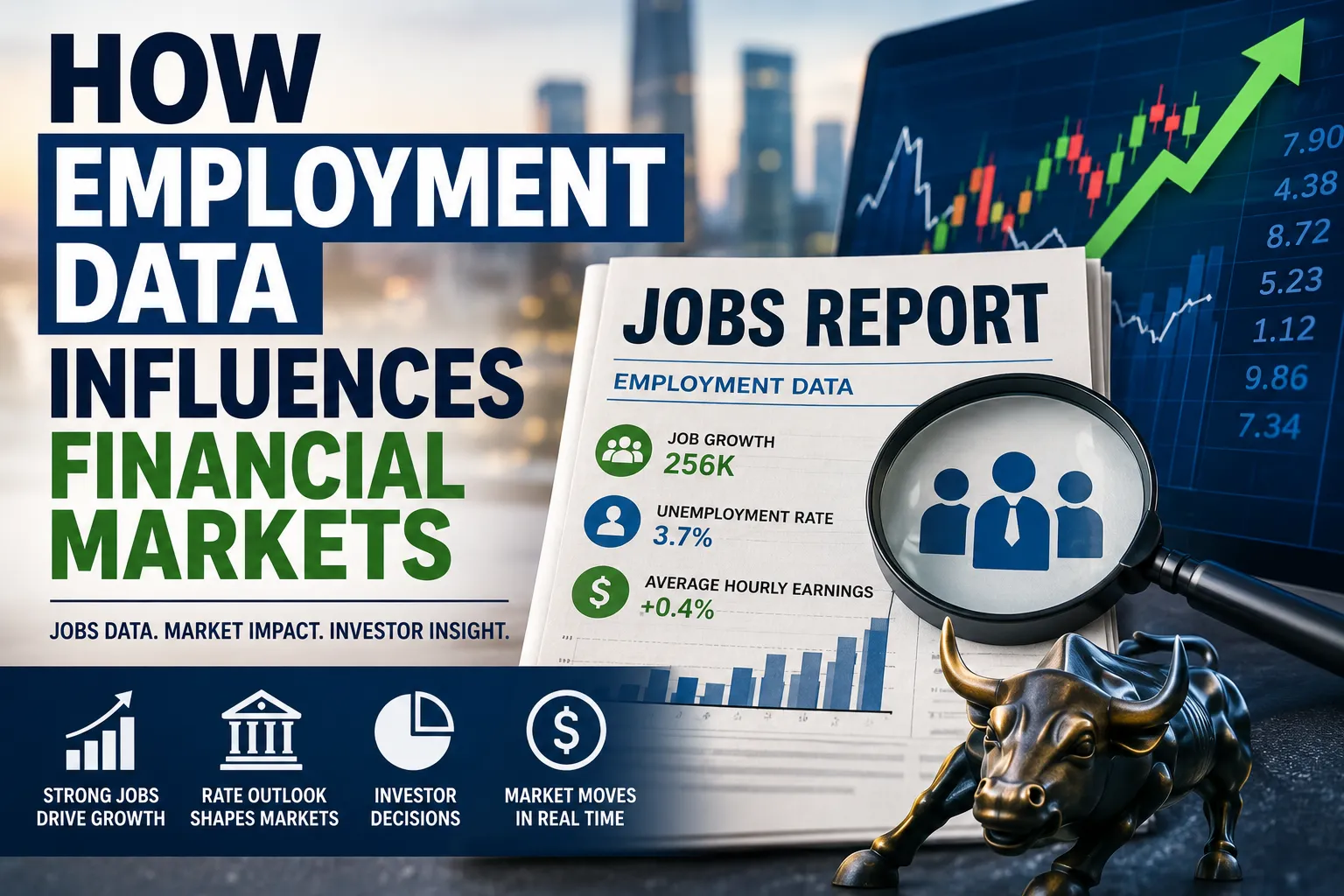
How Employment Data Influences Financial Markets
Employment data is one of the most closely watched sources of economic information in financial markets. Investors, businesses, central banks and policymakers all use labor-market indicators to assess the health of the economy and anticipate what could happen next.
When hiring is strong, unemployment is low and wages are rising at a sustainable pace, markets may interpret the data as evidence of solid economic activity. When job creation slows, unemployment rises or layoffs increase, investors may begin to worry about weaker consumer spending and slower economic growth.
The relationship is not always straightforward, however. Good employment news can sometimes push stocks lower, while weak employment data can occasionally lift markets. The reason is that investors care not only about what the employment report says about the economy today, but also what it might mean for interest rates, inflation, corporate profits and monetary policy in the future.
What Employment Data Actually Measures
Employment data is not a single number.
Governments and statistical agencies publish a range of indicators designed to show different aspects of the labor market.
Common measures include:
- Payroll employment
- Unemployment rate
- Labor-force participation rate
- Average hourly earnings
- Average weekly hours
- Job openings
- Hiring rates
- Layoffs
- Initial unemployment claims
- Continuing unemployment claims
- Private-sector employment
- Government employment
Each indicator provides a different piece of the economic picture.
For financial markets, the most important information often comes from looking at several measures together rather than reacting to one headline figure.
For a broader explanation of how economic data fits together, see the Complete Guide to Economic Indicators.
Why Investors Care About Jobs
Employment has a direct connection to consumer spending.
People who have jobs generally have income to spend on housing, food, transportation, entertainment and other goods and services.
When employment is strong, household income can support economic activity.
Businesses may respond to strong demand by increasing production, investing in equipment and hiring additional workers.
This can create a cycle in which employment, income and spending reinforce one another.
The opposite can happen when employment deteriorates.
Falling employment can reduce household income, weaken consumer spending and pressure businesses to reduce investment or hiring.
That is why labor-market data can provide important clues about the broader economy.
The relationship between employment, household finances and inflation is also important, as explained in How Inflation Affects Everyday Finances.
The Employment Report Can Move Markets Quickly
Major employment reports can cause substantial movements in financial markets when the numbers differ from expectations.
Investors constantly form forecasts about upcoming economic data.
Suppose economists expect an economy to add 150,000 jobs, but the report shows 250,000.
The headline result would be stronger than expected.
Markets might interpret this as evidence that economic activity is more resilient than previously thought.
But there is another possibility.
Investors could conclude that a stronger labor market will keep inflation elevated, making a central bank less likely to cut interest rates.
In that situation, stronger employment data could push bond yields higher and potentially pressure stock prices.
This illustrates why markets react to surprises relative to expectations, not simply whether a number looks good or bad in isolation.
Strong Jobs Data Can Sometimes Hurt Stocks
At first, this seems counterintuitive.
If more people have jobs, shouldn’t that be good for companies?
Often it is.
But financial markets are forward-looking.
Strong employment can create concerns about inflation and interest rates.
When labor markets are extremely tight, employers may need to raise wages to attract and retain workers. Businesses may then increase prices to offset higher labor costs.
If inflation remains persistent, a central bank may keep interest rates higher for longer.
Higher interest rates can make borrowing more expensive and reduce the present value investors assign to future corporate earnings.
This can be particularly important for companies whose valuations depend heavily on expected profits many years into the future.
Investors can therefore benefit from understanding the broader relationship between policy and markets, including How Monetary Policy Affects Financial Markets.
Weak Employment Data Can Sometimes Lift Stocks
The reverse situation can also occur.
Suppose a weaker-than-expected employment report suggests that economic growth is losing momentum.
Investors may initially worry about corporate profits.
But if the same report suggests inflationary pressure is easing, markets could begin expecting lower interest rates.
Lower expected rates can support stocks by reducing borrowing costs and increasing the relative attractiveness of risk assets.
As a result, stocks can sometimes rise after disappointing employment data.
The market’s reaction depends on what investors believe the report means for the future.
Employment Data and the Federal Reserve
In the United States, labor-market conditions are particularly important to the Federal Reserve because its monetary-policy responsibilities include maximum employment alongside price stability.
The Fed examines a broad range of employment indicators when assessing economic conditions.
Employment data can therefore influence expectations about:
- Interest-rate increases
- Interest-rate cuts
- The pace of balance-sheet changes
- Future monetary policy
- Inflation risks
Markets constantly adjust their expectations about what central bankers are likely to do.
That means an employment report can affect asset prices even before the central bank makes an official decision.
Unemployment Is One of the Most Important Indicators
The unemployment rate measures the percentage of people in the labor force who are unemployed and actively looking for work.
A rising unemployment rate can signal weakening labor-market conditions.
A falling unemployment rate generally indicates improvement.
But unemployment needs context.
A very low unemployment rate may indicate a strong economy, but an exceptionally tight labor market can also contribute to wage pressures.
Conversely, a rising unemployment rate may signal economic weakness and declining demand.
Investors therefore consider both the level of unemployment and its direction.
The Labor-Force Participation Rate Matters Too
The unemployment rate does not tell the entire story.
The labor-force participation rate measures the share of the working-age population that is working or actively looking for work.
Suppose unemployment falls because many people find jobs.
That is generally positive.
But unemployment could also fall because unemployed people stop looking for work and leave the labor force.
In that case, a lower unemployment rate may not indicate a stronger labor market.
This is why investors examine participation alongside unemployment.
Job Creation Provides a Broader Economic Signal
The number of jobs added or lost during a particular month can provide a useful indication of the pace of economic activity.
Consistent job creation can indicate that businesses are expanding or maintaining demand for workers.
Persistent job losses can suggest weakening economic conditions.
However, one monthly change rarely tells the whole story.
Employment figures can be volatile, and data are often revised as additional information becomes available.
Investors typically pay attention to trends over several months rather than treating one report as definitive.
Revisions Can Change the Picture
Initial employment estimates are not necessarily final.
Government agencies can revise previously published figures as more complete information becomes available.
This matters because the latest report may contain revisions to earlier months.
Imagine that an initial report showed 200,000 jobs were created in a previous month.
A later revision could change that figure to 140,000.
That revision can alter the perceived momentum of the labor market.
Experienced investors therefore look beyond the newest headline number and examine revisions as part of the broader trend.
Wage Growth Can Influence Markets
Average hourly earnings and other wage measures provide information about labor costs and household purchasing power.
Rising wages can benefit consumers because workers have more income to spend.
That can support businesses that depend on consumer demand.
But rapid wage growth can also contribute to inflation if productivity does not increase enough to offset higher labor costs.
This creates an important balancing act.
Moderate wage growth can support economic expansion, while unusually rapid wage growth may increase concerns about inflation.
Markets therefore pay close attention to both the pace of wage growth and its relationship with productivity and inflation.
Employment Data Influences Bond Markets
The bond market can react strongly to labor-market reports.
When employment data is stronger than expected, investors may anticipate:
- Higher inflation
- Stronger economic growth
- Fewer interest-rate cuts
- Higher future interest rates
Those expectations can push bond yields higher.
When employment data is weaker than expected, investors may anticipate:
- Slower economic growth
- Lower inflation
- More accommodative monetary policy
- Potential interest-rate cuts
That can put downward pressure on bond yields.
Because bond prices and yields generally move in opposite directions, changes in rate expectations can produce significant movements in fixed-income markets.
Interest Rates Affect Stock Valuations
Interest rates have an important relationship with equity valuations.
When rates rise, investors can demand greater returns from riskier assets.
Higher rates can also increase companies’ financing costs.
For growth companies, the effect can be particularly important because a larger portion of their expected value may come from profits projected far into the future.
When interest rates fall, the opposite dynamic can emerge.
Lower borrowing costs can support corporate investment, housing activity and consumer spending while potentially making stocks more attractive relative to bonds and cash.
Employment data can therefore affect stocks indirectly through its impact on interest-rate expectations.
Employment Data Can Move Currency Markets
Labor-market reports can also influence foreign-exchange markets.
If investors believe strong employment data will lead a central bank to maintain higher interest rates, demand for that country’s currency may increase.
Higher expected interest rates can make assets denominated in that currency more attractive to international investors.
Weak employment data can have the opposite effect if markets expect monetary policy to become more accommodative.
Currency reactions are complicated by other factors, including inflation, economic growth, trade conditions and interest-rate expectations in other countries.
Commodities Can React as Well
Employment conditions can influence commodity markets through expectations about economic activity.
Strong employment can suggest stronger consumer demand and business activity, potentially supporting demand for energy and industrial commodities.
But if strong employment increases inflation and interest-rate expectations, the resulting rise in the currency or borrowing costs can offset some of that effect.
Gold provides another example.
Investors often consider gold in the context of inflation, interest rates, currency movements and economic uncertainty. Employment data can influence several of these factors simultaneously.
The Market Cares About Expectations
Perhaps the most important principle when interpreting employment data is that markets price in expectations before the report is released.
Investors, economists and financial institutions publish forecasts.
Market prices incorporate those expectations.
As a result, the actual employment number matters partly because of how it compares with what investors already anticipated.
For example:
| Employment Result | Market Expectation | Possible Interpretation |
|---|---|---|
| Stronger than expected | Moderate | Strong economic momentum |
| Stronger than expected | Already very strong | Limited surprise |
| Weaker than expected | Strong growth expected | Potential economic concern |
| Weaker than expected | Severe weakness expected | Could be less surprising |
This is why two identical employment reports can produce different market reactions at different points in the economic cycle.
The Same Data Can Affect Different Assets Differently
There is no single “market reaction.”
Employment data can affect asset classes in different ways.
For example:
Stocks: May rise on stronger growth expectations but fall if rate expectations increase.
Bonds: May sell off when stronger data pushes yields higher.
Currency: May strengthen when investors expect higher interest rates.
Gold: May react to changes in real yields, inflation expectations and currency values.
Commodities: May respond to changes in expected economic demand.
This interconnectedness is one reason financial markets can appear contradictory after an economic report.
Employment Data Is Also a Recession Indicator
Labor-market deterioration can provide evidence that an economy is entering a downturn.
Rising unemployment, increasing layoffs, declining job openings and falling hours worked can all signal weakening economic conditions.
However, employment data often changes gradually.
Other economic indicators can deteriorate before unemployment rises significantly.
Investors therefore monitor labor-market data alongside:
- Consumer spending
- Industrial production
- Business investment
- Housing activity
- Manufacturing surveys
- Services activity
- Corporate earnings
- Credit conditions
No single indicator can reliably predict every recession.
For additional context on how downturns develop and affect markets, see How Recessions Happen and Affect Financial Markets.
Jobless Claims Can Provide a More Frequent Signal
Monthly employment reports attract enormous attention, but weekly unemployment claims can provide a more frequent view of labor-market conditions.
Initial claims measure new applications for unemployment benefits, while continuing claims provide information about people who remain on unemployment benefits.
A sustained increase in claims can suggest that layoffs are becoming more widespread.
A declining trend can indicate improving labor-market conditions.
Because the data arrives more frequently than many major employment reports, investors often watch it for early signs of change.
Job Openings Can Reveal Labor Demand
Job openings provide another perspective.
A high number of available positions can indicate that businesses are actively seeking workers.
If job openings decline significantly, it could indicate that employers are becoming more cautious.
The relationship between vacancies and unemployment can also provide information about the balance between labor demand and labor supply.
This helps economists evaluate whether the labor market is unusually tight or beginning to loosen.
Productivity Changes the Meaning of Wage Growth
Wage growth should not be analyzed by itself.
Suppose wages rise 5% while worker productivity also rises substantially.
Businesses may be able to absorb those higher wages without increasing prices significantly.
But if wages rise rapidly while productivity remains weak, companies may face greater pressure on profit margins or prices.
That is why investors often consider wage growth alongside productivity data and broader inflation measures.
Employment Data Can Affect Corporate Earnings Expectations
Businesses need workers to produce goods and services.
Employment trends can therefore influence corporate revenue and expenses.
A strong labor market can support consumer demand, but higher wages can increase costs.
A weakening labor market can reduce consumer spending, but it may also reduce wage pressures.
For investors, the question is often:
Will employment conditions ultimately help or hurt corporate profitability?
The answer varies by industry.
A retailer may benefit from stronger household income, while a labor-intensive company could face higher wage costs.
Different Industries Feel Employment Trends Differently
Employment data affects sectors unevenly.
Consumer discretionary businesses may benefit from strong employment because households have more money available for nonessential purchases.
Banks may benefit from economic expansion and loan demand, although interest rates and credit quality also matter.
Technology companies may be influenced more heavily by investment trends, corporate spending and interest-rate expectations.
Industries such as hospitality, construction and transportation can be particularly sensitive to changes in labor demand and consumer activity.
Investors therefore consider the sector-specific implications rather than applying the headline employment number equally across the market.
Why Financial Markets Sometimes Overreact
Markets are constantly processing new information.
When an employment report significantly differs from expectations, traders may rapidly adjust positions.
Automated trading systems can also respond to numerical surprises within seconds.
This can create sharp short-term movements.
But the initial market reaction is not always the final interpretation.
Investors may later reconsider the data after examining revisions, wage figures, unemployment, participation and other economic reports.
For long-term investors, trying to predict every short-term movement can be less useful than understanding the broader economic trend.
Don’t Build an Investment Strategy Around One Employment Report
Employment reports can be important, but they should not become the sole basis for investment decisions.
Markets respond to hundreds of variables at the same time.
These include:
- Corporate earnings
- Inflation
- Interest rates
- Geopolitical events
- Consumer demand
- Government policy
- Global economic conditions
- Commodity prices
- Credit markets
- Investor sentiment
A single employment report rarely changes the fundamental outlook for every company and asset class overnight.
Long-term investors generally benefit from maintaining a strategy that matches their goals and risk tolerance rather than repeatedly changing positions based on individual economic releases.
How Investors Can Read an Employment Report
A useful approach is to work through the report in stages.
Start With the Headline
Look at payroll growth and compare the figure with expectations.
Check the Unemployment Rate
Determine whether unemployment increased, decreased or remained stable.
Examine Labor-Force Participation
A change in participation can help explain movements in unemployment.
Look at Wage Growth
Consider whether wages are accelerating, slowing or remaining stable.
Review Previous Months
Look for revisions that change the earlier picture.
Examine the Broader Trend
Ask whether the report confirms or contradicts what other economic indicators have been showing.
Consider the Interest-Rate Implications
Finally, think about what the data could mean for monetary policy.
This approach is generally more informative than focusing on the headline job number alone.
Employment Data Is a Window Into the Economy
Labor-market statistics offer one of the clearest ways to understand how economic conditions are affecting workers and businesses.
Strong employment can support household income and consumer spending. Weakening employment can signal that economic momentum is fading.
At the same time, strong employment can contribute to inflationary pressure, potentially influencing central-bank policy and interest rates. That is where the relationship between jobs and financial markets becomes more complicated.
For investors, the key is not to ask whether an employment report is simply good or bad. The more useful questions are: How did the numbers compare with expectations? What do they say about economic growth? What do they imply about inflation and interest rates? And how might those changes affect corporate earnings and asset valuations?
Understanding those connections makes employment data far more useful than simply watching the monthly headline. It becomes a tool for interpreting the forces that connect the labor market, the economy and financial markets.