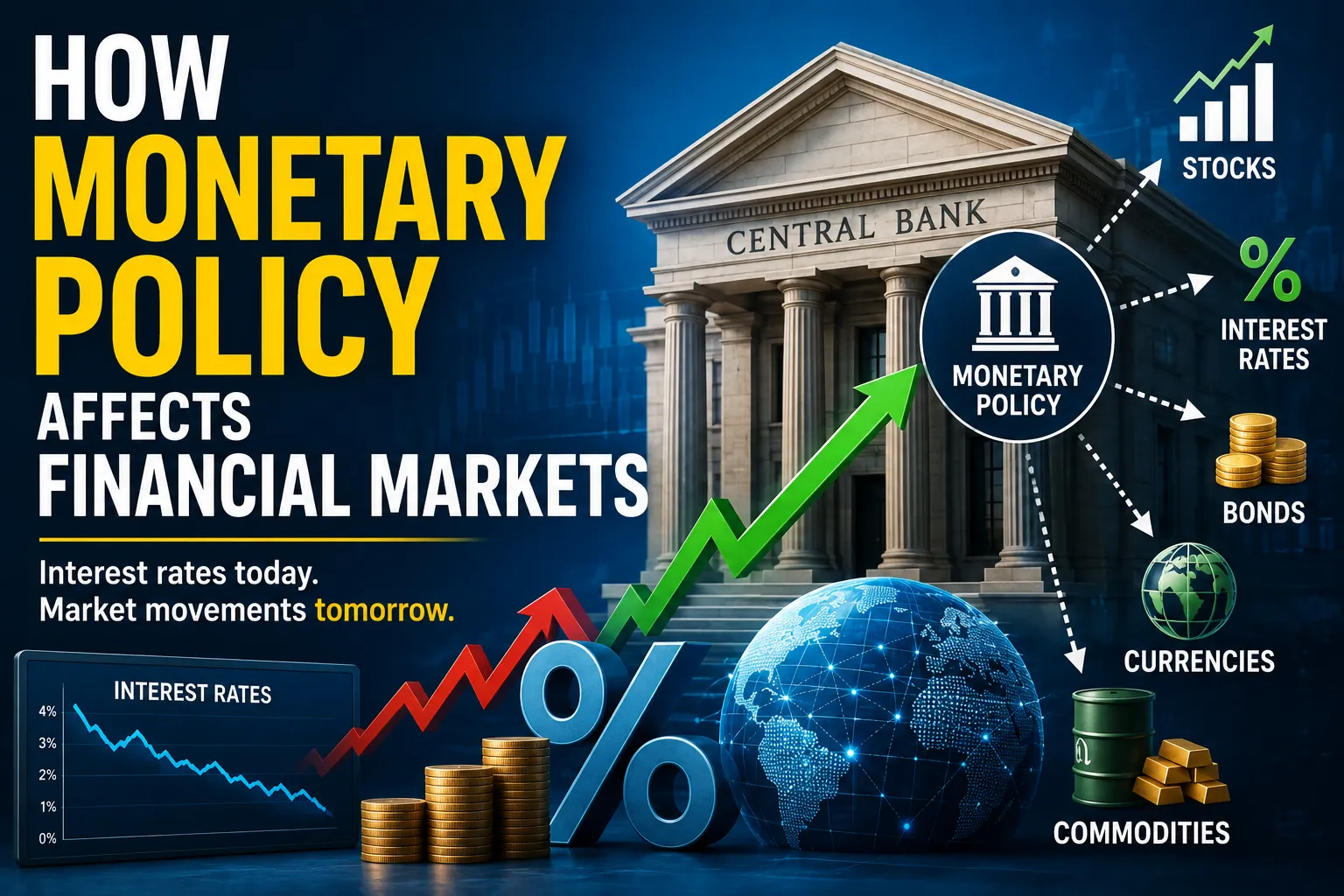
How Monetary Policy Affects Financial Markets
When a central bank changes interest rates, the decision can travel through the financial system remarkably quickly.
A policy announcement that lasts only a few minutes can move government bonds, currencies, stocks, commodities and credit markets within seconds. The effects don’t stop there. Over time, monetary policy can influence mortgage rates, business investment, consumer spending, bank lending and ultimately economic growth and inflation.
This is why investors pay so much attention to central-bank meetings.
Whether a central bank is raising rates to contain inflation, cutting rates to support economic activity or holding rates steady while waiting for more data, financial markets are constantly trying to anticipate what comes next.
The relationship isn’t always straightforward. A rate cut can send stocks higher in one situation and lower in another. A rate increase can hurt bonds while benefiting certain financial companies. A central bank can even leave rates unchanged and still trigger major market moves if its communication changes investors’ expectations.
Understanding these relationships makes financial news easier to interpret.
What Is Monetary Policy?
Monetary policy refers to the actions a central bank takes to influence financial conditions and the broader economy.
Central banks generally use monetary policy to pursue objectives such as:
- Price stability
- Sustainable economic activity
- Employment, where included in the central bank’s mandate
- Financial stability
The exact mandate varies by country.
One of the most important tools is the policy interest rate.
When a central bank raises its policy rate, monetary policy generally becomes tighter.
When it lowers the rate, policy generally becomes more accommodative.
For a broader explanation of how monetary policy fits into the wider economic system, see the Complete Guide to Economic Indicators.
Why Financial Markets Care About Central Banks
Financial markets are essentially pricing machines.
Investors constantly estimate what assets are worth based on expectations about:
- Future earnings
- Interest rates
- Inflation
- Economic growth
- Risk
- Liquidity
- Currency movements
Monetary policy affects many of these variables simultaneously.
When investors believe a central bank is about to raise rates, they may adjust portfolios before the official decision.
Likewise, markets can rally before a rate cut actually occurs if investors become convinced that easier monetary policy is coming.
This is why expectations can matter as much as the policy decision itself.
The Basic Monetary Policy Transmission Chain
A simplified version looks like this:
Central bank decision
↓
Short-term interest rates
↓
Bond yields, bank rates and financial conditions
↓
Stocks, currencies, credit and other asset prices
↓
Borrowing, saving and investment
↓
Economic growth and inflation
The process isn’t perfectly linear.
Different markets react at different speeds, and investors may interpret the same policy decision differently.
What Happens When a Central Bank Raises Interest Rates?
A rate increase generally makes borrowing more expensive.
Commercial banks may raise lending rates, while money-market rates and other short-term rates can also move higher.
The effects can spread into:
- Mortgages
- Business loans
- Credit cards
- Corporate bonds
- Government bonds
- Consumer financing
Higher borrowing costs can reduce demand for credit and discourage some forms of spending and investment.
What Happens When a Central Bank Cuts Rates?
A rate cut generally moves in the opposite direction.
Lower policy rates can reduce some borrowing costs and encourage:
- Consumer spending
- Business investment
- Housing activity
- Credit demand
Lower rates can also make bonds and cash less attractive relative to riskier assets, potentially encouraging investors toward stocks and other investments.
But the reason for the rate cut matters enormously.
If rates are falling because inflation is under control and the economy remains healthy, markets may react positively.
If rates are falling because the economy is entering a severe recession, investors may interpret the move as a warning rather than a reason to celebrate.
Why Markets Often Move Before the Central Bank
Financial markets are forward-looking.
Suppose investors believe inflation is falling rapidly and conclude that a central bank will cut rates in several months.
Bond yields may decline immediately.
Stocks may rise.
The currency may weaken.
Credit markets may adjust.
All of this can happen before the central bank makes a single change.
The Importance of Expectations
Imagine a central bank raises its policy rate by 0.25 percentage points.
If investors expected a 0.50-point increase, the decision could actually be interpreted as dovish and markets might rally.
Now imagine the central bank raises rates by 0.25 points exactly as expected but signals that several additional increases are likely.
Markets could fall sharply.
The headline decision is identical.
The market reaction is completely different.
That’s because investors care about the future path of monetary policy, not just today’s interest rate.
Monetary Policy and Bond Markets
The bond market is usually one of the most direct channels through which monetary policy affects financial markets.
Bond prices and yields generally move in opposite directions.
When yields rise, existing bonds with lower fixed coupons tend to become less valuable.
When yields fall, existing bonds with higher coupons can become more attractive.
Because central-bank policy strongly influences short-term interest rates and expectations for future rates, monetary policy can have major effects on government and corporate bonds.
Why Bond Yields Matter So Much
Government bond yields are used as reference points throughout the financial system.
They can influence:
- Corporate borrowing costs
- Mortgage rates
- Valuations of financial assets
- Government financing costs
- Currency markets
- Investment decisions
Long-term yields don’t simply follow today’s policy rate.
They reflect expectations about future short-term rates, inflation and risk premiums.
Short-Term vs. Long-Term Interest Rates
This distinction is important.
Short-Term Rates
These are more directly influenced by central-bank policy.
Examples include:
- Overnight rates
- Money-market rates
- Treasury bills
Long-Term Rates
These are influenced by:
- Expected future policy
- Inflation expectations
- Economic growth
- Government borrowing
- Risk premiums
- Investor demand
A central bank can therefore cut short-term rates while long-term bond yields remain elevated.
For a broader look at how rates affect households, businesses and investments, see Understanding Interest Rates and Their Effects.
The Yield Curve
The yield curve compares interest rates across different maturities of bonds, commonly government securities.
A typical upward-sloping curve means longer-term bonds yield more than short-term bonds.
But the curve can also become:
- Flat
- Inverted
- Steep
Investors closely monitor these changes because they contain information about expectations for growth, inflation and future monetary policy.
How Monetary Policy Affects Stocks
The relationship between interest rates and stocks is more complicated than simply:
Rates up = stocks down
and
Rates down = stocks up.
Several mechanisms are involved.
1. The Discount Rate Effect
A stock represents a claim on future cash flows.
Investors estimate what those future earnings are worth today.
Higher interest rates generally increase the rate used to discount future cash flows.
That can reduce the present value of those future earnings.
This is particularly important for companies whose expected profits are far in the future.
2. The Borrowing-Cost Effect
Companies often borrow money to:
- Build factories
- Purchase equipment
- Expand operations
- Develop products
- Acquire other companies
Higher interest rates increase financing costs.
That can reduce investment and potentially squeeze profits.
Lower rates can have the opposite effect.
3. The Consumer-Demand Effect
Higher borrowing costs can affect consumers.
If mortgages, vehicle loans and other financing become more expensive, households may reduce spending.
That can affect corporate revenue.
Lower rates can encourage borrowing and spending, although the strength of the effect varies.
4. The Relative-Attractiveness Effect
Investors compare stocks with other assets.
If safe government bonds offer attractive yields, some investors may become less willing to take equity risk.
If bond yields fall significantly, stocks may become more attractive by comparison.
This is one reason interest-rate expectations can influence equity valuations.
Growth Stocks Can Be Especially Sensitive
Growth companies often derive a significant portion of their valuation from earnings expected years in the future.
When interest rates rise, those future earnings are discounted more heavily.
This can put pressure on high-growth sectors such as:
- Technology
- Software
- Biotechnology
- Emerging industries
That doesn’t mean these companies necessarily become less valuable businesses.
It means investors may be willing to pay less for the same expected future cash flows.
Value Stocks Can Behave Differently
Value-oriented companies often have:
- More mature businesses
- More established cash flows
- Lower growth expectations
- Greater emphasis on current earnings
They can still be affected by interest rates, but their valuations may respond differently from high-growth companies.
The distinction isn’t absolute.
Economic conditions, sector exposure and company-specific factors remain important.
Monetary Policy and Bank Stocks
Banks occupy a unique position because interest rates affect both their revenue and costs.
Higher rates can increase the interest banks earn on certain loans.
But banks may also have to pay more to attract deposits and other funding.
Higher rates can additionally increase the risk of:
- Loan defaults
- Credit losses
- Bond-market losses
- Weak loan demand
The net effect depends on the bank’s balance sheet and the broader economy.
Monetary Policy and Corporate Bonds
Corporate borrowing costs are influenced by both government bond yields and credit spreads.
A credit spread represents the additional yield investors demand to hold corporate debt rather than comparable government securities.
When monetary policy tightens and investors become more concerned about economic risk, credit spreads can widen.
That makes it more expensive for companies to borrow.
Risk Premiums Matter
Investors don’t only care about the risk-free interest rate.
They also demand compensation for taking additional risk.
This compensation is often referred to as a risk premium.
During periods of financial stress, investors may demand larger risk premiums.
That can cause:
- Corporate bond prices to fall
- Credit spreads to widen
- Riskier stocks to decline
- Emerging-market assets to weaken
Monetary Policy and Currency Markets
Interest rates can strongly influence foreign-exchange markets.
If one country’s interest rates rise relative to another country’s rates, its currency may become more attractive to some investors seeking higher returns.
That can increase demand for the currency.
However, exchange rates depend on much more than interest rates.
They can also respond to:
- Economic growth
- Inflation
- Trade balances
- Political developments
- Commodity prices
- Global risk sentiment
- Expectations about future policy
Why a Strong Currency Matters
A stronger currency can make imports cheaper.
That may help reduce inflationary pressure.
But it can also make a country’s exports more expensive for foreign buyers.
A weaker currency can have the opposite effect.
This means monetary policy can affect businesses indirectly through exchange rates.
Monetary Policy and Emerging Markets
Emerging markets can be particularly sensitive to global monetary conditions.
When major central banks tighten policy, global investors may shift toward assets offering higher liquidity or perceived safety.
That can put pressure on emerging-market:
- Currencies
- Bonds
- Stocks
Countries with high external debt or significant foreign-currency borrowing can be particularly vulnerable to changes in global financing conditions.
Monetary Policy and Commodities
Commodity prices are influenced by many factors, including:
- Supply
- Demand
- Weather
- Geopolitical events
- Currency movements
- Economic growth
Monetary policy can still play an important role.
Higher interest rates can slow economic activity and reduce demand for some commodities.
A stronger currency can also make dollar-denominated commodities more expensive for international buyers.
What About Gold?
Gold doesn’t pay interest or dividends.
That means its relative attractiveness can change when interest rates and bond yields move.
When real yields decline, the opportunity cost of holding gold can become less burdensome.
Gold can also attract investors seeking protection against:
- Inflation
- Currency weakness
- Financial uncertainty
- Geopolitical risk
But gold is not guaranteed to rise whenever rates fall.
Investor sentiment and the dollar matter too.
Monetary Policy and Real Estate
Housing markets are highly sensitive to interest rates because property purchases often involve substantial borrowing.
Higher mortgage rates can:
- Reduce affordability
- Lower demand
- Slow home sales
- Reduce construction activity
Lower rates can increase affordability and stimulate demand.
However, housing supply, income growth and local conditions can sometimes overwhelm the effect of interest rates.
Why Housing Can Behave Differently From Stocks
A falling stock market can reprice almost instantly.
Housing markets usually adjust more slowly.
Transactions take longer, supply is relatively fixed in the short term and homeowners may be reluctant to sell properties when doing so would mean giving up an unusually cheap mortgage.
This can make monetary-policy transmission into housing slower and less uniform.
Monetary Policy and Consumer Credit
Interest-rate changes can influence:
- Credit-card rates
- Auto loans
- Personal loans
- Student loans
- Home-equity borrowing
Higher rates can encourage households to save more and borrow less.
Lower rates can encourage the opposite.
Monetary Policy and Business Investment
Companies constantly evaluate whether a project is worth pursuing.
Suppose a new factory is expected to generate a 7% return.
If financing costs are 3%, the project may look attractive.
If financing costs rise to 8%, management may decide that the project no longer makes economic sense.
This is one reason tighter monetary policy can eventually reduce business investment.
Monetary Policy and Employment
The effects on employment are usually indirect.
Higher rates can reduce:
- Business investment
- Housing construction
- Consumer demand
Businesses may respond by slowing hiring.
If the economy weakens substantially, unemployment can rise.
Lower rates can support demand and investment, potentially helping employment.
This is one reason central banks carefully balance inflation and economic activity.
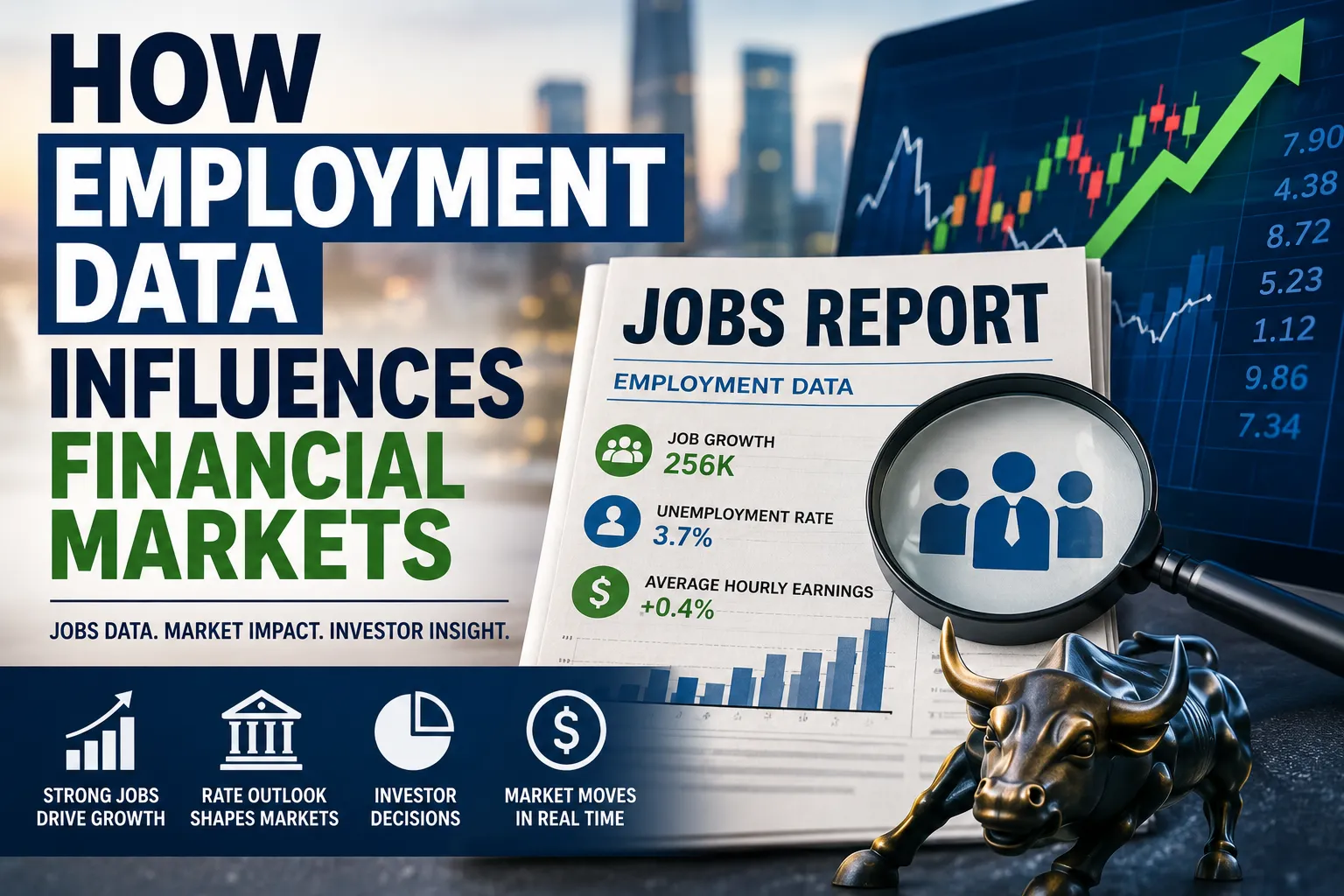
For a closer look at how labor-market data feeds into financial-market expectations, see How Employment Data Influences Financial Markets.
Why Monetary Policy Works With a Lag
Financial markets can react immediately.
The broader economy usually doesn’t.
A rate change can take time to affect:
- Existing loans
- Business investment
- Household spending
- Employment
- Inflation
This creates a major challenge for central bankers.
They must make decisions today based partly on where they believe the economy will be months from now.
Financial Markets React Faster Than the Economy
This creates an interesting difference.
Markets
Can respond within seconds or minutes.
Businesses
May take months to adjust investment plans.
Consumers
May gradually change spending and borrowing.
Inflation
Can take even longer to respond.
As a result, financial markets often move well before economic data confirms the change.
Central-Bank Communication Can Move Markets
A central bank doesn’t have to change interest rates to influence financial markets.
Statements, speeches, meeting minutes and economic forecasts can all change expectations.
If policymakers signal that rates may remain high for longer, markets can react immediately.
If they indicate that inflation is cooling and rate cuts are becoming more likely, financial conditions may loosen before any cut occurs.
What Is a Hawkish Policy?
A hawkish central-bank stance generally emphasizes controlling inflation and may favor tighter monetary conditions.
Hawkish signals can include expectations of:
- Higher interest rates
- Fewer rate cuts
- Continued balance-sheet reduction
- Greater concern about inflation
Markets may respond with:
- Higher bond yields
- A stronger currency
- Pressure on some stocks
- Tighter credit conditions
What Is a Dovish Policy?
A dovish stance generally places greater emphasis on supporting economic activity and may favor easier monetary conditions.
Signals can include:
- Lower rates
- More expected rate cuts
- Greater concern about economic weakness
- More accommodative financial conditions
Possible market responses include:
- Lower bond yields
- Higher bond prices
- Stronger equity valuations
- A weaker currency, depending on circumstances
Again, the reaction depends on what investors already expected.
The Difference Between a Policy Surprise and an Expected Decision
This distinction is crucial.
Expected Decision
Investors already priced it into asset prices.
The market may barely react.
Unexpected Decision
Investors weren’t prepared for it.
Prices may move sharply.
Monetary-policy surprises can produce significant responses across government bond yields, stock prices and exchange rates.
Why “Good News” Can Sometimes Be Bad for Stocks
Suppose economic data shows unexpectedly strong growth.
That sounds positive.
But if strong growth increases the likelihood that inflation will remain high, investors may expect the central bank to keep rates higher for longer.
Bond yields rise.
Stock valuations fall.
The market could therefore respond negatively to economic news that is objectively positive.
This is why investors must interpret economic data through the lens of monetary policy.
Why “Bad News” Can Sometimes Be Good for Stocks
The opposite can happen.
Suppose economic data shows weaker employment.
That’s bad news for the economy.
But investors may conclude that the central bank will cut interest rates sooner.
Bond yields fall.
Stocks rise.
Markets aren’t necessarily celebrating weaker employment.
They’re responding to the expected policy reaction.
Monetary Policy and Market Volatility
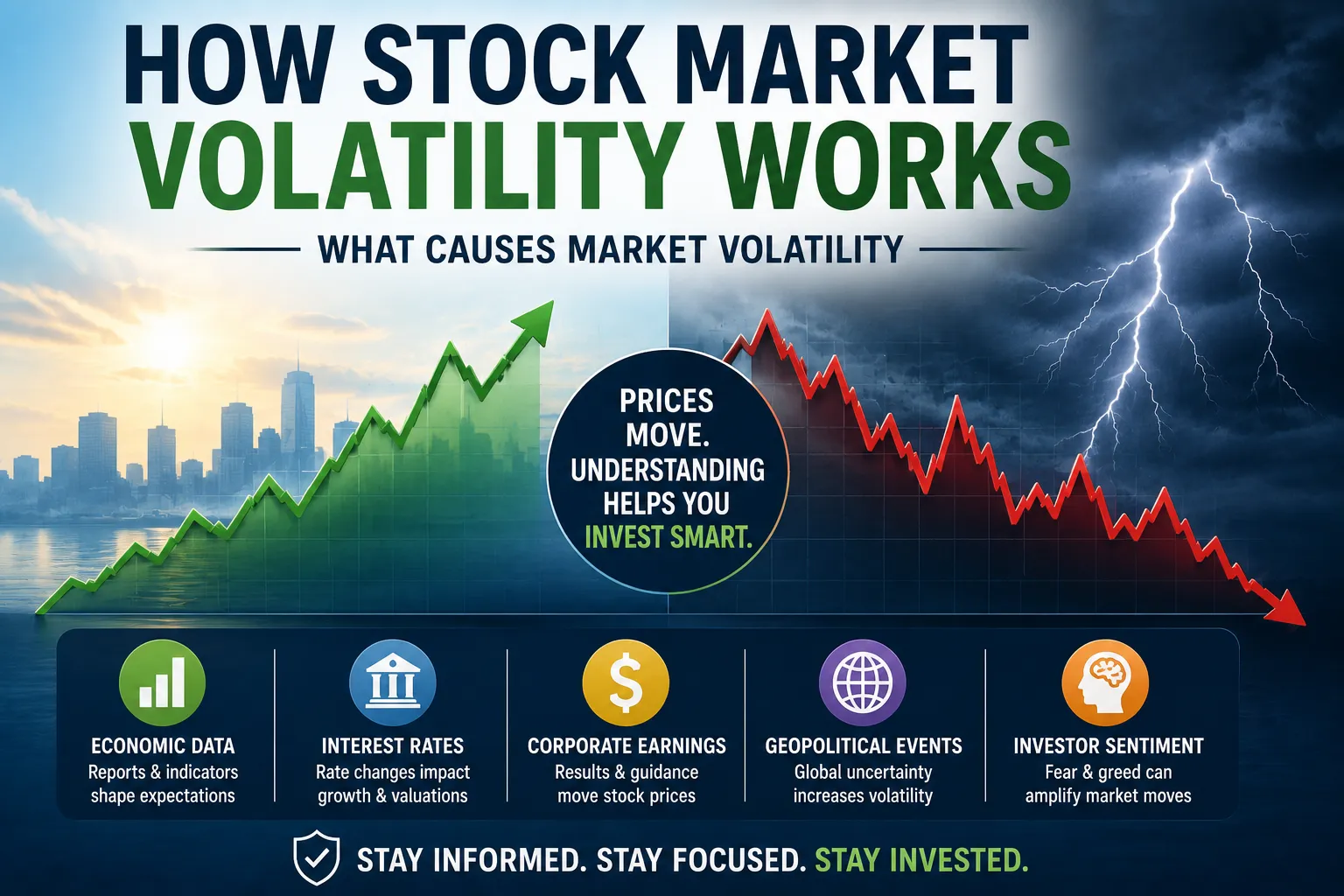
Central-bank announcements can increase volatility because investors are updating expectations simultaneously.
Volatility can be especially high when:
- Inflation is unpredictable
- Economic data is mixed
- Policy guidance is unclear
- Markets are heavily positioned in one direction
- Geopolitical risks are elevated
Large market moves don’t necessarily mean monetary policy has changed dramatically.
Sometimes they simply reflect a large change in expectations.
Quantitative Easing and Asset Prices
Interest rates aren’t the only monetary-policy tool.
Central banks have also used large-scale asset purchases, commonly called quantitative easing, during certain periods.
Buying government bonds and other eligible securities can influence:
- Bond yields
- Liquidity
- Portfolio allocation
- Risk premiums
- Asset prices
The effects depend on the circumstances and the way the policy is implemented.
Quantitative Tightening
When central banks reduce their balance sheets, the process is often called quantitative tightening.
This can contribute to tighter financial conditions by reducing the central bank’s footprint in certain asset markets.
The effects vary by monetary system and implementation method.
But investors often monitor balance-sheet policy alongside interest-rate decisions.
Monetary Policy and Liquidity
Liquidity refers broadly to how easily assets can be bought or sold without causing large price changes, while financial-system liquidity also concerns the availability of funding.
Tighter monetary conditions can reduce liquidity in some markets.
When liquidity is abundant, investors may be more willing to hold riskier assets.
When liquidity becomes scarce, investors often become more defensive.
This can amplify market movements.
Why Credit Spreads Matter During Tightening Cycles
A central bank may raise its policy rate without causing an immediate recession.
But if investors become increasingly worried about economic growth, corporate credit spreads can widen.
Companies then face higher borrowing costs even if the central bank hasn’t raised rates again.
This is one reason financial conditions can tighten more than the policy rate alone suggests.
The Bank Lending Channel
Commercial banks play a major role in transmitting monetary policy.
Higher rates can reduce bank profitability or increase funding pressure in some circumstances.
Banks may respond by tightening lending standards.
That can make credit less available even for borrowers willing to pay higher interest.
The Balance-Sheet Channel
Higher rates can also affect the value of assets used as collateral.
If property or financial assets decline in value, borrowers may have less collateral available.
Banks may then become more cautious about lending.
This can reinforce the effect of higher interest rates.
Wealth Effects
Changes in asset prices can influence household behavior.
When stock and property values rise, households may feel wealthier and increase spending.
When asset prices fall, confidence and spending can weaken.
Monetary policy can therefore influence the economy indirectly through asset-price movements.
The Exchange-Rate Channel
Interest-rate changes can influence currency values.
A stronger currency can:
- Reduce import costs
- Lower some inflationary pressure
- Hurt exporters
A weaker currency can:
- Increase import costs
- Support exporters
- Add inflationary pressure
For open economies, this can be an important part of monetary-policy transmission.
Monetary Policy Doesn’t Affect Every Asset Equally
Different assets have different sensitivities.
| Asset | Potential Sensitivity to Higher Rates |
|---|---|
| Government bonds | High |
| Corporate bonds | High |
| Growth stocks | Often high |
| Value stocks | Variable |
| Bank stocks | Mixed |
| Real estate | Often high |
| Gold | Indirect |
| Cash | Positive for savers |
| Currencies | High, but highly context-dependent |
| Commodities | Variable |
These are general relationships, not guaranteed outcomes.
Why Investors Should Watch Real Interest Rates
Nominal interest rates don’t tell the whole story.
Suppose a government bond yields 5%.
If inflation is 4%, the approximate real yield is only 1%.
If inflation falls to 2%, the same 5% nominal yield represents a much higher real return.
Real interest rates can therefore influence:
- Bond demand
- Stock valuations
- Gold
- Currency markets
- Investment decisions
Monetary Policy and Inflation Expectations
Markets don’t only respond to current inflation.
They also respond to expectations about future inflation.
If investors believe inflation will remain high, they may demand higher yields on long-term bonds.
That can push borrowing costs higher throughout the economy.
Central banks therefore pay close attention to inflation expectations.
Why Central Bank Credibility Matters
A central bank’s ability to influence financial conditions depends partly on whether markets believe its commitments.
If investors trust that policymakers will eventually bring inflation under control, inflation expectations may remain relatively anchored.
If confidence weakens, investors may demand higher risk premiums and higher bond yields.
Communication and credibility therefore matter alongside actual policy decisions.
Global Monetary Policy Matters Too
Investors shouldn’t look at one central bank in isolation.
Major institutions include:
- The U.S. Federal Reserve
- European Central Bank
- Bank of England
- Bank of Japan
- People’s Bank of China
- Reserve Bank of India
- Central Bank of Kenya
Changes in one major economy can influence financial conditions elsewhere.
This is particularly important because global investors can move capital across borders.
Why the U.S. Federal Reserve Has Global Influence
The U.S. dollar plays a major role in global finance.
U.S. Treasury securities are also widely held internationally.
Consequently, changes in Federal Reserve policy can affect:
- Global bond yields
- Dollar exchange rates
- Emerging-market currencies
- Commodity prices
- Global borrowing costs
- International capital flows
This is one reason investors around the world closely follow Fed decisions.
Monetary Policy in Emerging and Frontier Markets
The transmission mechanism can differ across economies.
Banking systems, financial-market depth, exchange-rate regimes and capital flows all matter.
Monetary-policy changes can pass into short-term market rates and influence bank deposit and lending rates, although the speed and strength of transmission can vary substantially between economies.
That highlights an important point:
Monetary policy is global in its influence, but its effects are not identical everywhere.
Why Investors Should Watch the Whole Financial System
Focusing exclusively on the policy rate can lead to an incomplete picture.
Investors should also watch:
- Treasury yields
- Credit spreads
- Mortgage rates
- Bank lending standards
- Currency movements
- Equity valuations
- Commodity prices
- Liquidity conditions
- Inflation expectations
Together, these indicators show how monetary policy is actually being transmitted.
A Simple Example
Imagine a central bank unexpectedly raises its policy rate.
First
Short-term market rates rise.
Next
Government bond yields increase.
Then
Corporate borrowing becomes more expensive.
Meanwhile
The currency strengthens as investors reassess interest-rate differentials.
Stocks
Growth-stock valuations come under pressure.
Consumers
Mortgage and loan costs increase.
Businesses
Some investment projects become less attractive.
Eventually
Economic demand slows.
Finally
Lower demand can help reduce inflationary pressure.
The complete process can take considerable time.
Another Example: An Unexpected Rate Cut
Now imagine inflation has fallen faster than expected and the central bank unexpectedly cuts rates.
Possible reactions could include:
- Government bond yields falling
- Bond prices rising
- Stocks rising
- Currency weakening
- Credit conditions easing
But imagine the same rate cut occurs because unemployment is suddenly surging.
The market reaction could be much more cautious.
The reason behind the decision matters.
What Investors Should Watch Around a Central-Bank Meeting
Before a policy meeting, pay attention to:
Inflation
Is price growth accelerating or slowing?
Employment
Is the labor market strengthening or weakening?
Economic Growth
Is demand resilient?
Wage Growth
Are labor costs creating persistent inflation pressure?
Financial Conditions
Are borrowing costs already restrictive?
Central-Bank Communication
What does the institution suggest about future policy?
Market Expectations
What has already been priced into bonds, stocks and currencies?
Don’t Focus Only on the Rate Decision
The most important information may be in:
- The policy statement
- Economic projections
- Press conference
- Meeting minutes
- Speeches from policymakers
A central bank can leave rates unchanged but deliver a message that dramatically changes market expectations.
How Monetary Policy Can Affect Your Investments
For individual investors, the effects can show up through portfolio performance.
Bonds
Higher rates can pressure existing bond prices.
Stocks
Higher discount rates can pressure valuations.
Cash
Higher rates can increase returns on cash and savings products.
Real Estate
Higher mortgage rates can reduce affordability.
Gold
Changes in real yields and the dollar can influence demand.
International Investments
Currency movements can alter returns for foreign assets.
Should Investors Change Their Portfolios Whenever Rates Change?
Not necessarily.
Trying to make every portfolio decision based on central-bank announcements can lead to excessive trading.
Instead, investors should consider:
- Investment horizon
- Financial goals
- Risk tolerance
- Diversification
- Existing asset allocation
Monetary policy is one input among many.
Long-Term Investors Have a Different Perspective
A long-term investor may experience several monetary-policy cycles over their investing lifetime.
There will be:
- Rate hikes
- Rate cuts
- Recessions
- Recoveries
- Inflation scares
- Deflation concerns
- Bull markets
- Bear markets
Trying to perfectly predict each cycle is extremely difficult.
A diversified strategy designed around long-term objectives may be more sustainable than constantly attempting to anticipate the next central-bank move.
Common Monetary-Policy Mistakes Investors Make
Assuming Rate Cuts Always Mean Stocks Will Rise
The reason for the cuts matters.
Assuming Rate Hikes Always Mean Stocks Will Fall
Strong economic growth can sometimes offset higher rates.
Ignoring Expectations
Markets often move before official decisions.
Focusing Only on the Policy Rate
Bond yields, credit spreads and currencies also matter.
Trading Every Announcement
Short-term market reactions can be unpredictable.
Ignoring Inflation
Nominal rates without inflation context can be misleading.
Forgetting Global Policy
International central banks can influence domestic markets.
Monetary Policy Is a Market-Wide Force
Perhaps the most important lesson is that monetary policy doesn’t belong to one asset class.
It can affect virtually every major part of the financial system.
A rate decision can simultaneously influence:
- Bonds through yields
- Stocks through discount rates and earnings expectations
- Currencies through interest-rate differentials
- Real estate through mortgage costs
- Banks through funding and lending
- Commodities through demand and currency effects
- Gold through real yields and risk sentiment
- Credit markets through borrowing costs and risk premiums
The effects aren’t always immediate or predictable, but the connections are powerful.
The Bigger Picture for Investors
Monetary policy is ultimately about more than whether interest rates go up or down.
It is about financial conditions and expectations.
A central bank can influence the price of money, but markets determine how that change spreads through bonds, stocks, currencies, credit and other assets.
The most useful way to interpret monetary policy is therefore to follow the entire transmission chain:
Policy → expectations → interest rates → asset prices → credit → spending and investment → economic growth and inflation.
For investors, this means a central-bank announcement should never be viewed in isolation.
The better question isn’t simply “Did the central bank raise or cut rates?”
It is:
“What does this decision tell us about future interest rates, inflation, economic growth and the level of risk investors are willing to take?”
That broader perspective is what turns a headline about monetary policy into a meaningful understanding of financial markets.