How Inflation Affects Everyday Finances
Inflation can sound like a distant economic concept discussed by central banks, economists and financial markets. In reality, it has a direct effect on everyday financial decisions—from how much a family spends on groceries to how much it needs to save for a future goal.
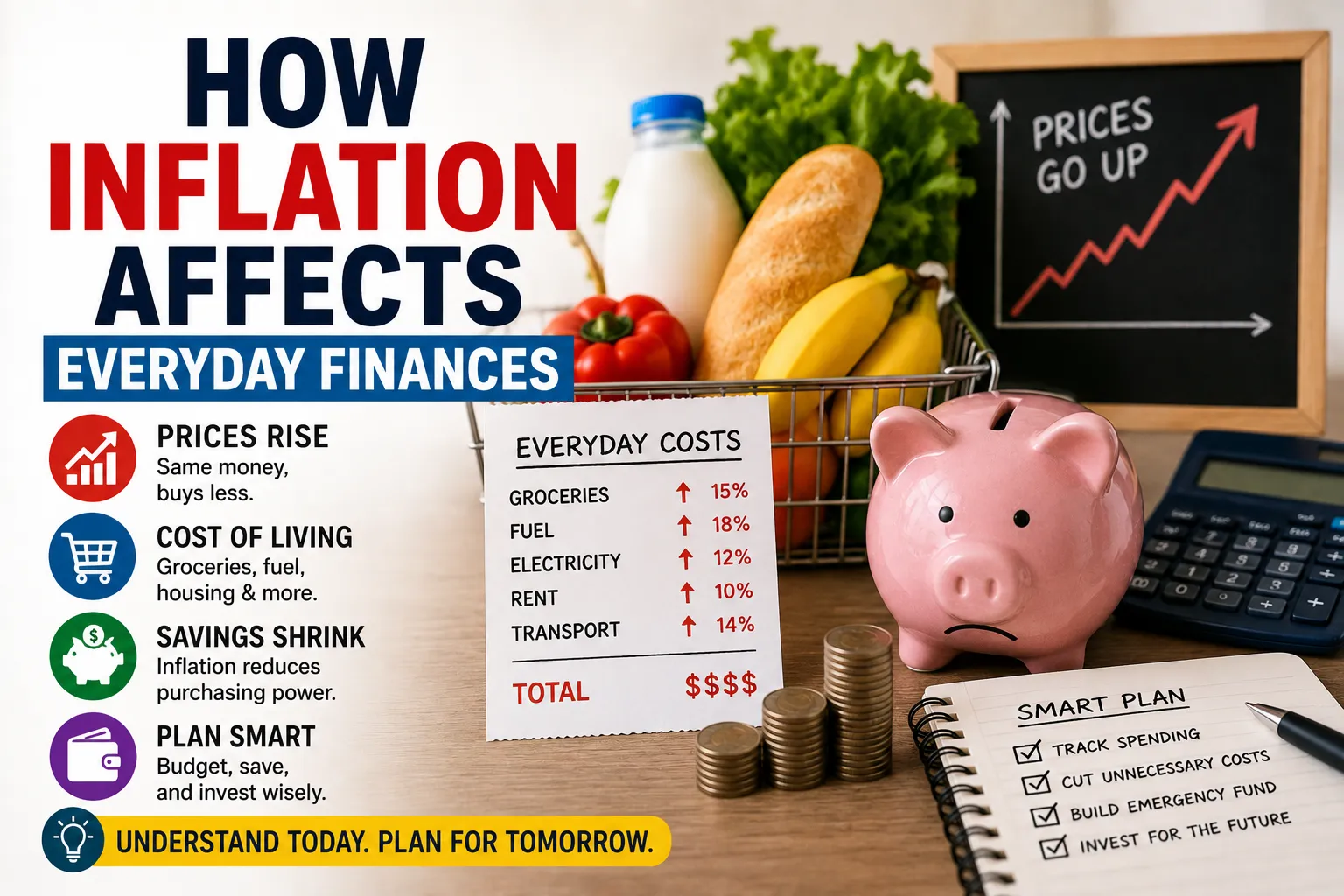
When prices rise faster than income, the same amount of money buys fewer goods and services. This reduction in purchasing power is one of the most important ways inflation affects households.
Inflation can also influence borrowing costs, savings, investments, housing decisions and household budgets. Understanding these effects can make it easier to adjust a financial plan when the cost of living changes.
For a broader understanding of how inflation fits into the economy alongside other indicators, see the Complete Guide to Economic Indicators.
What Is Inflation?
Inflation is the increase in the prices of goods and services over time.
It doesn’t necessarily mean that every product becomes more expensive at the same rate. Some prices may rise quickly, while others remain relatively stable or even decline.
Economists commonly measure consumer inflation using a Consumer Price Index (CPI), which tracks changes in the cost of a representative basket of goods and services.
For example, imagine a household spends:
- $300 on groceries
- $100 on transportation
- $200 on housing-related costs
- $100 on utilities
- $100 on other purchases
If many of these costs increase, the household may need more money to maintain the same lifestyle.
That is why inflation is ultimately a personal financial issue—not just an economic statistic.
How Inflation Reduces Purchasing Power
The most obvious effect of inflation is reduced purchasing power.
Suppose you have $1,000 today. If prices increase significantly over several years, that same $1,000 may no longer buy the same amount of goods and services.
The money hasn’t necessarily disappeared. Its real value has declined.
A Simple Example
Imagine a weekly grocery budget of $100.
If the prices of the products you regularly buy rise by 10%, maintaining the same shopping basket could require approximately $110.
If your income remains unchanged, you have several choices:
- Spend more
- Buy fewer products
- Switch to cheaper alternatives
- Reduce spending elsewhere
- Increase your income
- Use savings
This is how inflation moves from an economic statistic into a household budgeting problem.
Inflation Can Affect Households Differently
There isn’t necessarily one inflation rate that perfectly represents every household’s experience.
A CPI is based on a representative basket, but individual households spend their money differently. Someone who spends a large portion of their income on food and transportation may experience rising costs differently from someone whose budget is dominated by housing, healthcare or other categories.
This is particularly important for lower-income households.
Research has found that households with lower incomes can be more vulnerable to food inflation because food often represents a larger share of their budgets.
In practical terms, a household shouldn’t rely exclusively on the headline inflation rate when evaluating its own finances.
It should also examine personal inflation—how much its own regular expenses are changing.
How Inflation Affects Grocery Bills
Food is one of the most visible areas where households notice inflation.
When food prices rise, families may respond by:
- Comparing supermarket prices
- Buying store brands
- Purchasing certain products in larger quantities
- Planning meals more carefully
- Reducing food waste
- Cooking more meals at home
- Substituting expensive ingredients
- Shopping at different stores
However, cutting grocery costs doesn’t necessarily mean choosing the cheapest product every time.
A better approach is to consider cost per serving, nutritional value, quality and waste.
For example, a cheaper product isn’t necessarily better value if more of it gets thrown away.
Housing Costs Can Change Too
Housing is one of the largest expenses for many households, so inflation can have a substantial effect on financial security.
Renters may face higher rents as landlords respond to rising operating and maintenance costs or changing market conditions.
Homeowners can experience inflation through:
- Repairs
- Construction materials
- Property maintenance
- Insurance
- Utilities
- Property taxes where applicable
Mortgage borrowers can also be affected differently depending on whether their loans have fixed or variable interest rates.
A fixed-rate borrower may have more predictable loan payments, while a borrower with a variable-rate loan may see payments change as interest rates move.
Inflation and Interest Rates Are Connected
Inflation is closely connected to monetary policy.
Central banks often adjust policy interest rates to influence borrowing, spending and economic activity. When monetary policy is tightened, borrowing costs can rise, which can reduce demand in the economy.
For consumers, this can affect:
- Credit cards
- Personal loans
- Mortgages
- Auto loans
- Business borrowing
The relationship isn’t instantaneous or identical in every economy, but interest rates are an important part of how inflation affects household finances.
For a deeper look at the connection between monetary policy and asset prices, see How Monetary Policy Affects Financial Markets.
What Inflation Means for Borrowers
Inflation can have complicated effects on debt.
Suppose someone has a fixed-rate loan. Their required payment may remain unchanged even while prices and wages increase.
If their income rises along with inflation, the fixed payment could become easier to manage in real terms over time.
Unexpected inflation can redistribute purchasing power between borrowers and lenders, particularly when debt has a fixed interest rate.
However, this doesn’t mean inflation automatically benefits borrowers.
If interest rates rise because policymakers are responding to inflation, new loans and variable-rate debt can become more expensive.
The type of debt matters.
Inflation Can Make Credit Card Debt More Expensive
Credit card debt deserves particular attention during periods of elevated inflation.
If interest rates rise, carrying a balance can become increasingly expensive.
For someone already struggling with higher grocery, transportation and housing costs, additional interest charges can put even more pressure on the monthly budget.
A useful strategy is to prioritize understanding:
- The interest rate
- Minimum payment
- Total outstanding balance
- Fees
- Promotional rates
- Promotional expiration dates
Paying only the minimum can result in debt lasting considerably longer than expected.
How Inflation Affects Savings
Inflation can quietly reduce the purchasing power of cash savings.
Suppose your savings account earns 2% interest while inflation is 5%.
Your account balance may increase in nominal terms, but the purchasing power of the money can still decline.
This is why savers should consider both:
Nominal return — how much the account balance increases.
Real return — how much the purchasing power changes after accounting for inflation.
A simplified approximation is:
Real return ≈ interest rate − inflation rate
The exact calculation uses compounding:
Real return = (1 + nominal return) ÷ (1 + inflation rate) − 1
The distinction matters because a growing account balance doesn’t necessarily mean your money is becoming more valuable in real terms.
Should You Stop Saving During Inflation?
Usually, rising prices aren’t a reason to abandon saving altogether.
Instead, inflation can make it even more important to have an organized savings strategy.
Emergency savings provide protection against unexpected expenses, while longer-term savings can support goals such as:
- Education
- Housing
- Business creation
- Retirement
- Major purchases
The appropriate savings product depends on the goal, timeframe, liquidity requirements and risk tolerance.
For short-term money, preserving access and reducing unnecessary risk may be more important than pursuing high returns.
Inflation Can Change Investment Decisions
Inflation also matters to investors.
If an investment earns 6% while inflation is 4%, the investor’s approximate real return before taxes and other costs is around 2%.
But different assets respond differently to inflation.
Depending on the economy and circumstances, investors may consider assets such as:
- Stocks
- Bonds
- Real estate
- Commodities
- Inflation-linked securities
- Cash and cash equivalents
There is no universal investment that automatically protects everyone from inflation.
Investment decisions should consider diversification, time horizon, risk tolerance, taxes and the specific characteristics of each asset.
Inflation and Long-Term Investing
For long-term investors, inflation is particularly important because financial goals may be decades away.
Imagine someone wants to accumulate $500,000 for retirement.
If they calculate the target using today’s purchasing power without considering future inflation, they may underestimate how much money they’ll eventually need.
This is why long-term financial planning often uses inflation-adjusted projections.
The goal isn’t necessarily to predict the exact inflation rate decades from now.
Instead, planners can use reasonable assumptions and periodically update the plan.
Inflation Can Affect Retirement Planning
Retirees and people approaching retirement can be especially sensitive to inflation.
Someone receiving a fixed amount of income may find that everyday expenses gradually consume a larger portion of their budget.
Inflation can affect:
- Food expenses
- Housing
- Healthcare
- Transportation
- Utilities
- Insurance
- Leisure spending
Inflation can reduce the purchasing power of fixed-income recipients when their income doesn’t rise as quickly as prices.
This is one reason retirement planning needs to consider not just how much money someone has, but how much purchasing power that money is likely to provide over time.
Inflation Can Affect Wages and Salaries
Inflation doesn’t necessarily mean that wages rise at the same rate.
If prices rise by 6% while someone’s salary increases by only 3%, their nominal income has increased but their purchasing power has fallen.
This is known as a decline in real income.
The gap between price increases and nominal income growth is a key way inflation reduces household purchasing power.
For employees, this makes compensation reviews and salary negotiations particularly important.
For employers, persistent inflation can increase labor costs and complicate decisions about wages, hiring and pricing.
Inflation Can Influence Household Budgets
A budget created several years ago may stop accurately reflecting today’s costs.
For example, a household might have originally allocated:
| Expense | Original Budget |
|---|---|
| Food | $400 |
| Transportation | $200 |
| Utilities | $150 |
| Entertainment | $100 |
| Savings | $250 |
| Total | $1,100 |
If food, utilities and transportation become more expensive, the household may need to revise its allocations.
Possible responses include:
- Increasing the total budget
- Reducing discretionary spending
- Finding cheaper alternatives
- Increasing income
- Adjusting savings contributions temporarily
- Reprioritizing financial goals
The important point is that a budget should be a living financial plan, not a document that never changes.
How to Protect Your Budget From Inflation
You cannot control inflation, but you can improve how your finances respond to it.
1. Track Your Actual Spending
Review several months of expenses to identify where prices are increasing most quickly.
2. Separate Fixed and Variable Costs
Fixed costs may be harder to change quickly, while variable expenses often provide more flexibility.
3. Review Recurring Subscriptions
Inflation can make small recurring charges more significant when combined.
4. Compare Prices Regularly
Don’t assume your usual supplier or retailer remains the cheapest option.
5. Reduce Waste
Food, energy and other forms of waste can become increasingly expensive when prices rise.
6. Protect Your Emergency Fund
Avoid using emergency savings for routine expenses whenever possible.
7. Review Debt
Pay particular attention to high-interest and variable-rate borrowing.
8. Increase Income Where Possible
Negotiating compensation, developing valuable skills or creating additional income streams can help offset rising expenses.
Inflation Makes Financial Goals More Expensive
A common mistake is to think about financial goals using today’s prices.
Suppose a family wants to save for a $20,000 expense several years from now.
If the cost of that expense rises over time, saving exactly $20,000 may not be enough.
This applies to goals such as:
- Education
- Home purchases
- Vehicle replacement
- Retirement
- Business startup costs
- Major renovations
Long-term goals should therefore be reviewed periodically rather than treated as fixed numbers forever.
Inflation and the Cost of Everyday Transportation
Transportation costs can be affected by several inflation-related factors.
These may include:
- Fuel
- Vehicle prices
- Spare parts
- Repairs
- Insurance
- Public transportation fares
- Financing costs
A household may respond by combining trips, maintaining vehicles more carefully, using public transportation where practical or reconsidering vehicle financing.
Again, the best response depends on the household’s circumstances.
Inflation Can Change Consumer Behavior
When prices rise, consumers often change what and how they buy.
They may:
- Delay major purchases
- Switch brands
- Buy fewer discretionary products
- Search for discounts
- Purchase used goods
- Reduce restaurant spending
- Change travel plans
- Substitute cheaper products
These decisions can influence businesses as well.
Companies may respond to higher input costs by changing prices, reducing costs, adjusting product sizes or changing product offerings.
Why Inflation Doesn’t Affect Everyone Equally
Two households earning the same income can experience very different financial pressures.
Consider two families:
Family A spends heavily on food, transportation and utilities.
Family B spends more on discretionary services and has lower transportation costs.
If food and fuel prices rise sharply, Family A may feel the impact more strongly.
Differences in household consumption patterns can result in different effective inflation rates.
This is why personal budgeting should be based on your actual spending patterns, rather than relying entirely on national inflation statistics.
Inflation Can Affect Wealth and Assets
Inflation can also affect the real value of assets and liabilities.
The effects can vary depending on whether someone owns assets, owes debt, receives fixed income or has other financial exposures.
Unexpected inflation can transfer purchasing power between borrowers and creditors, while persistent inflation can influence savings, investment and consumption decisions.
This makes inflation an important consideration in broader financial planning.
Common Inflation Mistakes to Avoid
Ignoring Rising Costs
A budget can become outdated without the household noticing.
Keeping All Long-Term Money in Cash
Cash can be useful for liquidity, but money intended for long-term goals may require a different strategy.
Taking on Expensive Debt
Higher household expenses can make high-interest debt particularly difficult to manage.
Assuming Salary Increases Equal Real Raises
A pay increase isn’t necessarily a real increase in purchasing power if prices are rising faster.
Making Emotional Investment Decisions
Inflation can create fear and encourage rushed decisions. Investment changes should be based on goals, risk and time horizon rather than headlines alone.
Focusing Only on the Headline Inflation Rate
Your personal expenses may be rising faster or slower than the national average.
A Practical Inflation-Resistant Financial Plan
There is no single strategy that completely eliminates inflation risk.
Instead, households can build resilience by combining several practices:
Track spending → Maintain emergency savings → Manage expensive debt → Review income → Adjust financial goals → Invest appropriately for long-term objectives → Reassess periodically
This approach gives a household several ways to respond when prices change.
The objective isn’t to predict inflation perfectly.
It’s to make the financial plan flexible enough to survive changing economic conditions.
Making Your Money Plan Adapt to Rising Prices
Inflation is ultimately about more than higher prices. It changes the relationship between income, spending, saving, borrowing and long-term financial goals.
The most important question isn’t simply “What is the inflation rate?”
It’s:
“How is inflation changing my household’s purchasing power?”
Once you know which expenses are rising fastest, you can make more informed decisions about your budget, savings, debt and investments.
Inflation cannot be controlled by an individual household, but financial habits can be adjusted. Regularly reviewing expenses, protecting emergency savings, managing debt carefully and updating long-term goals can help families remain financially resilient as the cost of living changes.
This article is for general educational purposes and does not constitute personalized financial advice. Inflation, interest rates, taxes and investment risks vary by country and individual circumstances.