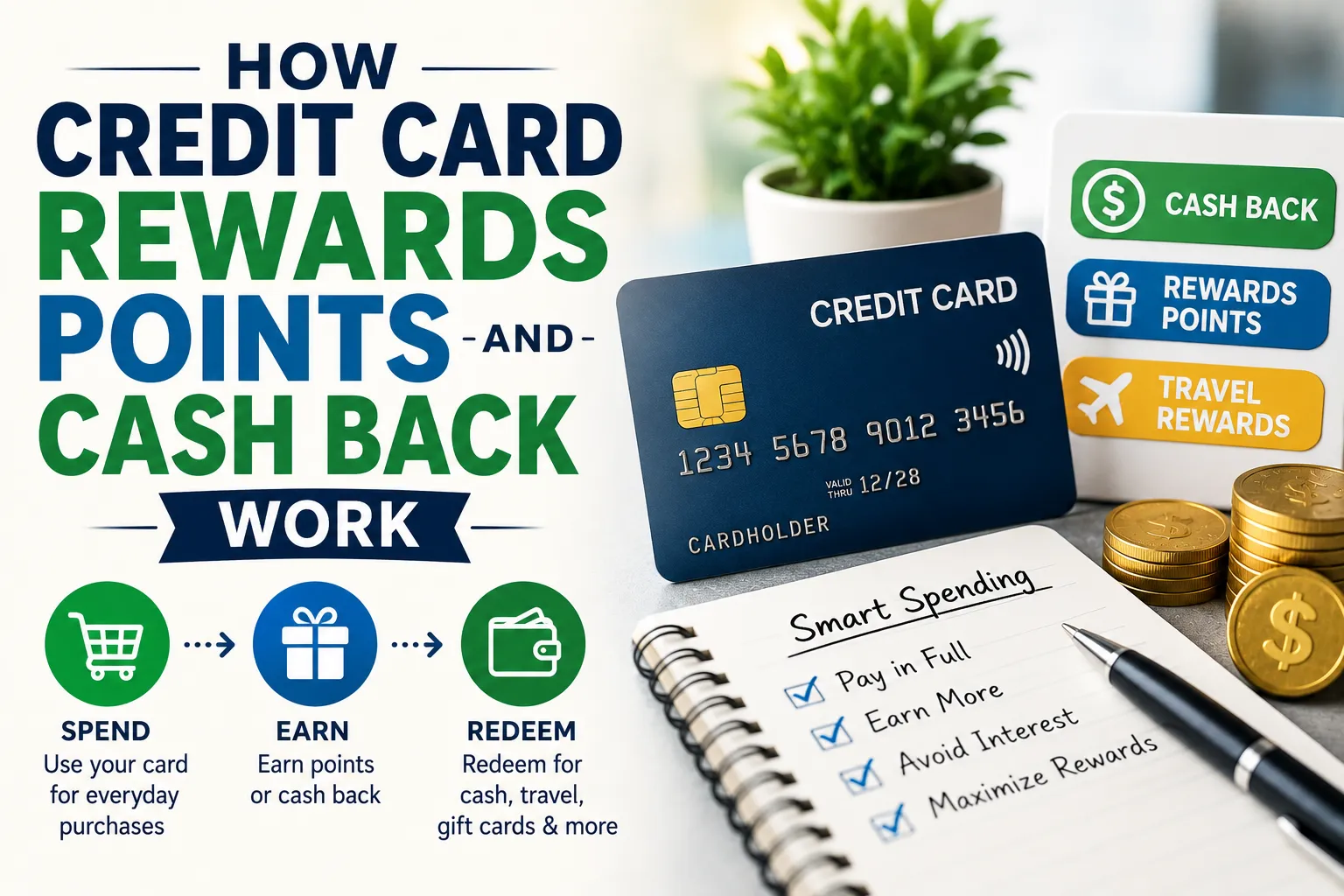
How Credit Card Rewards Points and Cash Back Work
Credit card rewards can make everyday spending more valuable, but they can also be confusing. Some cards offer points, others provide cash back, while travel-focused cards may use miles or flexible rewards that can be redeemed in several ways.
At their simplest, rewards programs give cardholders something back when they use a credit card for eligible purchases. The reward may be a percentage of the purchase price, a fixed number of points, or a combination of different earning rates.
The important part is understanding how rewards are earned, what they are actually worth, how they can be redeemed and what it costs to earn them.
A rewards card is only financially useful when the value of the rewards outweighs the fees, interest and other costs associated with using the card. For a broader overview of how credit cards and related financial tools fit together, see the Complete Guide to Credit Tools.
What Are Credit Card Rewards?
Credit card rewards are incentives offered by card issuers to encourage customers to use their cards.
The three most common forms are:
- Cash back
- Points
- Travel miles
Although these systems look different, they are based on the same basic idea: the card issuer provides a reward based on eligible spending.
For example, a card might offer:
- 1% cash back on eligible purchases
- 2 points per dollar spent on certain categories
- 3 points per dollar spent on travel
- Bonus rewards for specific types of purchases
The exact earning rules depend on the card. Before comparing reward structures, it can help to understand the basics in this Complete Guide to Credit Cards and How They Work.
How Cash Back Works
Cash-back cards are generally the easiest rewards cards to understand.
Instead of receiving points, the cardholder earns a percentage of eligible purchases back as a monetary reward.
Suppose a card offers 2% cash back on eligible purchases.
If you spend $500:
$500 × 2% = $10 cash back
If you spend $2,000:
$2,000 × 2% = $40 cash back
The reward may appear as a statement credit, deposit into a bank account, check or another redemption option, depending on the issuer.
Flat-Rate Cash Back
Some cards offer the same cash-back rate on most eligible purchases.
For example:
2% cash back on eligible purchases
This type of card is straightforward because you do not need to remember which categories earn higher rewards.
It can be particularly useful for people who want a simple rewards system.
Category-Based Cash Back
Other cards offer different rates for different spending categories.
A card might provide:
- 3% on groceries
- 3% on transportation
- 2% on selected bills
- 1% on other purchases
The exact categories and rates vary by card.
Category-based rewards can potentially generate more rewards than a flat-rate card, but they require greater attention.
Rotating Bonus Categories
Some rewards cards periodically change their bonus categories.
For example, a card could offer a higher reward rate for:
- Restaurants during one period
- Grocery stores during another
- Online shopping during another
The cardholder may need to activate the bonus category before qualifying for the higher rate.
If the cardholder forgets to activate it or spends outside the qualifying category, the standard rewards rate may apply instead.
How Credit Card Points Work
Points work similarly to cash back, but their value is not always fixed.
A credit card might award:
1 point for every $1 spent
A $500 purchase would therefore earn 500 points.
Another card might offer:
3 points per $1 on eligible travel purchases
A $500 qualifying travel purchase could generate 1,500 points.
The important difference is that one point does not necessarily equal one cent.
The value depends on how the points are redeemed.
What Are Credit Card Points Worth?
Points can have different values depending on the redemption method.
For example, 10,000 points might be worth:
- $50 as a statement credit
- $100 toward travel
- $75 in gift cards
- More or less through a specific rewards partner
This is why comparing rewards cards based only on the number of points earned can be misleading.
A card offering 3 points per dollar is not automatically better than a card offering 2 points per dollar.
The value of each point must also be considered.
A Simple Rewards Calculation
Imagine Card A offers:
2 points per $1 spent
Card B offers:
1% cash back
If Card A’s points are worth 0.5 cents each:
2 points × 0.5 cents = 1 cent
That means Card A effectively provides approximately 1% back.
If Card A’s points are worth 1 cent each:
2 points × 1 cent = 2 cents
That would effectively equal 2% back.
The same number of points can therefore have very different values depending on redemption.
Flexible Points Programs
Some credit cards use flexible rewards programs that allow points to be redeemed in several ways.
Possible options can include:
- Travel
- Statement credits
- Gift cards
- Merchandise
- Partner programs
- Other rewards
Flexible points can be valuable because they give cardholders more choices.
However, flexibility can also make the program harder to evaluate.
The best redemption option may not be the easiest one.
How Travel Rewards Work
Travel-focused cards may award points or miles that can be used toward:
- Flights
- Hotels
- Rental cars
- Travel bookings
- Airline loyalty programs
- Hotel loyalty programs
Some cards allow points to be transferred to participating travel partners.
This can create opportunities to receive more value than a simple cash redemption, but it also requires more research.
Travel rewards may involve:
- Availability restrictions
- Transfer ratios
- Expiration rules
- Taxes and fees
- Booking restrictions
- Different point values
People who do not travel regularly may prefer cash back because it is easier to understand and use.
How Credit Card Reward Rates Work
A reward rate tells you how much value you earn from eligible spending.
For cash back, the calculation is straightforward.
For example:
$1,000 × 3% = $30
For points, the calculation has two steps:
Purchase amount × points earned per dollar = points earned
Then:
Points earned × value per point = estimated reward value
This second calculation is important because points do not have a universal cash value.
Welcome Bonuses
Many rewards credit cards offer a welcome bonus to new cardholders.
A typical offer might provide a certain number of points or a cash-back bonus after the cardholder spends a specified amount within a particular period.
For example, a hypothetical offer could be:
Earn 20,000 points after spending $2,000 within the first three months.
The bonus can be significantly larger than the rewards earned from ordinary spending.
However, there is an important rule:
Never spend money you cannot afford simply to earn a rewards bonus.
A bonus is not a bargain if earning it causes you to carry an expensive credit-card balance.
Why Interest Can Destroy the Value of Rewards
Credit card rewards are most valuable when the balance is paid in full and on time.
Suppose someone earns $50 in rewards but carries a balance that generates substantial interest.
The interest charges can easily exceed the value of the rewards.
This is one of the biggest mistakes people make with rewards cards. Anyone already dealing with several balances may also benefit from understanding how debt repayment tools help plan debt payoff.
The goal should not be:
“How many rewards can I earn?”
It should be:
“How much value can I receive without paying unnecessary costs?”
Rewards Should Not Encourage Extra Spending
A rewards program can make spending feel more rewarding.
That can be dangerous.
If a card offers 2% cash back, spending an unnecessary $100 does not save $2.
It costs $98 after the reward.
The best rewards strategy is therefore to use the card for purchases you would make anyway.
What Purchases Earn Rewards?
Not every transaction necessarily earns rewards.
Eligible purchases depend on the card’s terms.
Some transactions may receive different treatment, including:
- Cash advances
- Balance transfers
- Fees
- Interest charges
- Certain government payments
- Gambling transactions
- Some financial services
The specific exclusions vary by issuer and card.
Always check the rewards program’s terms rather than assuming every transaction earns points or cash back.
Merchant Categories Matter
Credit-card rewards can sometimes depend on how a merchant is classified by its payment network.
For example, a purchase might appear to a consumer as a restaurant purchase but be processed under a different merchant category.
This can affect whether it qualifies for a bonus rewards rate.
This is one reason category-based rewards can sometimes be less predictable than they appear.
What Is a Statement Credit?
A statement credit is an amount deducted from the card balance.
For example, if your credit-card balance is $600 and you receive a $50 statement credit, the balance could be reduced to $550, assuming the credit is eligible and no other transactions affect the account.
Statement credits are one common way of redeeming cash-back rewards.
However, the exact rules vary between card programs.
Cash Back May Not Always Be Cash in Your Pocket
The phrase “cash back” can sound like the issuer is sending you physical cash.
That is not necessarily how it works.
Depending on the program, cash-back rewards may be provided as:
- Statement credits
- Bank deposits
- Checks
- Account credits
- Other eligible redemption options
Read the redemption rules before choosing a card.
Do Rewards Expire?
Some rewards programs have expiration rules, while others allow points to remain available as long as the account remains in good standing.
Rewards may also be affected if:
- The account is closed
- The cardholder violates program rules
- Points are transferred
- The issuer changes the program
- The rewards account becomes inactive
The specific rules are determined by the card’s terms.
If you have accumulated a large balance, understand what happens to the rewards if you close the card.
What Happens to Rewards When You Return a Purchase?
Rewards are generally tied to eligible purchases.
If you return an item, the original transaction may be reversed and the associated points or cash-back rewards may also be removed.
This prevents people from earning rewards permanently on purchases they ultimately did not keep.
Refunds and reward reversals can sometimes appear separately on account statements.
Annual Fees Can Change the Equation
Some rewards cards charge annual fees.
A card offering higher rewards is not necessarily better if the annual fee consumes the additional value.
Suppose:
Card A: 1.5% cash back, no annual fee
Card B: 3% cash back, $100 annual fee
If you spend $10,000 annually:
Card A:
$10,000 × 1.5% = $150
Card B:
$10,000 × 3% = $300
After the $100 annual fee:
$300 − $100 = $200
Card B would provide $50 more in annual value before considering any other benefits or costs.
But if you spend only $3,000:
Card A:
$3,000 × 1.5% = $45
Card B:
$3,000 × 3% = $90
After the annual fee:
$90 − $100 = −$10
In that example, the higher rewards rate would not justify the fee.
Calculate the Break-Even Point
You can estimate the spending level at which a rewards card becomes worthwhile.
Suppose:
- Card A earns 1.5%
- Card B earns 2.5%
- Card B has a $100 annual fee
The additional reward is:
2.5% − 1.5% = 1%
To recover the $100 fee:
$100 ÷ 1% = $10,000
You would need approximately $10,000 in eligible annual spending for the additional rewards to offset the $100 fee, assuming all spending qualifies for those rates.
This simple calculation can help determine whether a premium rewards card makes sense.
Reward Caps Matter
Some cards offer high rewards only up to a certain spending limit.
For example, a card might provide a higher rate on the first $5,000 spent in a particular category and a lower rate afterward.
If you spend heavily in that category, the effective rewards rate may be lower than the headline rate suggests.
Always check:
- Spending limits
- Time periods
- Category restrictions
- Activation requirements
- Standard rates after the limit
Promotional Rewards Can Change
Credit-card issuers can modify rewards programs.
A card may introduce:
- New bonus categories
- Lower reward rates
- Higher annual fees
- Different redemption values
- New transfer partners
- Changed eligibility requirements
This is why a card that was excellent several years ago may no longer be the best fit.
Review the terms periodically.
Credit Card Rewards and Credit Scores
Using a rewards card responsibly can be compatible with maintaining healthy credit.
However, rewards themselves do not improve a credit score.
Credit scoring systems generally consider factors such as:
- Payment history
- Credit utilization
- Length of credit history
- New credit applications
- Credit mix
Carrying large balances simply to earn rewards can increase credit utilization and potentially hurt your credit profile.
For a deeper look at how the underlying credit profile is measured, see the Complete Guide to Credit Scores and Credit Reports.
Pay on Time
Payment history is an important component of credit health.
Missing payments can lead to:
- Late fees
- Interest charges
- Loss of promotional benefits
- Potential credit-score damage
Rewards are never worth intentionally missing a payment.
Credit Utilization Still Matters
Credit utilization refers broadly to how much revolving credit you are using compared with your available credit.
Suppose your card has a $5,000 credit limit and you have a $2,000 balance.
Your utilization on that card is:
$2,000 ÷ $5,000 = 40%
Even if you plan to pay the balance in full, a high reported balance can sometimes affect credit scoring.
Using a credit card for rewards therefore requires attention to both spending and credit management.
Should You Use Multiple Rewards Cards?
Some experienced cardholders use multiple cards to maximize different reward categories.
For example:
- One card for groceries
- One for travel
- One for everyday spending
- One for business expenses
This can increase rewards if the cardholder understands the rules.
But more cards also create more complexity.
You have to track:
- Payment dates
- Annual fees
- Bonus categories
- Reward balances
- Spending limits
- Account terms
A simple card that you manage responsibly may be better than a complicated strategy that causes missed payments or unnecessary fees.
Cash Back vs. Points
There is no universal winner.
Cash Back May Be Better If You Want:
- Simplicity
- Predictable value
- Easy redemption
- No need to manage travel programs
- Straightforward budgeting
Points May Be Better If You:
- Travel regularly
- Understand loyalty programs
- Can redeem points strategically
- Value travel-related benefits
- Are willing to manage a more complicated rewards system
The best option depends on how you actually spend and redeem rewards.
Cash Back vs. Travel Points Example
Imagine you spend $20,000 annually on a card.
A cash-back card offers 2%.
You receive:
$20,000 × 2% = $400
A points card offers 2 points per dollar.
You earn:
20,000 × 2 = 40,000 points
If those points are worth an average of 1 cent each:
40,000 × $0.01 = $400
In that case, the two cards provide roughly the same reward value.
But if you can consistently redeem those points for 1.5 cents each:
40,000 × $0.015 = $600
The points card could potentially provide more value.
However, that higher value may require more work and may not be guaranteed.
How to Choose a Rewards Card
Before applying for a rewards card, consider your actual spending patterns.
Look at where your money goes each month.
For example:
| Spending Category | Monthly Spending |
|---|---|
| Groceries | $500 |
| Transportation | $200 |
| Dining | $250 |
| Utilities | $250 |
| Shopping | $300 |
| Other | $500 |
You can then compare different cards based on the categories where you actually spend money.
A card offering excellent rewards on travel may be of little value if you rarely travel.
Don’t Chase Rewards Categories
A rewards program should fit your existing spending.
It should not determine your spending.
If a card offers 5% back at a particular store, that does not mean you should spend $500 there instead of $100 simply to earn more rewards.
The additional $20 in rewards is not worth $400 of unnecessary spending.
Consider the Entire Package
Rewards are only one part of a credit card.
Also consider:
- Annual fee
- Interest rate
- Foreign transaction fees
- Late fees
- Introductory offers
- Travel benefits
- Purchase protection
- Extended warranties
- Fraud protection
- Customer service
- Redemption flexibility
A card with a slightly lower reward rate may provide greater overall value if it has fewer fees and better features.
Rewards and Debit Cards Are Different
Credit-card rewards are sometimes confused with debit-card rewards.
Credit cards provide a line of credit that must be repaid.
Debit cards generally draw money directly from a bank account.
The financial risks and protections can differ.
A rewards strategy should therefore not be based solely on the reward percentage. Consider how the payment method fits into your overall financial system.
What Happens If You Carry a Balance?
This is one of the most important questions to ask.
Suppose you earn 2% rewards on purchases but pay a much higher annualized interest rate on a balance you carry.
The reward is tiny compared with the financing cost.
For example, earning $20 in rewards on $1,000 of spending does not make sense if carrying that balance results in significantly more than $20 in interest.
This is why rewards cards are generally most attractive to people who can consistently manage their balances responsibly.
For households managing multiple balances, the broader question is often how to structure repayment, which is covered in How to Manage Household Debt and Pay Off Multiple Debts.
Use Automatic Payments Carefully
Automatic payments can help prevent missed due dates.
Some cardholders choose to automatically pay:
- The full statement balance
- The minimum payment
- A fixed amount
Paying the full statement balance can help avoid interest on purchases when the card’s terms provide a grace period and the account is managed appropriately.
However, make sure the linked bank account has enough money to cover the payment.
An automatic payment that causes an overdraft can create a different financial problem.
Keep Track of Reward Balances
If you use a points-based card, periodically check:
- Current points
- Expiration rules
- Redemption value
- Transfer options
- Upcoming changes
- Annual fees
A large points balance is not necessarily an asset if the program’s terms change or you cannot use the points effectively.
Don’t Let Rewards Complicate Your Budget
Your budget should track the money you spend, not just the rewards you receive.
If you spend $1,000 and earn $20 in cash back, your budget should still reflect the $1,000 purchase.
The $20 reward is a benefit, not a reason to understate your spending.
This distinction can help prevent rewards programs from creating a false sense of savings.
Credit Card Rewards and Fraud Protection
Credit cards can offer useful protections against unauthorized transactions.
If fraudulent activity occurs, cardholders generally have procedures for reporting unauthorized transactions and disputing certain charges.
However, consumers should still monitor their accounts.
For people who want a more structured approach to watching changes in their credit profile, How Credit Monitoring Tools Track and Explain Credit Health provides a useful companion resource.
Check statements regularly for:
- Unknown purchases
- Duplicate transactions
- Unexpected fees
- Changes to rewards
- Suspicious activity
Early detection can make resolving problems easier.
Common Credit Card Rewards Mistakes
Spending More to Earn Rewards
This defeats the purpose of the program.
Carrying a Balance
Interest can outweigh rewards.
Ignoring Annual Fees
A high reward rate may not justify a costly fee.
Forgetting Bonus Categories
You may fail to earn the advertised rate.
Assuming Every Point Has the Same Value
Redemption methods can produce different values.
Letting Rewards Expire
Unused rewards provide no benefit.
Opening Too Many Cards
Complexity can increase the risk of missed payments and unnecessary fees.
Choosing a Card Based Only on the Welcome Bonus
A large introductory offer may be attractive, but the long-term rewards structure matters too.
A Simple Strategy for Using Rewards Responsibly
For many people, an effective approach can be surprisingly simple:
- Choose a card that matches your normal spending.
- Understand its rewards structure.
- Avoid spending solely to earn rewards.
- Pay bills on time.
- Prefer paying the statement balance in full when financially possible.
- Track annual fees.
- Redeem rewards regularly or strategically.
- Review the program’s terms periodically.
- Monitor transactions for fraud.
- Reassess whether the card still provides value.
This approach focuses on the financial benefit rather than the excitement of collecting points.
Make the Rewards Work for Your Budget
Credit-card rewards can be useful when they are treated as a secondary benefit of responsible spending, rather than as a reason to spend more.
Cash back is generally easier to understand because its value is expressed directly in money. Points can potentially offer greater flexibility or value, particularly for people who understand travel and loyalty programs, but their worth depends heavily on how they are redeemed.
The most important calculation is not how many points a card offers. It is the relationship between rewards earned, fees paid, interest charged and spending that would have happened anyway.
A card that gives 2% back on purchases you were already planning to make can be useful. A card that encourages unnecessary purchases or expensive debt can quickly become costly.
The strongest rewards strategy is therefore simple: choose a program that fits your spending, understand the rules, pay responsibly and never let the promise of points or cash back override your budget.