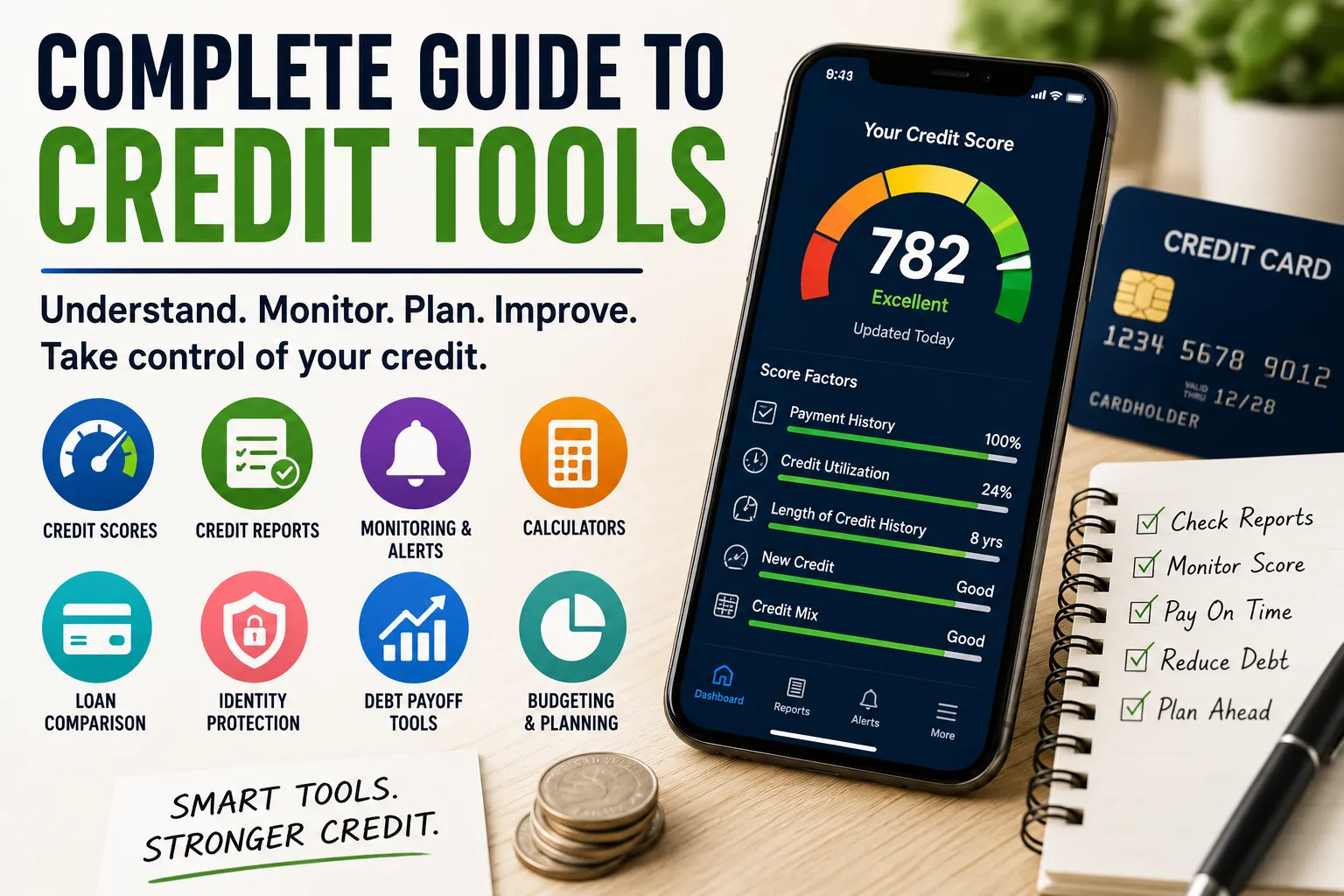
Complete Guide to Credit Tools
Credit can feel complicated because it involves several moving parts at once: credit reports, credit scores, interest rates, debt balances, payment histories, loan applications and sometimes identity theft.
Fortunately, you don’t have to manage all of it from memory.
A growing range of credit tools can help consumers monitor their credit, understand how scores work, compare borrowing options, calculate payments, organize debt and identify potential problems before they become expensive.
The challenge is knowing which tools actually help—and which ones simply add another subscription, advertisement or confusing number to your financial life.
This guide explains the major types of credit tools, what they do, how to use them effectively and what to watch out for.
Note: Credit-reporting rules and available tools vary by country. Examples involving the three major U.S. credit bureaus and FICO scores apply specifically to the United States.
What Are Credit Tools?
Credit tools are financial resources that help you understand, manage or improve some aspect of your credit.
They can include:
- Credit-report services
- Credit-score tools
- Credit-monitoring services
- Debt-payoff calculators
- Loan-payment calculators
- Credit-card payoff calculators
- Credit utilization calculators
- Debt-to-income calculators
- Credit comparison tools
- Prequalification tools
- Identity-theft monitoring
- Fraud alerts
- Credit freezes
- Credit-report dispute tools
- Budgeting tools
- Debt-management resources
Some are free, while others charge monthly or annual fees.
The most useful tool isn’t necessarily the most sophisticated one.
It’s the tool that helps you make a better financial decision.
Credit Report vs. Credit Score
Before choosing a credit tool, understand the difference between two terms that are often confused.
Your Credit Report
A credit report is a record of information related to your credit activity.
It can contain information such as:
- Credit accounts
- Payment history
- Account balances
- Credit limits
- Collections
- Public-record information where applicable
- Credit inquiries
- Account opening and closing dates
Your credit report is the underlying information used by scoring models.
If you want a deeper explanation of how the two fit together, see our complete guide to credit scores and credit reports.
Your Credit Score
A credit score is a numerical assessment generated from information in your credit report.
Different scoring models can produce different scores.
For example, FICO Scores use five broad categories: payment history, amounts owed, length of credit history, new credit and credit mix. These factors can have different levels of importance depending on the scoring model and consumer.
The important point is:
Your credit report contains the information. Your credit score summarizes some of that information into a number.
Why Credit Tools Matter
Credit affects more than whether you can get a credit card.
Depending on your country and situation, your credit history can influence:
- Loan approval
- Interest rates
- Credit-card offers
- Mortgage financing
- Auto financing
- Insurance pricing in some jurisdictions
- Rental applications
- Certain employment decisions
Checking your credit information for errors is important because inaccurate information can potentially affect your ability to obtain credit and the terms you receive.
A credit tool can therefore be useful not only when you’re applying for something, but throughout the year.
1. Credit-Report Tools
A credit-report tool lets you access and review your credit history.
For U.S. consumers, official resources can provide access to credit reports from the major nationwide credit reporting companies.
Your first priority should be accuracy.
Look for:
- Accounts you don’t recognize
- Incorrect balances
- Incorrect credit limits
- Late payments you believe were reported incorrectly
- Accounts listed as open when they were closed
- Duplicate accounts
- Incorrect personal information
- Collection accounts that don’t belong to you
These checks can help you identify potential errors or unauthorized activity before they create larger problems.
How Often Should You Check Your Credit Report?
Regularly.
At minimum, make credit-report review part of your annual financial routine.
You may also want to review your reports more frequently when:
- Applying for a mortgage
- Preparing for an auto loan
- Recovering from identity theft
- Building credit
- Paying down significant debt
- Monitoring a recent dispute
- Concerned about unauthorized accounts
Checking your own credit report does not itself hurt your credit score.
2. Credit-Score Tools
Credit-score tools show you an estimate or version of your credit score.
They can help answer questions such as:
- Has my score changed?
- Am I moving in the right direction?
- What factors may be affecting my score?
- Am I likely to meet a lender’s general credit requirements?
However, don’t assume that every score you see is the exact score a lender will use.
There are multiple scoring models and versions, and lenders may use different models for different products.
For a broader look at this subject, see our complete guide to credit scores and credit reports.
Why Your Credit Score May Differ Between Services
You may see one score through a credit-card provider and another through a financial app.
That doesn’t necessarily mean one is wrong.
Differences can occur because:
- Different scoring models are used
- Different credit-reporting agencies provide the underlying data
- Information reaches bureaus at different times
- Different scoring versions are used
- Some lenders use industry-specific models
Think of a displayed score as a useful indicator rather than a universal number.
3. Credit-Monitoring Tools
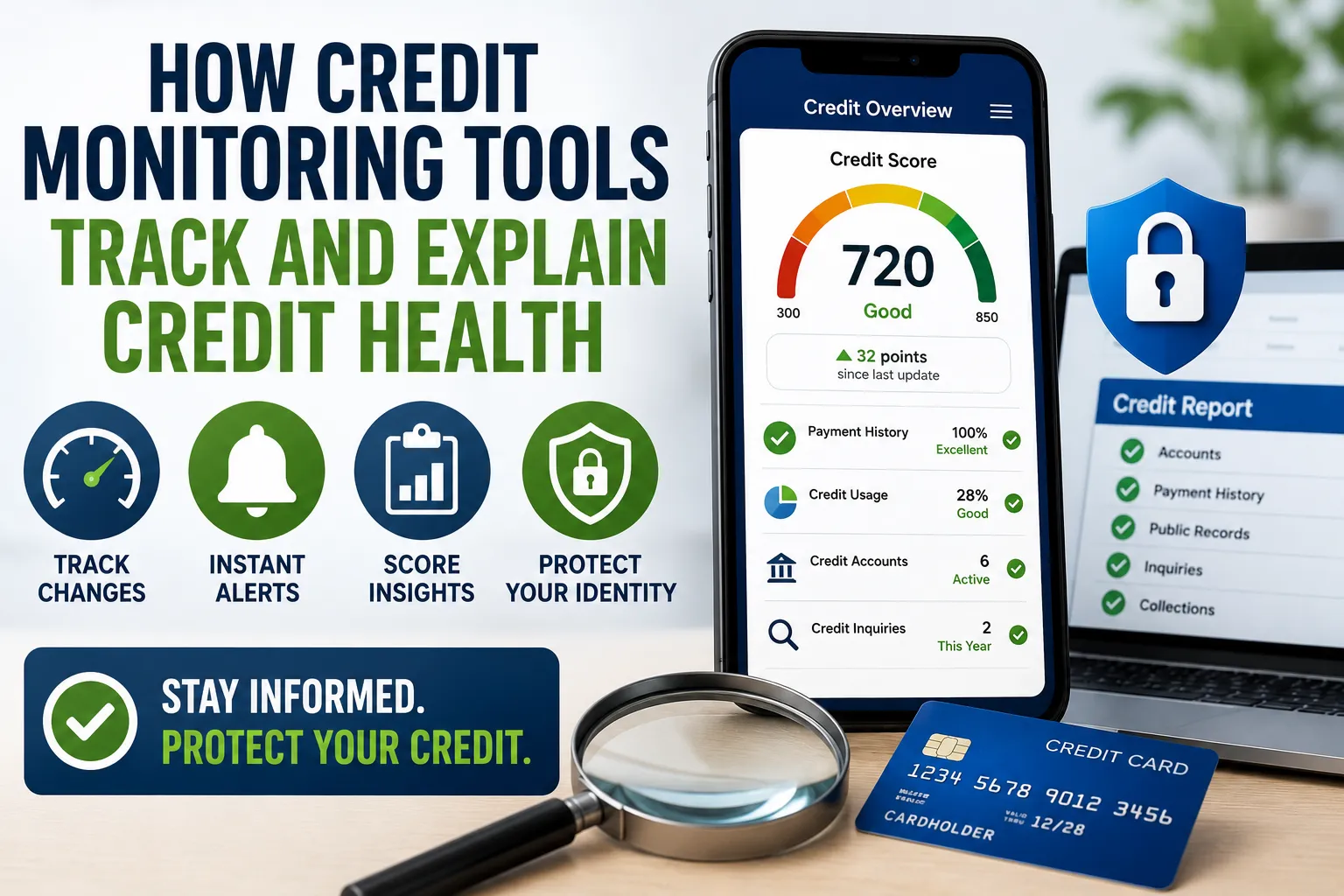
Credit monitoring services watch for changes in your credit reports and alert you when something changes.
Alerts may involve:
- New accounts
- Credit inquiries
- Changes to existing accounts
- Reported balances
- Other changes depending on the service
Credit monitoring can be particularly useful when you’re trying to detect unexpected activity quickly.
For more on how these services work and what they can tell you, see how credit monitoring tools track and explain credit health.
Is Credit Monitoring Worth Paying For?
It depends.
Paid monitoring may offer additional features such as:
- More frequent alerts
- Multiple-bureau monitoring
- Identity monitoring
- Score tracking
- Recovery assistance
- Identity-theft insurance in some plans
But you should compare the actual benefits against the cost.
Monitoring generally alerts you to problems rather than preventing your information from being stolen.
For many people, a free monitoring option combined with sensible security practices may be sufficient.
4. Credit Utilization Calculators
Credit utilization measures how much revolving credit you’re using relative to your available credit.
A simple calculation is:
Credit utilization = total revolving balances ÷ total revolving credit limits × 100
For example, if you have:
- $2,000 in credit-card balances
- $10,000 in total credit limits
your utilization is:
$2,000 ÷ $10,000 × 100 = 20%
Credit utilization is an important component of credit scoring models.
Why Credit Utilization Matters
A high utilization ratio can indicate that you’re using a large portion of your available revolving credit.
A utilization calculator can therefore help you understand how paying down a balance or changing credit limits might affect the ratio.
But don’t take this as a recommendation to borrow simply to manipulate your score.
The healthiest strategy is generally to manage credit responsibly and avoid unnecessary debt.
5. Debt-Payoff Calculators
A debt-payoff calculator can show how long it may take to repay a balance based on:
- Current balance
- Interest rate
- Minimum payment
- Additional monthly payment
This can make the cost of carrying debt much easier to understand.
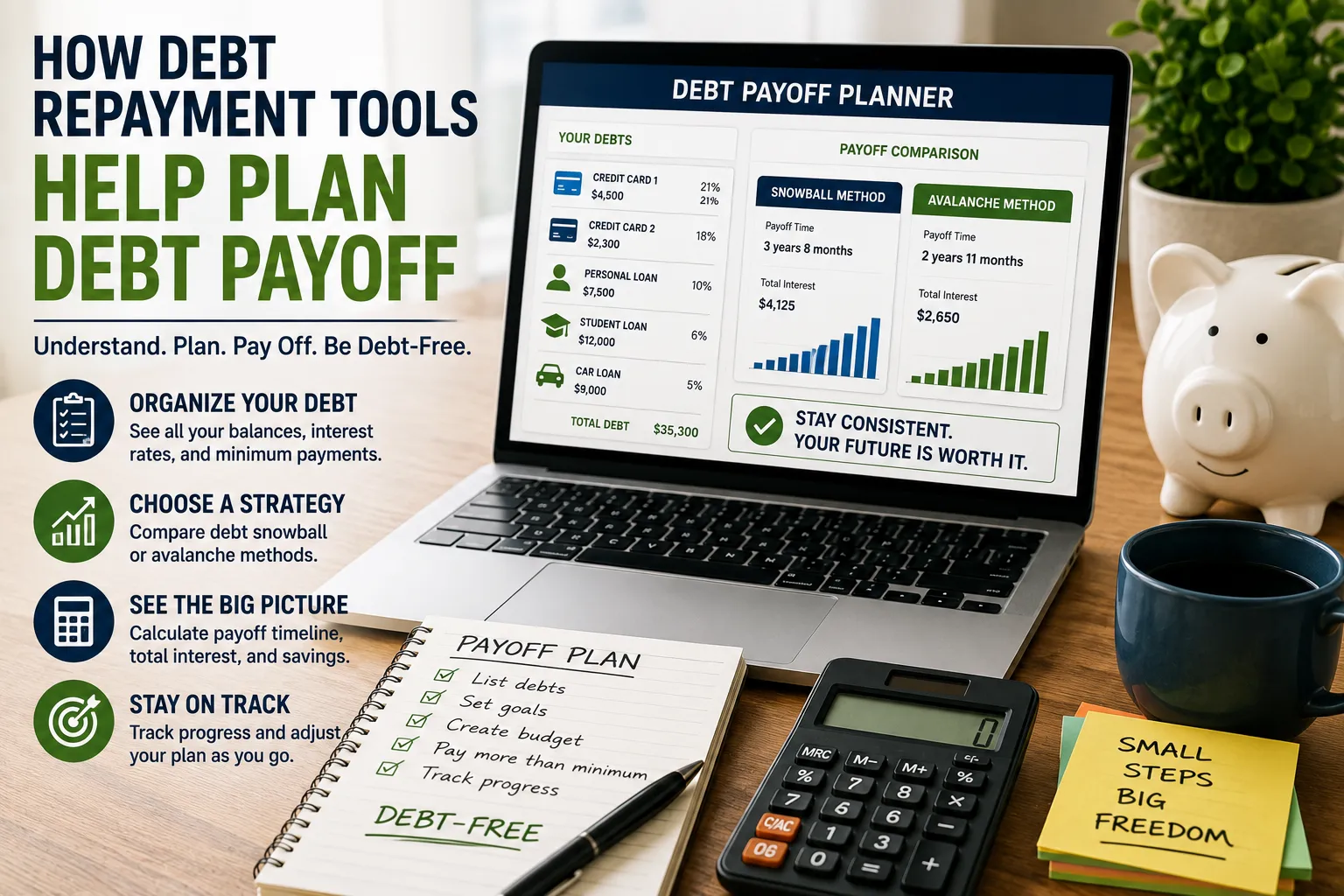
For consumers dealing with multiple balances, debt repayment tools that help plan debt payoff can provide a more structured way to compare repayment strategies.
Example: Why Minimum Payments Can Be Expensive
Imagine you have a credit-card balance and make only the minimum payment.
A calculator can show:
- Estimated payoff date
- Total interest
- Total amount paid
- Time saved by making additional payments
Seeing the numbers can make a vague debt problem much more concrete.
Snowball vs. Avalanche Debt Tools
Two popular debt-repayment strategies are:
Debt Snowball
Pay minimums on all debts while directing extra money toward the smallest balance first.
Once that debt is paid off, move the freed-up payment to the next balance.
Debt Avalanche
Pay minimums on all debts while directing extra money toward the debt with the highest interest rate first.
This approach can reduce interest costs when followed consistently.
A debt calculator can help you compare the two strategies using your actual balances and rates.
Which Debt Strategy Is Better?
Mathematically, the avalanche method can often reduce interest because it prioritizes higher-cost debt.
But personal finance isn’t purely mathematical.
The snowball method can provide psychological motivation because eliminating smaller balances creates visible progress.
The best method is often the one you can consistently follow.
6. Loan Payment Calculators
Before taking a loan, calculate the payment yourself.
A loan-payment calculator can estimate:
- Monthly payment
- Total interest
- Total repayment
- Effect of different interest rates
- Effect of different loan terms
- Impact of a larger down payment
This is particularly useful for:
- Auto loans
- Personal loans
- Student loans
- Mortgages
Our complete guide to loan calculators provides a broader look at how these tools can be used when evaluating borrowing costs.
Don’t Focus Only on the Monthly Payment
A lender may advertise a low monthly payment by extending the repayment term.
That can make a loan appear affordable while increasing the total amount of interest paid.
Always compare:
Monthly payment + loan term + total repayment
rather than looking only at the monthly figure.
7. Mortgage Calculators
Mortgage calculators can help estimate housing costs.
Depending on the calculator, you may be able to include:
- Purchase price
- Down payment
- Interest rate
- Loan term
- Property taxes
- Homeowners insurance
- Mortgage insurance
- HOA fees
The result can provide a more realistic estimate of monthly housing costs.
Mortgage Calculators Aren’t Approval Tools
A calculator can tell you what a payment might look like.
It cannot guarantee:
- Loan approval
- Interest rate
- Affordability
- Property eligibility
- Underwriting approval
Lenders evaluate income, debt, credit history, assets and other information.
Treat calculator results as planning estimates.
8. Debt-to-Income Calculators
Debt-to-income ratio, commonly abbreviated as DTI, compares debt obligations with gross income.
A simplified formula is:
DTI = monthly debt payments ÷ gross monthly income × 100
For example:
- Monthly debt payments: $1,500
- Gross monthly income: $5,000
DTI:
$1,500 ÷ $5,000 × 100 = 30%
Lenders may use DTI when assessing applications, although requirements vary by lender and loan type.
Why DTI Is Useful Even When You’re Not Applying for a Loan
DTI can help you understand how much of your income is already committed to debt.
A rising DTI can signal that new borrowing may put additional pressure on the household budget.
It’s therefore useful as a personal financial-health indicator, not just a lender metric.
9. Credit-Card Payoff Calculators
These tools focus specifically on revolving credit-card balances.
You can typically enter:
- Current balance
- Annual percentage rate
- Monthly payment
Then compare different repayment scenarios.
For example:
| Monthly Payment | Likely Result |
|---|---|
| Minimum payment | Slowest payoff |
| Minimum + $50 | Faster payoff |
| Minimum + $100 | Faster still |
| Fixed aggressive payment | Potentially much faster |
The exact savings depend on the balance, APR and issuer’s calculation method.
If credit-card balances are putting pressure on household finances, you may also benefit from understanding how credit-card debt can affect household budgets.
10. Interest Calculators
Interest calculators are useful whenever you’re comparing borrowing options.
They can demonstrate how:
- Higher interest rates increase costs
- Longer terms increase total interest
- Larger payments reduce interest
- Early repayment can change the overall cost
This is especially useful when comparing seemingly similar loans.
APR vs. Interest Rate
Don’t confuse these terms.
The interest rate describes the rate charged on borrowed money.
The annual percentage rate (APR) can incorporate certain fees and provides a broader measure of borrowing cost for many credit products.
When comparing loans or credit offers, examine the APR and the applicable fees rather than relying solely on the advertised interest rate.
11. Credit-Card Comparison Tools
Credit-card comparison tools can help consumers compare features such as:
- Annual fees
- APR
- Rewards
- Introductory offers
- Balance-transfer terms
- Foreign transaction fees
- Late fees
- Other charges
If you’re unfamiliar with how cards work before comparing them, start with our complete guide to credit cards and how they work.
But comparison sites may earn money from advertisers or referral arrangements.
That doesn’t automatically make them unreliable.
It means you should verify important terms directly with the issuer before applying.
Don’t Choose a Credit Card Based Only on Rewards
A rewards card isn’t automatically a good deal.
Consider:
- Annual fee
- Interest rate
- Spending requirements
- Redemption rules
- Expiration restrictions
- Category limitations
If you regularly carry a balance, interest charges can outweigh rewards.
For a closer look at the mechanics behind points and cash back, see how credit-card rewards, points and cash back work.
12. Prequalification Tools
Some lenders allow consumers to check whether they may qualify for certain offers before submitting a full application.
These tools can be useful for comparison shopping.
However, check whether the process uses a soft inquiry or a hard inquiry.
A soft inquiry generally doesn’t affect your score in the same way a hard inquiry can.
The specific terms depend on the lender and product, so read the disclosure before proceeding.
13. Credit-Report Dispute Tools
If you find inaccurate information, you have rights to dispute it.
A dispute may involve:
- Incorrect account information
- Wrong payment status
- Incorrect balance
- Identity theft
- Duplicate information
- Accounts that don’t belong to you
Keep documentation supporting your claim.
How to Dispute a Credit-Report Error
Step 1: Identify the Error
Be specific about what is incorrect.
Step 2: Gather Evidence
Collect statements, payment records or other supporting documents.
Step 3: Contact the Credit Reporting Company
Submit the dispute using its available process.
Step 4: Contact the Information Furnisher
This could be the lender, creditor or collection company that supplied the information.
Step 5: Keep Records
Save:
- Copies of correspondence
- Supporting documents
- Dates
- Confirmation numbers
- Responses
14. Identity-Theft Monitoring Tools
Identity-monitoring services can watch for suspicious use of personal information.
Depending on the service, monitoring may include:
- Credit applications
- Public records
- Other personal-information activity
- Certain online sources
Some services also offer recovery assistance or insurance.
Prices and features vary widely, so consumers should understand exactly what a service covers before paying for it.
15. Credit Freezes
A credit freeze is a more restrictive security measure than ordinary monitoring.
A freeze can limit access to your credit report for new-credit applications.
It can be particularly useful if you believe your identity information has been compromised.
The key distinction is:
Monitoring tells you something happened.
A freeze can make it harder for someone to open certain new accounts using your information.
Rules and procedures vary by country.
16. Fraud Alerts
A fraud alert can tell businesses that they should take additional steps to verify your identity before extending certain types of credit.
This is different from a credit freeze.
The appropriate option depends on your circumstances and the protections available in your jurisdiction.
Credit Freeze vs. Fraud Alert vs. Monitoring
| Tool | Main Purpose |
|---|---|
| Credit monitoring | Alerts you to changes |
| Fraud alert | Signals lenders to verify identity |
| Credit freeze | Restricts access to credit files for new-credit applications |
| Identity monitoring | Watches for broader signs of identity misuse |
You don’t necessarily need every service.
Choose based on your risk and circumstances.
17. Budgeting Tools
Credit management doesn’t exist separately from your household budget.
A budgeting tool can help you see:
- Income
- Housing costs
- Food
- Transportation
- Debt payments
- Savings
- Credit-card spending
- Discretionary spending
This matters because credit problems often begin when spending consistently exceeds available income.
18. Credit Utilization Planning Tools
A simple spreadsheet can function as a credit tool.
Create columns for:
- Card
- Credit limit
- Current balance
- Utilization
- Interest rate
- Minimum payment
- Due date
For example:
| Card | Limit | Balance | Utilization |
|---|---|---|---|
| Card A | $5,000 | $1,000 | 20% |
| Card B | $3,000 | $1,500 | 50% |
| Card C | $7,000 | $700 | 10% |
Total utilization would be:
$3,200 ÷ $15,000 = 21.3%
This gives you a clearer picture than looking at balances individually.
19. Payment-Reminder Tools
One of the simplest credit tools is also one of the most important:
automatic payment reminders.
You can use:
- Calendar alerts
- Banking notifications
- Credit-card alerts
- Automatic payments
- Budgeting apps
Payment history is an important factor in credit scoring models.
Missing payments can therefore be costly beyond the immediate late fee.
Automate Minimum Payments Carefully
Automatic payments can help prevent missed due dates.
But make sure the linked bank account has enough money.
A failed automatic payment can create additional problems.
A practical approach may be to automate at least the minimum payment while manually paying more when your budget allows.
20. Credit-Card Due-Date Tools
If you have multiple cards, their due dates can become difficult to remember.
Consider:
- Creating one calendar
- Turning on issuer alerts
- Moving due dates where the issuer allows it
- Aligning payments with your pay schedule
The goal is to make timely payments routine rather than something you remember at the last minute.
21. Credit-Score Simulator Tools
Some credit platforms offer simulators that estimate how certain actions could affect a score.
For example:
- Paying down a balance
- Opening an account
- Closing an account
- Missing a payment
- Increasing a credit limit
These can be useful for education.
But treat the results as estimates, not promises.
Actual scoring outcomes depend on the complete credit file and the scoring model being used.
Why Credit Simulators Aren’t Guarantees
Scoring models consider many pieces of information.
A simulator may not perfectly reproduce:
- A particular lender’s model
- A different credit bureau’s data
- A specialized industry score
- Changes that occur before the lender pulls your report
Use simulations to understand possibilities, not to predict an exact future score.
22. Credit-Building Tools
For someone with limited or damaged credit history, tools may include:
- Secured credit cards
- Credit-builder loans
- Authorized-user arrangements
- Automatic payment systems
- Credit-monitoring services
But the right tool depends on the person’s circumstances.
The goal should be to build a positive record of responsible credit management—not simply to accumulate more accounts.
For someone starting without an established credit history, our guide on how to build credit from scratch for the first time provides additional guidance.
Don’t Open Accounts Just to Increase Your Credit Mix
Credit mix is one component of credit scoring, but it represents a relatively small portion of many scoring models.
You generally shouldn’t take out a loan you don’t need merely to diversify your credit profile.
Borrowing money costs money.
A credit-building strategy should make financial sense beyond its potential effect on a score.
23. Credit-Repair Services
Be cautious when evaluating companies that promise to “fix” your credit.
Accurate negative information generally cannot simply be removed because you paid a company to do so.
No company can legitimately guarantee that accurate negative information will disappear simply because you hire it.
A legitimate credit professional may help you understand your reports or develop a debt-management plan.
But be skeptical of guarantees.
Warning Signs of Credit-Repair Scams
Be cautious if a company:
- Guarantees a specific score
- Promises to remove accurate negative information
- Tells you to dispute information you know is accurate
- Demands large upfront payments
- Claims to have a secret government program
- Encourages you to create a false identity
- Tells you to stop communicating with creditors
If something sounds too good to be true, slow down.
24. Debt-Management Tools
If you have substantial debt, consider tools designed to organize repayment.
These may include:
- Debt calculators
- Budgeting software
- Debt-management plans
- Nonprofit financial counseling
- Creditor hardship programs
A reputable counselor can help you understand your options without promising instant results.
For households dealing with several balances at once, how to manage household debt and pay off multiple debts can provide a useful framework for organizing repayment.
25. Credit-Comparison Spreadsheets
You don’t need a specialized app to compare credit products.
A spreadsheet can include:
| Product | APR | Annual Fee | Balance Transfer | Rewards | Other Fees |
|---|---|---|---|---|---|
| Card A | 22% | $0 | No | Cash back | Standard |
| Card B | 19% | $95 | Yes | Points | Standard |
| Card C | 27% | $0 | No | None | Standard |
This can prevent marketing language from distracting you from the actual numbers.
What Makes a Credit Tool Good?
A useful credit tool should be:
Accurate
Its calculations and information should be reliable.
Transparent
You should understand how it works.
Affordable
The cost should make sense for the benefit.
Secure
Financial information should be handled responsibly.
Easy to Understand
A complicated tool that you don’t use isn’t particularly useful.
Actionable
It should help you make a decision or take a meaningful step.
Free vs. Paid Credit Tools
Free tools can be sufficient for many consumers.
Paid tools may offer additional features.
Before paying, ask:
- What does the free version provide?
- What extra information am I getting?
- How frequently will I use it?
- Is there a monthly subscription?
- Can I cancel easily?
- Are there additional products being marketed to me?
A $20 monthly subscription costs $240 a year.
If you only use the service twice, it’s probably not providing good value.
Don’t Confuse Convenience With Value
A paid service may make financial information easier to access.
That’s useful—but convenience has a price.
If you can accomplish the same task with a free government resource, spreadsheet and calendar, you may not need another subscription.
How to Build Your Own Credit Toolkit
A simple credit-management system could contain:
Credit Reports
Review them regularly.
Credit Score
Track changes without obsessing over every point.
Budget
Know how much you can afford to borrow and repay.
Debt Tracker
Record balances and interest rates.
Payment Calendar
Track every due date.
Utilization Calculator
Monitor revolving-credit usage.
Emergency Savings
Reduce the need to rely on credit when unexpected costs occur.
That’s a powerful toolkit without requiring dozens of apps.
A Monthly Credit Checkup
Once a month, review:
- Credit-card balances
- Payment due dates
- Credit utilization
- New inquiries
- New accounts
- Debt balances
- Interest charges
- Budget progress
This doesn’t need to take more than a few minutes.
A Quarterly Credit Review
Every three months, go deeper.
Review:
- Credit reports
- Debt payoff progress
- Credit-card interest rates
- Annual fees
- Unused accounts
- Spending patterns
- Financial goals
Ask:
Is my credit helping me achieve my financial goals, or am I using credit to compensate for a budget problem?
That question can be more valuable than any credit score.
What to Do Before Applying for a Major Loan
If you’re planning to apply for a mortgage, auto loan or other major financing:
Check Your Credit Reports
Look for errors early.
Review Your Score
Understand where you stand.
Reduce High-Cost Debt
Where practical, improve your overall financial position.
Avoid Unnecessary New Applications
Recent credit activity can be considered by scoring models.
Check Your Budget
Make sure the potential payment fits comfortably.
Compare Multiple Offers
Don’t assume the first lender has the best terms.
Be Careful About Opening Multiple Accounts
Credit scoring models can consider new credit as part of their calculations.
Opening several new credit accounts in a short period can represent greater risk, particularly for people with shorter credit histories.
This doesn’t mean you should never apply for new credit.
It means applications should have a purpose.
What About Shopping for a Loan?
Loan shopping deserves a little nuance.
Certain scoring models may treat multiple inquiries for the same type of loan within a specified shopping period differently from unrelated applications.
The exact treatment varies by scoring model and product.
Don’t assume every credit inquiry is treated identically.
Credit Tools for Families
Families can benefit from a shared financial system.
Consider tracking:
- Household debt
- Credit-card balances
- Loan payments
- Major upcoming expenses
- Credit reports
- Annual fees
- Insurance renewals
For couples, agreeing on who monitors which accounts can reduce the chance that an important payment or renewal gets overlooked.
Credit Tools for Young Adults
Young adults can start with basic tools:
- Budgeting spreadsheet
- Payment reminders
- Credit-report monitoring
- Credit-score education
- Debt calculator
- Savings system
The goal isn’t to maximize credit activity.
It’s to establish responsible habits early.
Credit Tools for People Rebuilding Credit
If your credit history has problems, prioritize:
- Checking your reports
- Disputing genuine errors
- Paying bills on time
- Managing revolving balances
- Avoiding unnecessary applications
- Creating a realistic debt-repayment plan
- Building savings so emergencies don’t automatically become debt
Improving credit takes time.
There is no instant tool that can replace consistent financial behavior.
Common Credit-Tool Mistakes
Checking Only Your Score
A score can look fine while a report contains an error.
Paying for Information That Is Available Free
Always check whether a free alternative exists.
Tracking Too Many Numbers
You don’t need 15 different scores.
Obsessing Over Daily Changes
Credit scores can fluctuate.
Focus on long-term behavior.
Using Tools Without Changing Behavior
A calculator can’t pay your debt.
Applying for Products Because an App Recommends Them
A recommendation isn’t automatically a good financial decision.
Credit Tools Can’t Replace Good Financial Habits
No app can compensate for consistently spending more than you earn.
No calculator can make high-interest debt cheap.
No monitoring service can guarantee that identity theft won’t occur.
Tools are valuable because they make good decisions easier.
They aren’t substitutes for those decisions.
The Most Important Credit Tools Are Often Simple
You don’t need a complicated financial dashboard.
A strong credit-management system can be built around:
- A credit report
- A reliable score source
- A debt tracker
- A payment calendar
- A budget
- A savings reserve
These tools address the fundamentals.
Credit Tool Checklist
Before choosing a credit tool, ask:
- Is it free or paid?
- What exactly does it provide?
- Does it use my actual credit data?
- Which credit bureau does it use?
- Which scoring model does it show?
- How often is information updated?
- Does it use a soft or hard credit inquiry?
- Does it sell or share information?
- Are there cancellation requirements?
- Is there a cheaper alternative?
- Does the tool actually help me make a decision?
Frequently Asked Questions
What Is the Best Credit Tool?
There isn’t one universal best tool.
A person trying to detect identity theft needs different tools from someone trying to pay off credit-card debt or compare mortgage offers.
Start with your financial goal.
Is Checking My Credit Score Bad for My Credit?
Checking your own score generally doesn’t hurt your credit.
However, applying for new credit can generate inquiries that scoring models may consider.
Should I Pay for Credit Monitoring?
Not necessarily.
Free monitoring may be enough for some consumers. Paid services can provide additional features, but compare the cost and coverage carefully.
How Often Should I Check My Credit Report?
At least periodically throughout the year is a sensible habit, particularly when you’re actively managing or preparing to use credit.
Does Paying Off a Credit Card Improve Your Credit Score?
Reducing a revolving balance can reduce your credit utilization, which can help a score depending on the overall credit profile and scoring model.
But paying off debt is valuable even beyond its potential scoring effect because it can reduce interest costs and improve cash flow.
Should I Close an Unused Credit Card?
Not automatically.
Closing an account can affect available credit and therefore utilization. The impact depends on your overall credit profile.
Consider the annual fee, account age, utilization and your broader financial goals before closing it.
Can a Credit-Repair Company Remove Negative Information?
Accurate negative information generally cannot simply be removed because you hired a company.
Be especially cautious about anyone promising guaranteed results.
Is a Credit Score More Important Than a Credit Report?
They serve different purposes.
The report contains the underlying information.
The score summarizes certain aspects of that information.
You should understand both.
A Practical Credit-Tool Strategy
You don’t need to download every financial app available.
Start with the basics.
First, monitor your credit reports.
You can’t effectively manage information you never review.
Second, understand your score.
Know what factors are influencing it without becoming obsessed with small fluctuations.
Third, calculate the cost of debt.
Use payoff and interest calculators to understand what your borrowing is actually costing.
Fourth, organize your payments.
Use reminders or automation to avoid preventable late payments.
Fifth, compare borrowing options carefully.
Look at APR, fees, repayment periods and total cost—not just the monthly payment.
Sixth, protect your identity.
Consider monitoring, fraud alerts or freezes when appropriate for your situation.
Finally, connect credit management to your broader budget.
A strong credit score is useful, but financial stability is the bigger objective.
Turning Credit Tools Into Financial Leverage
Credit tools are most useful when they turn confusing financial information into clear decisions.
A credit report can reveal a problem before a lender does. A utilization calculator can show how much of your available revolving credit you’re using. A debt calculator can demonstrate the cost of carrying a balance. A payment reminder can prevent a missed due date. A loan calculator can expose the difference between an attractive monthly payment and an expensive long-term loan.
The important thing is not to collect as many tools as possible.
It’s to build a simple system that helps you see your credit clearly, borrow deliberately, protect your information and pay what you owe on time.
Used properly, credit tools don’t magically improve your finances. They do something more practical: they give you better information before you make decisions that can affect your money for months or years.