How Payment Systems Work and How Money Moves Between Accounts
Every day, billions of dollars move between people, businesses and financial institutions. A customer pays for groceries, an employer sends a salary, a business pays a supplier and a friend transfers money to another person.
From the user’s perspective, these transactions can appear almost instantaneous. Tap a card, scan a QR code or press a button in a banking app, and the payment seems to disappear from one account and appear in another.
Behind that simple experience is a complex network of banks, payment processors, card networks, clearing systems and settlement institutions.
Understanding how payment systems work helps explain why some payments are instant while others take hours or days, why transactions can sometimes be reversed and why sending money does not always mean that physical cash is moving between banks.
For a broader look at the different types of accounts consumers use, see this complete guide to bank accounts and account types.
What Is a Payment System?
A payment system is the collection of institutions, technologies, rules and processes used to transfer money from one party to another.
Payment systems can support many types of transactions, including:
- Bank transfers
- Debit and credit card payments
- Mobile payments
- Direct deposits
- Electronic bill payments
- Cash withdrawals
- Checks
- International transfers
- Digital wallet transactions
Although these systems operate differently, most have to accomplish the same basic tasks.
They must identify the parties involved, authorize the transaction, communicate payment instructions, record the transaction, clear obligations between institutions and ultimately settle the money.
The Basic Journey of a Payment
A typical electronic payment involves several stages:
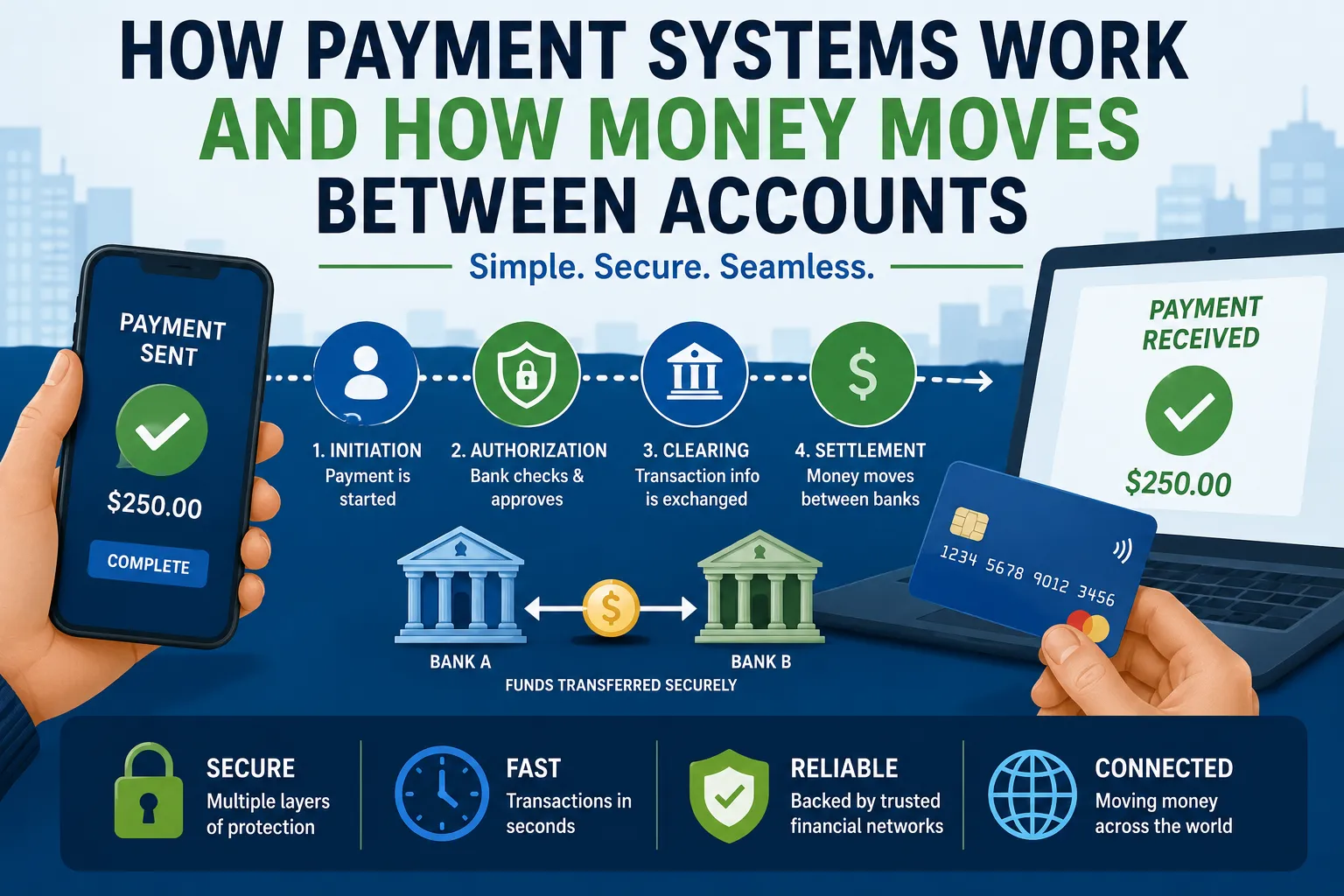
Initiation → Authorization → Clearing → Settlement
These stages can happen extremely quickly, but they are not necessarily the same thing.
For example, when someone uses a debit card at a store, the payment may be authorized within seconds. However, the final movement and settlement of funds between financial institutions can occur later.
This distinction is one of the most important concepts in understanding modern payment systems.
What Happens When You Pay With a Debit Card?
Imagine buying groceries with a debit card.
You insert, tap or swipe the card at the merchant’s payment terminal.
The terminal sends information about the transaction through the payment network.
The transaction generally involves several parties, including:
- The customer
- The merchant
- The merchant’s acquiring bank or payment provider
- The card network
- The customer’s issuing bank
The issuing bank is the financial institution that provided the customer’s card.
The acquiring institution handles card payments on behalf of the merchant.
The card network provides the infrastructure and rules that allow the institutions to communicate.
For a broader explanation of how checking accounts support everyday transactions, see this complete guide to checking accounts and everyday banking.
Step One: The Payment Is Initiated
The process begins when the customer presents the card or otherwise authorizes the payment.
The terminal captures information necessary to process the transaction.
Depending on the transaction and technology involved, this can include card credentials, transaction amount and authentication information.
The terminal does not simply send money directly to the merchant.
Instead, it sends a request for authorization.
Step Two: The Bank Checks the Transaction
The authorization request eventually reaches the customer’s issuing bank.
The bank checks whether the transaction should be approved.
It may consider factors such as:
- Whether the account or card is active
- Available funds or credit
- Security checks
- Transaction limits
- Fraud indicators
- Whether the transaction appears consistent with normal activity
If the bank approves the transaction, an authorization response travels back through the network to the merchant.
The customer sees the familiar result: approved.
Authorization Is Not the Same as Settlement
This distinction often causes confusion.
When a card transaction is approved, the merchant has received confirmation that the transaction can proceed.
But the merchant may not yet have received the money in its bank account.
The payment has effectively been authorized, but the final financial settlement can happen later.
This is why a card purchase can appear as a pending transaction before it becomes fully posted.
What Is Clearing?
Clearing is the process of exchanging and reconciling transaction information between financial institutions.
Payment systems need to determine how much each participating institution owes another.
Imagine Bank A’s customers make payments to merchants whose accounts are held at Bank B.
Bank A may owe Bank B money after thousands of transactions are processed.
At the same time, Bank B’s customers may be making purchases from merchants whose accounts are held at Bank A.
Rather than physically moving money for every individual transaction, payment systems can calculate the amounts owed between institutions.
This is known as netting.
What Is Settlement?
Settlement is the point at which financial obligations between participating institutions are actually discharged.
If Bank A owes Bank B $10 million after transactions are cleared, settlement is when the relevant funds are transferred to satisfy that obligation.
Settlement can occur through accounts that financial institutions maintain with a central bank or through other settlement arrangements.
This is one reason financial systems can process enormous numbers of transactions without physically transferring cash for every purchase.
Why Money Does Not Usually Move Like Cash
When someone transfers $500 electronically, there is generally no physical bundle of $500 traveling from one bank to another.
Instead, financial institutions update records.
One account balance decreases, another increases, and the participating institutions’ records are adjusted through the appropriate payment and settlement systems.
Modern money is therefore heavily dependent on accounting records.
The numbers displayed in a bank account represent claims and balances recorded within the financial system.
How Bank-to-Bank Transfers Work
Bank transfers can use several different payment rails.
The exact process depends on the country and the type of transfer.
Some systems are designed for large-value transactions between financial institutions. Others are designed for routine consumer payments.
A simplified bank transfer might look like this:
Customer → Sending Bank → Payment System → Receiving Bank → Recipient
The sending bank receives instructions from the customer.
The payment system carries or processes the payment information.
The receiving bank identifies the recipient and credits the appropriate account.
The underlying settlement process ensures that the participating institutions’ obligations are ultimately resolved.
The customer-facing side of these transfers is increasingly handled through online and mobile banking, where instructions can be submitted without visiting a branch. A deeper explanation is available in this guide to how digital banking and online banking work.
Why Some Transfers Take Longer Than Others
Not all payment systems operate continuously.
Some process transactions in batches.
Others provide near-real-time or real-time settlement.
A transfer can therefore take longer because of:
- Processing schedules
- Weekends and public holidays
- Fraud checks
- Compliance requirements
- Cut-off times
- Differences between payment networks
- International time zones
- Currency conversion
- Bank-specific processing procedures
An instant-looking transaction and a traditional bank transfer may therefore use completely different infrastructure.
Real-Time Payment Systems
Real-time payment systems are designed to move payment instructions and funds much faster than traditional batch-based systems.
Depending on the system, recipients can receive money within seconds or minutes.
Countries around the world have developed or expanded instant payment infrastructure.
These systems can make person-to-person payments, business transactions and other transfers significantly faster.
However, “instant” refers to the speed of the payment process under the relevant system. It does not necessarily mean every transaction can always be reversed or recovered immediately.
The Role of Central Banks
Central banks play an important role in many payment systems.
Among other responsibilities, central banks can provide settlement infrastructure and accounts used by financial institutions.
In the United States, for example, the Federal Reserve operates payment services and provides infrastructure supporting certain forms of interbank settlement.
Central banks can also issue the base money used by commercial banks to settle certain obligations.
This provides an important foundation for the broader financial system.
Commercial Banks Create Most Everyday Deposit Money
Most people think of money as something physically issued by a central bank.
But the money appearing in an ordinary bank account is generally a bank deposit.
Commercial banks maintain records showing how much customers have deposited or otherwise hold in their accounts.
These deposits can be used to make payments.
When a customer pays another person at a different bank, the banking system has to reconcile the resulting obligations between the two institutions.
This is one reason payment infrastructure is so important to the financial system.
How Credit Card Payments Differ
Credit card payments work differently from debit card transactions because the customer’s purchase is generally made using a line of credit.
The basic participants are similar:
- Cardholder
- Merchant
- Issuing bank
- Acquiring bank
- Card network
- Payment processor
When a credit card transaction is approved, the issuer authorizes the purchase against the customer’s available credit.
The customer’s bank account does not necessarily lose money immediately.
Instead, the transaction becomes part of the customer’s credit card balance.
Later, the customer pays the credit card issuer.
What Is a Payment Processor?
A payment processor helps transmit and process payment information between merchants, banks and payment networks.
Businesses can work with payment processors directly or through payment service providers that combine several functions.
The processor may help handle:
- Transaction routing
- Authorization messages
- Security checks
- Transaction data
- Settlement processes
- Reporting
For online businesses, payment processors are particularly important because they connect a merchant’s website or application to the broader financial system.
The Role of Card Networks
Card networks provide the infrastructure and rules that allow card transactions to work across different financial institutions.
When a customer uses a card issued by one institution at a merchant served by another, the network helps connect the transaction participants.
This is why someone can generally use a card at a merchant without the merchant and customer’s banks being the same institution.
The network acts as an important communication and transaction-routing layer.
What Is an Acquiring Bank?
The acquiring bank, sometimes called the acquirer, provides services to merchants that allow them to accept card payments.
It receives transaction information from the merchant and works with the relevant payment networks and issuing institutions.
The merchant ultimately receives funds through its acquiring relationship, subject to processing arrangements and fees.
What Is an Issuing Bank?
The issuing bank provides the customer’s payment card or account.
When a transaction occurs, the issuer may authorize or decline it based on available funds, available credit, security checks and other factors.
For debit cards, the issuer generally maintains the customer’s underlying deposit account.
For credit cards, the issuer provides the credit facility associated with the card.
Why Merchants Do Not Receive the Entire Purchase Price
A card payment can involve several fees.
Depending on the transaction, these can include fees associated with the payment processor, acquiring institution and card network.
There can also be an interchange fee, which is generally paid by the merchant’s acquiring side to the card issuer as part of the card payment ecosystem.
The exact fee structure varies by payment method, country, card type and commercial arrangement.
This is why a merchant’s gross sales and the amount ultimately deposited into its account may differ.
Businesses and consumers can also encounter a variety of account-related charges. For more context, see this guide to banking fees and how to avoid them.
How Direct Deposits Work
Payroll is another common example of a payment system.
An employer instructs its financial institution to send employees’ wages through an appropriate electronic payment network.
The payment instructions identify the recipient’s financial institution and account.
The receiving bank processes the incoming payment and credits the employee’s account.
The employee does not need to receive physical cash.
The financial system records the transaction electronically.
How Automatic Bill Payments Work
Recurring payments use similar infrastructure.
A customer authorizes a utility company, lender, subscription service or other business to collect payments according to an agreed arrangement.
On the scheduled date, the payment instruction is submitted through the relevant payment system.
The customer’s financial institution processes the transaction, subject to authorization, available funds and applicable rules.
The recipient’s institution then receives the payment through the payment network and settlement process.
Why a Payment Can Be Reversed
Not every payment is final immediately.
A transaction may be reversed, refunded, canceled or disputed depending on the payment method and circumstances.
For example, a merchant can issue a refund after a purchase.
A cardholder may dispute an unauthorized transaction.
A bank may reject a payment before completion.
Some payment systems also provide mechanisms for correcting processing errors.
The ability to reverse a transaction depends heavily on the payment rail and the stage the transaction has reached.
Pending Transactions Explained
A pending transaction generally means that a payment has been authorized or initiated but has not yet been fully posted or settled.
For card payments, a merchant may place an authorization hold before completing the final transaction.
This can temporarily reduce the customer’s available balance or available credit.
The final amount can sometimes differ from the initial authorization.
This can happen with transactions where the final amount is not known immediately, such as certain hospitality or transportation payments.
Why Available Balance and Account Balance Can Differ
A bank account may display multiple concepts of balance.
The current or ledger balance represents transactions recorded according to the bank’s accounting system.
The available balance reflects how much money can generally be used at that moment after considering applicable holds, pending transactions and other restrictions.
These figures can differ.
Understanding the difference can help explain why someone appears to have money in an account but cannot necessarily spend all of it immediately.
How Online Payments Work
Online payments introduce additional layers because there is no physical card terminal involved.
A typical online purchase may involve:
Customer → Website or App → Payment Gateway → Processor → Card Network → Issuing Bank
The customer enters payment information or uses a stored payment credential.
The merchant’s system sends the transaction information to its payment provider.
The transaction is routed through the appropriate network to the issuing institution.
The issuer approves or declines the payment.
The result travels back to the merchant.
If approved, the transaction eventually proceeds through clearing and settlement.
What Is a Payment Gateway?
A payment gateway acts as an interface between a merchant’s online checkout system and payment processing infrastructure.
It helps securely transmit transaction information for authorization and processing.
For consumers, the gateway may be invisible.
For businesses, it is a critical part of the infrastructure that allows an online store to accept payments.
Mobile Wallets Add Another Layer
Mobile wallets can simplify payments without eliminating the underlying payment infrastructure.
A smartphone may store a tokenized representation of a payment card rather than exposing the actual card number to every merchant.
When the customer pays, the device and payment network use the appropriate credentials and authentication mechanisms to process the transaction.
The customer experiences a simple tap.
Behind the scenes, multiple systems are still communicating.
What Is Tokenization?
Tokenization replaces sensitive payment information with a substitute value known as a token.
The token can be used within a particular payment environment without exposing the underlying payment credentials in the same way.
This can reduce the exposure of sensitive payment information.
Tokenization is widely used in modern digital payment environments, including mobile wallets and online transactions.
Security Checks Happen Throughout the Process
Payment systems need to balance speed with security.
Banks and payment providers may use systems designed to detect unusual transactions.
Security measures can include:
- Multi-factor authentication
- Device verification
- Transaction monitoring
- Encryption
- Tokenization
- Spending limits
- Fraud detection models
- One-time security codes
A payment that appears simple to the customer can therefore trigger multiple automated checks in a fraction of a second.
Why Payments Sometimes Get Declined
A declined payment does not necessarily mean that the customer has no money.
Possible reasons include:
- Insufficient available funds
- Exceeded credit limit
- Incorrect payment information
- Suspicious transaction activity
- Expired card
- Merchant restrictions
- Network problems
- Bank security controls
- Account restrictions
The exact reason may only be visible to the financial institution or payment provider.
International Payments Are More Complicated
Sending money across borders introduces additional considerations.
An international payment may involve:
- Multiple financial institutions
- Correspondent banks
- Currency conversion
- Foreign exchange rates
- Regulatory checks
- International payment networks
- Additional fees
- Different settlement systems
A domestic transfer may require only a few participants, while an international payment can pass through several institutions before reaching the recipient.
What Are Correspondent Banks?
Correspondent banks provide services that allow financial institutions to conduct transactions in countries or currencies where they do not have a direct presence.
For example, a bank in one country may use a relationship with another bank to facilitate payments in a foreign currency.
This network of banking relationships has historically been an important part of international finance.
Why International Transfers Can Be Expensive
International payments can involve more participants and more processing steps.
Currency conversion can also add a cost.
The sender may therefore encounter:
- Transfer fees
- Currency conversion spreads
- Intermediary bank charges
- Receiving bank fees
The amount received by the recipient can consequently be lower than the amount originally sent.
The Importance of Payment Finality
Payment systems need clear rules about when a transaction becomes final.
Finality means that the transfer is considered complete and the relevant obligations have been discharged according to the rules of that system.
This matters particularly for large financial transactions.
A system that allows uncertainty about whether payments are final could create significant risks for banks and businesses.
What Happens When a Bank Is Closed for the Day?
Not every payment system stops operating when a bank branch closes.
Many electronic systems operate outside traditional branch hours.
However, some payment processes still depend on business-day schedules, processing windows or settlement cycles.
This is why a transfer submitted on a weekend can behave differently from one submitted during a weekday.
The distinction between bank branch hours and payment-system operating hours is important.
Payment Systems Are Built on Trust
At a fundamental level, payment systems depend on trust.
A merchant accepts a customer’s payment because it expects the financial system to honor the transaction.
A bank credits a recipient because it expects the corresponding settlement process to work.
Customers trust that their balances accurately represent their financial claims.
Rules, regulations, security controls and settlement mechanisms all help support this trust.
Why Payment Systems Matter to the Economy
Efficient payment systems are essential to economic activity.
Businesses need them to collect revenue and pay suppliers.
Employees need them to receive wages.
Governments use them to collect taxes and distribute payments.
Consumers rely on them to purchase goods and services.
Financial institutions use them to move enormous amounts of money between accounts every day.
When payment systems work efficiently, most people barely notice them.
When they fail, their importance becomes immediately obvious.
The Future of Payments
Payment technology continues to evolve.
Real-time transfers, mobile wallets, account-to-account payments, digital identities and new forms of financial infrastructure are changing how money moves.
The basic objective remains the same: allow value to move securely and reliably between parties.
The biggest changes are happening behind increasingly simple interfaces.
A customer may only see a phone screen that says “Payment successful.”
Behind that message, however, a sophisticated network may have authenticated the transaction, checked for fraud, routed instructions between institutions, recorded the transaction and prepared the necessary settlement.
Understanding the Invisible Infrastructure
The next time money moves from one account to another, it is worth remembering that the process is much more than a number changing on a screen.
Payment systems connect customers, merchants, banks, processors, networks and settlement institutions.
Authorization determines whether a payment can proceed. Clearing determines what participating institutions owe one another. Settlement ultimately discharges those obligations.
Once these distinctions are understood, everyday transactions become easier to explain. A card tap, direct deposit or bank transfer may take only seconds from a customer’s perspective, but each relies on an extensive financial infrastructure designed to make electronic money movement reliable, secure and increasingly fast.