U.S. Retail Sales Fell in July: What the Spending Drop Means for Household Budgets
A weaker-than-expected July retail sales report is giving economists, businesses and households another reason to pay close attention to consumer spending.
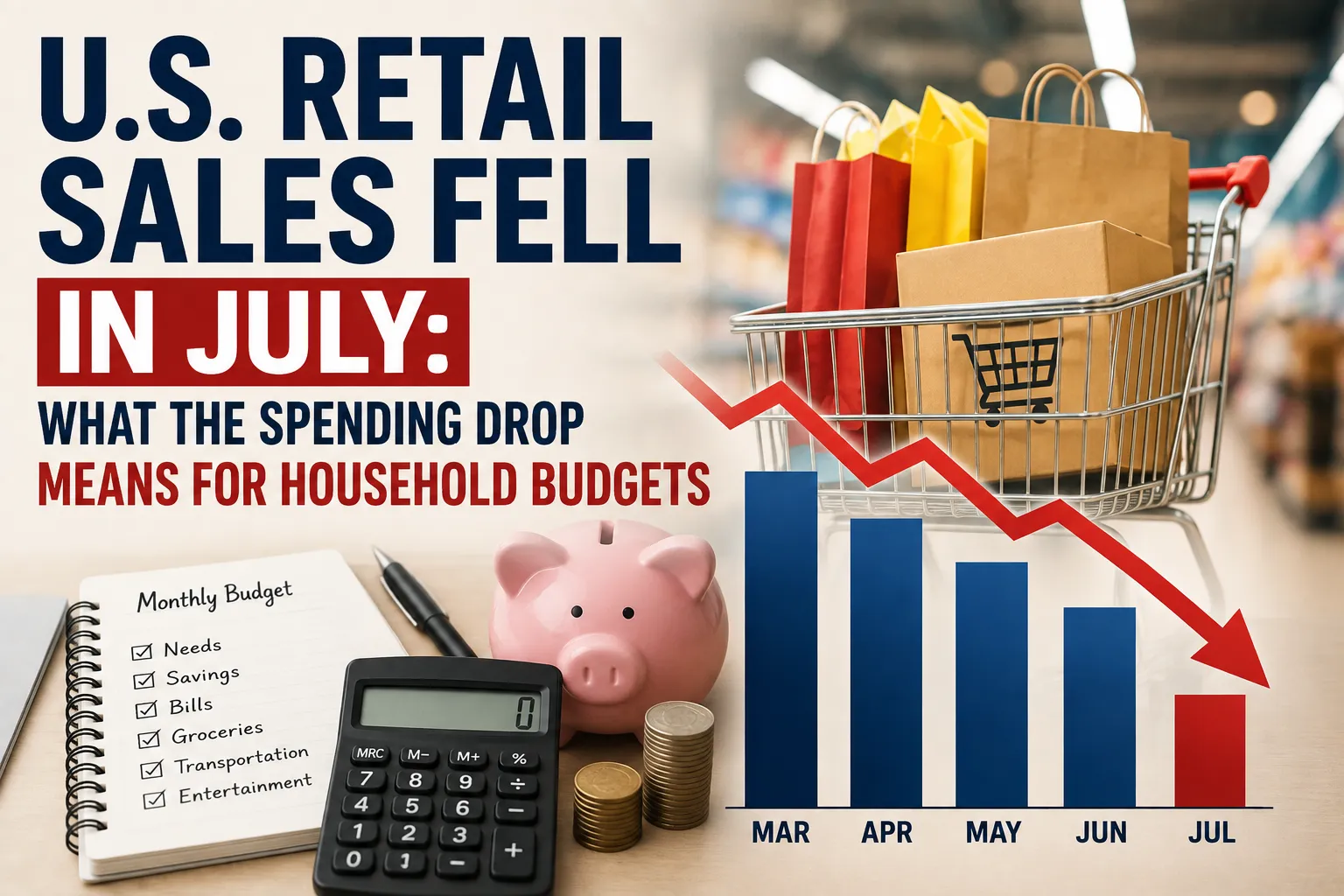
U.S. retail and food-service sales fell 0.6% in July from June, according to the Census Bureau’s advance estimate. It was the first monthly decline in nine months, although sales were still 5.0% higher than in July 2025. The three-month period from May through July was also 6.3% above the same period a year earlier.
The figures do not necessarily mean American households have suddenly stopped spending. Several temporary factors affected July’s results, including lower gasoline prices and Amazon moving its Prime Day event from July into June. But the decline comes at a time when households are still dealing with elevated prices and borrowing costs, making the report an important signal for family budgets.
For consumers, the biggest question is not simply whether retail sales went down. It is what the numbers say about household purchasing power and how families should manage their money if spending becomes more cautious.
What Happened to U.S. Retail Sales in July?
The Census Bureau estimated total U.S. retail and food-service sales at $763.6 billion in July, seasonally adjusted.
That represented:
- A 0.6% decline from June
- A 5.0% increase from July 2025
- A 6.3% increase for May-July compared with the same period a year earlier
The figures are adjusted for seasonal and calendar effects but not for price changes. That distinction matters because a higher dollar value of sales does not necessarily mean households purchased more goods in real terms.
Core retail sales, which exclude some volatile categories and are used as an input into estimates of consumer spending in gross domestic product, also declined in July. The weakness prompted economists to reduce some third-quarter growth forecasts.
So while the headline decline is notable, it needs to be viewed alongside inflation, income growth, employment and household debt.
For a broader explanation of how individual economic releases fit together, see the Complete Guide to Economic Indicators.
Why Did Retail Sales Fall?
Several factors contributed to July’s decline.
Lower Gasoline Prices
Gasoline stations recorded weaker sales partly because fuel prices were lower.
That can make the retail-sales number look weaker even when households are not necessarily cutting back on other purchases. A family spending less at the gas station has more money available for other expenses, but the lower fuel bill still counts as a decline in retail sales.
Amazon Prime Day Moved Earlier
Amazon’s major shopping event took place in June rather than July this year.
That shifted some spending from July into the previous month and created an unusually difficult comparison for July retailers. The timing of major shopping events can therefore make individual monthly readings more volatile.
Tax-Refund Effects Faded
Earlier in the year, larger tax refunds had provided some additional spending power for households.
As that effect diminished, some of the momentum behind consumer purchases also faded.
Households Remain Price-Conscious
The broader economic environment is also important.
July consumer prices were 3.4% higher than a year earlier, while core prices, excluding food and energy, increased 0.2% during July.
That means families are still making purchasing decisions in an environment where many everyday expenses cost more than they did a year ago. The relationship between prices, purchasing power and household decisions is explored further in How Inflation Affects Everyday Finances.
A Retail Sales Decline Does Not Mean Americans Stopped Spending
The headline can sound more dramatic than the underlying situation.
Retail sales were down month over month, but they remained substantially higher than a year earlier.
That distinction matters.
A household that spends $500 less on retail purchases in July than in June may not necessarily be experiencing financial distress. It could have:
- Bought a major appliance in June
- Purchased fewer clothes
- Spent less on gasoline
- Shifted a large online purchase into June
- Delayed a discretionary purchase
- Spent more money on services rather than merchandise
Retail sales also do not capture every category of household consumption.
Services such as housing, healthcare, education and many financial services are not represented in the same way as traditional retail purchases.
For household budgeting, the more useful question is therefore whether total income is keeping pace with essential expenses.
What the Numbers Mean for Household Budgets
For families, weaker retail sales could actually have a positive interpretation.
If households are becoming more selective about discretionary purchases, they may be creating more room in their budgets for savings and debt repayment.
That can be especially valuable when interest rates remain relatively high.
A family that decides to postpone a new television, furniture purchase or expensive vacation may be able to redirect that money toward:
- Emergency savings
- Credit-card debt
- Mortgage payments
- Retirement accounts
- Insurance premiums
- Necessary home repairs
A reduction in unnecessary spending is not automatically a sign of financial weakness.
Sometimes it is simply better budgeting.
The Difference Between Cutting Spending and Cutting Waste
There is an important distinction between spending less because you cannot afford necessities and spending less because you are becoming more intentional.
The first can indicate financial pressure.
The second can strengthen household finances.
Families should therefore avoid reacting to the retail-sales headline by making arbitrary spending cuts.
Instead, examine where money is going.
A useful budget divides expenses into three broad categories:
Essential Expenses
These include:
- Housing
- Food
- Utilities
- Transportation
- Insurance
- Healthcare
- Minimum debt payments
Financial Priorities
These include:
- Emergency savings
- Retirement contributions
- Additional debt repayment
- Education savings
- Other long-term goals
Discretionary Spending
This can include:
- Entertainment
- Dining out
- Clothing beyond necessities
- Hobbies
- Travel
- Electronics
- Subscription services
When household finances are under pressure, discretionary spending is generally the easiest place to make temporary adjustments.
Should Households Become More Conservative With Money?
The July retail figures alone do not mean every household needs to enter financial lockdown.
However, they provide another reason to review spending habits.
The broader economic picture remains mixed. U.S. inflation is still above the Federal Reserve’s long-run 2% target, while recent economic data have raised questions about the strength of consumer demand. The interaction between economic data and financial markets is also important, as explained in How Employment Data Influences Financial Markets.
For households, uncertainty makes flexibility valuable.
That means maintaining enough cash reserves to deal with unexpected expenses can be more important than maximizing discretionary consumption.
Build a Budget Around Real Spending
A budget based on estimates can look good on paper while failing in real life.
Instead, households can examine several months of actual transactions.
Look for:
- Recurring bills
- Food spending
- Transportation
- Online purchases
- Subscriptions
- Dining expenses
- Insurance
- Debt payments
- Impulse purchases
Then compare the actual figures with the planned budget.
This can reveal where spending has gradually increased without being noticed.
Watch for Small Recurring Expenses
A household does not necessarily need one enormous unnecessary expense to experience budget pressure.
Several smaller recurring expenses can add up.
For example:
- Multiple streaming services
- Frequent food delivery
- App subscriptions
- Convenience purchases
- Unused memberships
- Repeated online shopping
Eliminating or reducing a handful of low-value expenses can create meaningful savings without dramatically changing someone’s lifestyle.
Protect an Emergency Fund
When economic conditions become uncertain, cash savings provide flexibility.
An emergency fund can help cover unexpected expenses such as:
- Car repairs
- Medical bills
- Home repairs
- Temporary income interruptions
- Essential travel
- Unexpected family expenses
Without savings, households may need to rely on credit cards or other expensive forms of borrowing.
That can make a temporary financial problem significantly more difficult.
The appropriate emergency-fund target varies according to income stability, household size and expenses, but building the reserve gradually is often more realistic than waiting until a large amount can be saved at once.
Pay Attention to High-Interest Debt
Households carrying expensive credit-card balances have another reason to review their budgets carefully.
When interest rates are high, carrying a balance can make purchases substantially more expensive over time.
Suppose someone purchases $1,000 of goods but carries the balance instead of paying it off. The eventual cost can be considerably higher once interest and fees are included.
That means a household may be better off directing some discretionary spending toward high-interest debt rather than making additional purchases.
Avoid Replacing One Problem With Another
Cutting spending while continuing to accumulate expensive debt does not solve the underlying problem.
A stronger strategy is to look at both sides of the household budget:
Reduce unnecessary spending + reduce costly debt + increase savings where possible.
That combination can improve financial resilience.
What Lower Retail Sales Could Mean for Prices
Weaker consumer demand can eventually influence how businesses price products.
If retailers have too much inventory and fewer customers are willing to buy, they may respond with:
- Discounts
- Promotions
- Sales events
- Clearance pricing
- More attractive financing offers
That could create opportunities for consumers.
However, households should not assume every future discount will make waiting worthwhile.
If something is genuinely needed, compare current prices, expected lifespan and financing costs rather than attempting to predict the perfect time to buy.
Big Purchases Deserve Extra Planning
When household budgets are uncertain, major purchases should be evaluated differently from everyday spending.
Before buying a car, appliance, furniture or other expensive item, ask:
- Is it necessary?
- Can the purchase wait?
- Can I pay for it without creating expensive debt?
- Have I compared prices?
- What will maintenance cost?
- Is there a cheaper alternative?
- Will the purchase interfere with savings goals?
A lower monthly payment can be misleading if it comes with a much longer repayment period.
Focus on the total cost, not simply the monthly figure.
What Retail Sales Tell Us About the Economy
Consumer spending is an important part of the U.S. economy.
When households spend confidently, businesses have greater incentive to hire, invest and expand.
When consumers become cautious, businesses may respond by:
- Reducing inventory
- Cutting costs
- Delaying expansion
- Offering promotions
- Adjusting hiring plans
That is why economists and investors pay close attention to retail sales.
The July decline is one piece of a broader economic picture. Investors and economists generally need to compare consumer spending with employment, inflation, income and other indicators before drawing larger conclusions about economic momentum.
Why Lower Spending Could Eventually Help Inflation
There is an interesting relationship between consumer demand and inflation.
If households continue spending rapidly while businesses struggle to keep up with demand, prices can remain under pressure.
If demand slows, businesses may have less ability to raise prices.
That does not mean consumers should deliberately stop spending.
It means a gradual normalization of demand can potentially reduce some price pressures.
July’s CPI report showed annual headline inflation at 3.4%, while the monthly all-items index rose 0.1% on a seasonally adjusted basis.
For households, slower price growth would eventually make budgeting easier—but only if incomes and employment remain sufficiently strong.
Don’t Confuse Lower Retail Sales With a Recession
One weak monthly report cannot establish that the economy is entering a recession.
Retail sales can fluctuate because of:
- Weather
- Holidays
- Promotions
- Gasoline prices
- Tax refunds
- Shopping-event timing
- Automobile purchases
- Seasonal patterns
That is why economists examine several months of data and compare retail sales with employment, income, industrial activity, business investment and other indicators.
The July number is important because it represents the first monthly decline in nine months, but it is not sufficient by itself to define the direction of the entire economy.
How Households Can Respond Without Overreacting
A sensible response to uncertain economic conditions does not have to involve dramatic lifestyle changes.
Instead, households can:
1. Review the Last Three Months
Look at actual bank and credit-card transactions.
2. Identify Flexible Spending
Find categories that can be reduced temporarily if necessary.
3. Protect Essential Bills
Make sure housing, utilities, insurance, food and transportation remain adequately funded.
4. Strengthen Cash Reserves
Direct some available money toward emergency savings.
5. Prioritize Expensive Debt
Paying down high-interest debt can provide a guaranteed financial benefit through reduced interest costs.
6. Delay Low-Priority Purchases
If an expensive purchase is not necessary, consider waiting until the household budget is stronger.
7. Compare Prices Before Buying
Lower demand may create more promotions, so shopping around can become particularly valuable.
The Bigger Picture for Savers
For savers, cautious consumer spending can have an unexpected benefit.
When households stop treating every available dollar as spending money, they create an opportunity to build financial assets.
Even modest monthly savings can compound over time.
For example, redirecting money that previously went toward unnecessary purchases into an emergency fund can eventually create a financial cushion that reduces reliance on credit.
The goal should not be to eliminate enjoyment from the household budget.
It is to make sure discretionary spending does not consistently undermine longer-term financial security.
A Spending Slowdown Can Be a Budgeting Signal, Not a Crisis
The July retail-sales decline deserves attention, but it should not be interpreted in isolation. U.S. retail sales fell 0.6% from June while remaining 5.0% above a year earlier, and several temporary factors—including lower gasoline prices and the earlier timing of Amazon’s Prime Day—help explain the monthly weakness.
For households, the more useful lesson is that the economic environment remains one where careful spending decisions matter. Inflation is still elevated relative to the Federal Reserve’s long-term goal, borrowing can remain expensive, and consumer demand is showing signs of becoming more selective.
That makes this a good time to distinguish needs from wants, spending from waste, and short-term consumption from long-term financial progress.
A household does not need to predict the next recession or perfectly time the economy to improve its finances. Building savings, controlling unnecessary expenses, managing high-interest debt and planning major purchases carefully can provide protection whether consumer spending accelerates again or continues to cool.