Weekly Jobless Claims Could Offer Fresh Clues About Household Financial Security
For millions of households, financial security begins with something deceptively simple: a steady paycheck.
That makes weekly jobless claims an important economic indicator even though the numbers can seem far removed from everyday budgeting. When fewer people file for unemployment benefits, it can signal that layoffs remain contained. When claims begin rising persistently, the trend can point to increasing pressure in the labor market—and potentially greater financial stress for households.
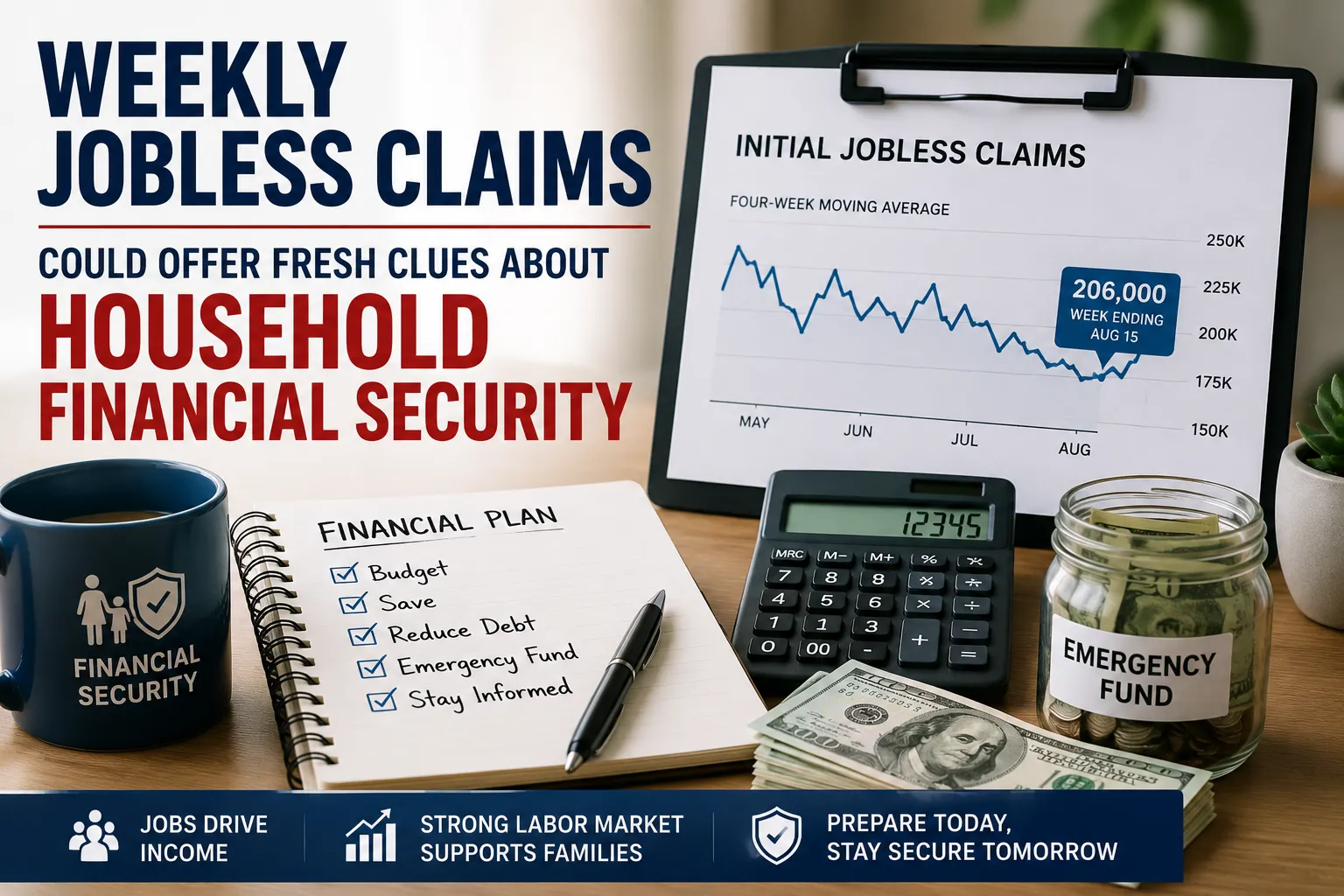
The latest data have so far pointed to a labor market that remains relatively stable, although hiring has been less vigorous. The U.S. Department of Labor reported that initial unemployment claims fell to 206,000 for the week ending August 15, down from a revised 212,000 the previous week. The four-week moving average rose to 204,000.
A new weekly report covering the period ending August 22 is scheduled for release on August 27, making the next reading another closely watched piece of evidence about the direction of employment and what it could mean for household finances.
Why Jobless Claims Matter to Household Finances
Employment is one of the most important sources of income for most households.
When someone loses a job, the financial consequences can extend well beyond the missing paycheck. Savings may be used to cover rent or mortgage payments, groceries, utilities, transportation and debt obligations.
A prolonged period of unemployment can also make it harder to keep up with retirement contributions, emergency savings and other long-term financial goals.
That is why weekly jobless claims can serve as an early indicator of changing financial conditions.
They do not measure household wealth directly. Instead, they provide information about one of the foundations of household financial stability: employment.
For a broader explanation of how employment data fits into the wider economic picture, see the Complete Guide to Economic Indicators.
What Weekly Jobless Claims Actually Measure
Initial jobless claims represent the number of people filing new claims for unemployment benefits.
The figure is released each week by the U.S. Department of Labor and is closely followed by economists, policymakers and financial markets.
The data are particularly useful because they arrive much more frequently than many major economic reports.
A monthly employment report can provide a broader picture of hiring, unemployment and wage growth, while weekly claims can offer a more immediate look at whether layoffs are increasing or declining.
But one week’s number rarely tells the whole story.
The Four-Week Average Can Provide a Clearer Picture
Weekly claims can be volatile.
Holidays, seasonal patterns, weather events, temporary layoffs and administrative changes can cause the number to move unexpectedly from one week to another.
That is why economists often look at the four-week moving average.
In the latest available report, the four-week average was 204,000, up from a revised 199,750 the previous week.
A sustained increase in the average would generally be more significant than a single weekly jump.
Likewise, a one-week decline does not necessarily mean household financial conditions are improving.
Low Claims Suggest Layoffs Remain Relatively Limited
The recent claims figures indicate that widespread layoffs have not yet become a dominant feature of the labor market.
Claims remained within the relatively low range seen during 2026, while continuing claims were still relatively contained. At the same time, hiring had slowed even as layoffs remained low.
That combination is important.
A labor market can remain stable even when employers are becoming more cautious about adding workers.
For households, that can create a mixed picture: existing workers may retain their jobs, but people searching for new employment could find fewer opportunities.
Hiring and Layoffs Tell Different Stories
Jobless claims primarily tell us about people losing work and applying for unemployment benefits.
They do not directly measure how many new jobs are being created.
This distinction matters.
Imagine a labor market in which companies are laying off very few workers but are also barely hiring.
Jobless claims could remain low, suggesting stability, while unemployed workers might still struggle to find new positions.
That is one reason economists examine claims alongside payroll growth, unemployment, job openings, wages and other indicators.
For another perspective on how employment data can affect investors and markets, see How Employment Data Influences Financial Markets.
What Rising Claims Could Mean for Household Budgets
If jobless claims begin rising consistently, households could face several financial consequences.
The first is obvious: more people may be experiencing lost income.
But the effects can spread further.
Workers who fear layoffs may postpone large purchases. Households may reduce restaurant spending, travel and discretionary shopping. Consumers may delay buying cars or making home improvements.
People may also increase emergency savings if they become concerned about job security.
In this way, employment uncertainty can affect household spending even before unemployment rises substantially.
Emergency Savings Become More Important During Labor-Market Uncertainty
A stable labor market can make it easier for households to plan.
When employment conditions become less certain, emergency savings become especially valuable.
An emergency fund can provide a financial cushion for unexpected expenses or temporary income disruption.
For households with limited savings, even a relatively short period without a paycheck can create difficult choices.
That can lead to increased credit-card balances, missed payments or the need to borrow money.
Household Debt Can Become More Difficult to Manage
Job loss does not automatically eliminate financial obligations.
Mortgage payments, rent, car loans, student loans, insurance premiums and other recurring expenses generally continue regardless of employment status.
For households already carrying substantial debt, an unexpected income loss can therefore create significant pressure.
Even households with adequate savings may need to reconsider discretionary spending if employment conditions deteriorate.
Consumers May Become More Cautious
Employment confidence can influence consumer behavior.
Someone who feels secure about their job may be comfortable replacing an aging vehicle, upgrading a home or making a major purchase.
Someone worried about layoffs may decide to postpone those expenses.
If enough households behave this way, weaker consumer spending can eventually affect businesses.
That creates a potential feedback loop:
Employment uncertainty → cautious households → weaker spending → slower business activity → additional pressure on employment.
Such a chain is not inevitable, but it illustrates why labor-market indicators matter beyond the unemployment office.
Jobless Claims Can Also Affect Interest-Rate Expectations
Financial markets watch jobless claims closely because employment conditions can influence expectations for monetary policy.
If labor-market weakness becomes more pronounced, investors may begin expecting policymakers to place greater emphasis on supporting employment.
If employment remains resilient while inflation stays elevated, policymakers may have less reason to ease financial conditions quickly.
That makes jobless claims particularly relevant alongside inflation and interest-rate indicators. Understanding that relationship is also useful when reading Understanding Interest Rates and Their Effects.
For households, interest rates matter because they influence borrowing costs.
Borrowing Costs Affect Household Financial Security
Interest rates can affect:
- Mortgage payments
- Credit-card interest
- Auto loans
- Personal loans
- Home-equity borrowing
- Savings returns
A household facing employment uncertainty may simultaneously be dealing with expensive credit.
That combination can be particularly challenging.
Someone who loses income while carrying high-interest debt has fewer options for absorbing the shock.
Savings Rates Matter Too
Interest rates do not only affect borrowers.
Households with money in savings accounts, certificates of deposit or other interest-bearing assets can benefit from higher rates.
This means changes in monetary policy can affect different households in different ways.
A household with significant savings may receive more interest income, while another household carrying large credit-card balances may face higher financing costs.
What a Stable Claims Number Does Not Mean
It would be a mistake to interpret low jobless claims as proof that every household is financially comfortable.
Employment is only one part of household financial health.
Families can struggle because of:
- High housing costs
- Rising food prices
- Medical expenses
- Childcare costs
- Debt payments
- Low wage growth
- Insufficient savings
- Unexpected repairs
A person can have a job and still have very little financial breathing room.
Jobless claims therefore provide one piece of a much larger picture.
Why the Next Reading Could Matter
The next weekly claims report will provide another opportunity to determine whether the recent pattern is holding.
The most important question is unlikely to be whether claims rise or fall by a few thousand in a single week.
Instead, economists and investors will be watching for a sustained change.
If claims remain relatively low, it would reinforce the view that layoffs are contained.
If they begin moving noticeably higher over several weeks, it could suggest that employers are becoming less willing or able to retain workers.
The four-week average will be particularly useful in determining whether a weekly move represents a genuine shift or normal short-term volatility.
Household Budgets Should Not Depend on One Economic Indicator
For individual households, waiting for economic data to confirm that the labor market is weakening is not necessarily the best financial strategy.
People can prepare for uncertainty before it appears in the headlines.
That can include building emergency savings, reducing high-interest debt, reviewing recurring expenses and avoiding unnecessary financial commitments.
Households may also want to understand how long their current savings could cover essential expenses if their income were temporarily interrupted.
A Simple Financial Stress Test Can Help
One useful exercise is to imagine a temporary income disruption.
Ask:
How long could essential expenses be covered using available savings?
Then calculate the cost of necessities such as:
- Housing
- Food
- Utilities
- Transportation
- Insurance
- Minimum debt payments
- Essential healthcare
This provides a clearer picture than simply knowing the balance of a savings account.
A household with $5,000 saved could be in a very different position depending on whether essential monthly expenses are $2,000 or $4,500.
Don’t Ignore the Broader Employment Picture
Weekly claims become more useful when viewed alongside other labor-market indicators.
Households and investors can watch:
- Unemployment rates
- Monthly payroll growth
- Wage growth
- Job openings
- Hiring trends
- Continuing unemployment claims
- Layoff announcements
- Consumer spending
Together, these measures provide a more complete picture of whether employment conditions are strengthening, weakening or simply changing.
The Difference Between Job Security and Income Security
A worker can have a stable job but still have fragile finances.
For example, someone with little savings and significant debt may face considerable financial risk even if their employer has no plans for layoffs.
Conversely, someone with substantial savings and low fixed expenses may be better positioned to handle a temporary period of unemployment.
This distinction is important when interpreting economic news.
Job security is not the same thing as financial security.
The condition of the labor market can influence household finances, but individual financial resilience depends on savings, debt, expenses and income diversification as well.
What Households Should Watch Going Forward
The latest jobless claims figures provide some reassurance that a sharp wave of layoffs has not yet emerged. Initial claims fell to 206,000 in the latest available week, although the four-week average moved higher.
That combination suggests a labor market that remains relatively resilient but deserves close monitoring, particularly because hiring has been less robust.
For households, the most important signal will not come from one Thursday morning release.
It will come from the direction of the data over time.
If jobless claims remain contained, household income prospects could continue to benefit from a relatively stable employment environment. If claims begin rising persistently, the numbers could become an early warning that more families may need to tighten budgets, strengthen emergency savings and prepare for greater income uncertainty.
In an economy where a paycheck remains the foundation of most household budgets, the weekly unemployment report can provide an unusually timely glimpse into how secure that foundation really is.