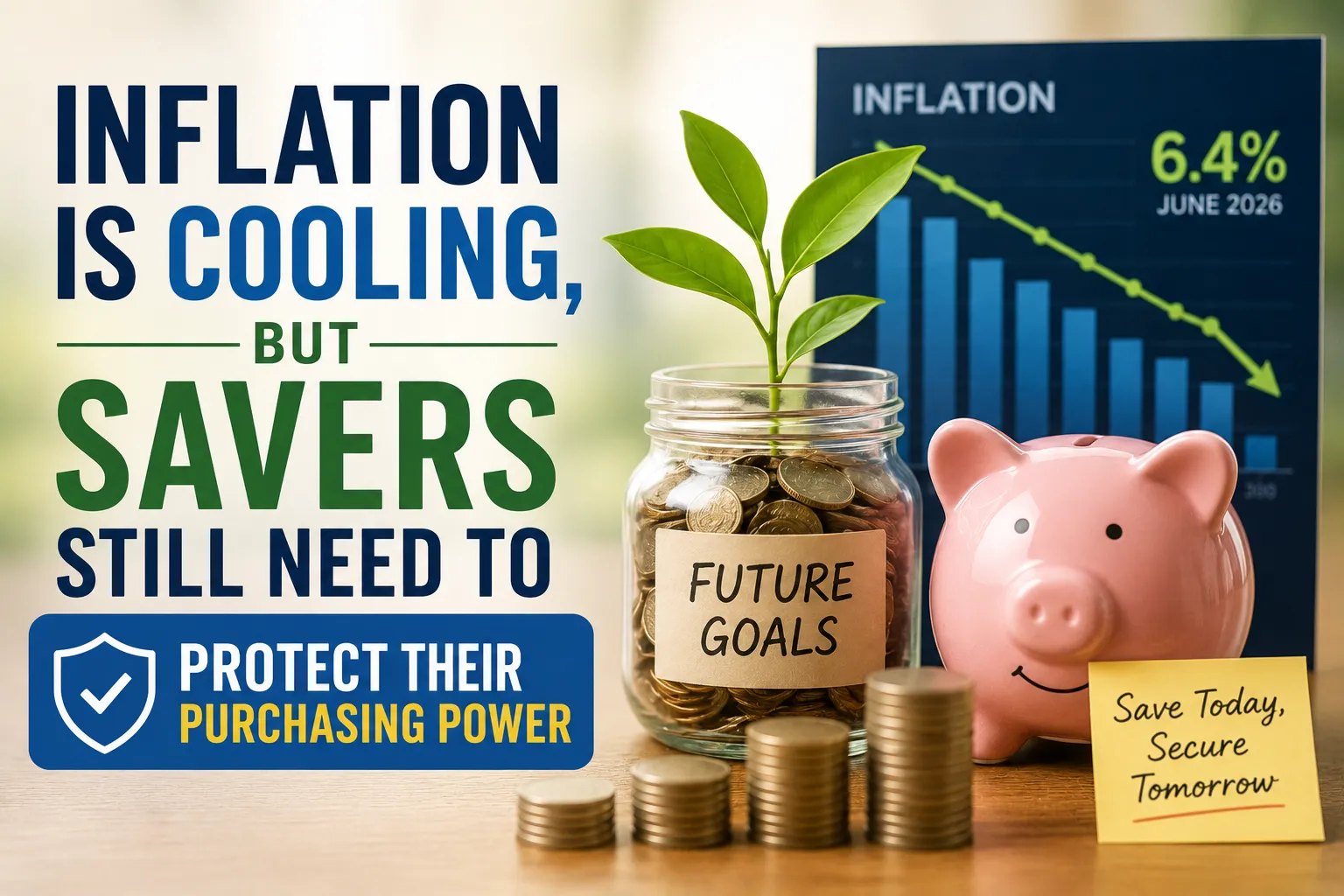
Inflation Is Cooling, but Savers Still Need to Protect Their Purchasing Power
Inflation may be easing, but that doesn’t mean the cost-of-living problem has disappeared.
For savers, this distinction matters. When inflation slows, prices are generally rising more slowly than before—but they are still rising. A basket of goods that cost KSh 10,000 last year can still cost more today even if the inflation rate has fallen.
That means keeping money in a savings account isn’t simply about watching the balance increase. Savers also need to consider whether their money is gaining value faster than prices are rising.
In Kenya, official data illustrates the point. The Kenya National Bureau of Statistics reported annual consumer price inflation of 6.4% in June 2026, down from 6.7% in May. However, prices were still 6.4% higher than a year earlier, with food and non-alcoholic beverages, transport, and housing-related costs among the major contributors.
For households trying to build emergency funds, save for school fees, prepare for retirement, or simply maintain financial security, the question is no longer just “How much am I saving?”
It is also:
“Will these savings still buy what I expect them to buy in the future?”
What Inflation Really Means for Your Savings
Inflation measures the rate at which the prices of goods and services increase over time.
If inflation is 6%, it does not mean every item in your shopping basket becomes exactly 6% more expensive. Some prices may rise much faster, others more slowly, and some may even fall.
The published inflation rate is a broad measure of changing prices across a basket of goods and services.
For individual households, the experience can be different.
A family spending heavily on food and transport may experience a different effective increase in living costs from someone who spends more on housing, education, entertainment, or other categories.
This is why headline inflation is useful, but it shouldn’t be the only number you consider when planning your finances.
For a broader explanation of how inflation, employment, interest rates, and other measures fit together, see the complete guide to economic indicators.
Falling Inflation Doesn’t Mean Falling Prices
This is one of the most important concepts for savers to understand.
Suppose the price of a product increases from KSh 1,000 to KSh 1,100.
The following year, the price rises to KSh 1,155.
The inflation rate has fallen from the first year’s 10% increase to a 5% increase, but the product hasn’t become cheaper.
Its price has continued rising.
This is the difference between disinflation and deflation.
Disinflation
Prices continue to rise, but at a slower rate.
Deflation
The general price level falls.
When people hear that inflation is “cooling,” they sometimes interpret it as prices returning to where they were before.
Usually, that isn’t what it means.
For savers, understanding this distinction helps explain why purchasing-power protection remains important even when inflation is moving in the right direction.
The Difference Between Your Savings Balance and Its Real Value
Imagine you put KSh 100,000 into an account.
After a year, your balance has increased to KSh 106,000.
At first glance, that looks like a successful year. You’ve earned KSh 6,000.
But suppose inflation over the same period was 6%.
The amount of goods and services your money can purchase has barely changed.
This is why financial planning distinguishes between nominal returns and real returns.
Nominal Return
This is the return shown on your account or investment before adjusting for inflation.
Real Return
This is the return after accounting for the effect of inflation.
A simplified way to think about it is:
Real return ≈ investment return − inflation rate
For greater precision, the calculation is:
Real return = (1 + nominal return) ÷ (1 + inflation) − 1
The difference can become significant over long periods.
Why a High Savings Balance Can Still Lose Purchasing Power
The number in your account may be increasing while its purchasing power is declining.
This can happen when the interest earned is lower than inflation.
For example, the Central Bank of Kenya’s published market information showed an average savings rate of 3.23% in May 2026, while the inflation rate reported for June was 6.4%. These figures are from different reporting periods and shouldn’t be treated as a direct personal return comparison, but they illustrate why savers need to look beyond the headline account balance.
If a savings product earns substantially less than the rate at which your living costs are increasing, your money can lose purchasing power even though the bank balance continues to grow.
That doesn’t make the savings account useless.
It simply means different financial goals require different types of accounts and investments.
Savings Accounts Still Have an Important Job
Protecting purchasing power doesn’t mean moving all your money out of a savings account.
Cash has advantages that investments don’t always provide.
Savings accounts can offer:
- Easy access
- Predictability
- Low volatility
- Convenience
- A place to keep emergency funds
- Protection from short-term market fluctuations
An emergency fund, for example, isn’t primarily designed to maximize returns.
Its job is to be available when you need it.
If your car breaks down, your income is interrupted, or an unexpected household expense appears, you don’t necessarily want your emergency money invested in something whose value could fall at exactly the wrong moment.
The key is to match the savings vehicle to the purpose of the money.
Start by Separating Short-Term and Long-Term Money
One of the easiest ways to improve financial decision-making is to stop treating all savings as the same.
Money you need next month has a different job from money you won’t touch for 15 years.
Short-Term Money
This could include:
- Rent
- School expenses
- Emergency funds
- Medical expenses
- Upcoming purchases
- Annual insurance payments
- Travel plans
This money generally needs accessibility and stability.
Medium-Term Money
This might include:
- A home deposit
- Business capital
- Education expenses
- A vehicle purchase
- A major renovation
You may have more flexibility with how this money is managed, depending on the time horizon and your tolerance for risk.
Long-Term Money
This could include:
- Retirement savings
- Long-term wealth building
- Children’s future education
- Financial independence goals
With a longer time horizon, investors may have more opportunity to consider assets that can potentially outpace inflation over time.
However, higher potential returns generally come with greater risk.
Don’t Chase Returns Without Understanding Risk
When inflation is high, savers can become tempted by investments promising dramatically higher returns.
This is where caution matters.
A product offering a much higher return than ordinary savings may also involve:
- Greater price volatility
- Limited liquidity
- Credit risk
- Market risk
- Currency risk
- Business risk
- Lock-in periods
- Possibility of losing some or all of the invested capital
The goal isn’t simply to find the highest advertised percentage.
The goal is to find an appropriate balance between return, risk, liquidity, and time horizon.
If you need the money in three months, an investment designed for a 10-year horizon may be inappropriate even if its historical returns look attractive.
Build an Emergency Fund Before Taking More Investment Risk
Before worrying about maximizing long-term returns, many households should establish a basic emergency reserve.
The exact amount depends on income stability, household obligations, insurance coverage, debt, and other circumstances.
A household with highly predictable income may require a different reserve from someone whose earnings fluctuate significantly.
The emergency fund should generally be kept somewhere relatively accessible and stable.
Its purpose is not to beat inflation every year.
Its purpose is to prevent an unexpected expense from forcing you into expensive debt or the premature sale of long-term investments.
Compare Savings Products Carefully
Not all savings products work the same way.
When comparing accounts or financial products, look beyond the advertised interest rate.
Check:
- Effective annual rate
- Fees
- Minimum balance requirements
- Withdrawal restrictions
- Lock-in periods
- Compounding frequency
- Tax treatment
- Deposit protection or applicable safeguards
- Whether the rate is fixed or variable
- Conditions required to earn the advertised rate
A product with a slightly lower headline rate can sometimes be more useful if it has fewer fees or better access to your money.
Likewise, a higher rate may not be attractive if your money is locked away when you need it.
Consider Money Market and Fixed-Income Options Carefully
For savers who want alternatives to ordinary bank savings, money market and fixed-income products can sometimes provide additional options.
Depending on the jurisdiction and product, these may include:
- Money market funds
- Treasury bills
- Government bonds
- Fixed deposits
- Other regulated fixed-income instruments
These products are not interchangeable.
They have different levels of liquidity, risk, minimum investment requirements, taxation, and potential returns.
For example, a government security may have a different risk and maturity profile from a money market fund, while a fixed deposit may restrict access to funds for a specified period.
Always understand the product before committing your savings.
Think About Purchasing Power in Real Terms
A useful budgeting exercise is to translate future goals into today’s money.
Suppose you want to save for an expense that currently costs KSh 500,000.
If prices rise over time, the amount required in the future may be significantly higher.
You don’t need to predict inflation perfectly.
Instead, recognize that future expenses should generally be planned with some allowance for rising prices.
This is particularly important for long-term goals such as:
- Retirement
- Education
- Housing
- Healthcare
- Business expansion
Underestimating future costs can create a large gap between what you save and what you eventually need.
The Rule of 72 Offers a Useful Warning
A simple rule of thumb can help demonstrate how inflation compounds.
The Rule of 72 estimates how long it takes for a value to double when a constant rate applies.
Divide 72 by the inflation rate.
At 6% inflation:
72 ÷ 6 = 12 years
That suggests prices could roughly double over 12 years if inflation remained consistently at 6%.
Real-world inflation doesn’t stay constant, so this is only an illustration.
But it highlights why even seemingly moderate inflation can have a significant long-term effect.
Don’t Let Inflation Make You Abandon Your Budget
When prices rise, some people respond by abandoning their budget entirely.
That’s understandable.
If groceries, transport, utilities, and other essentials become more expensive, an old budget may stop reflecting reality.
The answer is to update the budget rather than give up on budgeting.
Review:
- Essential spending
- Discretionary spending
- Debt payments
- Savings contributions
- Insurance
- Transport
- Food
- Housing
- Subscriptions
- School and household costs
Some categories may need more money.
Others may provide opportunities for reductions.
A budget should be a living plan, not a document that becomes irrelevant after prices change.
Increase Savings When Your Income Rises
One of the most effective ways to protect long-term purchasing power is to increase the amount you save as your income grows.
If your salary increases by 8%, you don’t necessarily need to increase your lifestyle spending by the full 8%.
Directing part of the additional income toward savings or long-term investments can accelerate wealth building.
This approach can be especially powerful because it avoids relying entirely on investment returns.
You are also increasing the amount of capital working toward your future goals.
Automate Your Savings
Saving manually requires repeated decisions.
Automation reduces that friction.
If your bank or financial provider offers the functionality, you can arrange for a predetermined amount to move into a savings or investment account shortly after receiving income.
This changes saving from:
“I’ll save whatever is left.”
to:
“I’ll spend what remains after saving.”
The second approach can make it easier to maintain consistency.
Diversification Can Help Long-Term Savers
For long-term goals, diversification can reduce dependence on a single asset or economic outcome.
Depending on your circumstances, a diversified portfolio might contain different types of assets rather than relying entirely on cash.
The appropriate mix depends on:
- Time horizon
- Risk tolerance
- Financial goals
- Income stability
- Existing assets
- Liquidity requirements
- Tax considerations
Diversification doesn’t eliminate investment risk.
It simply reduces the danger of having all your money exposed to one particular investment or economic scenario.
Cash Is Not the Enemy
Inflation discussions can sometimes create the impression that holding cash is always a mistake.
That’s too simplistic.
Cash is valuable for:
- Emergencies
- Short-term spending
- Upcoming bills
- Planned purchases
- Unexpected expenses
- Financial flexibility
The problem occurs when all of your long-term wealth remains in low-return cash for many years.
A balanced financial plan can have both liquid savings and longer-term investments.
The key is giving each portion of your money a specific job.
Be Careful With “Inflation-Proof” Claims
There is no universally guaranteed investment that automatically protects everyone from inflation under every circumstance.
Be skeptical of products or schemes marketed as:
- Guaranteed inflation protection
- Risk-free high returns
- Quick wealth solutions
- Guaranteed double-digit returns
- Secret inflation-beating investments
Higher returns usually involve higher risks or trade-offs.
Before investing, understand exactly how the return is generated, what could cause you to lose money, when you can access your funds, and who regulates the provider.
Watch Your Fees
Fees can quietly undermine returns.
Suppose two investments have similar gross returns, but one charges significantly higher management or transaction fees.
Over a long period, that difference can compound.
When comparing financial products, look at the net return after applicable fees and taxes, not simply the headline return.
Small percentages can become meaningful when large balances are involved over many years.
Don’t Forget Taxes
The return advertised on a financial product may not necessarily be the amount you ultimately keep.
Depending on the product and jurisdiction, interest, dividends, capital gains, or other investment income may be subject to taxes or withholding.
That means purchasing-power analysis should ideally consider:
Net return after fees and taxes compared with inflation.
A product that appears to beat inflation before costs may not do so after all deductions.
Inflation Can Affect Debt Too
Inflation isn’t only a savings issue.
It also affects borrowers.
If you have fixed-rate debt and your income rises over time, the real burden of those fixed payments can potentially become smaller.
However, variable-rate debt can behave differently, especially when interest rates change.
High-interest consumer debt can also overwhelm the potential benefit of chasing investment returns.
For many households, paying down expensive debt may be a more reliable financial improvement than taking additional investment risk.
Keep Increasing Your Earning Power
Protecting purchasing power isn’t only about where you keep your money.
It’s also about your ability to earn money.
Skills, professional qualifications, business capabilities, and career development can potentially increase future income.
For working households, increasing earning power can be one of the strongest defenses against rising living costs.
The more room you create between income and essential expenses, the more capacity you have to save and invest.
A Practical Inflation-Protection Strategy
There is no single formula that works for everyone, but a sensible framework can look like this:
1. Know Your Essential Monthly Costs
Calculate what you actually need to maintain your household.
2. Build an Emergency Reserve
Keep an appropriate amount in a relatively accessible, stable form.
3. Eliminate Expensive Debt
Prioritize high-cost debt where appropriate.
4. Compare Savings Rates
Don’t assume your current account is competitive simply because you’ve used it for years.
5. Separate Short-Term and Long-Term Goals
Give money different jobs based on when you’ll need it.
6. Invest for Long-Term Goals
Consider appropriately diversified investments when your time horizon and risk tolerance allow it.
7. Review Your Plan Regularly
Inflation, interest rates, income, expenses, and personal circumstances change.
Your financial plan should change with them.
A Simple Example of Purchasing-Power Protection
Imagine two savers each have KSh 500,000.
Saver A keeps the entire amount in an account earning a relatively low return.
Saver B keeps an emergency reserve in accessible savings but allocates some long-term money to a diversified investment strategy appropriate for their risk tolerance and time horizon.
Neither approach is automatically right for everyone.
Saver A may have greater simplicity and liquidity but potentially weaker long-term purchasing-power protection.
Saver B accepts more investment risk in exchange for the possibility of higher long-term returns.
The important lesson is that the right strategy depends on what the money is for.
Money needed next month should not be treated the same way as money intended for retirement decades from now.
What Savers Should Watch as Inflation Cools
When inflation begins easing, savers should resist the temptation to stop paying attention.
Keep an eye on:
- Inflation trends
- Savings and deposit rates
- Government security yields
- Investment fees
- Interest-rate changes
- Household spending patterns
- Income growth
- Tax changes
- Your personal financial goals
Kenya’s central bank has also been adjusting its monetary policy stance as economic conditions evolve. In June 2026, the Central Bank of Kenya reported that the Monetary Policy Committee maintained the Central Bank Rate at 8.75%, while noting that inflation had risen to 6.7% in May before the subsequent June decline reported by KNBS.
Changes in monetary policy can eventually affect borrowing costs, deposit rates, investment yields, and other parts of the financial system.
For more context on how central-bank decisions can influence markets and financial conditions, see how monetary policy affects financial markets.
Changes in interest rates also matter directly to savers and borrowers, making understanding interest rates and their effects useful when reviewing where to keep money.
Inflation can also influence everyday household decisions, which is why how inflation affects everyday finances provides useful related context.
That makes it worthwhile to review your savings strategy periodically rather than choosing an account once and forgetting about it.
The Goal Isn’t to Beat Inflation Every Single Month
Inflation protection shouldn’t become an obsession with chasing the highest possible return.
A sound financial strategy is more nuanced.
You want enough liquidity to handle emergencies, enough stability for short-term obligations, and an appropriate long-term strategy for money you won’t need immediately.
Sometimes the best decision is to accept a lower return because you need safety and access.
At other times, leaving long-term money entirely in low-return cash may create unnecessary purchasing-power risk.
The right answer depends on the purpose of the money.
Make Your Money Work for the Life You Want
Cooling inflation is welcome news, but it doesn’t erase the effects of years of rising prices.
For savers, the bigger lesson is that a growing account balance isn’t the same thing as growing wealth.
If your money earns 3% while the cost of the things you regularly buy rises by 6%, your balance is technically increasing—but your purchasing power is moving in the opposite direction.
The solution isn’t to panic or chase risky investments.
It is to become more deliberate.
Keep emergency money accessible. Compare savings products. Control fees. Reduce expensive debt. Increase your savings rate when income allows. Invest appropriately for long-term goals. Review your strategy as economic conditions change.
Most importantly, measure financial progress not only by how many shillings you have, but by what those shillings will be able to buy when you actually need them.
This article is for general educational purposes and is not personalized financial or investment advice. Interest rates, inflation, taxes, product terms, and investment risks can change. Consider reviewing specific financial decisions with a qualified financial professional and checking current terms directly with regulated providers.