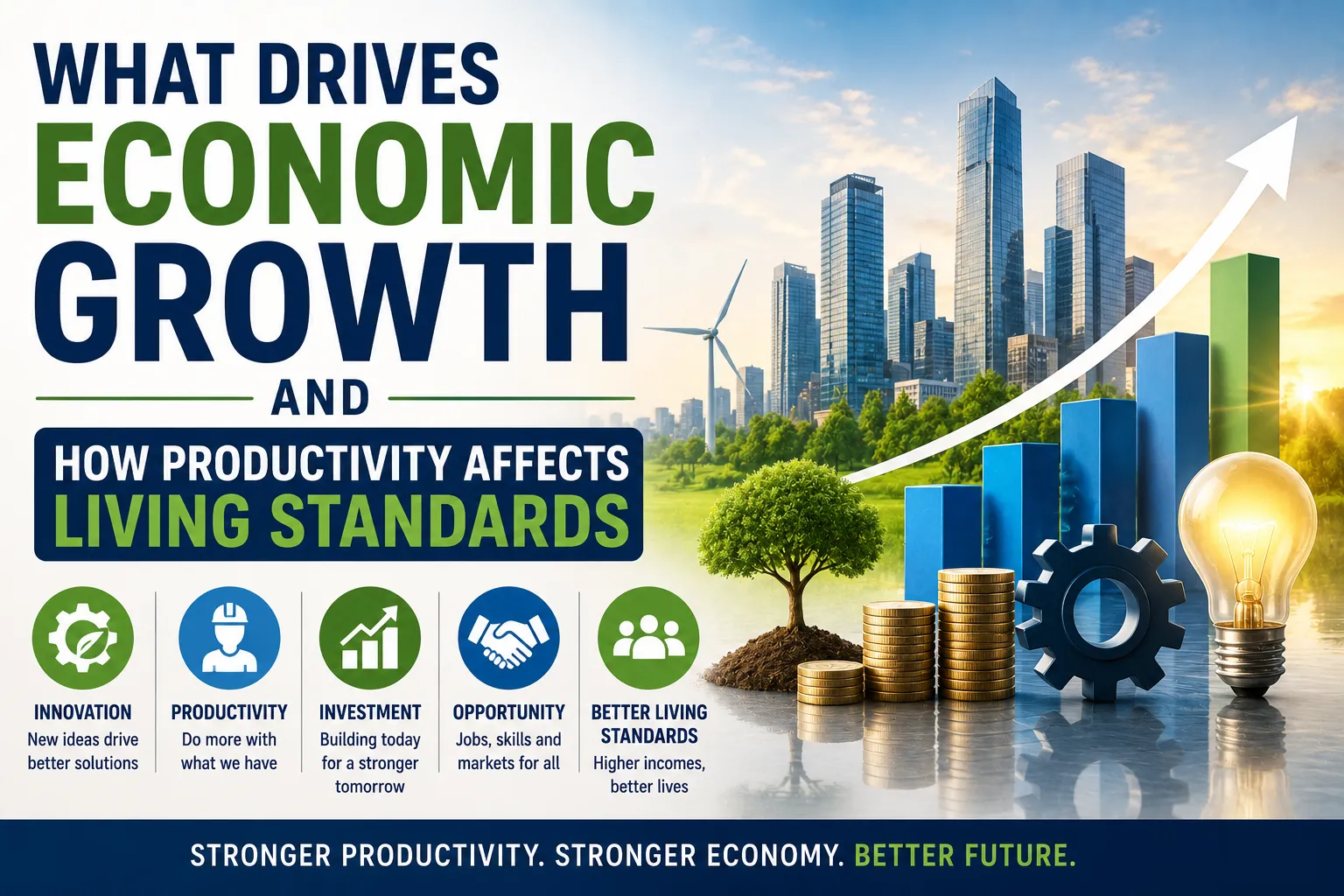
What Drives Economic Growth and How Productivity Affects Living Standards
Economic growth is one of the most important concepts in understanding why some societies become wealthier over time while others struggle to improve living standards.
When an economy grows, businesses may produce more goods and services, employment opportunities can expand, incomes can rise, and governments may have greater resources to invest in infrastructure and public services. But economic growth is not simply about producing more.
What matters in the long run is how much an economy can produce with the resources it has.
That is where productivity becomes especially important.
Productivity helps explain why an economy can sometimes raise incomes without simply requiring people to work longer hours. Better technology, improved skills, stronger infrastructure, more efficient businesses, and better ways of organizing work can allow workers and companies to produce more value from the same underlying resources.
Understanding the relationship between growth, productivity, investment, labor, technology, and living standards provides a useful framework for making sense of the broader economy.
For a broader overview of how growth, productivity, inflation, employment and other measures fit together, see the Complete Guide to Economic Indicators.
What Is Economic Growth?
Economic growth generally refers to an increase in the amount of goods and services an economy produces over time.
A commonly used measure is real gross domestic product (GDP), which adjusts for changes in prices so economists can distinguish increases in production from inflation.
If an economy produces more goods and services than it did previously, real GDP can increase.
Economic growth can come from several sources, including:
- More workers entering the labor force
- More hours worked
- More capital investment
- Better technology
- Improved worker skills
- More efficient production
- Better infrastructure
- Greater business investment
- Improved institutions
- More effective allocation of resources
These factors do not contribute equally in every country or period.
Over longer periods, productivity growth becomes particularly important.
Why Economic Growth Matters
Economic growth can influence many aspects of daily life.
When an economy expands sustainably, it can create opportunities for:
- Higher household incomes
- More employment
- Business expansion
- Increased investment
- Greater tax revenues
- Improved public services
- Higher consumption
- Better infrastructure
Growth does not automatically guarantee that everyone benefits equally.
However, sustained growth can make it easier for a society to increase overall material living standards.
Economic Growth Is Not the Same as Inflation
Economic growth and inflation are different concepts.
Growth concerns the quantity of goods and services produced.
Inflation concerns the general increase in prices.
An economy can experience:
- Growth with low inflation
- Growth with high inflation
- Little growth with inflation
- Falling output alongside rising prices
This distinction matters because simply spending more money does not necessarily mean an economy is producing more.
If prices rise while physical production remains unchanged, nominal GDP can increase even though real economic activity has not increased by the same amount.
Real GDP Provides a Better Picture of Production
Suppose an economy produces the same number of products as last year, but those products become 5% more expensive.
The value of production measured at current prices rises.
But the economy has not necessarily produced 5% more goods and services.
Real GDP attempts to account for price changes.
This makes it more useful when assessing whether an economy is actually expanding its output.
What Is Productivity?
Productivity measures how efficiently resources are transformed into goods and services.
One of the most commonly discussed measures is labor productivity, which looks at output relative to the amount of labor used to produce it.
A simplified version is:
Labor productivity = Output ÷ Labor input
Labor input may be measured by workers or hours worked, depending on the productivity measure.
If a factory produces 1,000 units with the same number of labor hours that previously produced 800 units, productivity has increased.
The workers have not necessarily worked harder.
They may have better equipment, improved processes, better training, superior software, or a more efficient production system.
Why Productivity Matters for Living Standards
Productivity is closely connected to the ability of an economy to increase incomes over the long term.
When workers and businesses can produce more value per hour, there is greater potential for:
- Higher wages
- Greater business profits
- Lower production costs
- More investment
- Higher tax revenues
- Increased consumption
This is one reason economists pay so much attention to productivity.
An economy cannot sustainably increase living standards indefinitely simply by adding more workers or asking existing workers to work more hours.
Eventually, efficiency and output per worker become increasingly important.
Productivity Allows More Output From the Same Resources
Imagine a farmer who can produce 100 kilograms of crops using a certain amount of land, labor, and equipment.
If better seeds, irrigation, machinery, or farming techniques allow the farmer to produce 150 kilograms using essentially the same resources, productivity has improved.
The additional output creates new economic possibilities.
The farmer could:
- Sell more produce
- Earn more income
- Reduce prices
- Invest in better equipment
- Hire additional workers
- Save more money
At the economy-wide level, similar improvements can contribute to rising living standards.
Technology Is a Major Driver of Productivity
Technological progress has historically played an important role in economic growth.
Technology can allow people to perform tasks:
- Faster
- More accurately
- At lower cost
- At larger scale
- With fewer resources
Examples include:
- Agricultural machinery
- Industrial automation
- Computers
- Telecommunications
- Internet services
- Modern logistics
- Medical technologies
- Advanced manufacturing
- Artificial intelligence
Technology alone does not guarantee productivity gains.
Businesses and workers must be able to adopt and effectively use new technologies.
Innovation Is Broader Than Technology
Innovation does not always mean inventing a new machine.
It can involve creating a better:
- Business model
- Production process
- Management system
- Distribution network
- Product
- Service
- Organizational structure
A company that redesigns its workflow and produces the same product with fewer delays has improved efficiency even if it has not invented new technology.
Innovation is therefore both technological and organizational.
Human Capital Drives Productivity
Workers are not simply units of labor.
Their knowledge, skills, experience, health, and ability to solve problems influence how productive they can be.
Economists often refer to these capabilities collectively as human capital.
Education and training can help workers develop human capital.
Important areas include:
- Literacy
- Numeracy
- Technical skills
- Digital skills
- Management
- Communication
- Problem-solving
- Professional expertise
An economy with a highly skilled workforce may be better positioned to adopt new technologies and develop innovative businesses.
Education Can Support Long-Term Growth
Education can contribute to economic growth in several ways.
It can help people:
- Acquire specialized skills
- Adapt to technological change
- Start businesses
- Solve complex problems
- Improve productivity
- Move into higher-value occupations
However, simply increasing years of schooling does not automatically produce strong economic growth.
The quality and relevance of education matter.
An economy benefits when education equips people with capabilities that can be productively applied.
Infrastructure Supports Productivity
Infrastructure provides the foundation on which economic activity takes place.
Important infrastructure can include:
- Roads
- Railways
- Ports
- Airports
- Electricity networks
- Water systems
- Telecommunications
- Internet infrastructure
Poor infrastructure can make it expensive and time-consuming to move people, products, information, and energy.
Reliable infrastructure can reduce these costs.
For example, a manufacturer may be more productive when dependable electricity reduces interruptions and efficient transportation allows goods to reach customers quickly.
Reliable Energy Matters
Modern economies depend heavily on reliable energy.
Businesses need electricity to operate:
- Factories
- Offices
- Data centers
- Hospitals
- Retail stores
- Transportation systems
- Communications networks
Frequent power disruptions can reduce productivity because workers and equipment cannot operate normally.
Investment in reliable and affordable energy can therefore support economic activity.
Institutions Influence Economic Growth
Economic growth is not determined solely by physical resources.
Institutions matter too.
These include systems governing:
- Property rights
- Contracts
- Competition
- Taxation
- Regulation
- Financial markets
- Courts
- Corporate governance
Businesses are more likely to invest when they have confidence that contracts will be enforced and property rights will be respected.
Predictable rules can reduce uncertainty and encourage long-term investment.
The Rule of Law Supports Investment
Businesses often make investments that take years to pay off.
They may build factories, develop products, hire employees, or establish distribution networks.
If businesses cannot reliably enforce contracts or protect assets, they may become less willing to make those investments.
A predictable legal environment can therefore support economic activity by reducing uncertainty.
Competition Can Improve Productivity
Competition can encourage businesses to become more efficient.
When companies compete for customers, they have incentives to:
- Improve products
- Reduce costs
- Innovate
- Increase efficiency
- Improve customer service
A business that becomes complacent may lose customers to a more efficient competitor.
Competition does not guarantee productivity growth, but well-functioning competitive markets can create strong incentives for improvement.
Investment Creates Productive Capacity
Businesses need capital to expand.
Investment can include spending on:
- Machinery
- Buildings
- Vehicles
- Software
- Research
- Equipment
- Infrastructure
These investments can increase the economy’s productive capacity.
For example, a manufacturer purchasing automated equipment may be able to produce more goods per worker.
A company investing in software may reduce administrative costs.
A logistics company investing in better routing technology may deliver more products using the same fleet.
Capital Deepening Can Raise Productivity
When workers have more or better capital to work with, they can often produce more.
This is sometimes described as capital deepening.
Consider two construction workers.
One has basic hand tools.
The other has access to modern power tools, machinery, digital plans, and specialized equipment.
Their skills may be identical, but the second worker may be able to accomplish substantially more in the same amount of time.
Capital investment can therefore increase the productivity of labor.
Savings Can Support Investment
Investment generally requires resources.
Household and business savings can help provide funds for investment through financial markets and financial institutions.
Banks, for example, can channel deposits toward borrowers who need financing for productive activities.
Capital markets can also connect investors with companies seeking funds.
This creates a link between saving today and productive capacity tomorrow.
Financial Markets Can Support Growth
Well-functioning financial systems can help economies allocate capital toward productive uses.
Financial institutions can:
- Provide loans
- Facilitate payments
- Evaluate borrowers
- Pool savings
- Manage risk
- Support investment
When businesses can obtain financing for productive projects, they may be able to expand more quickly.
However, financial systems also need effective regulation and risk management.
Poorly allocated credit can produce the opposite result and contribute to financial instability.
Entrepreneurship Creates New Economic Activity
Entrepreneurs can contribute to growth by identifying opportunities and creating new businesses.
They may introduce:
- New products
- New services
- New production methods
- New markets
- New business models
Successful entrepreneurship can increase competition, create jobs, and generate new sources of economic value.
Not every new business succeeds.
But experimentation and business formation can contribute to a dynamic economy.
Trade Can Expand Economic Opportunities
International trade allows countries to specialize and exchange goods and services.
A country may focus more heavily on activities where it has particular advantages while importing products that can be produced more efficiently elsewhere.
Trade can provide access to:
- Larger markets
- Specialized inputs
- New technologies
- Foreign investment
- Competitive pressure
- Different products
Open trade does not guarantee that every individual benefits equally.
Workers and regions exposed to import competition can experience significant adjustment challenges.
But at the economy-wide level, trade can contribute to productivity and specialization.
Specialization Can Increase Productivity
Consider a small economy in which every person attempts to produce everything they need.
People would spend considerable time switching between unrelated tasks.
Specialization allows people and businesses to focus on activities where they are relatively more productive.
A software developer can focus on software while a farmer focuses on agriculture and a manufacturer focuses on equipment.
They can then exchange the products and services they create.
This division of labor can dramatically increase overall productivity.
Population Growth Can Increase Economic Output
A larger population can increase total economic output because there are more people available to work and produce goods and services.
But population growth does not automatically increase living standards.
If the population grows faster than productive capacity, output per person may not increase.
This is why economists often distinguish between:
Total GDP
and
GDP per person.
GDP per capita is often more useful when thinking about average material living standards.
GDP Per Capita Matters
Suppose an economy’s GDP increases by 3% while its population increases by 3%.
Total production has grown, but output per person may not have increased much.
If GDP grows by 5% while population grows by 1%, GDP per person can rise substantially faster.
This illustrates why economic growth should not be evaluated solely by looking at the total size of an economy.
Working More Hours Is Not the Same as Higher Productivity
An economy can produce more simply because people work more hours.
But that is different from producing more per hour.
Imagine an employee produces $200 of output during an eight-hour shift.
If the employee works 10 hours and produces $250, total output has increased.
But output per hour has risen only slightly, or potentially not at all depending on the comparison.
Long-term improvements in living standards are generally more sustainable when they come from producing more value per hour rather than continuously increasing working time.
Productivity and Wages
Productivity and wages are closely related, although the relationship is not always immediate or evenly distributed.
When workers produce more valuable output per hour, businesses have greater potential to pay higher wages.
But productivity gains can also be distributed among:
- Workers
- Business owners
- Consumers
- Investors
- Governments
through different combinations of wages, profits, lower prices, taxes, and investment.
This means rising productivity does not automatically guarantee that every worker experiences the same increase in income.
Why Productivity Gains May Not Be Shared Equally
Several factors can influence how productivity gains are distributed.
These include:
- Worker bargaining power
- Labor-market conditions
- Competition
- Industry structure
- Education and skills
- Technological change
- Tax policy
- Business ownership
- Institutional arrangements
An economy can therefore experience strong productivity growth while some households see relatively modest improvements in income.
Productivity Can Lower Prices
Productivity improvements do not necessarily show up only as higher wages.
They can also allow businesses to reduce costs.
If a company can produce the same product using fewer resources, it may be able to charge less.
Consumers then benefit from greater purchasing power.
Technology has repeatedly produced products and services that are more capable and affordable than earlier alternatives.
Productivity Can Improve Product Quality
Economic progress is not always captured by counting physical quantities.
A newer product may provide substantially more value than an older product even if its price is similar.
Modern smartphones, for example, combine capabilities that previously required multiple separate devices.
Better quality, convenience, reliability, and functionality can represent meaningful improvements in living standards.
Measuring these improvements accurately is an ongoing challenge for economists.
Productivity and the Service Economy
Productivity is relatively straightforward to measure in some industries.
A factory can count units produced.
Services can be more difficult.
How do you measure improvements in:
- Healthcare?
- Education?
- Financial services?
- Consulting?
- Software?
- Entertainment?
The challenge becomes particularly important in advanced economies where services represent a large share of economic activity.
Digital Technology Can Change Productivity
Digital technologies can reduce the cost of:
- Communication
- Data processing
- Administration
- Research
- Marketing
- Payments
- Logistics
Cloud computing, software automation, digital payments, and artificial intelligence can potentially increase productivity by allowing workers to perform tasks faster or differently.
However, technology adoption often requires investment, training, organizational changes, and reliable infrastructure.
Artificial Intelligence and Productivity
Artificial intelligence has generated significant interest because it could automate or augment certain tasks across many industries.
Potential productivity benefits include:
- Faster information processing
- Automated routine work
- Assistance with writing and coding
- Improved customer service
- Faster research
- Better forecasting
- Process optimization
But productivity gains are not automatic.
Businesses may need to redesign workflows, train employees, improve data systems, and determine where AI genuinely adds value.
The economic impact will depend on how effectively organizations integrate the technology into productive processes.
Productivity Growth Can Be Disruptive
Technological progress can create new opportunities while making some existing skills and jobs less valuable.
Historical economic transformations have repeatedly changed labor markets.
Workers may need to:
- Learn new skills
- Move between industries
- Relocate
- Adapt to new technologies
This transition can be difficult even when the broader economy benefits.
Policies that support education, retraining, mobility, and employment can help workers adjust.
Productivity Is Not Just About Working Faster
A narrow definition of productivity can lead to misunderstandings.
Productivity is not simply about pushing workers to complete more tasks in less time.
Sustainable productivity can involve:
- Better tools
- Better training
- Better processes
- Less waste
- Smarter management
- Improved technology
- Better infrastructure
If workers are simply pressured to work faster without improving the underlying system, the result may be burnout rather than genuine productivity growth.
Health Can Affect Productivity
Worker health can influence economic output.
Illness, injury, inadequate healthcare, and poor working conditions can reduce the amount of productive labor available.
Health improvements can therefore have economic effects beyond individual well-being.
A healthier workforce may be able to work more consistently and effectively.
Management Quality Matters
Two businesses can have similar technology and equally skilled workers but produce very different results.
Management affects:
- Resource allocation
- Communication
- Incentives
- Scheduling
- Training
- Decision-making
- Workflow design
Good management can reduce unnecessary delays and help employees use their skills effectively.
Productivity Requires Coordination
Modern production is highly interconnected.
A factory depends on suppliers.
A retailer depends on transportation.
A software company depends on digital infrastructure.
A hospital depends on medical supply chains.
A disruption in one part of the system can reduce productivity elsewhere.
This is why logistics, infrastructure, communication, and reliable institutions are important components of economic efficiency.
Natural Resources Can Support Growth
Natural resources such as:
- Oil
- Gas
- Minerals
- Timber
- Water
- Agricultural land
can contribute to economic activity.
But natural-resource wealth alone does not guarantee high living standards.
Countries also need effective institutions, investment, human capital, infrastructure, and economic diversification.
Resource-dependent economies can become vulnerable when commodity prices fluctuate.
Economic Diversification Can Improve Resilience
An economy dependent heavily on one industry can be vulnerable to shocks.
Diversification creates multiple sources of economic activity.
For example, an economy might develop capabilities in:
- Manufacturing
- Agriculture
- Technology
- Tourism
- Finance
- Professional services
- Energy
A broader economic base can make employment and government revenues less dependent on a single sector.
Government Can Influence the Conditions for Growth
Governments do not create all economic growth directly.
However, public policy can influence the environment in which businesses and workers operate.
Government can contribute through:
- Infrastructure investment
- Education
- Research funding
- Effective regulation
- Stable institutions
- Public health
- Competition policy
- Tax policy
- Trade policy
The challenge is finding policies that encourage productive activity without creating unnecessary distortions or instability.
For a deeper look at how government spending and taxation can influence economic conditions, see Fiscal Policy: Government Spending and Taxes Explained.
Taxes Can Affect Economic Incentives
Taxes fund public services and infrastructure, but tax structures can also influence economic behavior.
They can affect incentives to:
- Work
- Save
- Invest
- Start businesses
- Hire employees
- Purchase assets
The effect depends heavily on the type and design of the tax.
A well-designed tax system can raise revenue while limiting unnecessary barriers to productive activity.
Government Spending Can Support Productivity
Public spending can contribute to future productivity when it is directed toward productive investments.
Examples include:
- Roads
- Ports
- Schools
- Research
- Digital infrastructure
- Energy systems
- Public health
However, not all government spending increases productivity.
The quality and effectiveness of spending matter.
Research and Development Drive Long-Term Innovation
Many important technologies emerge from years of research.
Businesses, universities, governments, and research institutions can all contribute to innovation.
Research and development can produce:
- New technologies
- New medicines
- New production methods
- New materials
- New software
- New energy systems
These innovations can eventually create productivity gains across entire industries.
Productivity Growth Can Compound
One reason economists care so much about productivity is compounding.
Suppose productivity increases by a modest amount every year.
Those annual improvements build on one another.
A 2% annual increase may appear small in isolation.
Over several decades, however, the cumulative effect can be substantial.
This is one reason small differences in long-term productivity growth can produce very different levels of living standards across generations.
The Importance of Productivity Per Person
The ultimate economic question is not simply:
“How much does the economy produce?”
It is also:
“How much productive capacity exists for each person?”
A growing population can increase total output while leaving output per person relatively unchanged.
Sustained improvements in productivity per worker are therefore crucial for long-term improvements in average material living standards.
Growth Has Limits
Economic growth does not mean that physical consumption can increase indefinitely without consequences.
Economies depend on:
- Energy
- Land
- Water
- Materials
- Ecosystems
Environmental constraints can influence long-term growth.
This has increased interest in concepts such as:
- Resource efficiency
- Clean energy
- Circular economies
- Sustainable production
- Low-carbon technologies
The challenge is finding ways to increase human well-being while reducing unnecessary environmental damage.
Economic Growth and Quality of Life Are Not Identical
GDP is useful, but it does not measure everything that makes life better.
Economic statistics do not fully capture:
- Leisure
- Family relationships
- Community
- Environmental quality
- Personal freedom
- Safety
- Mental well-being
- Unpaid household work
A society can become richer while still facing serious social or environmental challenges.
This is why living standards are broader than GDP alone.
Income Distribution Matters
Average income can rise while inequality also increases.
If most gains from economic growth go to a relatively small portion of the population, the average may improve without every household experiencing similar gains.
This is why economists and policymakers often examine:
- Median income
- Poverty
- Wealth distribution
- Employment
- Wage growth
- Access to essential services
rather than relying solely on GDP per capita.
Economic Growth Can Create More Fiscal Capacity
When incomes and business activity increase, governments may collect more revenue even without increasing tax rates.
Additional revenue can provide resources for:
- Infrastructure
- Education
- Healthcare
- Public safety
- Social programs
- Debt management
This can create a positive feedback loop when public investment supports future productivity.
But Debt Can Complicate the Picture
Governments can borrow to finance spending and investment.
Borrowing may be useful when it funds productive projects that increase future economic capacity.
However, excessive debt can create financial pressure through rising interest costs.
The sustainability of government debt depends on factors including:
- Economic growth
- Interest rates
- Tax revenues
- Government spending
- Debt maturity
- Investor confidence
Growth can make existing debt easier to manage when economic output and revenues rise sufficiently.
What Causes Productivity to Slow?
Productivity growth can weaken for many reasons.
Possible causes include:
- Weak investment
- Skills shortages
- Aging infrastructure
- Poor management
- Slow technology adoption
- Regulatory barriers
- Weak competition
- Supply disruptions
- Low research investment
- Misallocation of capital
Identifying the cause matters because different problems require different solutions.
Why Productivity Statistics Matter
Productivity statistics help economists evaluate whether economic growth is being driven primarily by:
- More workers
- More hours
- More capital
- Greater efficiency
They can also help businesses assess their performance.
If output is increasing but productivity is falling, an organization may need to investigate whether it is adding resources faster than it is improving efficiency.
Businesses Can Improve Productivity
Companies can look for productivity improvements through:
- Better employee training
- Automation
- Workflow redesign
- Improved software
- Equipment upgrades
- Supply-chain improvements
- Better management
- Reduced waste
- Data-driven decision-making
The most effective strategy depends on the industry.
Workers Can Improve Their Productivity Too
Individuals can increase productivity through:
- Skill development
- Better tools
- Training
- Improved organization
- Learning new technologies
- Reducing repetitive tasks
- Better communication
However, individual productivity is only one part of the picture.
A highly skilled worker can still be held back by poor systems, outdated equipment, or inefficient organizational processes.
Productivity and Work-Life Balance
Higher productivity does not necessarily mean people should work longer.
In principle, productivity growth can create the possibility of producing the same amount with less labor time.
That can create opportunities for:
- Higher incomes
- More leisure
- Shorter working hours
- Better public services
- Greater consumption
How those benefits are distributed depends on economic institutions, workplace practices, and social choices.
The Long-Term Relationship Between Growth and Living Standards
The connection can be summarized as a chain:
Investment → better capital and technology → higher productivity → greater output per worker → potential for higher incomes and consumption → improved living standards
But each link matters.
Investment without useful technology may have limited effects.
Technology without skilled workers may be poorly utilized.
Productivity growth without broad access to opportunities may produce unequal gains.
Economic growth without environmental sustainability may create long-term costs.
The strongest improvements in living standards tend to come from several factors working together.
The broader relationship between economic expansion and financial conditions is also important, particularly when considering how economies move through periods of expansion and slowdown. How Economic and Financial Market Cycles Work provides additional context.
What a Productive Economy Looks Like
A productive economy generally has the ability to:
- Produce goods and services efficiently
- Adapt to technological change
- Invest in productive assets
- Develop skilled workers
- Support entrepreneurship
- Move resources toward productive uses
- Maintain reliable infrastructure
- Encourage innovation
- Facilitate trade
- Protect contracts and property rights
- Adjust to economic shocks
No economy performs perfectly in all of these areas.
But weaknesses in several areas at once can make sustained growth more difficult.
Why Productivity Is Ultimately About People
It can be tempting to think of productivity as a technical statistic.
But behind every productivity figure are people using tools, developing skills, creating businesses, solving problems, and producing goods and services.
Productivity improvements can allow societies to achieve more without proportionally increasing the amount of labor and resources required.
That can create more choices.
People may be able to afford better housing, healthcare, education, transportation, technology, recreation, or other goods and services.
Turning Economic Growth Into Better Living Standards
Economic growth is more meaningful when it translates into improvements in people’s everyday lives.
The most sustainable path is not simply to employ more people or increase the number of hours they work. It is to create an environment in which workers and businesses can produce more value with the resources they already have.
That requires investment in skills, technology, infrastructure, research, businesses, and institutions. It also requires attention to how the gains from growth are distributed and whether economic progress remains environmentally sustainable.
Productivity is therefore one of the most important pieces of the economic puzzle. When an economy becomes better at turning time, skills, capital, technology, and natural resources into valuable goods and services, it creates the foundation for higher incomes and better living standards over the long term.