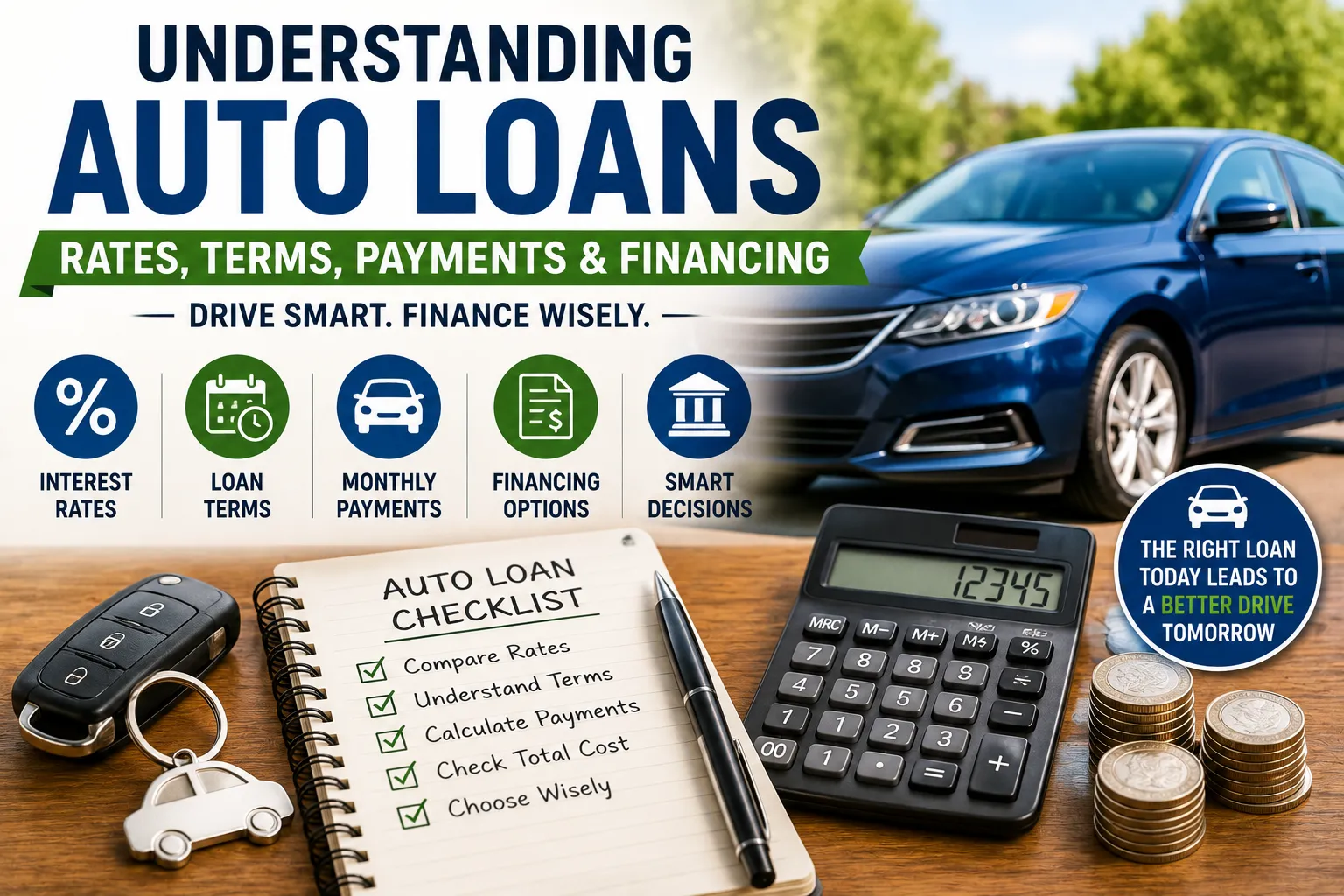
Understanding Auto Loans: Rates, Terms, Payments and Financing
Buying a vehicle is one of the largest financial decisions many households make, and for most buyers, paying the full purchase price in cash is not realistic. Auto loans allow consumers to spread the cost of a vehicle over several years, but the financing arrangement can significantly affect how much the vehicle ultimately costs.
Understanding auto loan rates, loan terms, monthly payments, down payments, fees and financing options can help buyers make more informed decisions before signing a contract.
Auto loans are one part of the broader borrowing landscape covered in the Complete Guide to Credit Tools.
What Is an Auto Loan?
An auto loan is a type of installment loan used to finance the purchase of a vehicle.
A lender provides money to purchase the car, and the borrower repays that amount over an agreed period with interest. The vehicle typically serves as collateral for the loan, meaning the lender may have the right to repossess it if the borrower fails to make payments.
An auto loan generally consists of:
- Principal: The amount borrowed.
- Interest: The cost of borrowing the money.
- Loan term: How long the borrower has to repay the loan.
- Monthly payment: The amount due each payment period.
- Down payment: Money paid toward the vehicle upfront.
- Fees: Charges associated with the loan or vehicle purchase.
The combination of these factors determines the total cost of financing.
How Auto Loan Interest Rates Work
The interest rate is one of the most important factors in an auto loan because it determines how much the borrower pays the lender for providing the financing.
A lower interest rate generally means less interest paid over the life of the loan, assuming the other loan terms are the same.
For example, consider a hypothetical $25,000 auto loan:
| Loan Amount | Interest Rate | Term | Approx. Monthly Payment |
|---|---|---|---|
| $25,000 | 5% | 60 months | $472 |
| $25,000 | 8% | 60 months | $507 |
| $25,000 | 12% | 60 months | $556 |
These figures are illustrative rather than quotes for a particular lender.
The difference may look modest each month, but over several years, a higher interest rate can add thousands of dollars to the total financing cost.
APR Versus Interest Rate
Consumers should also distinguish between an interest rate and an annual percentage rate (APR).
The interest rate represents the cost of borrowing expressed as a percentage. APR can provide a broader measure of borrowing costs because it may incorporate certain fees associated with the loan.
When comparing financing offers, looking at APR alongside the monthly payment can make it easier to compare loans on a more consistent basis.
What Determines Your Auto Loan Rate?
Lenders generally consider several factors when deciding what interest rate to offer.
Credit History
A strong credit history can make it easier to qualify for competitive financing. Lenders use credit information to assess how reliably a borrower has managed debt in the past.
A weaker credit profile does not necessarily prevent someone from obtaining an auto loan, but it may result in a higher interest rate or less favorable terms.
Income and Employment
Lenders may consider income, employment and other financial information when evaluating whether a borrower can comfortably repay the loan.
Stable income can help demonstrate repayment capacity.
Debt-to-Income Ratio
A borrower’s existing debt obligations can also affect the financing decision.
A high debt-to-income ratio may indicate that a substantial portion of income is already committed to debt payments, potentially increasing the lender’s perceived risk.
Loan Amount
The amount being borrowed can influence the lender’s assessment and the structure of the loan.
Borrowing less through a larger down payment may reduce the overall financing burden.
Vehicle Characteristics
The vehicle itself can matter, particularly because it serves as collateral for many auto loans.
Factors can include whether the vehicle is new or used, its age, its value and the lender’s policies.
Why Loan Terms Matter
The loan term is the amount of time the borrower has to repay the loan.
Common terms can range from a few years to much longer periods.
A longer loan term usually produces a lower monthly payment because the balance is spread across more payments. However, it can also result in substantially more interest being paid.
For example, suppose someone borrows $30,000 at a hypothetical 7% interest rate:
- A shorter loan term would generally require higher monthly payments.
- A longer term would generally reduce the monthly payment.
- The longer loan would typically generate more total interest.
This creates an important trade-off: lower monthly payments do not necessarily mean a cheaper loan.
The True Cost of a Monthly Payment
One of the most common mistakes when financing a vehicle is focusing exclusively on the monthly payment.
A dealer or lender may present an attractive monthly figure by extending the loan term.
For example, imagine two financing offers:
Loan A
- Higher monthly payment
- Shorter repayment period
- Less total interest
Loan B
- Lower monthly payment
- Longer repayment period
- More total interest
Loan B may appear more affordable because the monthly payment is smaller. But the borrower could pay considerably more over the life of the loan.
The better question is not simply:
“Can I afford this monthly payment?”
It is:
“What will this vehicle and financing arrangement cost me altogether?”
Down Payments and Trade-Ins
A down payment reduces the amount that needs to be financed.
Suppose a vehicle costs $30,000 and the buyer makes a $6,000 down payment. Before accounting for taxes, fees, trade-in value and other adjustments, the financing requirement would be reduced to $24,000.
A larger down payment can:
- Reduce the loan balance.
- Lower monthly payments.
- Reduce total interest.
- Potentially make loan approval easier.
- Provide more equity in the vehicle from the beginning.
A trade-in can have a similar effect if the vehicle has positive equity.
However, consumers should understand exactly how the trade-in value is being calculated and whether any outstanding balance on the old vehicle is being rolled into the new loan.
Understanding Negative Equity
Negative equity occurs when a vehicle is worth less than the amount still owed on its loan.
For example, if a vehicle is worth $15,000 but the borrower owes $19,000, there is $4,000 of negative equity.
This can become particularly important when trading in a vehicle.
If the outstanding balance is rolled into a new auto loan, the borrower could effectively start the next loan owing money from the previous vehicle in addition to the cost of the replacement vehicle.
That can make the new loan considerably more expensive.
New-Car Financing Versus Used-Car Financing
Financing conditions can differ between new and used vehicles.
New vehicles may sometimes qualify for more competitive financing because they generally have higher values and can present different levels of risk to lenders.
Used vehicles can offer lower purchase prices, but older vehicles may have:
- Higher interest rates.
- Shorter available loan terms.
- Greater maintenance uncertainty.
- Lower loan-to-value limits.
The cheapest vehicle to purchase is not always the cheapest vehicle to finance and own.
Consumers should consider the purchase price, financing costs, insurance, maintenance, fuel and expected depreciation together.
Dealer Financing Versus Direct Lending
Car buyers typically have several ways to obtain financing.
Dealer Financing
With dealer financing, the dealership helps arrange a loan through a bank, credit union or finance company.
The convenience can be valuable because the financing and vehicle purchase can often be handled in one place.
However, buyers should understand the financing terms rather than focusing only on the negotiated monthly payment.
Bank Financing
A buyer can seek financing directly from a bank before visiting a dealership.
Obtaining a preapproval can provide a useful benchmark when negotiating the vehicle purchase.
Credit Union Financing
Credit unions can also offer auto loans, sometimes with competitive rates for qualifying members.
Membership requirements and loan terms vary, so borrowers should compare the complete financing offer rather than assuming one type of lender will always be cheaper.
Why Preapproval Can Help
Getting preapproved before shopping for a vehicle can provide a clearer understanding of the financing budget.
A preapproval can help a buyer determine:
- Approximately how much they can borrow.
- What interest rate they may qualify for.
- What monthly payment fits their budget.
- How much they may need for a down payment.
It can also separate two decisions that are sometimes combined at the dealership: negotiating the vehicle price and arranging financing.
That can make the overall purchasing process easier to evaluate.
Fees Can Change the Final Cost
The interest rate isn’t the only cost associated with purchasing a vehicle.
Depending on the location and transaction, buyers may encounter costs such as:
- Documentation fees.
- Registration costs.
- Taxes.
- Title fees.
- Dealer-installed products.
- Financing-related charges.
- Optional protection products.
Some costs are unavoidable, while others may be optional.
Before signing, buyers should review the paperwork carefully and ask what each charge represents.
How to Compare Auto Loans
Comparing loans based only on monthly payments can produce misleading results.
Instead, compare the following:
| Factor | Why It Matters |
|---|---|
| APR | Helps compare borrowing costs |
| Loan amount | Determines how much is financed |
| Loan term | Affects monthly payment and total interest |
| Monthly payment | Determines ongoing affordability |
| Total interest | Shows the financing cost |
| Fees | Can increase the overall cost |
| Down payment | Reduces the amount borrowed |
| Prepayment terms | May affect early repayment options |
The goal is to evaluate the entire financing package, not just one number.
For borrowers comparing the payment implications of different loan amounts and terms, the Complete Guide to Loan Calculators can provide a useful framework for evaluating financing scenarios.
Common Auto Loan Mistakes
Choosing the Longest Loan Term Automatically
A longer term can make an expensive vehicle appear affordable based on the monthly payment alone.
But the borrower may pay more interest and remain in debt for longer.
Shopping by Monthly Payment
This can obscure the actual purchase price and financing cost.
Always determine the total amount being financed and the total amount that will be repaid.
Skipping Loan Comparisons
Accepting the first financing offer can mean missing a potentially better rate elsewhere.
Comparing multiple legitimate offers can give borrowers a stronger basis for evaluating financing.
Rolling Old Debt Into a New Loan
Negative equity from an existing vehicle can increase the amount financed on the replacement vehicle.
This should be understood before agreeing to the transaction.
Ignoring the Total Ownership Cost
The loan payment is only one part of owning a vehicle.
Insurance, fuel, repairs, maintenance, taxes and registration can significantly affect the household budget.
How to Reduce Auto Financing Costs
Several strategies can potentially reduce the cost of borrowing.
Improve your credit profile before applying. A stronger credit history may help you qualify for better terms.
Save for a larger down payment. Borrowing less generally means paying less interest.
Compare multiple lenders. Banks, credit unions and other lenders may offer different terms.
Choose a reasonable loan term. A shorter term can reduce total interest, provided the payment fits comfortably within the budget.
Negotiate the vehicle price separately. The purchase price is just as important as the financing terms.
Avoid unnecessary add-ons. Optional products can increase the amount financed.
Read the contract carefully. Make sure the final paperwork matches the terms you agreed to.
What Happens If You Pay Off an Auto Loan Early?
Some borrowers choose to make additional payments or pay off their auto loans ahead of schedule.
Doing so may reduce the amount of interest paid because interest is generally calculated based on the outstanding balance and applicable loan terms.
However, borrowers should review their loan agreement for any applicable early-payment conditions or fees.
It’s also important to consider whether paying down the vehicle loan is the best use of extra money compared with other financial priorities, such as building an emergency fund or paying higher-interest debt.
For households balancing an auto loan with several other obligations, understanding how to manage household debt and pay off multiple debts can help put the vehicle debt into a broader repayment strategy.
Questions to Ask Before Signing
Before accepting an auto loan, a buyer should be able to answer several basic questions:
- What is the vehicle’s negotiated purchase price?
- How much am I financing?
- What is the APR?
- How long is the loan term?
- What is the total amount I will repay?
- How much interest will I pay?
- What fees are included?
- Is there a prepayment penalty?
- What happens if I miss a payment?
- Are optional products included in the financing?
- Am I carrying negative equity from another vehicle?
- Does the monthly payment fit comfortably within my overall budget?
If any of these answers are unclear, it’s worth asking for an explanation before signing.
Building a Car Budget Beyond the Loan
A financially manageable vehicle purchase requires more than qualifying for a loan.
A useful household budget should account for the complete cost of ownership.
For example:
Monthly vehicle cost = loan payment + insurance + fuel + maintenance + parking + other ownership expenses
A buyer who qualifies for a $600 monthly loan payment may still find the vehicle unaffordable after adding these other expenses.
This is why lenders’ maximum approval amounts should not automatically become a buyer’s spending target.
A Smarter Way to Approach Vehicle Financing
An auto loan can be a useful financial tool when the vehicle purchase and repayment plan fit comfortably within a household’s finances.
The most important numbers are not necessarily the ones displayed most prominently at the dealership. Purchase price, APR, loan term, amount financed and total repayment cost provide a much clearer picture of the financial commitment.
Taking time to compare financing before signing can help buyers avoid unnecessarily expensive loans and make decisions based on long-term affordability rather than a tempting monthly payment.
Ultimately, the strongest auto financing decision is one that allows the buyer to obtain a reliable vehicle without allowing the loan to place excessive pressure on the rest of the household budget.