Investors Are Pouring Money Into Emerging Markets Again—Why the Trade Is Back
For years, emerging markets were often treated as the riskier corner of the global investment landscape. Higher growth potential came with higher perceived risks, including political uncertainty, currency swings, inflation shocks and sensitivity to changes in U.S. interest rates.
That relationship is beginning to look different.
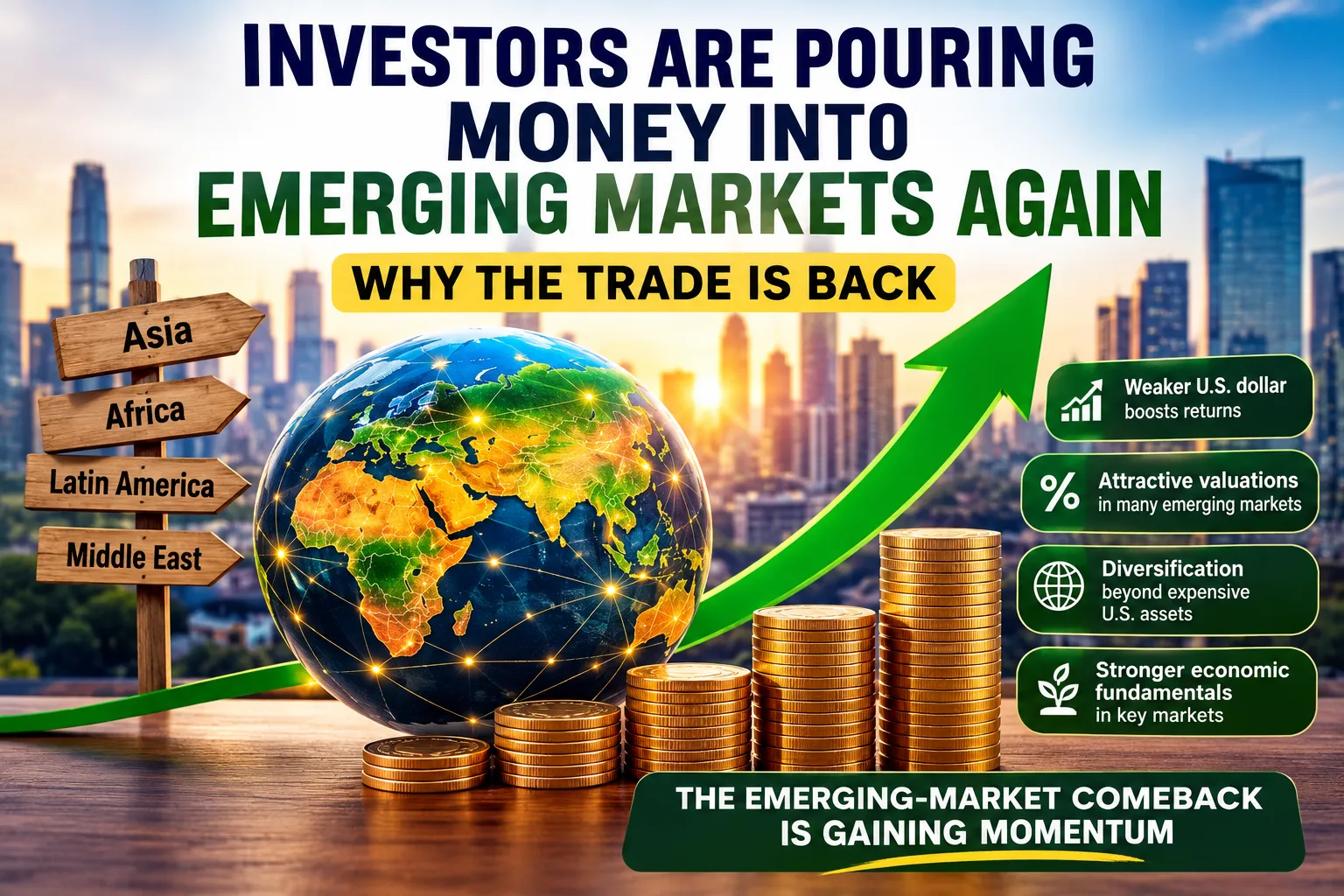
In 2026, international investors are showing renewed interest in emerging-market assets, helped by a weaker U.S. dollar, relatively attractive valuations, improving economic fundamentals and the search for diversification beyond expensive developed-market assets. Emerging-market debt has been particularly notable: foreign capital inflows into emerging-market debt topped $214 billion through July, according to Reuters, the strongest pace in more than two decades.
The revival is not simply a repeat of previous emerging-market rallies. Investors are becoming more selective, focusing on countries with stronger reserves, more credible monetary policy, improving fiscal positions and deeper domestic capital markets.
That makes the current trade worth watching—not because every emerging market is suddenly attractive, but because several long-running forces are aligning in its favor.
For context on how emerging-market assets fit within the broader financial system, see the complete guide to financial markets and how they work.
Why Emerging Markets Are Back on Investors’ Radar
The biggest change is that investors are increasingly looking outside the United States for returns and diversification.
Emerging economies represent a large and diverse group of countries, from major Asian manufacturing economies to commodity exporters in Latin America and developing markets across Africa and the Middle East.
Their economies can behave differently from those of developed markets. That can make emerging-market assets useful in a diversified portfolio, although it also introduces additional risks.
LSEG identified renewed capital inflows, resilient growth and changing global monetary and geopolitical conditions as important factors behind the stronger emerging-market outlook for 2026.
The result is a market where investors are no longer simply asking whether emerging markets are too risky. Increasingly, they are asking whether ignoring them creates its own portfolio risk.
A Weaker Dollar Is Providing an Important Tailwind
One of the most important variables for emerging markets is the U.S. dollar.
A strong dollar can create difficulties for emerging economies because many governments and companies have historically borrowed in dollars. When the dollar rises, those debts become more expensive in local-currency terms.
A weaker dollar can have the opposite effect.
It can reduce pressure on dollar-denominated borrowers, ease some inflationary pressures and give emerging-market central banks more room to adjust monetary policy.
Investment managers have pointed to the dollar’s weakness as one of the factors supporting emerging-market assets. HSBC Asset Management, for example, noted a relationship between dollar weakness and stronger emerging-market equity performance while also highlighting improvements in fiscal management, foreign-exchange reserves and central-bank credibility.
That does not mean emerging-market currencies will automatically rise. Currency movements remain unpredictable. But the change in the dollar’s direction can significantly alter the investment environment.
Interest-Rate Differences Are Also Important
Interest rates remain central to the emerging-market story.
Many emerging economies raised interest rates relatively early during the post-pandemic inflation surge. In several cases, that helped bring inflation under control sooner and left policymakers with greater room to reduce rates later.
This creates an interesting setup for international investors.
If an emerging-market economy has relatively high real interest rates while inflation is moderating, its bonds or currency can offer potentially attractive returns compared with assets in countries where real yields are lower.
Franklin Templeton has highlighted relatively high emerging-market real interest rates, discounted currencies and stronger reserves as factors supporting the case for emerging-market local assets.
However, investors have to distinguish between attractive yields and sustainable returns. A high interest rate can sometimes be compensation for substantial economic or political risk.
Emerging-Market Debt Is Becoming a Major Part of the Story
The resurgence is not limited to stocks.
Emerging-market bonds have attracted considerable attention, particularly local-currency debt.
Foreign capital inflows into emerging-market debt exceeded $214 billion through July 2026, while emerging-market issuers had sold a record $187 billion in bonds by midyear.
That matters because bonds can provide investors with exposure to emerging economies without relying entirely on rising stock prices.
Local-currency bonds can also provide exposure to both interest-rate movements and currency changes. That can increase potential returns, but it can also increase losses when currencies depreciate.
The growing size of domestic bond markets is another important development. Some emerging economies have become less dependent on foreign-currency borrowing, making their financial systems somewhat more resilient to external shocks.
Investors seeking a broader understanding of fixed-income markets can also explore the complete guide to bond markets.
Economic Fundamentals Have Improved in Several Markets
Another reason the current environment looks different from some previous emerging-market cycles is the improvement in economic resilience across parts of the developing world.
The picture varies enormously by country, but several emerging economies now have:
- Larger foreign-exchange reserves
- More developed domestic capital markets
- Stronger monetary-policy frameworks
- Lower reliance on foreign-currency borrowing
- More diversified sources of financing
- More experienced central banks
- Growing domestic investor bases
Stronger policy-making, improved reserves and expanding local investor pools have all supported emerging markets in 2026.
That does not eliminate risk. Instead, it can reduce the likelihood that every external shock automatically turns into a full-scale financial crisis.
Investors Are Looking for Diversification
Portfolio concentration has become another part of the emerging-market argument.
U.S. stocks have delivered powerful returns over long stretches, particularly in technology-related sectors. But strong performance can also create expensive valuations and concentration risks.
Investors who already have significant exposure to U.S. equities may increasingly look for assets that behave differently.
Emerging markets can provide exposure to industries and economic drivers that are less dominant in developed-market indexes, including:
- Semiconductor manufacturing
- Commodities
- Banks
- Consumer growth
- Infrastructure
- Energy
- Industrial production
- Telecommunications
- Expanding domestic consumer markets
The diversification argument is one reason international capital has returned to the asset class. Investors have been increasing allocations to emerging markets partly because of a weaker dollar and a desire to diversify away from the United States.
Asia Remains Central to the Emerging-Market Story
Asia accounts for a large share of the world’s emerging-market economic activity, making it impossible to discuss the asset class without considering the region.
Countries such as India, Indonesia, South Korea and others offer different combinations of manufacturing, technology, consumer demand and export exposure.
South Korea and Taiwan, for example, have benefited from their important roles in the semiconductor supply chain. LSEG highlighted semiconductor strength in Korea and Taiwan alongside domestic-demand stories in countries such as India and Indonesia.
This creates an important distinction between today’s emerging-market opportunity and the broad-brush approach investors sometimes used in the past.
Instead of simply buying “emerging markets,” investors are increasingly examining individual countries, sectors and companies.
Africa Is Part of the Broader Shift
Africa also illustrates why emerging markets should not be treated as one homogeneous investment category.
Countries across the continent have different currencies, political systems, commodity exposures, demographics and financial-market structures.
Some are benefiting from stronger domestic capital markets and improved investor interest, while others continue to face substantial financing and currency challenges.
Recent credit-rating upgrades in countries including Ghana and Nigeria form part of a broader improvement in conditions across some emerging economies.
For investors, that means country-level analysis is particularly important.
A positive emerging-market trend does not automatically make every individual market attractive.
The AI Boom Is Creating New Emerging-Market Opportunities
Artificial intelligence is another factor reshaping the investment landscape.
The AI boom is not confined to Silicon Valley. It requires enormous quantities of semiconductors, electricity, data-center infrastructure, industrial equipment and raw materials.
That creates opportunities for economies positioned within global technology supply chains.
South Korea and Taiwan are particularly important because of their semiconductor industries. Meanwhile, commodity-producing economies may benefit from increased demand for metals and other resources needed for infrastructure and technology.
This creates a more complicated emerging-market investment thesis: some opportunities come from traditional economic growth, while others are linked to their role in global technology supply chains.
But the Rally Does Not Remove the Risks
The renewed interest in emerging markets should not be confused with a risk-free investment environment.
Emerging-market assets can experience sharp declines when global investors suddenly become more cautious.
The International Monetary Fund has warned that the increasing role of nonbank investors—including investment funds, hedge funds, pension funds and insurers—has expanded financing opportunities for emerging economies while also making some capital flows more sensitive to changes in global risk sentiment.
During periods of market stress, investors can withdraw capital rapidly.
That can lead to:
- Currency depreciation
- Higher borrowing costs
- Falling bond prices
- Lower stock valuations
- Wider credit spreads
- Reduced access to international financing
The IMF estimates that portfolio flows to emerging markets have increased dramatically since the global financial crisis, reaching roughly $4 trillion cumulatively by 2025. But it also emphasizes the vulnerability created by increasingly mobile nonbank capital.
Investors should also remember that changing market conditions can produce substantial price swings. Understanding how stock market volatility works and what causes market volatility can provide useful context when evaluating the risks of international assets.
Political Risk Still Matters
Political and institutional conditions remain important when investing internationally.
Changes in government policy can affect:
- Taxes
- Regulations
- Trade
- Currency policy
- Capital controls
- Government spending
- Foreign investment
- Corporate ownership rules
Two countries with similar economic growth rates can therefore produce very different investment outcomes.
This is one reason professional investors often examine individual countries rather than treating an entire emerging-market region as a single trade.
Currency Risk Can Change the Investment Outcome
Currency movements are another major consideration.
An investor can correctly predict that a local stock market will rise and still receive disappointing returns if the local currency falls significantly against the investor’s home currency.
For example, a 10% gain in a foreign stock market does not necessarily translate into a 10% gain for an investor whose home currency appreciates substantially during the same period.
Currency exposure can therefore amplify both gains and losses.
Investors considering emerging-market assets should understand whether a fund or investment is hedged against currency movements or leaves the investor fully exposed.
The Current Rally Is Becoming More Selective
The strongest argument for emerging markets today may not be that the entire asset class is cheap.
Instead, the opportunity may lie in the growing differences between individual markets.
Some countries have stronger fiscal positions. Others have better demographics. Some benefit from commodity demand, while others are positioned within global manufacturing or technology supply chains.
Some currencies appear inexpensive relative to historical measures, while others may already reflect optimistic expectations.
That creates an environment where country selection, sector selection and valuation matter.
The broad emerging-market trade may be returning, but investors are becoming more discriminating about where they put their money.
What Could Keep the Trade Going?
Several forces could continue supporting emerging-market assets if they persist.
Continued Dollar Weakness
A sustained decline in the U.S. dollar could improve financial conditions for many emerging economies and increase the attractiveness of local-currency assets.
Lower Inflation
If inflation remains under control, emerging-market central banks may have greater flexibility to lower interest rates without destabilizing their currencies.
Global Portfolio Diversification
If investors continue reducing concentration in U.S. assets, even relatively modest reallocations could produce meaningful capital flows into smaller emerging markets.
Stronger Domestic Markets
Deeper local bond and equity markets can make emerging economies less dependent on foreign banks and short-term external financing.
Supply-Chain Diversification
Companies seeking alternatives to highly concentrated manufacturing networks could continue investing in emerging economies with strong industrial infrastructure and skilled workforces.
Why Investors Should Resist Chasing the Rally
Strong inflows can create their own risks.
When large amounts of foreign capital enter a relatively small market, asset prices can rise rapidly. Investors arriving late may end up paying significantly higher valuations than those who entered earlier.
The IIF’s data also illustrates how quickly flows can reverse. Its June 2026 tracker showed emerging-market portfolio flows falling into negative territory again in May after a sharp rebound in April.
That volatility is a reminder that capital-flow trends are not guarantees of future performance.
Emerging markets can remain attractive while individual securities become overpriced.
What Individual Investors Should Watch
Anyone considering emerging-market investments should pay attention to several indicators rather than focusing on headlines about money flowing into the asset class.
Key signals include:
-
The U.S. dollar — Sustained dollar weakness can support emerging-market assets.
-
U.S. interest rates — Higher global rates can make riskier assets less attractive.
-
Emerging-market inflation — Falling inflation can create room for monetary easing.
-
Foreign-exchange reserves — Strong reserves can provide greater protection during external shocks.
-
Current-account balances — Stronger external positions can reduce financing vulnerabilities.
-
Government debt — High debt levels can constrain fiscal policy.
-
Capital flows — Rapid inflows can support markets but may also reverse quickly.
-
Commodity prices — Important for resource-exporting economies.
-
Domestic consumption — A growing middle class can provide an alternative to export-led growth.
-
Political and regulatory changes — Policy decisions can have a significant effect on individual markets.
A New Chapter for Emerging-Market Investing?
The return of international money to emerging markets reflects more than a short-term change in investor sentiment.
The global investment landscape is evolving. The dollar has become less dominant in some portfolios, investors are searching for diversification, emerging economies have strengthened parts of their financial infrastructure, and several countries offer relatively attractive yields and valuations.
At the same time, the risks that have historically defined emerging-market investing have not disappeared.
The IMF’s research makes that tension particularly clear: international capital can help emerging economies deepen financial markets and expand access to financing, but those same flows can become a source of instability when global risk appetite suddenly changes.
For investors, the lesson may be less about making a sweeping bet on “emerging markets” and more about understanding what is driving each market.
The trade is back—but this time, the most important question may not be whether to invest in emerging markets. It may be which emerging markets have the economic strength, valuations and financial resilience to justify the risk.