Salesforce and CrowdStrike Earnings Could Reignite Software Stock Buying
Software stocks have spent much of 2026 navigating an uncomfortable question: Will artificial intelligence ultimately make traditional software more valuable, or make some software businesses less necessary?
That debate has weighed on parts of the sector as investors reassessed subscription models, pricing power and the possibility that AI agents could replace some of the applications people use today.
This week’s results from Salesforce and CrowdStrike offer investors a more encouraging counterpoint.
Both companies reported quarterly results on August 26, with Salesforce raising its full-year outlook and CrowdStrike delivering record quarterly results. Their performances could provide a fresh test of whether software companies capable of incorporating AI into their products can turn the technology from a competitive threat into a growth engine.
Why Software Stocks Have Faced an AI Reckoning
For years, investors rewarded software companies for predictable subscription revenue, expanding customer bases and strong recurring cash flow.
The arrival of generative AI and increasingly capable AI agents complicated that model.
If businesses can use AI to perform tasks that once required separate applications, some investors have questioned whether companies will continue paying for large collections of traditional software products.
That concern contributed to a broader selloff in parts of the software sector earlier this year, with fears that AI could undermine the value of established SaaS platforms.
The question now is becoming more nuanced.
Rather than simply asking whether AI will replace software, investors are increasingly asking which software companies can become more valuable because of AI.
Salesforce and CrowdStrike provide two different examples.
Salesforce Delivers a Stronger-Than-Expected Quarter
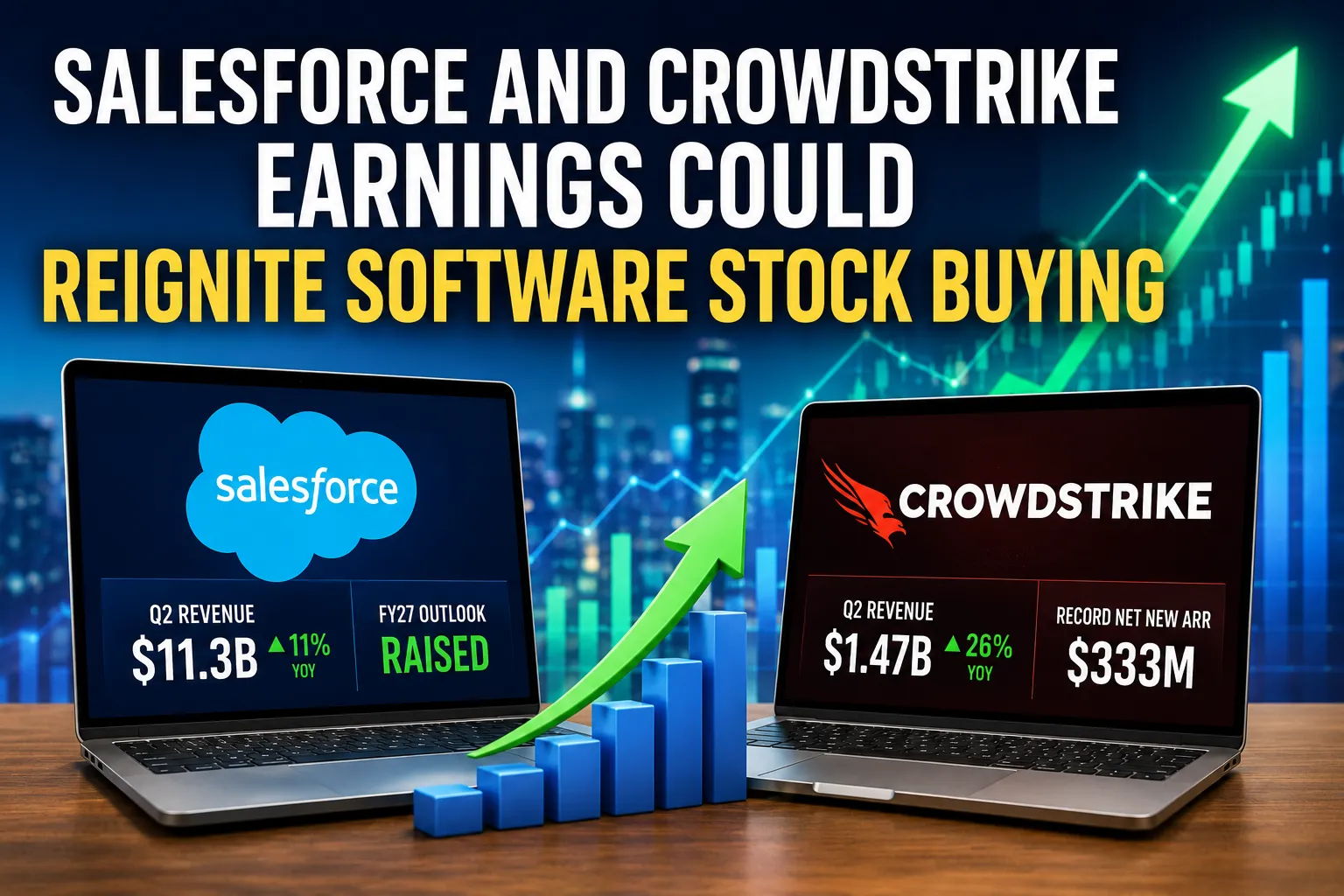
Salesforce reported fiscal second-quarter revenue of about $11.3 billion, up 11% year over year. Subscription and support revenue increased 12%, while current remaining performance obligations rose 14% in constant currency to $33.5 billion.
The company also reported adjusted earnings per share of $5.90, more than double the comparable figure from a year earlier.
Perhaps more importantly for investors, Salesforce raised its fiscal 2027 revenue guidance by $200 million at the midpoint.
The company now expects full-year revenue of approximately $46.1 billion to $46.4 billion, according to its latest results.
Those numbers matter because Salesforce has been at the center of the debate over whether AI agents could disrupt established software companies.
Agentforce Is Central to Salesforce’s AI Strategy
Salesforce has been positioning its Agentforce platform as a way for companies to deploy AI agents alongside their existing applications, data and workflows.
That strategy attempts to turn a potential threat into an opportunity.
If AI agents become a standard part of business operations, Salesforce wants customers to use its platform to manage those agents rather than abandon the company’s broader software ecosystem.
The company also announced a new partnership with Anthropic around Claudeforce, combining Salesforce functionality with Anthropic’s Claude AI models.
For investors, the important issue is not simply whether Salesforce can add AI features.
The bigger question is whether those features can generate incremental revenue, increase customer engagement and strengthen the company’s position in enterprise software.
CrowdStrike Offers a Different AI Story
CrowdStrike’s business is focused on cybersecurity, making its relationship with AI somewhat different.
The rapid adoption of AI creates new opportunities for attackers as well as businesses.
More AI systems, autonomous agents, data connections and cloud workloads can create additional security challenges, potentially increasing demand for cybersecurity products.
CrowdStrike’s latest results suggest that dynamic is already benefiting the company.
The cybersecurity provider reported $1.47 billion in quarterly revenue, a 26% increase from the same period a year earlier. Subscription revenue increased 27% to approximately $1.40 billion.
The company also reported ending annual recurring revenue of $5.84 billion.
CrowdStrike Posts Record New ARR
One of the more notable figures from CrowdStrike’s quarter was its $333 million in net new annual recurring revenue.
The company said that figure represented 51% year-over-year growth and helped lead it to raise its fiscal 2027 net-new ARR growth guidance to 34% at the midpoint.
CrowdStrike also generated record operating and free cash flow during the quarter.
Those metrics are particularly relevant to investors because recurring revenue and cash generation are important indicators of the durability of a subscription-based software business.
The results suggest customers are not simply experimenting with cybersecurity products. They are continuing to expand their spending.
AI Could Strengthen the Case for Cybersecurity Spending
AI introduces a paradox for cybersecurity companies.
It can help attackers automate and scale attacks, but it can also create more demand for sophisticated defenses.
Companies adopting AI need to secure additional data, identities, applications, endpoints and automated systems.
That can expand the potential market for cybersecurity platforms.
CrowdStrike has increasingly positioned its Falcon platform around protecting organizations during the broader transition toward AI-driven computing. Its investor materials describe the platform as covering areas including endpoint security, cloud security, identity protection, data protection and AI-related cybersecurity.
For investors, this makes CrowdStrike an example of a software company potentially benefiting from the very technology that threatens other parts of the industry.
The Results Could Challenge the “SaaS Apocalypse” Narrative
The term “SaaS apocalypse” has been used to describe fears that AI could dramatically weaken traditional software businesses.
Salesforce CEO Marc Benioff has pushed back against that thesis, arguing that the company’s customers and core workflows remain important even as AI interfaces become more prominent.
The latest earnings provide some evidence supporting that argument.
Salesforce’s subscription and support revenue continues to grow, while its remaining performance obligations point to substantial contracted business ahead.
That does not prove every software company will thrive in the AI era.
It does suggest that established platforms with valuable data, enterprise relationships and deeply embedded workflows may have more protection than the most pessimistic forecasts imply.
Investors Still Have to Watch Valuations
Strong earnings do not automatically make a stock attractive.
One of the biggest challenges for investors is valuation.
CrowdStrike shares had already risen substantially during 2026 before the latest earnings release, while Salesforce had faced a very different trajectory after falling earlier in the year amid concerns about AI disruption.
That creates different expectations for the two companies.
When a stock has already risen sharply, investors may demand increasingly impressive results to justify its valuation.
Even a strong quarter can result in a disappointing stock reaction if management’s outlook does not exceed expectations by enough.
Guidance May Matter More Than the Headline Numbers
Quarterly revenue and earnings are important, but investors often pay even closer attention to forward guidance.
A company can report strong historical results while signaling that growth is likely to slow.
Conversely, a company with less impressive historical numbers can generate enthusiasm if its outlook improves substantially.
Salesforce’s decision to raise its fiscal 2027 revenue forecast is therefore significant.
CrowdStrike’s increase in its net-new ARR growth outlook is similarly important.
Both suggest management sees enough demand to become more confident about future performance.
For a broader explanation of why earnings, forecasts and profitability can move stock prices and influence valuations, investors can also examine how corporate earnings affect stock prices and market valuations.
AI Monetization Remains the Bigger Test
There is still a major difference between adding AI to a software product and successfully monetizing AI.
Investors will want to see evidence that customers are willing to pay for AI capabilities rather than simply receiving them as part of existing subscriptions.
For Salesforce, that means watching the adoption and financial contribution of Agentforce and related AI products.
For CrowdStrike, the focus is more closely tied to whether AI-driven security needs translate into additional platform adoption, expanded contracts and higher recurring revenue.
The companies do not need to prove that AI will transform their businesses overnight.
They need to demonstrate that AI is becoming a meaningful contributor to long-term revenue and customer value.
Software Investors May Start Separating Winners From Losers
The latest earnings could reinforce a broader shift in how investors evaluate software companies.
During the earlier SaaS boom, many companies were valued primarily on recurring revenue growth and the size of their addressable markets.
The AI era may demand a more complicated assessment.
Investors may increasingly ask:
- Does the company own valuable proprietary data?
- Are its products embedded in critical workflows?
- Can AI make the platform more useful?
- Can the company charge for AI capabilities?
- Does AI reduce customer demand for the product?
- Does AI create new security or infrastructure requirements?
- Can the company maintain pricing power?
- Is the business generating durable free cash flow?
Those questions could lead to a wider gap between software companies that adapt successfully and those whose products become easier to replace.
Enterprise Relationships Could Become a Major Advantage
Salesforce and CrowdStrike share another important characteristic: deep relationships with enterprise customers.
Large organizations often operate complicated technology environments.
Replacing an established software platform can involve migrating data, changing workflows, retraining employees, managing integrations and dealing with security requirements.
That creates switching costs.
AI could increase the value of these relationships if established software companies become the infrastructure through which businesses deploy AI.
Instead of eliminating the incumbent platform, AI could make that platform more important.
Cybersecurity Has an Additional Tailwind
CrowdStrike’s results highlight another difference between software categories.
Cybersecurity is increasingly becoming a necessity rather than a discretionary technology purchase.
As businesses move more operations into cloud environments and deploy more AI systems, protecting those systems becomes increasingly important.
That can make cybersecurity spending relatively resilient even when companies become more cautious about technology budgets.
The latest CrowdStrike results—particularly its recurring revenue growth and cash generation—provide evidence that demand remains strong.
What Could Reignite Software Stock Buying?
A sustained recovery in software stocks would probably require more than one or two strong earnings reports.
Investors would need evidence that the industry’s growth model remains intact.
That could come from several developments:
- AI revenue becomes measurable.
- Enterprise software spending remains resilient.
- Subscription growth stabilizes or accelerates.
- Free cash flow continues improving.
- Companies raise forward guidance.
- AI becomes an enhancement rather than a replacement for core software.
- Valuations become more reasonable relative to expected growth.
Salesforce and CrowdStrike are now offering investors evidence on several of these points.
The Risks Have Not Disappeared
Despite the encouraging results, software investors should not assume the sector’s problems are solved.
AI development remains rapid.
New competitors can emerge quickly, particularly when AI lowers the cost of building software.
Customers may eventually consolidate their technology spending around fewer platforms.
Pricing pressure could increase if AI makes certain capabilities cheaper to provide.
And companies that currently appear well positioned could still struggle if technological changes happen faster than expected.
The latest earnings are therefore evidence, not proof, that the software industry can adapt.
What Investors Should Watch Next
The next stage of the software trade will likely be about execution.
For Salesforce, investors will be watching Agentforce adoption, enterprise spending, subscription growth, margins and whether the company’s raised guidance proves conservative.
For CrowdStrike, recurring revenue growth, new customer additions, Falcon platform adoption, cash flow and demand generated by AI-related security requirements will remain important.
The broader software sector will also need to demonstrate that these companies are not isolated success stories.
If other enterprise software companies begin reporting similar trends, confidence in the sector could improve substantially.
Investors can also put these developments into the wider market context by exploring how investing tools and platforms help investors research and manage investments.
Earnings Could Mark a Turning Point for Software
The latest results from Salesforce and CrowdStrike arrive at an important moment for technology investors.
The market has spent months debating whether AI will destroy the traditional software business or create an even larger opportunity for companies with strong platforms, data and customer relationships.
Both companies delivered results that lean toward the second possibility.
Salesforce is demonstrating that a major enterprise software platform can continue growing while aggressively incorporating AI into its products. CrowdStrike is showing how the expansion of AI can simultaneously create stronger demand for cybersecurity.
That does not mean every software stock is ready for a rebound.
But if more companies can show the same combination of revenue growth, recurring demand, improving cash generation and credible AI monetization, investors may have a reason to look at the sector differently.
For investors assessing the broader market, these developments also fit into the larger picture described in the complete guide to financial markets and how they work.
For software stocks, the biggest question is no longer simply whether AI is coming. It is whether established technology companies can turn AI into a source of durable revenue and competitive advantage. Salesforce and CrowdStrike’s latest earnings offer investors an early indication that some of the industry’s strongest businesses may be doing exactly that.