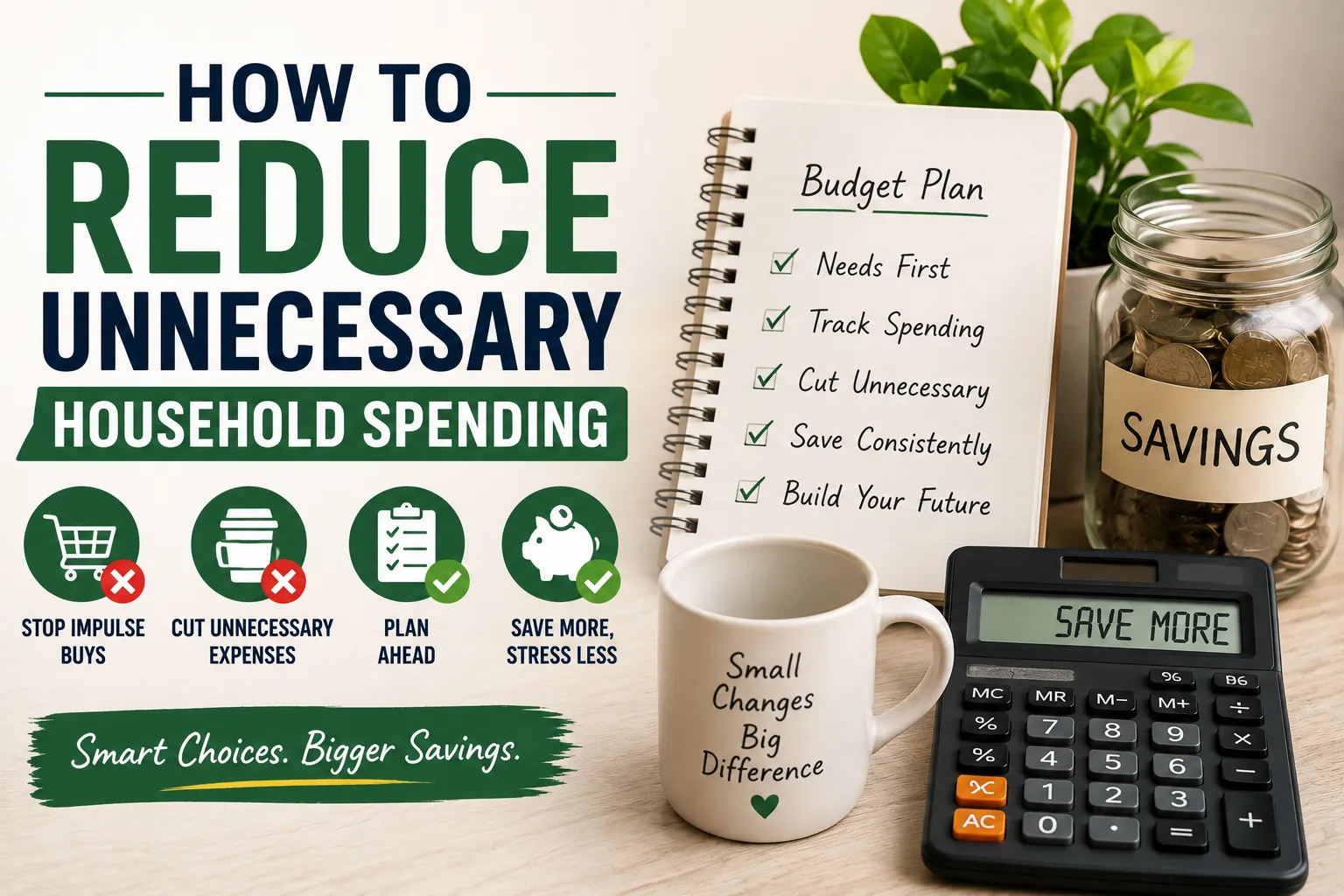
How to Reduce Unnecessary Household Spending
Household expenses have a way of growing quietly.
One subscription here, a takeaway meal there, a few impulse purchases during the week, and suddenly a large portion of your income has disappeared without going toward anything particularly important.
Reducing unnecessary household spending isn’t about making life miserable or refusing to spend money on things you enjoy. It’s about understanding where your money is going, separating genuine needs from convenient wants, and making deliberate decisions about the expenses that add value to your household.
The good news is that you don’t necessarily need a dramatic lifestyle change to make a difference. Small adjustments made consistently can free up money for savings, debt repayment, emergencies, family goals, or simply greater financial breathing room.
A good place to start is by building a broader money management system that gives you visibility into spending, savings, cash flow, and other household financial priorities.
What Counts as Unnecessary Household Spending?
An unnecessary expense isn’t necessarily something you don’t enjoy.
A restaurant meal, streaming subscription, weekend outing, or new piece of clothing can all be worthwhile if they fit comfortably within your budget.
The problem is spending that happens without intention or provides little value relative to its cost.
Examples can include:
- Subscriptions you rarely use
- Impulse purchases
- Frequent takeaway meals
- Unplanned online shopping
- Excessive convenience fees
- Buying groceries that regularly go unused
- Paying for services you no longer need
- Unnecessary bank or transaction fees
- Repeated purchases of items you already own
- Upgrading products before replacement is necessary
- Spending simply because something is discounted
The goal isn’t to eliminate every non-essential expense.
It’s to identify the expenses that don’t meaningfully improve your household’s life.
Start by Finding Out Where Your Money Goes
Before cutting expenses, you need a realistic picture of your current spending.
Many households underestimate how much they spend because small purchases don’t feel significant individually.
Spending KSh 300 several times a week, for example, can become a substantial monthly expense without ever appearing as a major transaction.
Review your bank statements, mobile money transactions, card statements, receipts, and other payment records.
Group your expenses into categories such as:
- Housing
- Food
- Transport
- Utilities
- Education
- Healthcare
- Debt payments
- Insurance
- Entertainment
- Shopping
- Subscriptions
- Personal care
- Family activities
- Savings and investments
Don’t judge your spending during the first review.
The initial goal is simply to understand it.
For households that want a more detailed picture, expense tracking and cash flow tools can make recurring spending patterns easier to identify.
Separate Needs From Wants
A useful first step is dividing expenses into three categories.
Essential Expenses
These are costs that are difficult to avoid, such as:
- Housing
- Basic food
- Utilities
- Essential transportation
- Healthcare
- Required insurance
- School-related necessities
- Minimum debt payments
Important but Flexible Expenses
These aren’t necessarily essential, but they contribute meaningfully to your household.
Examples might include:
- Internet
- Mobile phone services
- Children’s activities
- Gym memberships
- Regular family outings
- Professional development
These expenses can sometimes be reduced without eliminating them.
Discretionary Expenses
These are the easiest places to look for savings.
Examples include:
- Takeaway food
- Entertainment
- Impulse shopping
- Premium subscriptions
- Frequent restaurant meals
- Unplanned upgrades
- Non-essential convenience purchases
The distinction will vary between households.
Something that is unnecessary for one family may be genuinely important for another.
Don’t Try to Cut Everything at Once
One of the biggest budgeting mistakes is attempting an extreme financial reset.
A household might decide to eliminate restaurants, cancel every subscription, stop entertainment spending, buy only the cheapest groceries, and completely overhaul its lifestyle overnight.
That approach can work temporarily, but it often becomes exhausting.
Instead, identify the three or four spending categories with the greatest potential for improvement.
If reducing takeaway meals could save significantly more than switching to a slightly cheaper brand of soap, focus on the meals first.
Prioritize the changes that produce meaningful results without making daily life unnecessarily difficult.
Review Your Subscriptions
Subscriptions are among the easiest expenses to overlook.
Because payments are often automated, you may continue paying for services long after you stop using them regularly.
Review:
- Streaming services
- Music subscriptions
- Cloud storage
- Fitness memberships
- Software
- Gaming services
- News subscriptions
- Learning platforms
- Delivery memberships
- App subscriptions
Ask yourself:
“If this payment stopped today, would I genuinely miss the service?”
If the answer is no, cancel it.
If you use several similar services, consider keeping the one that provides the most value.
You can also rotate subscriptions rather than maintaining all of them year-round.
Stop Paying for Convenience You Don’t Need
Convenience has a price.
Food delivery, express shipping, ride-hailing, premium service tiers, and other conveniences can save time, but using them automatically can significantly increase household spending.
This doesn’t mean convenience is bad.
Time has value too.
The key is deciding when convenience is worth paying for and when it has simply become a habit.
For example, ordering delivery because you’re genuinely exhausted after a long day may be reasonable.
Ordering delivery several times a week because cooking wasn’t planned is a different problem.
Make a Grocery Plan
Food is one of the most flexible household expenses, but reducing grocery costs doesn’t mean buying poor-quality food.
A good starting point is planning meals before shopping.
Before going to the store:
- Check what you already have.
- Plan several meals.
- Make a shopping list.
- Set a realistic spending limit.
- Avoid shopping while extremely hungry.
- Compare prices where practical.
- Buy quantities you can realistically use.
A plan reduces the chance of buying ingredients that look appealing in the store but eventually end up unused.
Reduce Food Waste
Food that gets thrown away is money that has already been spent.
Common sources of household food waste include:
- Buying more fresh produce than the household can consume
- Forgetting leftovers
- Cooking excessive portions
- Allowing ingredients to expire
- Buying duplicates because the pantry wasn’t checked
Try organizing your refrigerator and pantry so that older items are easier to see.
Use leftovers creatively rather than treating them as a separate meal that nobody wants.
And when possible, freeze food before it reaches the point where you know you won’t use it.
Don’t Confuse Cheap With Good Value
The cheapest product isn’t always the most economical choice.
A very inexpensive item that breaks quickly may cost more over time than a durable product purchased once.
When comparing purchases, consider:
- Quality
- Durability
- Frequency of use
- Repairability
- Warranty
- Maintenance costs
- Replacement costs
The goal is value, not simply the lowest sticker price.
When evaluating larger financial products or services, it can also help to compare financial products based on fees, features, security and value rather than choosing solely on price.
Use the 24-Hour Rule for Impulse Purchases
Impulse spending often happens because the decision is made too quickly.
For non-essential purchases, introduce a waiting period.
For inexpensive items, that might be a few hours.
For larger purchases, consider waiting 24 hours, several days, or even a week.
During that time, ask:
- Do I actually need this?
- Do I already own something similar?
- Where will I keep it?
- How often will I use it?
- Would I still want it if it weren’t discounted?
- Does it fit my current budget?
- What financial goal could this money support instead?
A surprising number of impulse purchases lose their appeal after the initial excitement disappears.
Be Careful With Discounts
A discount only saves money if you were going to buy the product anyway.
Buying a KSh 5,000 item for KSh 3,500 isn’t saving KSh 1,500 if you didn’t need the item in the first place.
Sales can encourage people to spend more because the price feels attractive.
Before purchasing something on promotion, ask:
“Would I buy this at the normal price?”
If the answer is no, the discount may not be the opportunity it appears to be.
Reduce Household Utility Costs
Utilities can provide meaningful savings without requiring major lifestyle changes.
Simple habits can include:
- Turn off lights in unused rooms.
- Unplug devices that don’t need to remain powered.
- Use energy-efficient lighting.
- Avoid running appliances unnecessarily.
- Fix leaking taps and pipes.
- Monitor water usage.
- Use appliances efficiently.
- Maintain air-conditioning and other major equipment.
- Adjust heating or cooling settings where practical.
The exact savings will depend on your home, appliances, utility rates, and climate.
The important principle is to identify resources that are being consumed without providing meaningful value.
Review Your Mobile and Internet Plans
Communication expenses can quietly become expensive.
Review your current mobile and internet packages and compare them with your actual usage.
You may discover that you’re paying for:
- More data than you use
- Unnecessary premium features
- Multiple overlapping services
- A speed tier your household doesn’t need
- Additional lines or services that are rarely used
Don’t automatically downgrade to the cheapest plan.
Choose a plan that comfortably meets your household’s needs without paying for capacity you consistently don’t use.
Reduce Transportation Costs
Transportation can represent a major portion of household spending.
Look at your regular travel patterns.
Depending on your circumstances, savings might come from:
- Combining errands
- Carpooling
- Using public transportation when practical
- Walking shorter distances
- Planning trips efficiently
- Reducing unnecessary journeys
- Maintaining your vehicle properly
- Comparing fuel costs
- Using ride-sharing strategically
The best solution depends heavily on where you live and what transportation options are available.
Plan Errands Instead of Making Repeated Trips
Small errands can create hidden costs.
A quick trip to the supermarket can involve transportation expenses, parking, convenience purchases, and time.
Try grouping errands by location.
If you’re already going to a particular area, consider whether several tasks can be completed during the same trip.
This isn’t about avoiding every small journey.
It’s about reducing unnecessary repetition.
Review Banking and Payment Fees
Small fees can become surprisingly expensive over time.
Check your accounts for:
- Monthly account fees
- ATM fees
- Transfer charges
- Overdraft fees
- Foreign transaction fees
- Card-related charges
- Late-payment penalties
- Other service fees
Some fees may be unavoidable, but others can potentially be reduced by changing account types, planning transactions, or avoiding certain services.
Make sure you understand the fee structure before switching financial products.
Don’t Ignore Debt Costs
Interest is an expense too.
If your household is carrying high-cost debt, reducing that interest burden can sometimes provide a greater financial benefit than cutting small discretionary expenses.
Start by understanding:
- Total outstanding debt
- Interest rates
- Minimum payments
- Payment dates
- Remaining terms
- Penalties or fees
Avoid taking on additional expensive debt simply to maintain a lifestyle you cannot currently afford.
If you’re struggling with repayments, contact your lender early and explore legitimate options rather than ignoring the problem.
Make Shopping Less Automatic
Modern shopping is designed to remove friction.
One-click purchases, saved payment details, personalized recommendations, and constant promotions can make spending almost effortless.
Create some friction intentionally.
For example:
- Remove saved card details from shopping websites.
- Unsubscribe from promotional emails.
- Turn off shopping notifications.
- Avoid browsing online stores when bored.
- Keep a wish list instead of buying immediately.
- Use a separate account for discretionary spending.
The more time you create between wanting something and paying for it, the more opportunity you have to make a deliberate decision.
Create a Household Spending Limit for Fun
Cutting all entertainment spending isn’t sustainable for many families.
Instead, create a realistic amount for discretionary enjoyment.
This can cover:
- Restaurants
- Movies
- Family outings
- Games
- Hobbies
- Personal purchases
- Small treats
Once the money allocated to that category has been used, pause discretionary spending until the next budget period.
This allows you to enjoy your money without letting entertainment spending quietly take over the household budget.
Find Lower-Cost Alternatives
Reducing expenses doesn’t always mean giving something up.
Sometimes you can replace an expensive version with a cheaper alternative that provides nearly the same experience.
Examples include:
- Cooking at home instead of ordering frequently
- Visiting public parks instead of expensive attractions
- Borrowing books instead of buying every title
- Using a library where available
- Exercising outdoors instead of paying for a premium facility
- Hosting friends at home instead of always meeting at restaurants
- Choosing generic or store-brand products where quality is comparable
The goal is to preserve the activity while reducing the cost.
Learn to Distinguish Convenience From Necessity
A household can spend a surprising amount simply because something is convenient.
Examples include:
- Buying individual servings instead of larger economical packages
- Paying for same-day delivery
- Purchasing pre-cut ingredients
- Replacing something instead of repairing it
- Paying for premium features that aren’t needed
- Taking expensive transportation for short journeys
Convenience isn’t automatically wasteful.
The key is making the choice intentionally.
Repair Before Replacing
Modern consumer culture often encourages replacement.
But some household items can be repaired or maintained at a fraction of the replacement cost.
Before replacing something, ask:
- Can it be repaired?
- Is the repair safe?
- What would the repair cost?
- How much would a replacement cost?
- Is the existing item otherwise in good condition?
Don’t repair something simply because repair is cheaper if the item is unsafe or nearing the end of its useful life.
But don’t replace functioning products merely because a newer model exists.
Use What You Already Own
Before buying something, check what you already have.
This sounds obvious, but households often accumulate duplicates.
You may already have:
- Cleaning products
- Kitchen equipment
- Clothing
- Tools
- Storage containers
- Office supplies
- Toiletries
- Cables and chargers
A quick inventory can prevent unnecessary purchases.
It can also help you discover items you’ve forgotten about.
Set Spending Rules for Online Shopping
Online shopping deserves special attention because it is available around the clock.
Consider creating rules such as:
- No shopping after midnight.
- No purchases made while emotionally upset.
- No buying without checking the household budget.
- Wait 24 hours before non-essential purchases.
- Don’t add items simply to qualify for free shipping.
- Compare prices before purchasing expensive items.
These rules don’t need to be complicated.
Their purpose is to interrupt automatic spending.
Involve the Whole Household
A household budget works better when everyone understands the general goals.
Children don’t need to know every financial detail, but they can learn concepts such as:
- Needs versus wants
- Saving
- Planning purchases
- Avoiding waste
- Comparing prices
- Taking care of belongings
Adults should also communicate about major spending decisions.
One person’s efforts to reduce household expenses can be undermined if another person continues making large unplanned purchases.
The goal isn’t to police each other’s spending.
It’s to create shared priorities.
Give Every Saving a Purpose
Cutting expenses becomes easier when the money has a destination.
Instead of saying:
“We need to spend less.”
Try:
“We want to free up KSh 10,000 a month for our emergency fund.”
Or:
“We want to reduce spending enough to pay off this debt sooner.”
A specific goal makes sacrifice feel more meaningful.
Possible goals include:
- Emergency savings
- School expenses
- Home improvements
- Debt repayment
- A family holiday
- Business capital
- Retirement
- A future purchase
For households building a financial safety cushion, understanding how much emergency savings families should have can help turn reduced spending into a more specific target.
Redirect Savings Automatically
When you reduce an expense, don’t let the money disappear into another spending category.
If you cancel a subscription that costs KSh 1,000 per month, consider directing that KSh 1,000 toward a savings goal.
If you reduce takeaway spending by KSh 5,000, move some or all of the difference into savings or debt repayment.
This turns spending reductions into measurable financial progress.
Review Insurance Without Automatically Cutting Coverage
Insurance can be an area where households look for savings, but cutting necessary coverage can create much larger costs later.
Instead of simply choosing the cheapest policy, review:
- Coverage limits
- Deductibles
- Exclusions
- Premiums
- Additional benefits
- Whether you still need certain coverage
- Whether you’re paying for overlapping policies
Compare legitimate providers and make sure reduced premiums don’t come from removing protection you actually need.
Avoid Lifestyle Inflation
Lifestyle inflation happens when spending rises as income rises.
Someone receives a salary increase and immediately upgrades their phone, apartment, car, wardrobe, entertainment, and dining habits.
The income increase then disappears without significantly improving financial security.
A better approach is to divide additional income intentionally.
For example, some could go toward:
- Savings
- Investments
- Debt repayment
- Family priorities
- Enjoyment
You don’t have to reject lifestyle improvements.
Just make sure every increase in income doesn’t automatically become an increase in recurring expenses.
Use a Weekly Money Check-In
You don’t need to spend hours managing your budget every day.
A short weekly review can be enough to stay aware.
Look at:
- What you spent
- What bills are coming
- Whether you exceeded any category
- Whether unexpected expenses appeared
- What you can adjust next week
This helps catch problems before they become month-end surprises.
Create a “No-Spend” Challenge Carefully
A no-spend challenge can help households reset spending habits.
The idea is to temporarily avoid non-essential purchases while continuing to pay for necessities.
For example, a household might decide that for one week it will avoid:
- Restaurant meals
- Online shopping
- Entertainment purchases
- Unnecessary clothing
- Impulse purchases
The challenge works best when it is realistic.
You still need food, transportation, healthcare, and other essentials.
The purpose isn’t punishment.
It’s to demonstrate how much spending is habitual rather than necessary.
Don’t Sacrifice Quality of Life for a Perfect Budget
A budget that leaves no room for enjoyment is unlikely to last.
If reducing spending means your family can never eat out, children can never participate in activities, and every purchase becomes a source of guilt, the system may be too restrictive.
Financial discipline and quality of life can coexist.
The objective is to spend intentionally—not to spend nothing.
The Difference Between Frugal and Cheap
Frugality is about using money efficiently.
Being cheap can mean choosing the lowest possible cost regardless of quality, fairness, durability, or long-term consequences.
A frugal person might buy a durable product because it will last longer.
A cheap approach might choose the least expensive option even if it needs frequent replacement.
Frugality asks:
“How can I get the best value from this money?”
That’s a much more useful question than simply asking:
“What’s the cheapest option?”
A Simple Household Spending Audit
If you want to start immediately, conduct a one-hour spending audit.
Step 1: Review the Last 30 Days
Look through bank and mobile payment records.
Step 2: Highlight Unnecessary Purchases
Don’t worry about judging yourself.
Just identify them.
Step 3: Calculate the Total
Add up the discretionary or avoidable spending.
Step 4: Identify the Biggest Categories
Look for patterns.
Step 5: Choose Three Changes
Pick changes that are realistic.
Step 6: Redirect the Savings
Send the money toward a specific goal.
Step 7: Review Again Next Month
See whether the changes actually worked.
A Practical Monthly Household Spending Checklist
Use this checklist as a quick monthly review:
- Review bank and mobile payment transactions.
- Cancel unused subscriptions.
- Check grocery spending and food waste.
- Review transport costs.
- Check household utility usage.
- Review banking and transaction fees.
- Identify impulse purchases.
- Review debt payments and interest costs.
- Compare major recurring bills.
- Set a discretionary spending limit.
- Transfer planned savings.
- Discuss major household spending goals.
Small Changes Can Create Large Results
Reducing unnecessary household spending isn’t about finding one magical expense to eliminate.
It’s about noticing the small leaks.
A subscription you forgot about.
A delivery fee you pay repeatedly.
Food that gets thrown away.
A purchase made because something was on sale.
A service you no longer use.
A convenience that has quietly become a habit.
Individually, these expenses may seem insignificant. Together, they can represent a meaningful amount of money over a year.
The most effective household budget isn’t necessarily the strictest one. It’s the one that helps you understand where your money goes, protects the things that matter, reduces spending that provides little value, and consistently redirects the difference toward your family’s priorities.
Once you stop asking only “What can we cut?” and start asking “What is actually worth paying for?”, reducing household spending becomes less about deprivation and more about making your money work harder for the life you want.