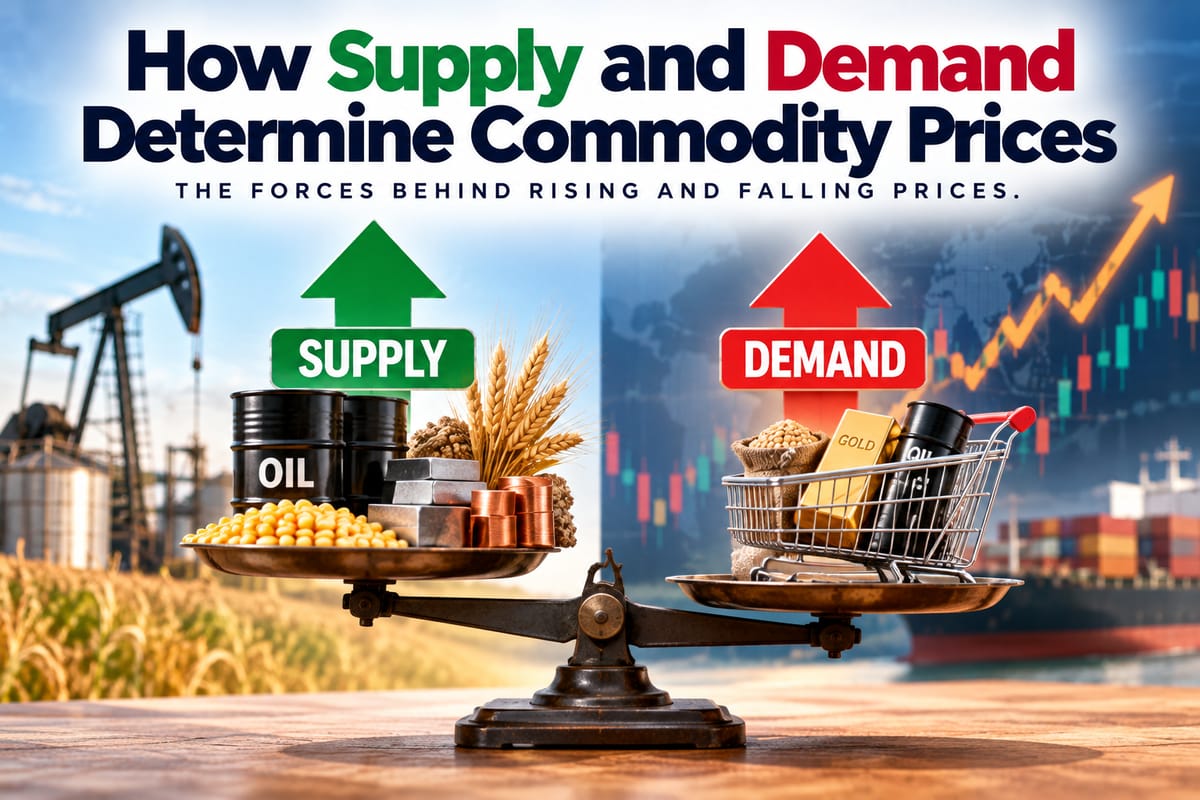
How Supply and Demand Determine Commodity Prices
Commodity prices can change significantly from one period to another, sometimes in response to events that seem far removed from the market itself. The price of oil may rise when production is disrupted, while grain prices can increase after poor harvests. At other times, prices may fall because production expands or consumers and businesses reduce their purchases.
Behind many of these movements are two fundamental forces: supply and demand.
Supply represents how much of a commodity producers are willing and able to sell, while demand represents how much buyers are willing and able to purchase at different prices. The interaction between the two helps determine the market price and the quantity traded.
Understanding this relationship provides a useful foundation for understanding everything from energy and agricultural markets to metals and other raw materials.
What Are Commodity Prices?
Commodity prices are the market prices paid for raw materials and primary goods that can generally be traded in standardized forms.
Common commodities include:
- Crude oil and natural gas
- Gold, silver, copper, and other metals
- Wheat, corn, soybeans, and other agricultural products
- Coffee, cocoa, sugar, and cotton
- Livestock and animal products
Unlike many finished consumer products, commodities are often traded in standardized quantities and grades. Their prices can be influenced by global production, consumption, inventories, transportation, weather, currency movements, economic conditions, and expectations about future supply and demand.
A useful starting point for understanding these markets is how commodity markets work, including the role played by producers, consumers, traders, exchanges, inventories, and other market participants.
How Supply Affects Commodity Prices
Supply refers to the quantity of a commodity available or expected to become available to the market.
When supply increases while other conditions remain relatively stable, sellers may face greater competition for buyers. This can place downward pressure on prices.
For example, imagine that several major oil-producing regions increase production at the same time. If global consumption does not rise enough to absorb the additional barrels, inventories may build. Buyers may then have less reason to offer high prices, potentially pushing the market price lower.
The opposite can happen when supply becomes constrained.
If production falls because of drought, equipment failures, transportation problems, production cuts, or other disruptions, buyers may compete for a smaller available quantity. Prices can rise as a result.
How Demand Affects Commodity Prices
Demand represents the amount of a commodity buyers want and are able to purchase at different prices.
When demand increases faster than available supply, prices can come under upward pressure.
Consider copper as an example. Copper is widely used in construction, electrical equipment, industrial machinery, and various technologies. If economic activity increases and businesses require more copper while production cannot expand quickly enough, buyers may compete for available supplies.
This can contribute to higher prices.
Demand can also decline. If industrial production slows, consumers reduce spending, or businesses postpone investment, demand for certain commodities may weaken. When supply remains plentiful, weaker demand can put downward pressure on prices.
The Role of Market Equilibrium
The interaction between supply and demand helps produce a market equilibrium.
At a simplified level, equilibrium occurs where the quantity sellers are willing to supply matches the quantity buyers are willing to purchase at a particular price.
If demand suddenly increases, the market may move toward a higher price until producers can increase supply or buyers reduce the amount they want to purchase.
If supply increases unexpectedly, the market may move toward a lower price until demand expands or producers reduce output.
Real commodity markets are more complicated than this simplified model, but the basic relationship remains an important way to understand price movements.
Why Commodity Supply Can Change Quickly
Commodity production does not always respond immediately to changes in price.
A farmer cannot instantly produce a new harvest because crop production follows planting and growing cycles. An oil company may require significant time and investment to develop new production capacity. A mining company can take years to bring a major new mine into operation.
This means commodity supply can sometimes be relatively inflexible in the short term.
When demand changes suddenly while production remains difficult to adjust, prices can move sharply.
Over a longer period, however, producers may respond to higher prices by investing in additional capacity, increasing production, or adopting more efficient technologies.
Why Demand Can Change Quickly
Demand can also change rapidly.
Economic growth, changes in consumer behavior, technological developments, government policies, and seasonal patterns can all influence how much of a commodity people and businesses want to buy.
For example, stronger industrial activity can increase demand for energy and metals. A slowdown can have the opposite effect.
Consumer behavior can matter as well. Changes in transportation preferences, energy use, construction activity, or food consumption can influence commodity demand over time.
What Happens When Demand Grows Faster Than Supply?
One of the clearest examples of supply and demand affecting prices occurs when demand rises faster than producers can respond.
Suppose global demand for a particular commodity increases significantly. Producers may initially have limited spare capacity. Buyers then compete for the available supply, causing prices to rise.
Higher prices can eventually encourage producers to increase output. They may invest in new facilities, expand existing operations, increase exploration, or seek alternative production methods.
At the same time, higher prices may encourage consumers and businesses to reduce consumption or find substitutes.
This adjustment can gradually reduce the imbalance between supply and demand.
The relationship between stronger demand and broader price increases is also important in understanding how strong demand can cause inflation.
What Happens When Supply Falls Suddenly?
A sudden supply reduction can have an immediate effect on prices.
Natural disasters, production accidents, transportation problems, export restrictions, labor disruptions, and geopolitical events can all reduce the amount of a commodity reaching the market.
When buyers still need roughly the same quantity but less supply is available, competition for the remaining supply can increase.
Energy markets are particularly sensitive to supply disruptions because oil and natural gas are important inputs for transportation, manufacturing, electricity generation, heating, and other economic activities.
Agricultural commodities can also experience supply shocks when droughts, floods, plant diseases, or other environmental conditions affect harvests.
The Impact of Geopolitical Events
Commodity markets are closely connected to global politics because production and consumption are distributed across different countries and regions.
A conflict, trade restriction, sanctions regime, political dispute, or disruption to an important transportation route can affect expectations about future supply.
Even when physical supply has not yet changed significantly, traders may adjust prices based on the possibility that it could become harder to obtain the commodity later.
This is one reason geopolitical disruptions can affect commodity markets.
The effect can extend beyond the commodity itself. Higher energy, food, or industrial material costs can influence businesses and consumers in other parts of the economy.
The Importance of Inventories
Inventories can help explain why the same supply disruption does not always produce the same price reaction.
If warehouses, storage facilities, or strategic reserves contain substantial quantities of a commodity, buyers may be able to rely on existing stocks when new supply is temporarily limited.
Large inventories can therefore provide a buffer against short-term disruptions.
When inventories are already low, however, even a relatively modest disruption may create greater concern among buyers.
Market participants therefore pay close attention to inventory levels when assessing potential changes in commodity prices.
Expectations Can Move Prices Before Supply Changes
Commodity markets do not only respond to what is happening today. Expectations about the future can also influence current prices.
Suppose traders expect oil production to decline several months from now. They may adjust their positions before the physical shortage occurs.
Likewise, if markets expect a large agricultural harvest, prices may weaken ahead of the actual arrival of the crop because participants anticipate greater future availability.
Expectations can therefore make commodity prices respond before changes in physical supply or demand become visible in official production and consumption data.
Weather and Agricultural Commodities
Weather is particularly important for agricultural commodities.
Farmers depend on suitable conditions for planting, crop development, and harvesting. Droughts can reduce yields, while excessive rainfall, floods, frost, or extreme temperatures can also damage crops.
When expectations for a harvest deteriorate, commodity prices may rise because traders anticipate tighter future supply.
Favorable growing conditions can have the opposite effect by increasing expectations for production.
This makes agricultural commodity markets particularly sensitive to seasonal forecasts and changing weather conditions.
Substitutes Can Change Demand
Consumers and businesses may sometimes switch from one commodity to another when prices change.
For example, manufacturers may look for alternative materials when one input becomes significantly more expensive. Energy consumers may also change fuel sources when relative prices shift.
The availability of substitutes can therefore influence how strongly demand responds to price changes.
If there are few practical alternatives, buyers may continue purchasing a commodity despite higher prices. If alternatives are readily available, demand may respond more quickly.
Transportation Costs Also Matter
A commodity’s market price is influenced not only by production and consumption but also by the cost of moving it.
Oil, grain, metals, and other commodities often travel long distances between producers and consumers.
Higher shipping, fuel, insurance, or infrastructure costs can increase the expense of getting commodities to market.
Transportation disruptions can have an even larger impact when important ports, railways, pipelines, roads, or shipping routes are affected.
As a result, two regions can sometimes experience different prices for the same commodity because of differences in transportation costs, local availability, and infrastructure.
How Commodity Prices Affect Other Prices
Commodities often serve as inputs into other products and services.
Oil and natural gas can affect transportation and energy costs. Metals can influence manufacturing expenses. Agricultural commodities can affect food production costs.
When commodity prices rise significantly, businesses may face higher input costs. Some businesses may absorb those costs, while others may pass part of them to customers.
This creates a connection between commodity markets and broader inflation.
The relationship becomes particularly important when price increases spread across multiple countries. How global inflation spreads across economies helps illustrate why inflationary pressures in one part of the global economy can influence prices elsewhere.
Why Prices Do Not Always Move in a Straight Line
Supply and demand rarely change independently.
A rise in commodity prices can eventually affect demand. Consumers may reduce consumption, businesses may seek substitutes, and producers may increase output.
Likewise, falling prices can discourage production and encourage consumption.
These feedback effects can create complex price movements.
Commodity prices can also respond to interest rates, currencies, financial market conditions, inventories, expectations, government policies, technological changes, and international trade.
Supply and demand provide a foundation, but they operate within a much larger economic system.
The Difference Between Short-Term and Long-Term Effects
The effect of a supply or demand change can differ depending on the time period being considered.
In the short term, production may be difficult to change. A mine cannot suddenly double output, and a farmer cannot immediately increase the size of a harvest.
Over the longer term, higher prices may encourage investment and innovation. Producers may develop new resources, expand capacity, improve efficiency, or adopt different technologies.
Consumers can also adapt over time by changing purchasing patterns or adopting substitutes.
This distinction helps explain why a temporary shortage can produce a sharp price increase without necessarily causing permanently high prices.
Why Commodity Prices Matter to Everyday Consumers
People do not need to trade commodities directly to be affected by their prices.
Commodity markets can influence everyday expenses through energy, transportation, food, construction, manufacturing, and other sectors.
For example, higher energy prices can increase transportation costs, while higher agricultural commodity prices can contribute to increased food production expenses.
The ultimate effect on consumers depends on many factors, including how long the commodity price change lasts, how businesses respond, and whether alternative supplies or substitutes become available.
Understanding the Bigger Market Picture
Supply and demand provide one of the clearest ways to understand why commodity prices change.
When supply becomes tighter while demand remains strong, prices can rise. When supply expands faster than demand, prices can fall. When both forces change at the same time, the resulting price movement depends on the relative size and timing of those changes.
From weather and harvests to industrial activity, inventories, transportation, technology, and geopolitical events, numerous factors can influence the balance between what the world produces and what it wants to consume.
For anyone trying to understand commodity markets, watching both sides of that equation is essential. Prices are not simply numbers on a trading screen—they reflect changing expectations about the availability and use of resources throughout the economy.