How Global Inflation Spreads Across Economies
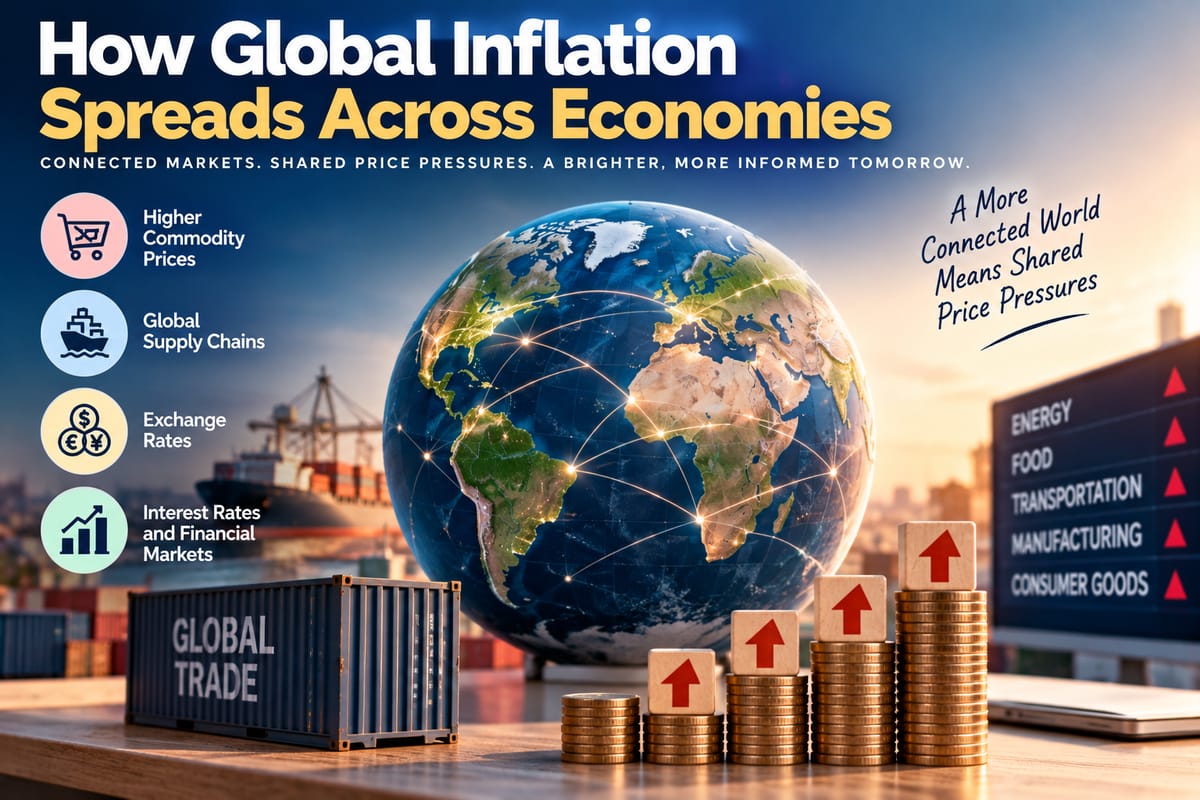
Inflation is often described as a domestic economic problem, but in an increasingly connected world, price pressures rarely remain entirely within one country’s borders. Changes in energy prices, food costs, exchange rates, wages, supply chains, interest rates, and consumer demand can move across economies and influence prices far beyond where the original pressure began.
This is why a disruption in one major economy or commodity market can eventually affect households and businesses in countries thousands of miles away. The effects are not always immediate, and they do not affect every economy in the same way, but global connections can create powerful channels through which inflation spreads.
Understanding these channels helps explain why prices can rise even when the underlying cause appears to originate somewhere else.
What Does Global Inflation Mean?
Inflation refers to a sustained increase in the general price level of goods and services over time. When inflation rises, the purchasing power of money generally declines, meaning consumers need more money to purchase the same amount of goods and services.
Global inflation does not necessarily mean that every country experiences exactly the same inflation rate. Instead, it describes a situation in which inflationary pressures are transmitted between economies through international trade, financial markets, commodities, currencies, and supply chains.
Some countries may experience stronger effects than others depending on their economic structure and exposure to international markets.
A useful starting point is the Complete Guide to Economic Indicators, which explains how inflation and other measures help reveal changes in economic conditions.
International Trade Is a Major Transmission Channel
Countries depend on one another for many products and raw materials.
A country may import oil, natural gas, food, machinery, electronics, industrial materials, or consumer goods from other parts of the world. When the cost of producing or transporting those products rises, exporters may increase their prices.
Importing countries can then face higher costs.
Businesses may respond by raising the prices they charge consumers, reducing profit margins, changing suppliers, or adjusting production. The resulting price increases can gradually spread through domestic economies.
This process is particularly important for countries that rely heavily on imports for essential goods.
Energy Prices Can Spread Inflation Quickly
Energy is one of the most important links between economies.
Oil and natural gas are used directly for transportation, heating, electricity generation, manufacturing, and numerous industrial processes. When energy prices rise significantly, the effects can extend well beyond the cost of filling a vehicle or heating a building.
Higher energy costs can increase the expense of producing and transporting other goods.
A manufacturer may pay more to operate machinery. A trucking company may face higher fuel expenses. A supermarket may pay more to transport products from suppliers. Businesses throughout the supply chain may then adjust their prices.
This can create what economists often describe as indirect inflationary effects.
Food Prices Can Cross Borders
Food markets are also closely connected internationally.
Countries may import grains, cooking oils, fertilizers, meat, dairy products, fruits, or other agricultural inputs. A disruption affecting production in one major exporting region can therefore influence prices elsewhere.
Weather conditions, transportation problems, geopolitical disruptions, fertilizer costs, and changes in energy prices can all affect agricultural markets.
When global food prices rise, countries that depend heavily on imports may experience particularly strong effects. Lower-income households can feel the pressure more intensely because food often represents a larger share of household spending.
The impact of inflation on individual households is explored in greater detail in How Inflation Affects Everyday Finances.
Supply Chains Can Carry Inflation Across Borders
Modern manufacturing often involves multiple countries.
A single product may depend on raw materials from one region, components manufactured in another, assembly somewhere else, and transportation through several international hubs before reaching consumers.
This creates efficiency, but it also creates interconnected risks.
If an important component becomes more expensive or difficult to obtain, manufacturers may face higher production costs. Transportation delays can create additional expenses. Businesses may then pass some of these costs through to distributors and consumers.
A supply-chain disruption in one location can therefore contribute to price pressures much farther away.
Exchange Rates Can Magnify Imported Inflation
Currency values play an important role in determining the domestic cost of imported goods.
Suppose a country’s currency loses value relative to the currencies of its major trading partners. Products priced in foreign currencies can then become more expensive for domestic buyers.
This can affect imported fuel, food, machinery, technology, medicine, and other goods.
The relationship works in the opposite direction as well. A stronger domestic currency can reduce the local cost of some imports, potentially easing certain inflationary pressures.
Exchange rates therefore provide another pathway through which international financial conditions can influence domestic prices.
Wages Can Create Additional Price Pressure
Inflation can also develop through domestic wage and price dynamics.
When living costs rise, workers may seek higher wages to maintain their purchasing power. Businesses facing higher labor costs may increase prices to protect their margins.
Higher prices can then contribute to additional wage demands.
This does not mean that higher wages automatically cause persistent inflation. Wage growth can also reflect improvements in productivity or an economy adjusting after a period of weak wage growth.
However, when strong demand, labor shortages, and rising costs occur together, wage and price pressures can reinforce one another.
Global Demand Can Push Prices Higher
Inflation can spread through demand as well as supply.
When major economies experience strong consumer spending, businesses may increase production and compete for raw materials, workers, transportation capacity, and other resources.
If global demand grows faster than supply can respond, prices can rise.
This is especially relevant for internationally traded commodities. A surge in demand from several large economies can place upward pressure on global prices, even if individual smaller economies are not experiencing unusually strong domestic demand.
Financial Markets Connect Economies
Inflation is closely connected to financial markets because investors respond to changes in economic conditions and expectations.
When inflation rises, investors may adjust expectations about interest rates, economic growth, corporate earnings, currencies, and government borrowing.
These changes can affect financial conditions across borders.
Capital can move between countries in response to changing interest rates and perceived risks. Currency values can shift, borrowing costs can change, and asset prices can respond to new expectations.
These interconnected movements are part of the broader patterns described in How Economic and Financial Market Cycles Work.
Central Banks Can Influence the Spread
Central banks play an important role in responding to inflation.
When inflation becomes persistent, a central bank may raise interest rates or use other monetary policy tools to reduce demand and keep inflation expectations under control. When inflation is weak, policymakers may take different actions to support economic activity.
Because major economies are connected through trade and financial markets, changes in monetary policy can affect other countries.
Higher interest rates in a major economy can influence capital flows, exchange rates, borrowing costs, and financial conditions elsewhere.
The broader relationship between monetary policy and borrowing costs is explained in Understanding Interest Rates and Their Effects.
Why Some Countries Experience More Inflation Than Others
Global inflationary pressure does not produce identical results everywhere.
Several factors can determine how strongly an economy is affected:
- Dependence on imported energy
- Reliance on imported food
- Currency stability
- Domestic production capacity
- Supply-chain resilience
- Government policies
- Wage growth
- Consumer demand
- Energy resources
- Exposure to international trade
An economy that produces much of its own energy, food, and manufactured goods may respond differently from one that depends heavily on imports.
Similarly, a country with a relatively stable currency may experience different imported inflation pressures from a country whose currency has weakened substantially.
Inflation Expectations Can Become Self-Reinforcing
What people expect to happen to prices can influence actual economic behavior.
If consumers believe prices will continue rising, they may bring forward purchases. Businesses may adjust prices sooner to protect against anticipated cost increases. Workers may seek higher wages in anticipation of rising living expenses.
These responses can influence actual prices and wages.
This is why central banks often pay close attention not only to current inflation but also to measures and indicators that provide information about future inflation expectations.
Keeping expectations stable can make it easier for an economy to adjust without creating a prolonged cycle of rising prices and costs.
Governments Can Also Affect Inflation
Fiscal policy can influence the strength of inflationary pressures.
Government spending, taxation, subsidies, transfers, and other fiscal measures can affect household purchasing power and overall demand.
Government policies can also directly influence certain prices. For example, changes in taxes, subsidies, energy policies, or regulated prices can affect the cost consumers face.
The effect depends heavily on the economic circumstances and the specific policy being implemented.
Global Inflation Does Not Always Move in One Direction
International price pressures can also weaken.
If energy prices fall, supply chains normalize, transportation costs decline, or commodity production increases, some inflationary pressures can ease.
Likewise, weaker global demand can reduce competition for scarce resources and lower prices for certain goods.
This means global inflation is not a one-way process. The same interconnected systems that transmit rising costs can also transmit improvements in supply and falling commodity prices.
Businesses Have to Adapt to Changing Costs
Businesses operating in global markets must constantly manage international price changes.
Companies may respond to inflation by renegotiating supplier contracts, changing product sizes, finding alternative suppliers, improving efficiency, adjusting inventories, or passing some costs to consumers.
Large multinational companies may have more options for managing international price differences, while smaller businesses can be more exposed to sudden changes in imported costs.
The ability to adapt can therefore influence how strongly global inflation reaches individual consumers.
Consumers Ultimately Feel the Effects
Although global inflation begins with large economic forces, its consequences eventually appear in everyday decisions.
Households may face higher prices for groceries, transportation, housing-related expenses, utilities, clothing, technology, and other goods and services.
When prices rise faster than income, households may need to change spending patterns. They may delay major purchases, reduce discretionary spending, switch products, or prioritize essential expenses.
Understanding these household effects is important because inflation is not simply an abstract economic statistic. It influences purchasing power and the choices people make every day.
Why Global Inflation Is Difficult to Predict
Inflation depends on many interconnected variables, making precise predictions difficult.
Energy markets can change quickly. Supply chains can improve or deteriorate. Weather can affect food production. Currency markets can move unexpectedly. Consumer demand can strengthen or weaken. Central banks can change monetary policy in response to new information.
A development that appears inflationary in one period may have a different effect later.
For that reason, economists and policymakers typically examine multiple indicators rather than relying on a single measure.
The Global Economy Creates Both Risks and Buffers
Economic interconnectedness can make inflation spread more easily, but international connections can also provide ways to absorb shocks.
Businesses can sometimes find alternative suppliers. Countries can diversify energy sources. Consumers can substitute between products. Producers can increase output when prices create stronger incentives.
International trade can therefore transmit economic problems while also providing mechanisms for adjustment.
The outcome depends on how flexible and resilient individual economies are.
Understanding Inflation in a Connected World
Global inflation is not caused by one factor or transmitted through a single pathway. It can move through energy markets, food prices, supply chains, exchange rates, wages, financial markets, consumer demand, and monetary policy.
The effects also vary considerably between countries. Economies with different currencies, trade relationships, resources, production structures, and policy frameworks can experience very different inflation outcomes even when they face the same global shock.
For households, businesses, investors, and policymakers, understanding these connections provides a clearer picture of why prices can change and why inflation in one part of the world can eventually become an economic concern somewhere else.