How Central Banks Affect Commercial Banks
Commercial banks are often the financial institutions people interact with most frequently. They hold deposits, provide loans, process payments, issue cards and offer a wide range of financial services to households and businesses.
Yet commercial banks do not operate in isolation.
Behind the banking system sits another layer of institutions with a much broader responsibility: central banks.
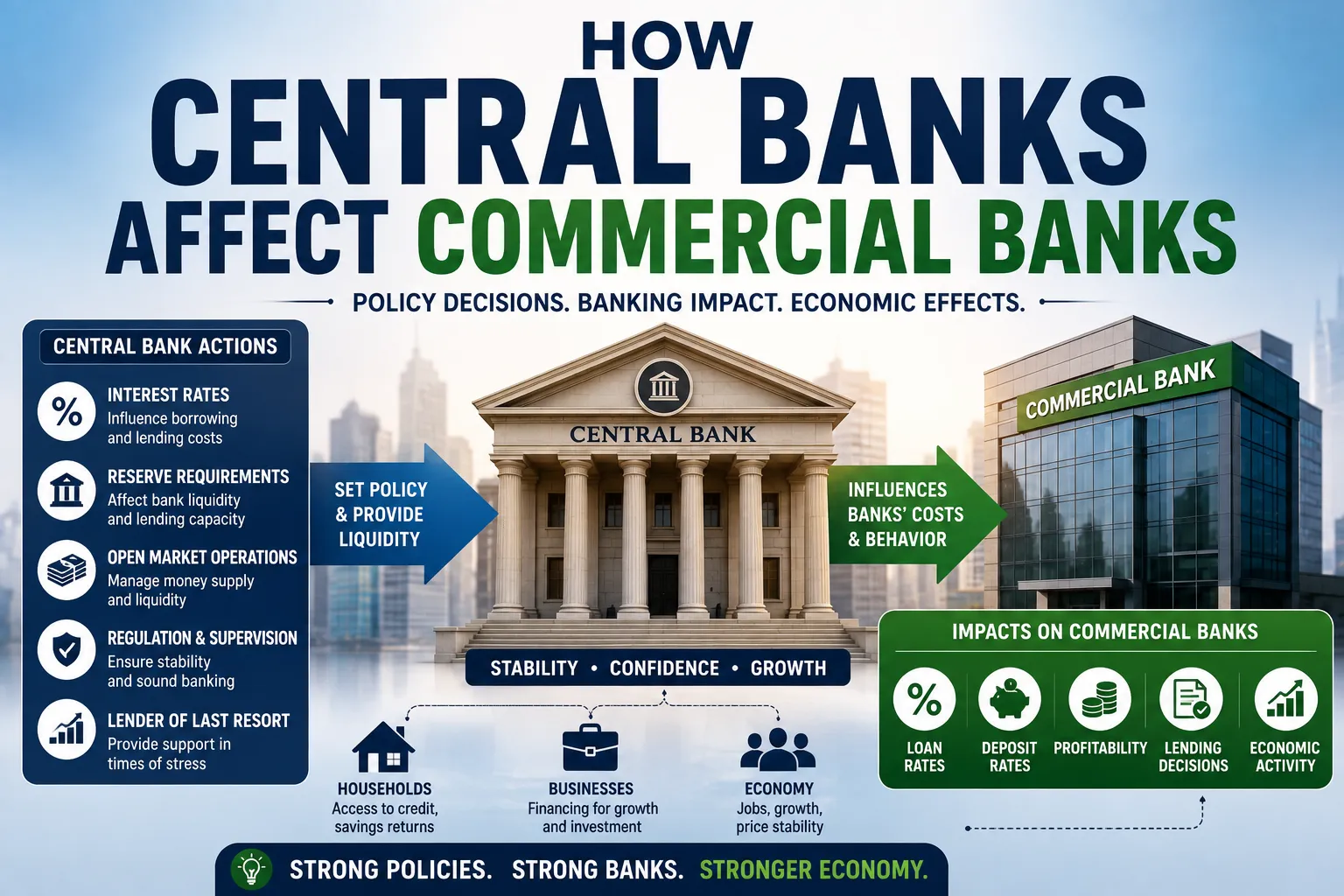
Central banks influence the financial environment in which commercial banks operate. Through interest-rate decisions, reserve policies, liquidity operations, regulation and other tools, they can affect how much banks charge borrowers, what they pay depositors, how easily they can access funding and how willing they are to lend.
These decisions can eventually reach almost everyone—from a homeowner applying for a mortgage to a business seeking working capital.
Understanding how central banks affect commercial banks therefore helps explain why borrowing costs change, why savings rates rise and fall, why banks sometimes tighten lending standards and why monetary policy can have such a powerful effect on the broader economy.
For a broader overview of the different types of banking relationships and accounts consumers use, see this complete guide to bank accounts and account types.
What Is a Central Bank?
A central bank is a country’s or monetary region’s institution responsible for important functions within the financial and monetary system.
Depending on the country, its responsibilities can include:
- Setting or influencing monetary policy
- Maintaining price stability
- Supporting financial stability
- Issuing or managing currency
- Providing banking services to financial institutions
- Managing foreign-exchange reserves
- Acting as a lender of last resort
- Supervising or supporting the banking system
Examples include the Federal Reserve in the United States, the Bank of England, the European Central Bank and the Central Bank of Kenya.
The exact responsibilities differ from one jurisdiction to another.
What Is a Commercial Bank?
A commercial bank is a financial institution that provides services to individuals, businesses and other organizations.
Typical activities include:
- Accepting deposits
- Providing loans
- Offering checking or current accounts
- Providing savings accounts
- Processing payments
- Issuing debit and credit cards
- Providing foreign-exchange services
- Financing businesses
- Offering mortgages
- Managing cash and treasury services
Commercial banks generally earn money by charging interest and fees on financial services while paying interest or other returns on certain deposits and funding sources.
The difference between what a bank earns on assets and what it pays on funding is an important part of its business model.
The Relationship Between Central and Commercial Banks
A useful way to think about the relationship is:
Central bank → financial conditions → commercial banks → households and businesses → broader economy
When a central bank changes monetary policy, commercial banks often adjust their own behavior.
For example:
Central bank raises policy rates → banks’ funding becomes more expensive → lending rates may rise → borrowing becomes less attractive → credit demand may fall.
The opposite can happen when monetary policy becomes more accommodative.
However, the process isn’t automatic or instantaneous.
Commercial banks consider many factors when setting rates and deciding whether to lend.
The Most Important Channel: Interest Rates
Interest rates are one of the most powerful ways central banks influence commercial banks.
A central bank may raise or lower a policy rate that affects short-term borrowing conditions in the financial system.
Commercial banks then consider those conditions when determining the rates they charge customers and the returns they offer on deposits.
What Happens When a Central Bank Raises Interest Rates?
Suppose a central bank raises its policy rate to combat persistent inflation.
The first effects occur within financial markets and the banking system.
Commercial banks may face higher costs for:
- Certain forms of market funding
- Interbank borrowing
- Central-bank facilities
- New deposits
- Other short-term financing
Banks may respond by increasing lending rates.
That can affect:
- Mortgages
- Business loans
- Personal loans
- Credit cards
- Overdrafts
- Other variable-rate borrowing
As borrowing becomes more expensive, some consumers and businesses may postpone taking out loans.
Why Higher Rates Can Help Banks Too
It might seem that higher interest rates are always bad for banks.
That’s not necessarily true.
Banks make money by earning interest on loans and investments.
If lending rates rise faster than funding costs, banks may experience stronger net interest margins.
For example:
A bank might previously have:
- Average lending yield: 7%
- Average funding cost: 3%
Approximate spread: 4 percentage points
After rates rise:
- Average lending yield: 10%
- Average funding cost: 5%
Approximate spread: 5 percentage points
In this simplified example, the bank’s interest spread improves.
But real-world banking is much more complicated.
If deposit costs rise rapidly, loan demand weakens or credit losses increase, higher rates can eventually become a problem.
What Is Net Interest Margin?
Net interest margin (NIM) measures the difference between the interest a bank earns on interest-generating assets and the interest it pays on funding, relative to its interest-earning assets.
It is an important indicator of bank profitability.
A simplified formula is:
Net Interest Margin = (Interest Income − Interest Expense) ÷ Average Interest-Earning Assets
Central-bank policy can have a significant influence on NIM.
But the impact varies by bank.
Why Banks Don’t Always Pass Rate Changes Directly to Customers
A central bank can change its policy rate, but that doesn’t mean every commercial-bank interest rate changes by exactly the same amount.
Banks consider:
- Competition
- Credit risk
- Funding costs
- Customer demand
- Loan maturity
- Deposit behavior
- Capital requirements
- Operating costs
- Market expectations
A central-bank rate increase of one percentage point could therefore produce different changes across different banking products.
Fixed-Rate and Variable-Rate Loans
The effect of central-bank policy also depends on the type of loan.
Variable-Rate Loans
These can respond relatively quickly to changes in market or benchmark rates.
Examples may include:
- Variable-rate mortgages
- Floating-rate business loans
- Some personal loans
Fixed-Rate Loans
The interest rate may remain unchanged for the agreed fixed period.
However, newly issued fixed-rate loans may become more expensive as market expectations change.
Central Banks and Deposit Rates
Central-bank decisions don’t only affect borrowers.
They also influence savers.
When policy rates rise, commercial banks may increase rates on:
- Savings accounts
- Fixed deposits
- Certificates of deposit
- Other interest-bearing accounts
But deposit rates don’t necessarily rise at the same pace as lending rates.
Banks may have little incentive to increase deposit rates aggressively if they already have enough funding.
Competition between banks can also determine how quickly deposit rates respond.
Why Deposit Competition Matters
When interest rates are low, customers may accept relatively modest returns on savings.
When rates rise, customers have a greater incentive to move money between banks or financial products in search of better returns.
Commercial banks may therefore increase deposit rates to retain customers.
This can raise their funding costs.
The result is a balancing act:
Higher loan rates can increase revenue, but higher deposit rates can increase expenses.
Central Banks and Bank Liquidity
Banks need liquidity to meet withdrawals, payments and other short-term obligations.
Central banks can influence liquidity conditions through monetary-policy operations and financial-market facilities.
When the financial system experiences stress, central banks may provide liquidity to eligible institutions under appropriate conditions.
This can help prevent temporary funding problems from becoming broader financial instability.
What Is a Lender of Last Resort?
A central bank can sometimes act as a lender of last resort.
This means providing emergency liquidity to financial institutions that are facing severe short-term funding pressure but may otherwise be fundamentally viable.
The purpose is not simply to rescue poorly managed banks.
It is to reduce the risk that temporary liquidity problems spread through the financial system.
A bank can potentially be solvent on paper but still experience a liquidity crisis if it cannot obtain cash quickly enough to meet immediate obligations.
Liquidity vs. Solvency
These terms are often confused.
Liquidity
The ability to meet financial obligations when they become due.
Solvency
The ability to remain financially viable because assets exceed liabilities over the relevant accounting and economic framework.
A bank can have valuable assets but still face a liquidity problem.
Central-bank liquidity facilities are primarily designed to address liquidity stress, subject to the applicable rules and collateral requirements.
Central Banks and Reserve Requirements
Some central banks require commercial banks to maintain certain reserves or liquidity buffers.
The precise rules vary significantly by country.
Reserve requirements can affect how banks manage:
- Deposits
- Lending
- Liquidity
- Cash
- Central-bank balances
A higher reserve requirement can constrain certain forms of lending or increase the amount of liquid assets banks need to hold.
A lower requirement can provide more flexibility, although the actual effect depends on the broader regulatory and monetary framework.
Modern Banking Uses More Than Reserve Requirements
Reserve requirements are only one part of modern monetary and banking systems.
Central banks can also influence financial conditions through:
- Policy interest rates
- Open-market operations
- Asset purchases or sales
- Lending facilities
- Standing facilities
- Liquidity operations
- Forward guidance
- Macroprudential tools in some jurisdictions
The relative importance of these tools differs between countries.
Open-Market Operations
Central banks can buy or sell certain financial assets as part of implementing monetary policy.
These transactions can influence:
- Bank reserves
- Short-term interest rates
- Bond yields
- Liquidity
- Financial conditions
The details vary depending on the monetary system.
In broad terms, central-bank operations can change the amount and cost of liquidity available within financial markets.
Quantitative Easing
During certain periods, central banks may purchase large quantities of financial assets, particularly government bonds.
This is commonly known as quantitative easing (QE).
QE can be used when conventional policy rates are already very low or when policymakers want to provide additional monetary support.
It can affect:
- Bond yields
- Asset prices
- Bank liquidity
- Borrowing conditions
- Investor behavior
The exact effects depend on economic conditions and how financial institutions respond.
Quantitative Tightening
The reverse process is often referred to as quantitative tightening (QT).
A central bank can reduce the size of its balance sheet by allowing certain assets to mature without replacing them or by selling assets under an appropriate policy framework.
This can contribute to tighter financial conditions.
Commercial banks may respond by adjusting their funding, lending and liquidity strategies.
Central Banks and Credit Creation
Commercial banks play an important role in creating credit.
When a bank makes a loan, it generally creates a corresponding deposit within the banking system.
However, banks cannot create unlimited credit.
They are constrained by factors such as:
- Capital
- Liquidity
- Regulation
- Credit risk
- Funding
- Profitability
- Borrower demand
Central-bank policy influences several of these conditions.
How Interest Rates Affect Loan Demand
When borrowing costs rise, fewer borrowers may find loans attractive.
A business might delay:
- Purchasing equipment
- Opening a new location
- Hiring workers
- Expanding production
A household might delay:
- Buying a home
- Financing a vehicle
- Taking a personal loan
- Making a major purchase
Lower rates can have the opposite effect.
This is one of the main ways monetary policy influences economic activity.
Central Banks and Credit Standards
Interest rates aren’t the only factor that matters.
Commercial banks also decide who qualifies for credit.
During uncertain economic conditions, banks may tighten lending standards even if central-bank rates are falling.
They might require:
- Higher credit scores
- Larger deposits
- More collateral
- Stronger business financials
- Lower debt levels
This is why lower policy rates don’t automatically mean every borrower can obtain cheap credit.
Why Banks Tighten Lending
Banks are businesses that must manage credit risk.
If economic conditions deteriorate, the probability that borrowers will struggle to repay loans may increase.
Banks can respond by becoming more cautious.
This can create a feedback effect:
Economic weakness → higher credit risk → tighter lending → less borrowing → weaker spending and investment.
Central banks may attempt to offset such conditions through easier monetary policy, but monetary policy cannot eliminate credit risk.
Central Banks and Bank Profitability
Central-bank decisions can affect several major sources of bank revenue and expenses.
Interest Income
Higher lending rates can increase interest income.
Funding Costs
Higher deposit and wholesale funding rates can increase expenses.
Loan Demand
Higher borrowing costs can reduce demand.
Credit Losses
Economic weakness can increase defaults.
Securities Portfolios
Changes in interest rates affect the market value of bonds and other assets.
The combined effect determines whether a particular bank benefits or suffers.
Why Rising Rates Can Create Bond Losses
Commercial banks often hold government bonds and other securities.
When market interest rates rise, the market value of existing fixed-rate bonds generally falls.
For example, suppose a bank owns a bond paying a fixed 3% coupon.
If newly issued comparable bonds begin paying 5%, the older 3% bond becomes less attractive in the market.
Its market value can decline.
This doesn’t necessarily mean the bank loses money permanently if the bond is held to maturity and the issuer pays as promised, but accounting treatment, liquidity needs and the bank’s portfolio classification can affect the financial impact.
The Interest-Rate Risk Banks Face
Banks must manage the risk that interest rates move in ways that hurt their balance sheets.
This is commonly known as interest-rate risk.
For example:
- Assets may reprice slowly
- Deposits may reprice quickly
- Loans may be fixed-rate
- Funding may be variable-rate
If the timing of these changes is unfavorable, profitability can suffer.
What Happens When Central Banks Cut Rates?
When a central bank reduces policy rates, commercial banks may eventually reduce some lending rates.
Potential effects include:
- Cheaper borrowing
- Higher demand for loans
- Lower debt-servicing costs for some borrowers
- Greater investment
- Increased consumer spending
But banks may also experience lower yields on new loans and securities.
So rate cuts aren’t automatically positive for bank profits.
Rate Cuts Can Create a Different Banking Challenge
Suppose a bank previously earned high interest rates on loans.
As rates fall, new loans may generate less interest income.
At the same time, banks may be reluctant to lower deposit rates by the same amount because customers are sensitive to savings returns.
This can compress margins.
Therefore:
Higher rates can create margin opportunities but also credit and funding risks.
Lower rates can support loan demand but potentially reduce interest margins.
Central Banks and Inflation
One of the central goals of monetary policy in many jurisdictions is price stability.
When inflation becomes too high, a central bank may tighten monetary policy.
Commercial banks then transmit those tighter financial conditions through the economy.
Higher borrowing costs can reduce demand.
Less demand can eventually reduce pressure on prices.
The process can take time.
How Inflation Affects Banks Directly
Inflation can influence commercial banks through:
- Borrower repayment capacity
- Wage costs
- Operating expenses
- Interest rates
- Loan demand
- Asset values
- Credit losses
High inflation can therefore create a complicated environment for banks.
Banks may charge higher interest rates, but their customers may simultaneously face higher living and operating costs.
Central Banks and Economic Growth
Central banks also pay attention to economic activity and employment, depending on their mandates.
If economic growth weakens substantially, policymakers may consider easing financial conditions.
Commercial banks can then potentially:
- Offer cheaper loans
- Increase credit availability
- Support investment
- Reduce borrowing costs for customers
However, commercial banks ultimately decide whether and how aggressively to lend.
The Transmission Mechanism
Economists often describe the process through which monetary policy affects the economy as the monetary policy transmission mechanism.
A simplified version looks like this:
Central bank changes policy
↓
Financial-market conditions change
↓
Commercial-bank funding and lending conditions change
↓
Households and businesses adjust borrowing and spending
↓
Economic activity changes
↓
Inflation and employment respond
This process can take months or longer.
Why Monetary Policy Doesn’t Work Instantly
Central-bank decisions affect the economy with variable and uncertain time lags.
A rate increase today doesn’t immediately change every mortgage, business loan or consumer purchase.
Banks need time to:
- Reprice loans
- Adjust deposit rates
- Change lending standards
- Update financial forecasts
- Respond to customer behavior
Borrowers also need time to change their spending and investment plans.
Central Banks and Foreign Exchange
Central-bank policy can also influence currency values.
When a country’s interest rates rise relative to those in other countries, its financial assets may become more attractive to some international investors.
This can affect demand for the country’s currency.
Exchange-rate movements can then affect commercial banks through:
- Foreign-currency lending
- Import financing
- Export financing
- International payments
- Foreign-currency deposits
- Cross-border investments
The relationship is complex because currencies respond to many factors beyond interest rates.
Commercial Banks and Foreign-Currency Loans
Banks that offer foreign-currency loans can face additional risks.
If a borrower earns income in one currency but owes debt in another, a currency depreciation can significantly increase the borrower’s repayment burden.
Central banks and financial regulators may therefore pay close attention to foreign-currency exposure.
Central Banks and Banking Regulation
Monetary policy isn’t the only way central banks can affect commercial banks.
Depending on their legal mandate, central banks may also supervise banks or work closely with financial regulators.
Rules can address areas such as:
- Capital adequacy
- Liquidity
- Risk management
- Governance
- Reporting
- Consumer protection
- Large exposures
These requirements can affect how banks allocate their resources.
What Is Bank Capital?
Bank capital acts as a financial cushion against losses.
A simplified balance-sheet relationship is:
Assets = Liabilities + Equity
Deposits and other borrowings are liabilities.
Loans and investments are assets.
Capital represents the bank’s own financial resources and provides protection against losses.
Higher capital requirements can make banks more resilient, but they can also influence how much capital a bank can deploy toward lending and other activities.
Why Capital Requirements Matter
Suppose a bank wants to expand its loan portfolio.
It cannot simply lend without considering regulatory capital requirements.
If the loans carry significant risk, the bank may need additional capital to support them.
This can affect:
- Loan growth
- Pricing
- Risk appetite
- Return on equity
Central banks and regulators therefore influence banking behavior not only through interest rates but also through prudential requirements.
Central Banks and Financial Stability
Central banks also monitor systemic risks.
A banking problem at one institution can sometimes spread to others through:
- Interbank lending
- Payment systems
- Common asset holdings
- Depositor confidence
- Market sentiment
This is known as contagion.
Central banks can work with regulators and governments to reduce systemic risks and maintain confidence in the financial system.
What Happens During a Banking Crisis?
A financial crisis can dramatically change the relationship between central banks and commercial banks.
If banks face severe liquidity pressure, central banks may provide emergency facilities subject to applicable rules.
They may also take steps to stabilize financial markets.
The goal is generally to prevent a temporary disruption from becoming a broader financial collapse.
However, central banks cannot eliminate every risk from the banking system.
Why Commercial Banks Watch Central-Bank Meetings
Bank executives, traders and economists pay close attention to central-bank announcements because they can influence:
- Loan pricing
- Deposit pricing
- Bond values
- Funding costs
- Customer demand
- Currency markets
- Economic forecasts
A small change in wording can sometimes affect market expectations.
Forward Guidance
Central banks may communicate their expectations about future monetary policy.
This is sometimes called forward guidance.
For example, a central bank might signal that it expects interest rates to remain restrictive for some time.
Commercial banks can use such information when making decisions about:
- Loan pricing
- Treasury investments
- Funding
- Liquidity
- Strategic planning
However, forward guidance is not a guarantee.
Economic conditions can change.
Why Expectations Matter as Much as Actual Rate Changes
Financial markets often react before a central bank actually changes its policy rate.
If investors strongly expect a rate cut, bond yields may fall before the central bank announces it.
Commercial banks then operate in an environment that has already changed.
This means expectations can influence:
- Mortgage rates
- Bond yields
- Funding costs
- Currency values
- Bank share prices
Monetary policy is therefore partly about managing expectations.
How Central Banks Affect Bank Customers
The central bank may not set the interest rate on your personal loan.
But its policies can influence the rate your bank offers.
The chain might look like:
Central bank policy rate
→ market interest rates
→ bank funding costs
→ commercial-bank pricing
→ customer loan or deposit rate
This is why a central-bank decision can eventually affect household finances.
How Borrowers Feel the Impact
Borrowers can experience central-bank policy through changes in:
- Mortgage payments
- Personal-loan rates
- Credit-card interest
- Business financing
- Overdraft costs
- Auto loans
The impact is particularly noticeable for borrowers with variable-rate debt.
How Savers Feel the Impact
Savers may see changes in:
- Savings rates
- Fixed-deposit returns
- Money-market yields
- Bond yields
Higher rates can benefit savers, particularly those holding interest-bearing assets.
But inflation matters.
A savings account paying 5% isn’t necessarily producing a strong real return if inflation is also high.
Real vs. Nominal Interest Rates
The nominal interest rate is the stated rate.
The real interest rate roughly reflects the nominal rate after accounting for inflation.
A simplified approximation is:
Real interest rate ≈ Nominal interest rate − Inflation rate
For example:
- Savings rate: 6%
- Inflation: 4%
Approximate real return: 2%
This is simplified and doesn’t account for taxes, fees or compounding.
Why Central Banks Can’t Control Everything
Central banks have powerful tools, but they don’t control the entire economy.
Factors outside their direct control include:
- Global commodity prices
- Wars
- Weather
- Supply-chain disruptions
- Government fiscal policy
- Consumer behavior
- Global demand
- Technological changes
Monetary policy can influence demand and financial conditions, but it cannot instantly produce more oil, food or semiconductors.
Fiscal Policy Is Different
Central-bank policy is generally associated with monetary policy.
Government decisions about taxation, spending and borrowing are associated with fiscal policy.
The two can interact.
For example, large government spending can affect economic demand, inflation and borrowing conditions.
Commercial banks respond to the combined economic environment rather than monetary policy alone.
How Central Banks Affect Different Types of Banks
Not every commercial bank experiences policy changes in exactly the same way.
A bank focused heavily on:
- Mortgages
- Corporate lending
- Consumer credit
- Small businesses
- Wealth management
may have a different sensitivity to interest-rate changes.
The structure of its deposits and loans also matters.
Large Banks vs. Smaller Banks
Larger banks may have:
- More diversified funding
- Greater access to capital markets
- Larger balance sheets
- More sophisticated risk-management systems
Smaller banks may have:
- Greater exposure to local economies
- More concentrated loan portfolios
- Different funding structures
Neither model is automatically better.
The important point is that central-bank policy passes through each bank differently.
Why Bank Stocks React to Central-Bank Decisions
Investors often watch bank stocks closely around central-bank meetings.
A rate increase can initially appear positive because banks may earn more on loans.
But investors also consider:
- Deposit costs
- Loan demand
- Credit losses
- Bond portfolios
- Recession risk
- Regulatory requirements
Therefore, the market reaction can be difficult to predict.
The “Goldilocks” Environment for Banks
A particularly favorable environment for some banks can occur when:
- Interest rates are high enough to support healthy margins
- Economic growth remains strong
- Loan demand is healthy
- Borrowers continue making payments
- Deposit costs remain manageable
- Credit losses remain low
This balance is sometimes described informally as a “Goldilocks” environment.
Too much economic weakness can increase defaults.
Too much inflation can force aggressive monetary tightening.
Very low rates can compress margins.
What Happens When Rates Stay High for Too Long?
Prolonged high rates can create pressure in several areas.
Borrowers may struggle with higher payments.
Businesses may reduce investment.
Housing activity can weaken.
Loan demand can fall.
Credit losses may eventually increase.
Commercial banks therefore need to manage not just the immediate effects of interest rates but their longer-term consequences.
What Happens When Rates Stay Low for Too Long?
Very low rates can also create challenges.
Banks may struggle to earn attractive returns on traditional lending.
Competition for profitable loans can increase.
Investors may search for higher-risk assets.
Asset prices can rise.
The appropriate policy environment therefore depends heavily on economic circumstances.
Central Banks and Digital Banking
The growth of digital banking hasn’t eliminated the influence of central banks.
Online banks and fintech companies still operate within financial systems influenced by:
- Interest rates
- Liquidity conditions
- Payment infrastructure
- Banking regulations
- Consumer-credit conditions
Technology changes how financial services are delivered, but monetary policy still affects the economic environment.
For more on the technology behind modern banking, see how digital banking and online banking work.
Central Banks and Payment Systems
Central banks often play important roles in national payment infrastructure or settlement systems.
Commercial banks use payment networks to transfer funds between institutions and customers.
Reliable payment infrastructure is essential because banks process enormous volumes of transactions every day.
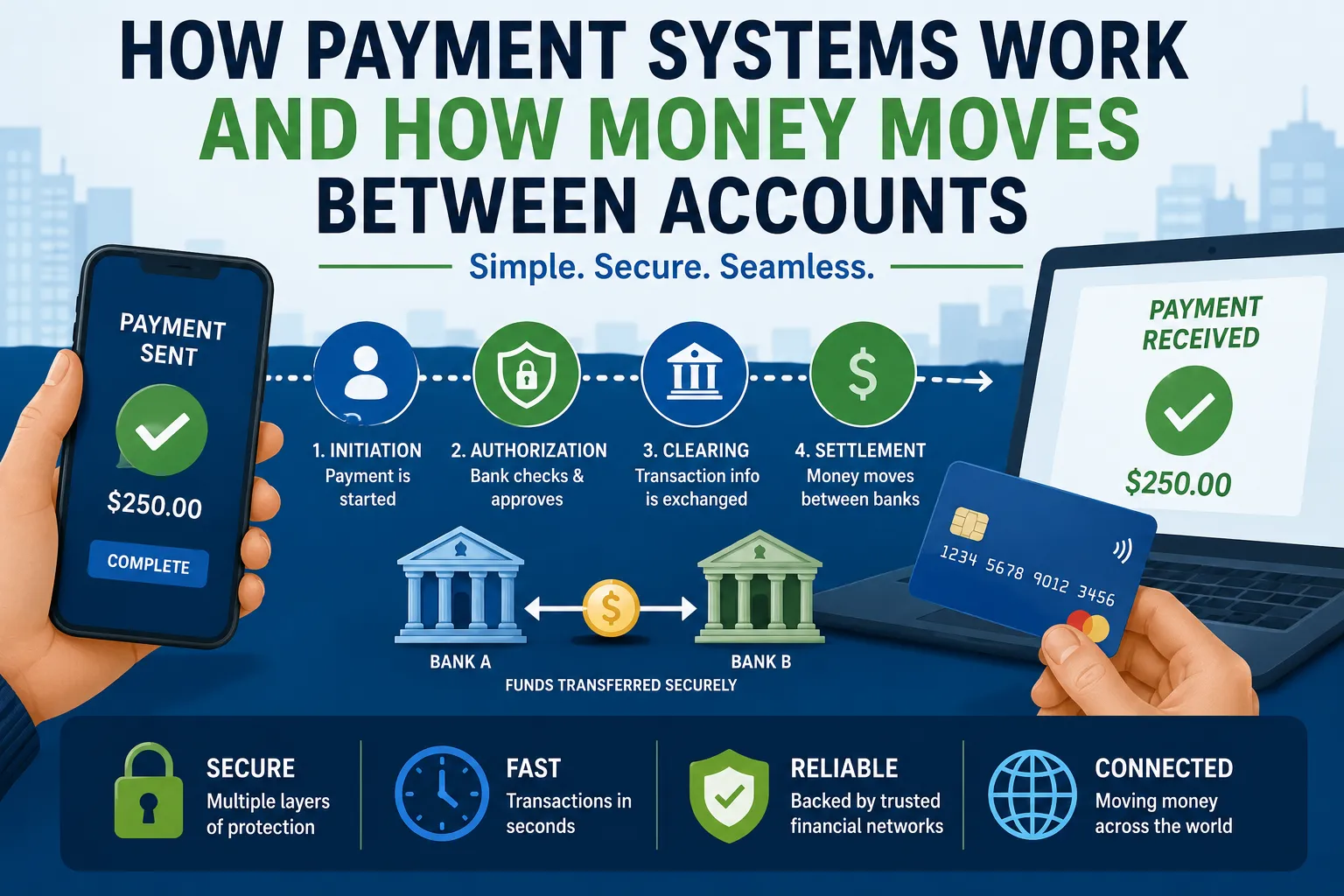
For a deeper explanation of the infrastructure behind transfers, clearing and settlement, see how payment systems work and how money moves between accounts.
Central-bank involvement can therefore affect the stability and efficiency of the broader financial system.
Digital Currencies and the Future Banking System
Some central banks are exploring or developing central bank digital currencies (CBDCs).
A CBDC would represent a digital form of central-bank money.
Its design could potentially affect:
- Commercial-bank deposits
- Payments
- Financial inclusion
- Monetary policy
- Bank funding
The exact effects depend heavily on how a CBDC is designed and implemented.
Commercial banks remain central to most existing financial systems, so any major change would require careful consideration of financial stability and bank funding.
What This Means for Everyday Consumers
Central-bank decisions may seem distant, but they can eventually show up in everyday financial decisions.
A policy-rate change can influence:
Mortgage costs
Savings returns
Credit-card interest
Business loans
Currency values
Investment returns
Consumer spending
This is why monetary policy matters even to people who never directly interact with a central bank.
What Borrowers Should Watch
If you’re considering borrowing money, pay attention to:
- Whether the loan has a fixed or variable rate
- How the rate is determined
- The benchmark used
- Fees
- Early repayment conditions
- Total borrowing cost
- How payments could change if rates rise
Don’t evaluate a loan solely by its initial interest rate.
What Savers Should Watch
Savers should consider:
- Interest rate
- Inflation
- Fees
- Lock-in periods
- Deposit insurance or protection
- Access to funds
- Bank stability
- Tax treatment
A higher advertised rate isn’t necessarily better if the account has restrictive conditions or significant fees.
What Business Owners Should Watch
Businesses can be particularly sensitive to central-bank policy when they depend on credit.
Before borrowing, consider:
- Fixed vs. floating rates
- Debt-service capacity
- Cash-flow projections
- Currency exposure
- Refinancing dates
- Interest-rate scenarios
A loan that appears affordable at today’s rate may become significantly more expensive if it has a floating interest rate.
Why Banks Care About Central Banks Every Day
Central banks don’t simply affect commercial banks during major policy announcements.
Their policies influence the environment in which banks make everyday decisions.
Banks constantly evaluate:
- Funding costs
- Liquidity
- Credit demand
- Interest-rate expectations
- Economic forecasts
- Capital requirements
- Credit risk
Central-bank policy is therefore part of the background framework of modern banking.
A Simple Example of the Entire Process
Imagine a central bank raises its policy rate by 1 percentage point.
Step 1: Funding Conditions Tighten
Short-term market rates increase.
Step 2: Banks Reassess Funding
Banks may pay more to attract deposits or obtain wholesale funding.
Step 3: Lending Rates Rise
Some commercial loans become more expensive.
Step 4: Borrowing Demand Slows
Consumers and businesses may postpone borrowing.
Step 5: Spending and Investment Change
Households may reduce major purchases, while businesses may delay expansion.
Step 6: Economic Demand Cools
Lower demand can reduce inflationary pressure.
Step 7: Banks Reassess Credit Risk
If economic growth slows, banks may become more cautious about lending.
This illustrates why a single policy decision can have effects that extend throughout the economy.
The Banking System Is a Transmission Network
The relationship between central banks and commercial banks is best understood as a transmission system rather than a simple command structure.
A central bank doesn’t tell every commercial bank exactly what rate to charge.
Instead, it changes the financial environment.
Commercial banks then respond based on:
- Market conditions
- Competition
- Risk
- Funding
- Regulation
- Customer demand
Those decisions ultimately influence households and businesses.
Common Misconceptions About Central Banks
“The Central Bank Sets Every Bank Rate”
Not exactly.
Central banks influence benchmark and market conditions, while commercial banks set their own customer pricing.
“A Rate Cut Makes Every Loan Cheaper Immediately”
Not necessarily.
Existing fixed-rate loans may remain unchanged, while variable-rate loans may respond differently.
“Higher Rates Are Always Good for Banks”
No.
Higher rates can improve margins but may also reduce loan demand, increase funding costs and raise credit risk.
“Lower Rates Are Always Good for Borrowers”
Lower rates can reduce borrowing costs, but banks may tighten lending standards if economic conditions deteriorate.
“Central Banks Control the Economy”
They have substantial influence, but many economic forces lie outside their control.
Frequently Asked Questions
How Do Central Banks Affect Commercial Banks?
They influence commercial banks through interest rates, liquidity operations, reserve and capital frameworks, financial regulation and other monetary-policy tools. These factors affect bank funding, lending, profitability and risk.
Why Do Banks Raise Loan Rates When Central Banks Raise Rates?
Higher policy rates can increase banks’ funding costs and market borrowing costs. Banks may pass some of these costs to borrowers through higher lending rates.
Do Central Banks Set Mortgage Rates?
Usually not directly. Central-bank policy influences market conditions that affect mortgage pricing, but commercial banks and lenders ultimately determine the rates they offer.
Can Central Banks Force Banks to Lend?
Generally, monetary policy influences incentives and financial conditions rather than forcing individual banks to approve particular loans. Banks still assess borrowers based on credit risk, capital and regulatory requirements.
Why Do Savings Rates Change When Central Banks Change Rates?
Commercial banks adjust deposit pricing partly in response to changes in market interest rates, funding needs and competition for deposits.
Can a Central Bank Save a Failing Bank?
A central bank may provide liquidity under certain circumstances, but liquidity support is different from making an insolvent institution financially viable. Bank resolution and government or regulatory intervention may involve other institutions and mechanisms.
What Happens to Banks During High Inflation?
High inflation can lead central banks to raise interest rates. Banks may benefit from higher lending rates in some circumstances, but they can also face weaker loan demand, higher operating costs and increased borrower stress.
Why Do Central Banks Care About Commercial Banks?
Commercial banks are major channels through which monetary policy reaches households and businesses. A stable banking system is also essential for payments, credit and financial stability.
The Bigger Picture
Central banks and commercial banks occupy different positions within the financial system, but their activities are closely connected.
A central bank changes the monetary environment.
Commercial banks transmit those conditions through their decisions about:
- Loans
- Deposits
- Liquidity
- Credit standards
- Investments
- Risk
Those decisions then affect consumers, businesses and the broader economy.
This relationship explains why a central-bank announcement can eventually influence something as ordinary as the interest paid on a savings account or the monthly cost of a loan.
Why the Central Bank–Bank Relationship Matters
Understanding this connection makes financial news easier to interpret.
When a central bank raises rates, don’t just ask whether borrowing will become more expensive. Consider how banks’ funding costs, lending standards, deposit competition and credit risk might change.
When rates fall, don’t assume every bank will immediately cut every loan rate. Consider how lower yields, stronger loan demand and changing deposit costs could affect banks’ decisions.
The most important lesson is that monetary policy works through a chain of financial relationships rather than a single switch.
Central banks set the broader financial conditions; commercial banks translate those conditions into everyday banking products and decisions.
And ultimately, those decisions determine how monetary policy reaches the people and businesses that make up the real economy.