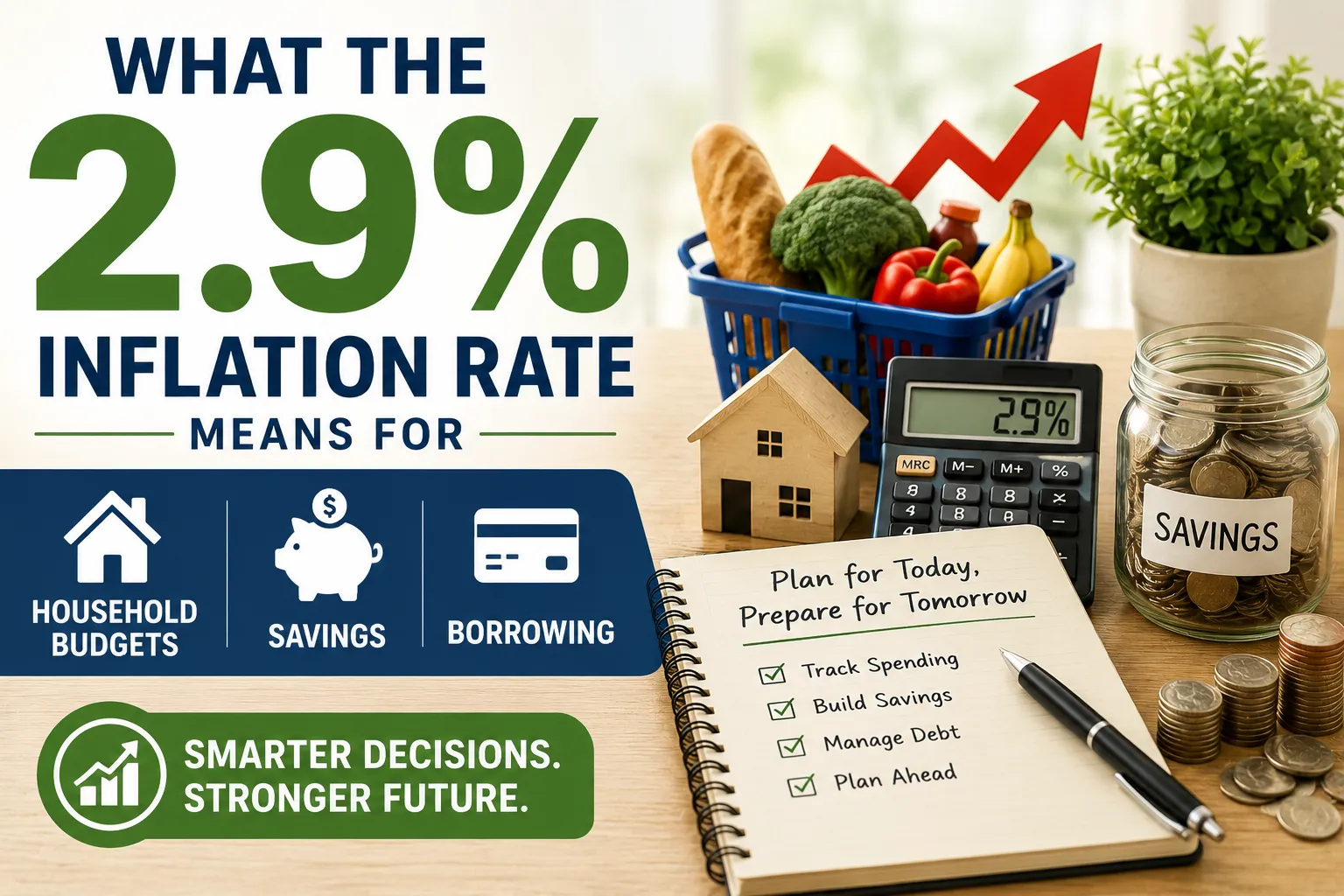
What the 2.9% Inflation Rate Means for Household Budgets, Savings and Borrowing
Inflation can be one of the most confusing economic numbers for ordinary households.
A headline such as 2.9% inflation may sound relatively modest compared with the much higher inflation rates experienced in recent years. But a lower inflation rate does not mean that prices have fallen. It means prices are generally rising more slowly than before.
That distinction matters.
When the cost of groceries, housing, transportation, utilities, insurance, and other necessities has already increased substantially, even a slower rate of inflation can continue putting pressure on household finances. At the same time, inflation affects more than the weekly shopping bill. It can influence how much families save, how they manage debt, and how they think about large purchases.
For context, the latest U.S. Consumer Price Index data available from the Bureau of Labor Statistics showed headline consumer prices rising 3.4% over the 12 months ending July 2026, while core CPI rose 2.5%. The Federal Reserve’s target for inflation remains 2%, and its July 2026 policy statement said inflation was still elevated relative to that goal.
To understand how inflation fits into the wider economy alongside GDP, employment, interest rates, consumer spending and other measures, see the Complete Guide to Economic Indicators.
So while a 2.9% inflation rate can be useful as a hypothetical benchmark for household planning, consumers should pay attention to the inflation measures that actually apply to their country and spending patterns.
What a 2.9% Inflation Rate Actually Means
Inflation measures how prices change over time.
If inflation is 2.9%, it generally means the overall price level represented by the relevant inflation index is about 2.9% higher than it was a year earlier.
It does not mean:
- Everything costs 2.9% more
- Your personal expenses will rise exactly 2.9%
- Prices will eventually return to their previous levels
- Your income will automatically increase by 2.9%
- Your savings account will earn 2.9%
Different households experience inflation differently.
Someone who spends most of their income on rent, food, transportation, and utilities may feel inflation much more strongly than someone whose largest expenses are discretionary purchases.
Lower Inflation Does Not Mean Lower Prices
This is perhaps the most important concept for household budgeting.
Imagine a product costs $100.
If its price rises by 8%, it becomes $108.
If inflation subsequently slows to 2.9%, the price does not automatically return to $100. It simply means the price level is increasing more slowly.
This is why households can continue feeling financially squeezed even after inflation has fallen substantially from a previous peak.
The rate of price increases can decline while the price level remains permanently higher.
Why Households Can Still Feel Pressure
Consider a family whose essential monthly expenses have already increased significantly over several years.
Even if inflation moderates, the family still has to pay those higher prices.
This can create a situation in which inflation statistics look better while household budgets remain uncomfortable.
The Federal Reserve has highlighted this distinction in its recent analysis of household finances, noting that some households are financially stretched and that borrowing costs remain elevated.
For households, the important question is therefore not simply:
“Is inflation falling?”
It is also:
“Are my income and savings keeping pace with the prices I actually face?”
How Inflation Changes a Household Budget
A household budget works by allocating limited income among different expenses.
When prices rise, the same amount of income buys fewer goods and services.
For example, a household earning $4,000 per month might previously have spent:
- $1,500 on housing
- $600 on food
- $400 on transportation
- $300 on utilities
- $300 on debt payments
- $300 on savings
- $600 on everything else
If several categories become more expensive, something has to change.
The household may:
- Reduce discretionary spending
- Increase income
- Save less
- Borrow more
- Substitute cheaper products
- Delay purchases
- Use existing savings
The effects can be particularly difficult for households with little financial flexibility.
Essential Expenses Usually Matter Most
Not every expense responds to inflation in the same way.
Some costs are relatively easy to reduce.
You can postpone a vacation, buy fewer restaurant meals, or delay purchasing new electronics.
Other expenses are much harder to avoid.
These can include:
- Housing
- Food
- Utilities
- Transportation
- Insurance
- Healthcare
- Debt payments
When inflation affects essential expenses, households have fewer opportunities to cut spending without changing their standard of living.
Food Inflation Can Be Especially Noticeable
Food is one of the expenses people encounter repeatedly.
Even relatively small price increases can become noticeable because households buy groceries frequently.
U.S. data for June 2026 showed food prices up 3.0% over the previous year, with food-at-home prices up 2.7%.
The July CPI report subsequently showed food prices rising 0.1% during the month.
For households, the practical response is not necessarily to eliminate favorite foods.
Instead, consider:
- Comparing unit prices
- Planning meals
- Reducing food waste
- Buying seasonal products
- Comparing brands
- Using discounts strategically
- Cooking more meals at home when practical
Small savings can become meaningful when repeated every week.
Housing Can Dominate the Budget
Housing is another major source of household financial pressure.
Renters may face higher rents when leases are renewed.
Homeowners can face changes in:
- Mortgage costs
- Property taxes
- Insurance
- Maintenance
- Utilities
In the July 2026 U.S. CPI report, shelter accounted for roughly two-thirds of the monthly increase in the headline index.
This illustrates why an average inflation figure can conceal substantial differences between categories.
A household heavily exposed to housing costs may experience financial pressure that is much greater than the headline inflation rate suggests.
Inflation and Your Purchasing Power
Purchasing power describes how much goods and services your money can buy.
When prices rise faster than your income, purchasing power falls.
Suppose your income increases by 3% while your household expenses rise by 4%.
On paper, you received a raise.
In practical terms, your purchasing power may have declined.
This is why households should consider real income growth, not just the size of a pay increase.
What Inflation Means for Savings
Inflation can quietly reduce the purchasing power of money sitting in cash.
Suppose you keep $10,000 in an account that earns no interest while prices rise by 2.9%.
The number on your account statement remains $10,000.
But that money buys less than it did previously.
This is why the return on savings should be considered relative to inflation.
For a broader look at how falling inflation can still affect the purchasing power of savings, see Inflation Is Cooling but Savers Still Need to Protect Their Purchasing Power.
The Real Return on Savings
A simple way to think about the real return on savings is:
Real return ≈ interest rate − inflation rate
So if a savings account earns 4% while inflation is 2.9%, the approximate inflation-adjusted return is about 1.1%, before taxes and other considerations.
If the account earns only 1%, the approximate real return is negative.
This does not mean cash savings are useless.
Cash provides:
- Liquidity
- Stability
- Emergency protection
- Access to money without selling investments
The point is simply that inflation affects what that cash can purchase over time.
Shop Around for Competitive Savings Rates
When inflation is elevated, it becomes more important to pay attention to where savings are held.
Different financial institutions can offer significantly different interest rates.
A household may therefore benefit from periodically comparing:
- Savings accounts
- Money market accounts
- Certificates of deposit
- Government securities
- Other appropriate low-risk savings options
The appropriate choice depends on when the money will be needed and the amount of risk a household is willing to accept.
Emergency Savings Become More Important
Inflation can make emergency funds more expensive to maintain because the cost of unexpected expenses rises.
An emergency fund that seemed adequate several years ago may no longer cover the same amount of essential spending.
For example, if your monthly necessities have increased from $2,500 to $3,000, a six-month emergency fund has also become more expensive to maintain.
Review your emergency savings periodically rather than assuming an old target remains sufficient.
Inflation and Borrowing Costs Are Connected—but Not Identical
Inflation can influence interest rates because central banks often consider inflation when setting monetary policy.
But inflation does not mechanically determine the interest rate on every loan.
The relationship depends on:
- Central-bank policy
- Market interest rates
- Credit conditions
- Loan type
- Borrower creditworthiness
- Loan duration
- Lender pricing
In the United States, the Federal Reserve maintained its federal funds target range at 3.50% to 3.75% at its July 2026 meeting and said inflation remained elevated relative to its 2% goal.
That matters because monetary policy influences broader financial conditions.
For a deeper explanation of how policy decisions affect borrowing, saving and the wider economy, see Understanding Interest Rates and Their Effects.
Why Borrowers Should Pay Attention
Higher borrowing costs can make inflation particularly difficult for households carrying variable-rate debt or taking out new loans.
This can affect:
- Credit cards
- Personal loans
- Auto loans
- Mortgages
- Home-equity borrowing
Even if the inflation rate itself is falling, borrowing costs may remain relatively high.
The two numbers should therefore not be treated as interchangeable.
Credit Card Debt Can Become Especially Expensive
Credit card balances can be particularly challenging in an inflationary environment.
If everyday expenses rise and a household uses credit to bridge the gap, the debt can become a long-term financial burden.
Interest can compound while the original expenses are long gone.
A useful priority is therefore to prevent temporary inflation-related spending pressure from turning into persistent high-interest debt.
Inflation Can Encourage More Borrowing
When household budgets become tight, borrowing can appear to offer immediate relief.
A family might use credit to pay for:
- Groceries
- Utilities
- Repairs
- Medical expenses
- School costs
- Transportation
The danger is that borrowing solves the immediate cash-flow problem while creating another monthly payment.
If the underlying income-and-expense imbalance continues, debt can grow.
Focus on the Cost of Debt, Not Just the Monthly Payment
When evaluating a loan, consumers often focus on the monthly payment.
That can be misleading.
A lower monthly payment may simply reflect a longer repayment period.
Compare:
- Annual percentage rate
- Total interest
- Loan term
- Fees
- Monthly payment
- Total repayment amount
The cheapest-looking monthly payment is not necessarily the cheapest loan.
Should You Pay Down Debt During Inflation?
There is no universal answer.
The decision depends on:
- Interest rate
- Type of debt
- Emergency savings
- Income stability
- Investment opportunities
- Tax considerations
- Personal risk tolerance
High-interest debt generally deserves serious attention because its cost can overwhelm modest savings or investment returns.
At the same time, using every available dollar to pay debt while maintaining no emergency savings can leave a household vulnerable to unexpected expenses.
A balanced approach is often more practical.
Inflation Changes the Meaning of a Raise
A salary increase is not automatically an improvement in financial well-being.
Suppose someone receives a 3% pay increase while their household expenses rise by 4%.
Their nominal income is higher, but their purchasing power may still be lower.
This is why workers should consider both:
Nominal income growth
and
Inflation-adjusted income growth.
The difference can have a major impact on household financial planning.
Protect Your Budget With Flexible Categories
Some household expenses are relatively fixed.
Others can be adjusted.
Flexible categories might include:
- Dining out
- Entertainment
- Clothing
- Travel
- Subscriptions
- Hobbies
- Nonessential shopping
During periods of elevated inflation, these categories can provide a buffer.
The objective is not necessarily to eliminate them.
It is to make sure discretionary spending does not crowd out:
- Emergency savings
- Debt payments
- Retirement contributions
- Essential bills
Review Subscriptions
Recurring charges can become easy to overlook.
Review subscriptions periodically for:
- Streaming services
- Fitness memberships
- Software
- Apps
- Cloud storage
- News services
- Delivery memberships
Canceling services you rarely use can free money for higher priorities.
The savings from one subscription may seem insignificant, but several recurring charges can add up.
Use a “Needs First” Budget
During periods of financial pressure, a needs-first budget can help.
Start with:
- Housing
- Utilities
- Food
- Transportation
- Insurance
- Healthcare
- Minimum debt payments
- Emergency savings
Then allocate remaining income toward discretionary spending and longer-term goals.
This approach creates a clearer picture of how much financial flexibility actually exists.
Inflation Makes Long-Term Planning More Important
Inflation does not only affect today’s grocery bill.
It also affects long-term financial goals.
Suppose you plan to need $500,000 for a future goal.
If prices rise over many years, that amount will not have the same purchasing power in the future.
This is why long-term financial planning needs to consider inflation rather than simply setting a fixed nominal target.
Retirement Planning Must Account for Inflation
Retirement is one of the clearest examples.
Someone who expects to spend $40,000 per year today may need substantially more in the future to maintain a similar lifestyle.
Inflation can affect:
- Food
- Housing
- Healthcare
- Transportation
- Insurance
- Leisure
- Utilities
Retirement planning should therefore consider future purchasing power rather than focusing only on today’s expenses.
Inflation and Investments
Inflation can also influence how investors think about their portfolios.
Cash is highly liquid but vulnerable to purchasing-power erosion when its return is below inflation.
Other assets may have greater potential to outpace inflation over long periods, but they also carry investment risk.
There is no universally inflation-proof investment.
A sensible strategy depends on:
- Time horizon
- Risk tolerance
- Diversification
- Financial goals
- Need for liquidity
Investors should avoid making major decisions simply because a single inflation report moved higher or lower.
Don’t React to Every Inflation Report
Economic data can change from month to month.
A single inflation reading does not establish a permanent trend.
It is more useful to examine:
- Several months of data
- Core inflation
- Food prices
- Energy prices
- Housing costs
- Wage growth
- Interest rates
- Employment conditions
This broader view can provide a more useful picture of household financial conditions.
Why the Headline Rate May Not Match Your Experience
Inflation indexes represent averages across large populations.
Your household has its own spending pattern.
If you spend more than average on housing, transportation, or healthcare, your personal inflation rate may differ substantially from the national headline.
This is why budgeting should be based primarily on your own expenses, rather than assuming the headline inflation rate perfectly describes your financial reality.
Create a Personal Inflation Check
Once or twice a year, review the major categories in your budget.
Compare what you currently spend with what you spent previously on:
- Housing
- Food
- Transportation
- Utilities
- Insurance
- Healthcare
- Education
- Debt
- Entertainment
Then calculate where the largest increases occurred.
This provides a personal inflation snapshot.
It can be much more useful for budgeting than a headline economic statistic alone.
Look for Permanent Savings, Not Just Temporary Discounts
When trying to manage inflation, households often focus on finding cheaper products.
That can help, but structural savings can be even more valuable.
Examples include:
- Refinancing expensive debt when appropriate
- Improving energy efficiency
- Negotiating recurring bills
- Switching insurance providers
- Eliminating unused subscriptions
- Reducing unnecessary transportation costs
- Preparing more meals at home
A permanent $50 monthly saving is worth $600 per year.
Increase Income Where Possible
Budgeting is only one side of the equation.
When expenses rise, increasing income can sometimes be more sustainable than cutting spending indefinitely.
Possible strategies include:
- Negotiating compensation
- Developing professional skills
- Taking additional work
- Freelancing
- Starting a small business
- Monetizing an existing skill
The right option depends on a person’s time, abilities, employment situation, and financial goals.
Keep Saving Even During Moderate Inflation
It can be tempting to stop saving when prices rise.
But abandoning savings entirely can make future financial problems more difficult.
Even a modest contribution can maintain the habit and provide a growing financial buffer.
If the household is under severe pressure, the savings amount may need to be temporarily adjusted.
The important distinction is between adjusting a savings rate and abandoning financial resilience altogether.
Protect Your Savings From Lifestyle Inflation
When income rises, spending often rises too.
This is known as lifestyle inflation.
A person may receive a raise and immediately upgrade:
- Housing
- Vehicles
- Restaurants
- Travel
- Electronics
- Subscriptions
If all additional income is consumed, the household may remain financially vulnerable despite earning more.
A better approach can be to direct at least part of every income increase toward savings or debt reduction.
Build a Buffer Against Future Price Increases
One of the most effective responses to uncertain inflation is financial flexibility.
A household with:
- Emergency savings
- Manageable debt
- Stable income
- Flexible spending
- Competitive savings returns
has more options when prices change.
Financial resilience does not mean predicting inflation perfectly.
It means being prepared when reality differs from expectations.
What a 2.9% Inflation Environment Could Mean
If inflation were running at 2.9%, households could reasonably expect prices to continue increasing rather than remaining unchanged.
For a simplified example, a $1,000 basket of goods that rose exactly in line with 2.9% annual inflation would cost approximately $1,029 after one year.
At the same rate, the same basket would cost about $1,059 after two years and roughly $1,153 after five years if the rate remained constant.
Real-world inflation does not behave this neatly, because individual prices rise at different rates and inflation changes over time.
The example nevertheless illustrates why seemingly small annual percentages can compound.
A Simple Household Response to 2.9% Inflation
A practical response could involve five steps.
1. Review Essential Expenses
Identify where prices have increased the most.
2. Protect Emergency Savings
Keep an appropriate cash reserve for unexpected expenses.
3. Compare Savings Returns
Make sure idle cash is not unnecessarily earning very little.
4. Control Expensive Debt
Prioritize high-interest balances and avoid unnecessary borrowing.
5. Revisit Long-Term Goals
Check whether retirement, education, housing, or other financial targets still make sense after accounting for higher prices.
These steps are useful regardless of whether inflation is 2.9%, 3.4%, or another number.
What Inflation Means for Different Households
The impact of inflation is not evenly distributed.
Lower-Income Households
These households may have less flexibility because a larger share of income can go toward necessities.
Middle-Income Households
They may have more flexibility but can still experience pressure from housing, childcare, transportation, and debt costs.
Higher-Income Households
They may have greater capacity to absorb higher prices, although investment returns, lifestyle costs, and large purchases can still be affected.
Retirees
People living on relatively fixed incomes may be especially sensitive to increases in essential expenses.
Borrowers
Households with substantial debt need to watch both inflation and borrowing costs.
Savers
People holding substantial cash need to consider whether their savings returns are keeping pace with inflation.
Don’t Let Inflation Turn Into a Permanent Budget Deficit
One of the biggest dangers during periods of elevated prices is repeatedly spending more than income.
A household might initially use a credit card to handle an unusually expensive month.
Then it happens again.
Eventually, debt payments become part of the regular budget.
The household is no longer simply responding to inflation—it has created a new fixed expense.
This is why temporary financial adjustments should be reviewed before they become permanent.
The Difference Between Cutting Costs and Cutting Quality of Life
Budgeting does not have to mean eliminating everything enjoyable.
A sustainable budget distinguishes between spending that provides genuine value and spending that happens automatically.
Instead of asking:
“What can I cut?”
ask:
“Which expenses matter most to me, and which ones provide little value?”
This approach can make financial adjustments more sustainable.
Inflation Is a Reminder to Stay Flexible
Economic conditions can change quickly.
Energy prices can move.
Interest rates can change.
Wages can accelerate or slow.
Housing costs can shift.
Unexpected events can alter consumer prices.
A household budget should therefore be flexible enough to adapt.
A rigid budget based on perfect economic forecasts is less useful than a flexible budget with room for surprises.
Turn the Inflation Number Into a Household Action Plan
Inflation statistics can seem abstract until they reach the grocery receipt, rent payment, loan statement, or savings account.
A rate around 2.9% would represent a much slower pace of price increases than periods of very high inflation, but it would still mean that purchasing power is gradually being eroded if incomes and savings returns fail to keep pace.
And the latest U.S. data shows why households should look beyond a single headline number: July 2026 CPI inflation was 3.4% year over year, with core inflation at 2.5%, while the Federal Reserve continues to regard inflation as elevated relative to its 2% goal.
For households, the most useful response is practical rather than reactive.
Track your actual expenses, protect emergency savings, compare the return on cash, limit expensive debt, review recurring costs, and adjust long-term financial goals as prices change.
Inflation may be measured as a percentage, but its real significance is measured in purchasing power. The households best positioned to handle it are not necessarily those that predict the next inflation report correctly—they are the ones that maintain enough flexibility to adapt when the cost of living changes.