U.S.-Canada Tariff Escalation Raises New Risks for Investors
A fresh breakdown in U.S.-Canada trade negotiations has pushed North American investors back into a familiar problem: trying to price the economic and corporate consequences of rapidly changing tariff policy.
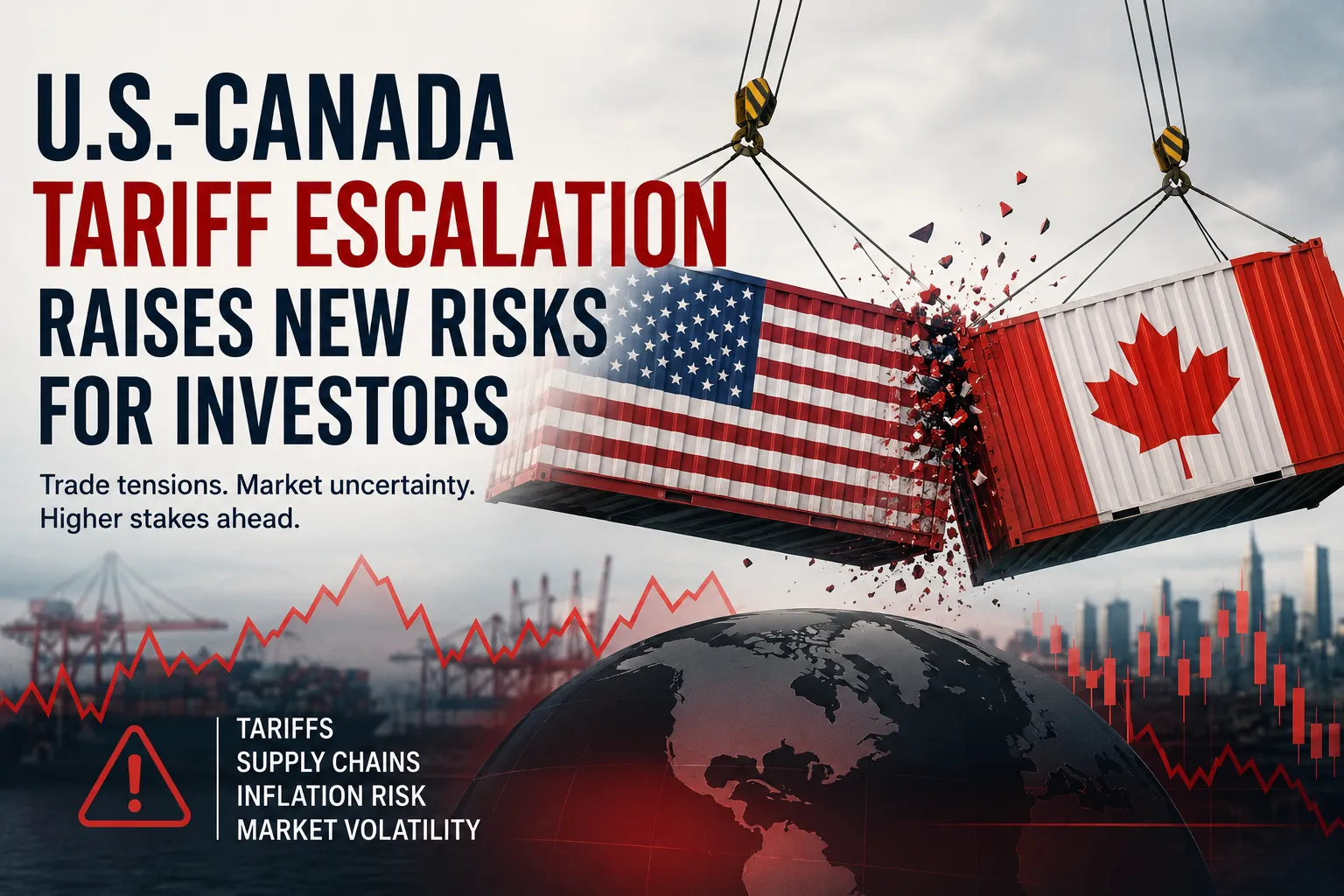
The latest escalation is significant because the United States has imposed 50% tariffs on roughly $20 billion of Canadian goods, while Canada has announced dollar-for-dollar retaliatory tariffs scheduled to begin September 8. The measures followed the collapse of negotiations that had appeared close to producing an agreement.
Although the newly targeted U.S. imports from Canada represent only about 5% of Canada’s exports to the United States, the investment implications extend beyond the value of the goods directly affected. The dispute raises questions about supply chains, inflation, corporate margins, currencies, interest rates and the future of North American trade arrangements.
For investors trying to understand how these forces interact across stocks, bonds, currencies and other assets, a broader understanding of how financial markets work and respond to economic developments provides useful context.
For investors, the central issue is no longer simply which products face higher duties. It is whether the latest confrontation becomes another temporary negotiating tactic or develops into a longer-lasting deterioration in the North American trading relationship.
What Triggered the Latest Tariff Escalation?
The latest round follows months of increasingly complicated trade negotiations between Washington and Ottawa.
On August 18, Canadian Prime Minister Mark Carney said substantial progress had been made in discussions with the United States, while acknowledging that important issues remained unresolved. The United States had agreed to postpone implementation of planned 50% tariffs until the end of August 21.
That delay ultimately expired without an agreement.
On August 21, the United States imposed the new 50% tariffs on approximately $20 billion of Canadian goods. Canada responded by announcing retaliatory measures that are scheduled to take effect September 8.
The products affected by the newest U.S. duties include a broad range of goods, with reports citing items such as sporting equipment, paper products, textiles, electronics, candles, honey and other consumer and industrial products. The latest measures are separate from tariffs already affecting major sectors such as steel, aluminum, automobiles and lumber.
Why Investors Should Pay Attention
Tariffs function as a tax on imports.
When an imported product becomes more expensive because of a tariff, someone in the supply chain has to absorb the additional cost.
That could be:
- The importer
- The manufacturer
- The retailer
- The consumer
- Or some combination of all four
For investors, the important question is what happens to corporate earnings.
A company that cannot pass higher costs to customers may experience lower profit margins. A company that raises prices may protect its margins but risk losing sales.
Investors looking more closely at this relationship can also examine how corporate earnings affect stock prices and market valuations, particularly when changes in costs begin appearing in company guidance.
That creates uncertainty for businesses with significant cross-border exposure.
The Bigger Risk Is Supply-Chain Disruption
The direct value of the latest tariff package may appear manageable relative to the size of the U.S. and Canadian economies.
The more important risk could be the effect on supply chains.
The United States and Canada have deeply integrated economies. Manufacturers routinely source components, materials and finished products from across the border.
An additional tariff can therefore affect more than the product that crosses the border.
A manufacturer importing a component from Canada may face higher costs. If that component is used to produce another product, the increased cost can travel through the supply chain.
That creates a multiplier effect.
Automobiles Remain a Major Investor Concern
The North American automotive industry is particularly sensitive to trade barriers because vehicles and components frequently cross the U.S.-Canada border during production.
Parts can move between factories multiple times before a finished vehicle reaches a customer.
Tariffs imposed at different stages can therefore increase the cost of manufacturing.
The current dispute has already involved disagreements over automotive policy, including tariff treatment and investment requirements. Reports indicate that the breakdown in negotiations included unresolved differences over the auto sector.
For investors, the key question is whether automakers can absorb higher costs, pass them to consumers or change production patterns.
Steel and Aluminum Remain Important
Steel and aluminum have also remained central to the dispute.
These materials affect a wide range of industries, including:
- Automobiles
- Construction
- Machinery
- Packaging
- Appliances
- Energy infrastructure
- Manufacturing
Higher input costs can create pressure for companies that rely heavily on metals.
At the same time, U.S. steel and aluminum producers could benefit from reduced competition from Canadian imports under some tariff scenarios.
That creates a classic example of how tariffs can produce both winners and losers within the same market.
Some U.S. Companies Could Benefit
Tariff escalation does not automatically mean every U.S. company will suffer.
Domestic producers competing directly with Canadian imports may gain pricing power or market share.
That possibility has already attracted attention from investors watching U.S. steel producers. Market reports have identified companies such as Nucor, Steel Dynamics and Cleveland-Cliffs as potential beneficiaries of continued tariff protection.
However, investors should be careful about treating tariffs as an automatic positive for domestic manufacturers.
Companies that benefit from protection can still face higher costs for imported raw materials, weaker demand or retaliation against their exports.
Canadian Exporters Face Greater Uncertainty
Canadian businesses with heavy dependence on the U.S. market face another challenge: uncertainty.
The United States remains Canada’s overwhelmingly dominant export destination, with roughly three-quarters of Canadian exports heading south of the border.
That dependence means prolonged trade friction could affect corporate investment decisions.
Businesses may delay expansion plans while waiting for greater clarity.
Some may look for alternative markets.
Others could consider relocating portions of production.
All of those decisions can affect employment, capital spending and future earnings.
The Canadian Dollar Is Already Sending a Signal
Currency markets can react quickly when investors reassess economic risks.
The Canadian dollar weakened against the U.S. dollar as the latest trade dispute intensified.
A weaker Canadian dollar can provide some support for exporters because their U.S. revenues become more valuable when converted into Canadian currency.
But it can also make imports more expensive for Canadian businesses and consumers.
For investors holding Canadian assets, currency movements can therefore become an additional source of returns—or losses.
Tariffs Could Add to Inflation Pressure
One of the biggest macroeconomic concerns is inflation.
Tariffs increase the cost of imported goods, and companies may eventually pass some of those costs to consumers.
If businesses across multiple industries raise prices simultaneously, tariffs can contribute to broader inflationary pressure.
That matters for investors because inflation influences central-bank policy.
Higher inflation can make it more difficult for central banks to reduce interest rates.
Interest Rates Could Become More Important
The Federal Reserve’s policy decisions are already closely watched by investors.
If tariff-related price increases contribute to persistent inflation, the central bank could face a difficult balancing act between supporting economic growth and keeping inflation under control.
Higher interest rates generally increase borrowing costs for businesses and consumers.
They can also put pressure on valuations for stocks whose prices depend heavily on expectations of future earnings growth.
The latest tariff escalation therefore has implications beyond individual importers.
It could influence the broader investment environment if it materially affects inflation or economic activity.
Investors should also consider how stock market volatility works and what causes market volatility, since uncertainty around trade policy can contribute to rapid changes in investor expectations and asset prices.
Bond Investors Are Watching the Same Developments
Trade policy can also influence bond markets.
If investors expect tariffs to produce higher inflation, they may demand higher yields on longer-term bonds.
At the same time, if tariffs significantly weaken economic growth, investors could move toward safer assets.
The result can be complicated because inflation and growth concerns can push markets in different directions.
Recent market trading illustrates the uncertainty. Global shares were mostly lower on August 24, while Treasury yields remained elevated and the Canadian dollar weakened amid the trade dispute.
Investors tracking this relationship should also consider how rising Treasury yields can put pressure on stock valuations because changes in long-term borrowing costs can amplify the market effects of tariff-driven inflation concerns.
Consumer Spending Could Become a Key Indicator
Investors should also watch consumer behavior.
Tariffs can raise prices for imported products, but consumers may respond by changing what they buy.
They could:
- Delay purchases
- Switch brands
- Choose cheaper alternatives
- Buy domestic products
- Reduce discretionary spending
For retailers and consumer companies, the effect depends heavily on how sensitive customers are to price increases.
A company with strong brand loyalty may be able to raise prices more successfully than a business operating in a highly competitive commodity market.
Small Businesses May Face a Different Challenge
Large multinational companies often have more resources to adjust their supply chains.
Small businesses may have fewer options.
A smaller importer may not have the negotiating power to obtain better supplier terms.
A small manufacturer may not be able to relocate production quickly.
A local retailer may have little ability to absorb higher wholesale prices.
That makes small businesses particularly vulnerable if tariff uncertainty persists.
The Canadian Federation of Independent Business has warned that a significant portion of small exporters could be directly affected by the latest measures.
Energy Is a Complicated Part of the Relationship
Energy remains one of the most important links between the United States and Canada.
Canada is a major supplier of energy to the United States, while American and Canadian energy markets are deeply interconnected.
That means trade disruptions can have consequences beyond manufactured goods.
Energy companies may respond differently depending on commodity prices, transportation infrastructure, tariff exemptions and the specific products affected.
Investors should therefore avoid assuming that a broad “U.S.-Canada trade war” will affect every Canadian energy company in the same way.
Trade Diversification Could Accelerate
One of the longer-term consequences could be a greater push by Canadian companies to diversify beyond the United States.
For years, geographic proximity and established trade relationships made the U.S. market an obvious destination for Canadian exporters.
If businesses begin viewing U.S. market access as less predictable, they may increasingly seek customers elsewhere.
That could mean greater attention to Europe, Asia and other international markets.
Diversification can make companies more resilient over time, but establishing new markets can be expensive and slow.
North American Supply Chains Could Be Reshaped
The dispute could also accelerate a trend that has already been underway: companies reassessing where they manufacture and source products.
Businesses may increasingly ask whether the lowest-cost supplier is still the best supplier if trade policy can change suddenly.
That could encourage:
- Domestic manufacturing
- Regional sourcing
- Multiple suppliers
- Greater inventory buffers
- Nearshoring
- Alternative transportation routes
Such changes can make supply chains more resilient but may also increase costs.
The USMCA Question Adds Another Layer of Risk
The latest dispute also raises questions about the United States-Mexico-Canada Agreement, the North American trade framework commonly known as USMCA.
The trade relationship has already faced substantial uncertainty, and the latest breakdown adds another complication for companies planning investments that depend on predictable cross-border access.
For manufacturers, the value of a long-term production investment depends partly on confidence that goods can move across borders under reasonably predictable rules.
Greater uncertainty can therefore discourage capital spending.
Investors Should Separate Headlines From Earnings
Tariff news can create dramatic market headlines.
But investors should distinguish between political announcements and their actual financial consequences.
A company may receive substantial media attention because it is exposed to a tariff, yet the tariff could represent only a small portion of its total costs.
Another company may receive little attention but have significant exposure through a complex supply chain.
Investors should therefore examine company-specific fundamentals.
Useful questions include:
- How much revenue comes from Canada or the United States?
- How much inventory crosses the border?
- Can the company pass higher costs to customers?
- Are alternative suppliers available?
- How quickly can production be moved?
- What percentage of operating costs are affected?
- Does the company have pricing power?
- What has management said about the risk?
Watch Corporate Earnings Guidance
Corporate management teams can provide important clues about the real-world effects of tariffs.
During earnings calls and investor presentations, executives may discuss:
- Margin pressure
- Pricing changes
- Supplier negotiations
- Inventory decisions
- Production relocation
- Capital expenditure
- Currency effects
Changes in earnings guidance can sometimes matter more than the tariff announcement itself.
If a company reduces its profit outlook because of tariffs, investors have a clearer indication that the policy is affecting financial performance.
Look for Companies With Strong Pricing Power
One characteristic investors may want to prioritize in an uncertain tariff environment is pricing power.
Companies with strong brands, differentiated products or limited competition may have greater ability to pass higher costs to customers.
Businesses selling highly interchangeable products may have less flexibility.
This distinction can become especially important if tariffs remain in place for several quarters.
Balance Sheets Matter More During Trade Shocks
Companies with strong balance sheets generally have more flexibility during periods of uncertainty.
They may be better positioned to:
- Absorb temporary cost increases
- Invest in alternative suppliers
- Build inventory
- Relocate production
- Maintain dividends
- Continue capital spending
Highly leveraged businesses may have fewer options.
That does not mean debt-heavy companies are automatically poor investments, but trade disruptions can make financial flexibility more valuable.
Investors Should Avoid Treating Tariffs as a Simple Binary Bet
It can be tempting to frame the situation as:
U.S. companies win, Canadian companies lose.
The reality is much more complicated.
A U.S. company may benefit from reduced Canadian competition but simultaneously pay more for Canadian raw materials.
A Canadian exporter may suffer from tariffs but benefit from a weaker currency.
A U.S. retailer may face higher import costs but pass some of those costs to customers.
A Canadian manufacturer may lose access to part of the U.S. market but accelerate expansion into Europe.
The investment consequences depend on the details.
Diversification Becomes More Valuable
Trade disputes are a reminder of why portfolio diversification matters.
Investors who concentrate heavily in a single country, industry or company can be more vulnerable to policy shocks.
Diversification across:
- Countries
- Industries
- Asset classes
- Company sizes
- Currencies
can reduce the effect of a single geopolitical or trade event.
Diversification does not eliminate risk, but it can prevent one policy decision from dominating an entire portfolio.
What Investors Should Watch Next
The next few weeks could be especially important.
Key developments include:
Canadian retaliation
Canada has announced dollar-for-dollar tariffs beginning September 8. Investors will watch the size and scope of the targeted U.S. products.
Further U.S. tariff threats
Washington has indicated that additional measures could follow if Canada retaliates.
Currency movements
The Canadian dollar could remain sensitive to changes in trade expectations.
Inflation data
Investors will want to see whether tariff-related costs begin appearing more clearly in consumer prices.
Corporate guidance
Companies with significant North American supply chains may provide more detail about the financial consequences.
Interest-rate expectations
Any evidence that tariffs are affecting inflation or growth could influence expectations for monetary policy.
USMCA negotiations
Progress or deterioration in the broader trade relationship could have much larger consequences than the latest $20 billion tariff package.
What This Means for Long-Term Investors
Long-term investors should be careful about making major portfolio decisions based solely on a single tariff announcement.
Trade policy can change quickly.
Today’s tariff can become tomorrow’s exemption.
Today’s confrontation can become next month’s negotiation.
That uncertainty is precisely why investors should focus on businesses with durable competitive advantages, strong balance sheets and the ability to adapt.
At the same time, dismissing tariff risks entirely would be a mistake.
The latest U.S.-Canada dispute demonstrates that trade policy has become an important variable in corporate planning and economic forecasting.
A New Test for North American Economic Integration
The latest escalation between Washington and Ottawa is more than another tariff headline.
It represents another test of an economic relationship that has supported deeply integrated North American supply chains for decades.
The immediate tariffs affect a relatively small portion of total Canadian exports to the United States, but the broader uncertainty is potentially much larger.
For investors, the most important developments may therefore come after the initial market reaction.
If negotiations resume and exemptions expand, some of the current risk premium could fade.
If retaliation expands and companies begin restructuring supply chains, the consequences could become more persistent.
The difference between those scenarios will matter for corporate earnings, inflation, currencies, interest rates and ultimately asset prices.
For now, investors should watch earnings guidance, tariff implementation, the Canadian dollar, inflation data, interest-rate expectations and the next round of U.S.-Canada negotiations rather than attempting to predict every political development.
The central investment lesson is straightforward: when trade policy becomes unpredictable, companies with strong finances, pricing power, diversified supply chains and the flexibility to adapt may be better positioned to withstand the shock.