Treasury Yields Are Surging: Why Rising Bond Yields Could Pressure Stocks Next
The bond market is sending a signal investors cannot easily ignore.
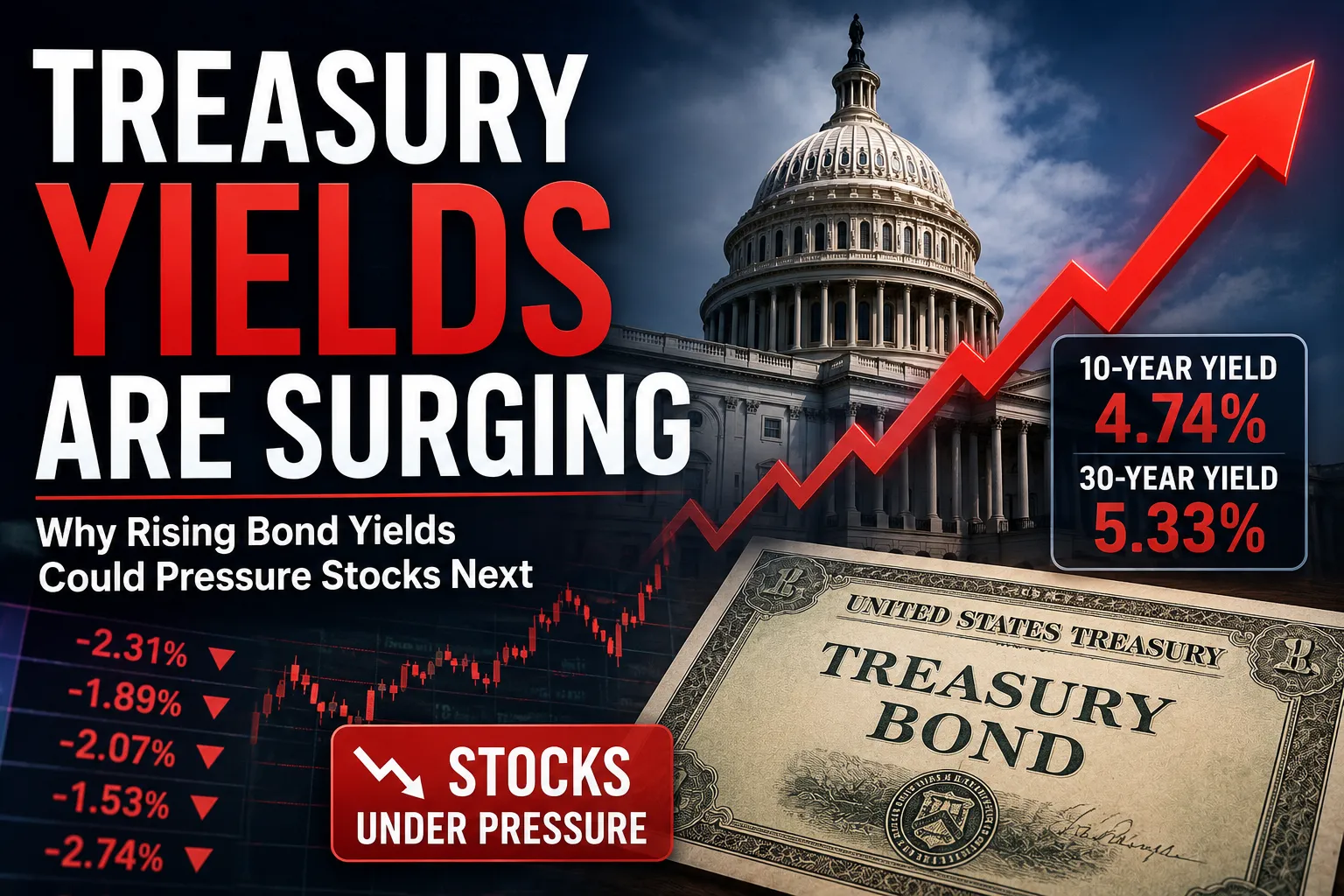
U.S. Treasury yields have climbed sharply in August, with the 30-year Treasury yield reaching roughly 5.33% on August 18, 2026, its highest level in nearly two decades, while the 10-year yield rose to around 4.74%.
The move has coincided with renewed inflation concerns, higher oil prices, heavy government borrowing and a surge in corporate debt issuance.
The unusual part is that the Federal Reserve does not necessarily need to raise its policy rate for long-term Treasury yields to keep climbing.
That matters for stock investors because Treasury yields influence everything from corporate borrowing costs to mortgage rates and the valuation investors place on future corporate profits.
Stocks have remained relatively resilient despite the bond-market selloff. But if yields continue rising, the relationship between bonds and equities could become increasingly important for the next phase of the market.
What Are Treasury Yields?
Treasury yields represent the return investors demand for holding U.S. government debt.
The U.S. Treasury issues securities with different maturities, including:
- Treasury bills with short maturities
- 2-year Treasury notes
- 5-year Treasury notes
- 10-year Treasury notes
- 20-year Treasury bonds
- 30-year Treasury bonds
Bond prices and yields move in opposite directions.
When investors sell existing Treasury bonds, their prices fall. Because the fixed interest payments become less valuable relative to the lower purchase price, the effective yield rises.
That relationship is at the center of the current market move.
Why Are Treasury Yields Rising?
There is no single explanation.
Several forces are pushing investors to demand higher returns from longer-term government bonds.
Inflation Concerns Are Returning
Oil prices have risen sharply as tensions surrounding the United States and Iran have intensified.
On August 18, Brent crude was trading around $91 a barrel, while higher energy prices were adding to concerns that inflation could remain elevated.
Higher oil prices can feed into transportation, manufacturing and consumer costs.
If investors believe inflation will remain higher for longer, they generally want greater compensation for lending money over 10, 20 or 30 years.
That can push long-term yields higher.
Government Borrowing Is Adding Supply
The U.S. government continues to issue large amounts of debt to finance its fiscal requirements.
At the same time, investors have to absorb substantial amounts of Treasury supply.
The more bonds the market needs to absorb, the more sensitive yields can become to investor demand.
Recent reporting has also pointed to concerns about large federal deficits and increased Treasury issuance as important factors behind elevated long-term borrowing costs.
Companies Are Borrowing More
It is not just governments competing for capital.
Large corporations, particularly technology companies investing heavily in artificial intelligence infrastructure, have also been issuing significant amounts of debt.
Major AI hyperscalers including Alphabet, Amazon and Meta had collectively issued nearly $220 billion of debt during 2026 by mid-August, contributing to competition for available capital.
When governments and corporations simultaneously seek large amounts of financing, investors may demand higher yields.
Why Long-Term Yields Matter So Much
The 10-year Treasury yield is one of the most closely watched numbers in global financial markets.
It influences the pricing of many other assets.
When the 10-year yield rises, borrowing costs can increase for:
- Businesses
- Homebuyers
- Consumers
- Property developers
- Governments
- Financial institutions
It also changes the calculation investors use when deciding how much they are willing to pay for stocks.
That is where the bond market becomes particularly important for equity investors.
For a broader explanation of how bonds, stocks and other markets interact, see the complete guide to financial markets and how they work.
Why Higher Yields Can Pressure Stock Valuations
Imagine an investor can earn a relatively attractive return from a U.S. government bond with very low credit risk.
That investor may become less willing to pay extremely high prices for risky assets.
Stocks have the potential to deliver higher returns, but they also carry substantially greater uncertainty.
When Treasury yields rise, the return available from relatively safe assets becomes more competitive.
This can put pressure on stock valuations, particularly when stocks are already expensive.
The Discount-Rate Effect
There is another, more mathematical reason rising yields can hurt stocks.
A stock’s value is ultimately linked to the present value of the cash flows investors expect the company to generate in the future.
Those future cash flows are discounted back to today’s value.
When interest rates rise, the discount rate generally rises as well.
That reduces the present value of distant future profits.
The effect can be especially significant for companies whose valuations depend heavily on earnings expected many years from now.
This is one reason growth stocks can be particularly sensitive to changes in long-term interest rates.
Why Technology Stocks Can Be Vulnerable
Technology companies have been among the biggest beneficiaries of the long-running investment boom in artificial intelligence.
But many technology stocks also carry valuations based on expectations of substantial future earnings growth.
If investors suddenly demand a higher rate of return to own those future earnings, the valuation multiple they are willing to pay can fall.
That does not necessarily mean the underlying business is deteriorating.
A company could continue increasing revenue while its stock price declines because investors assign a lower valuation to those future earnings.
This distinction is important when interpreting a rate-driven market selloff.
Rising Yields Can Also Affect AI Investment
The current environment is particularly interesting because the AI boom itself is becoming connected to the bond market.
AI infrastructure requires enormous amounts of capital.
Companies are spending on:
- Data centers
- Servers
- Advanced processors
- Networking equipment
- Power infrastructure
- Cooling systems
- Real estate
Some of that investment is being financed through corporate debt.
Heavy AI-related borrowing and rising real yields could eventually place greater pressure on economic growth and equity markets.
If borrowing costs remain elevated, companies may have to become more selective about which AI projects generate enough returns to justify their financing costs.
Rising Yields Can Hit Smaller Companies Harder
Large companies often have stronger balance sheets and easier access to capital markets.
Smaller businesses may have fewer financing options.
Higher interest rates can therefore create greater pressure for companies that:
- Carry substantial debt
- Need to refinance frequently
- Operate with thin margins
- Depend on external financing
- Are still investing heavily before generating significant profits
This can make smaller and more speculative stocks vulnerable when financial conditions tighten.
Housing and Real Estate Could Feel the Pressure
Higher Treasury yields also affect the housing market.
Mortgage rates are influenced by longer-term government bond yields and other market factors.
When Treasury yields rise, mortgage borrowing can become more expensive.
Higher mortgage rates can reduce housing affordability and potentially weaken demand for new homes.
Real estate investment trusts and property companies can also feel pressure because higher financing costs can reduce the attractiveness of property investments.
The Market Is Already Showing Some Signs of Strain
Global equity markets have begun responding to the combination of rising yields and higher oil prices.
European shares slipped on August 18 as rising bond yields and crude prices increased concerns about persistent inflation.
U.S. stock futures also moved lower, with Nasdaq 100 futures down more sharply than broader-market futures in early trading.
That does not establish a new bear market.
It does, however, demonstrate how quickly higher yields can become an equity-market issue.
Why Stocks Have Not Collapsed
There is an important counterargument.
Rising yields do not automatically mean falling stocks.
If yields are increasing because the economy is growing strongly, corporate profits may rise quickly enough to offset the valuation pressure created by higher interest rates.
That is one reason the relationship between Treasury yields and stocks is not always straightforward.
Recent market commentary has emphasized that equities can continue rising alongside yields when economic growth and corporate earnings are strong.
The problem becomes more serious when yields rise because of inflation, fiscal concerns or higher risk premiums while economic growth is simultaneously weakening.
That combination can pressure both stock valuations and corporate earnings.
The Most Dangerous Scenario for Stocks
The difficult scenario for equity investors would be a combination of:
Higher inflation + higher yields + weaker economic growth + declining earnings expectations.
Each factor creates a separate problem.
Higher inflation can reduce purchasing power and keep monetary policy restrictive.
Higher yields raise financing costs.
Slower growth reduces revenue opportunities.
Lower earnings expectations make existing stock valuations harder to justify.
When all four occur together, stocks can face significant pressure.
What If the Fed Does Not Raise Rates?
This is one of the most important developments in the current market.
Long-term Treasury yields can rise even when the Federal Reserve keeps its short-term policy rate unchanged.
That is because the 10-year and 30-year yields reflect expectations about inflation, economic growth, government borrowing, Treasury supply and future monetary policy.
Recent market pricing has actually shifted toward a lower probability of a September Fed rate increase following softer economic data.
Yet long-term yields have continued climbing.
That suggests investors are increasingly focused on forces beyond the immediate Fed policy decision.
The Bond Market May Be Sending a Different Message
The divergence between short-term rate expectations and long-term yields is worth watching.
If investors believe the economy is weakening enough to justify lower short-term rates but still demand higher long-term yields, they may be expressing concerns about:
- Persistent inflation
- Government debt
- Heavy Treasury issuance
- Long-term economic uncertainty
- Higher term premiums
- Strong demand for capital
In other words, the market can simultaneously expect easier monetary policy in the future and still demand higher long-term borrowing costs.
What Is the Term Premium?
The term premium is essentially the additional compensation investors may demand for holding a longer-term bond rather than repeatedly investing in shorter-term securities.
It can rise when uncertainty about inflation, government finances or future interest rates increases.
A higher term premium can push long-term Treasury yields upward even when expectations for the Fed’s short-term rate are relatively stable.
That is one possible explanation for why long-dated Treasury yields have remained elevated despite some softer economic data.
Why Bond Yields Matter to Stock Multiples
Investors frequently use valuation measures such as the price-to-earnings ratio to compare stocks.
But the appropriate multiple depends partly on the broader interest-rate environment.
When risk-free yields are low, investors may be more willing to pay higher multiples for stocks.
When Treasury yields become more attractive, investors may demand a larger potential return from equities.
That can compress valuation multiples.
A stock trading at 30 times expected earnings may appear reasonable in one interest-rate environment and expensive in another.
High-Growth Stocks Face the Biggest Valuation Test
Companies with stable current earnings may be less sensitive to discount-rate changes than businesses whose value depends primarily on profits expected far into the future.
This is why investors often pay close attention to long-term yields when evaluating:
- Technology stocks
- Software companies
- Unprofitable growth companies
- Biotech companies
- Speculative technology ventures
- High-duration assets
The companies themselves do not necessarily become worse overnight.
The mathematical value of their future cash flows changes.
What About Banks?
Banks can have a more complicated relationship with rising yields.
Higher interest rates can sometimes improve lending economics.
But rapidly rising long-term yields can also create losses on existing bond portfolios and increase funding pressures.
Banks also depend heavily on the overall health of the economy.
If higher borrowing costs eventually weaken businesses and consumers, credit quality can deteriorate.
So rising yields are not automatically positive or negative for financial stocks.
The direction and speed of the move matter.
Energy Stocks Could Be Different
The current yield surge is happening alongside higher oil prices.
That creates a different environment for energy companies.
Higher oil prices can increase revenues and profits for producers, potentially offsetting some of the broader pressure caused by higher rates.
This is one reason investors should not assume that every sector will respond identically to the same macroeconomic shock.
The market can rotate between sectors rather than simply moving uniformly higher or lower.
What Investors Should Watch Next
Several indicators could help determine whether rising Treasury yields become a temporary market disturbance or a more persistent problem.
The 10-Year Treasury Yield
The 10-year yield is one of the most important reference points for global asset markets.
A sustained move higher would likely receive close attention from equity investors.
The 30-Year Treasury Yield
The 30-year yield has already moved to levels not seen since 2007, according to recent market reports.
A continued rise would indicate that investors are demanding even more compensation for taking long-duration government debt.
Inflation Data
If inflation begins accelerating again, markets may become less confident that rates can fall quickly.
Oil Prices
Oil has become a key inflation variable in the current environment.
A sustained increase could reinforce concerns about price pressures.
Treasury Auctions
Demand at Treasury auctions provides clues about how comfortably the market is absorbing new government debt.
Weak demand can force yields higher.
Corporate Borrowing
Investors should also watch how aggressively large companies continue issuing debt.
Heavy corporate borrowing can add competition for available capital.
Corporate Earnings
Ultimately, stocks are still claims on businesses.
Strong earnings growth can help equities withstand higher yields.
Weakening earnings would make the valuation pressure more significant.
For more context on the role of corporate profits in determining stock prices, see how corporate earnings affect stock prices and market valuations.
Could Rising Yields Trigger a Stock Correction?
Yes—but it is not inevitable.
The current market is dealing with an unusual combination of elevated stock valuations, strong corporate earnings, significant AI investment and rising long-term borrowing costs.
That means the next phase could depend heavily on which force becomes dominant.
If economic growth remains strong and companies continue producing exceptional earnings, stocks could absorb higher yields.
If yields rise because inflation and fiscal concerns are becoming more severe while earnings growth slows, the pressure could become considerably greater.
Rising yields are generally more difficult for equities when they reflect inflation and debt concerns rather than strong economic growth.
Investors should also recognize that sharp rate moves can feed into broader market volatility, making how stock market volatility works and what causes market volatility particularly relevant when assessing the potential market impact.
What This Means for Long-Term Investors
Rising yields do not automatically invalidate a long-term investment strategy.
They do, however, change the environment in which stocks are valued.
Investors may want to pay closer attention to:
- Company debt levels
- Interest expenses
- Free cash flow
- Valuation multiples
- Earnings growth
- Refinancing requirements
- Exposure to economic cycles
- Dependence on external financing
A company with strong cash generation and limited debt may be better positioned for a high-rate environment than a heavily leveraged company that depends on continually refinancing its obligations.
The Bigger Signal From the Bond Market
The most important development may not be that Treasury yields have risen to a particular number.
It is why they are rising.
If yields rise because investors expect stronger economic growth, stocks may continue performing well.
If yields rise because inflation is becoming persistent, government borrowing is expanding and investors demand greater compensation for holding long-term debt, the consequences can be more difficult for equities.
That distinction could determine whether the current bond-market selloff becomes a temporary headwind or a much larger challenge for risk assets.
Why the Next Move in Yields Matters More Than the Headline Number
Treasury yields have become one of the most important variables for investors heading into the next stage of 2026.
The 10-year yield is near 4.74%, while the 30-year yield has climbed above 5.3%, levels that are forcing investors to reconsider the relationship between relatively safe bonds and richly valued equities.
For now, strong corporate earnings are providing stocks with an important buffer.
But if borrowing costs continue rising while economic growth and earnings expectations weaken, that buffer could become less effective.
The key question for investors is therefore not simply whether Treasury yields are high. It is whether they are becoming high enough—and staying there long enough—to change the economics behind stock valuations.
That is the bond-market signal worth watching next.