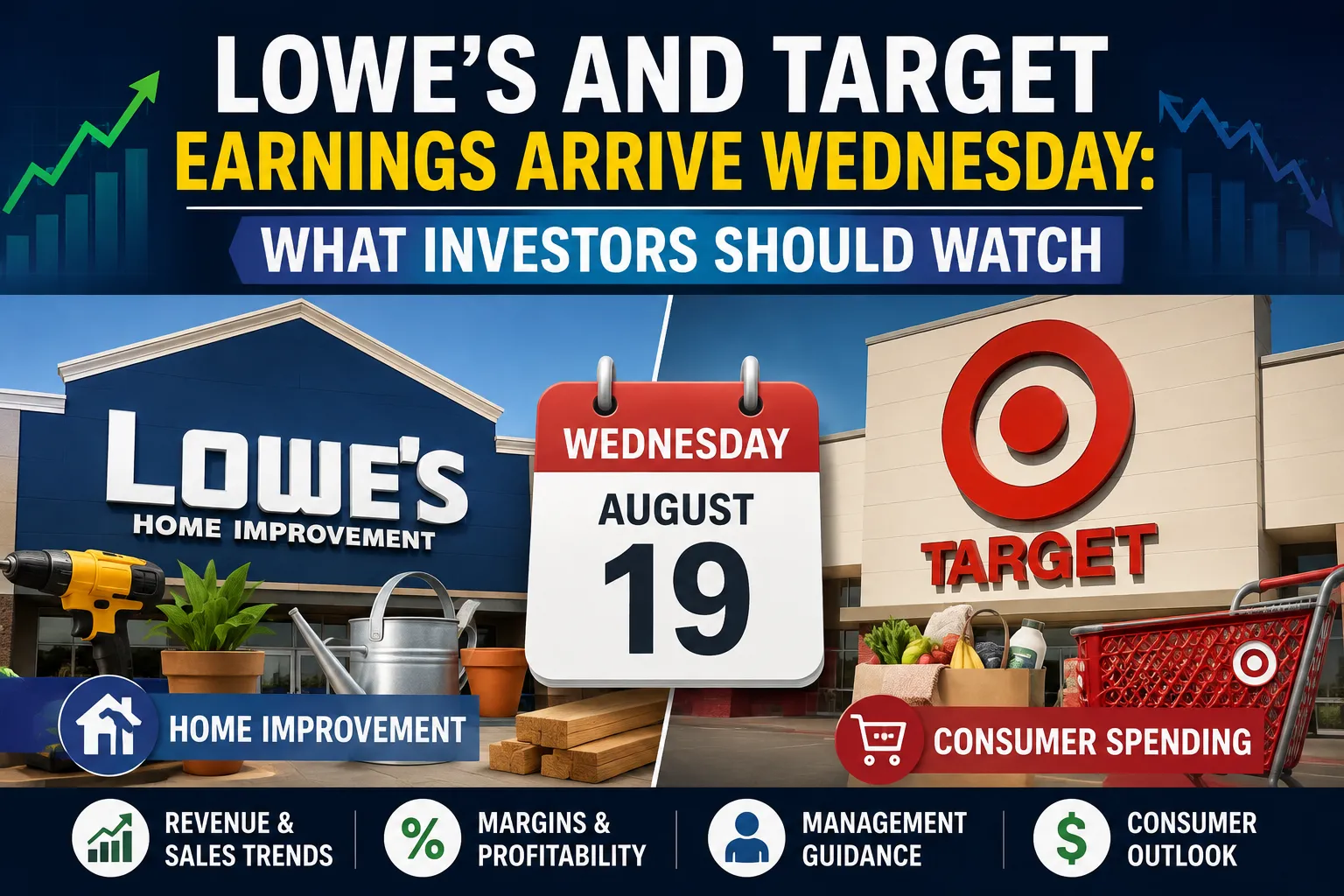
Lowe’s and Target Earnings Arrive Wednesday: What Investors Should Watch
Investors are heading into a closely watched retail earnings session on Wednesday, August 19, with Lowe’s and Target scheduled to report second-quarter fiscal 2026 results before the U.S. market opens.
The two companies offer very different windows into the consumer economy. Lowe’s provides a read on home improvement, repairs, housing-related spending and professional customers, while Target offers a broader look at household consumption across groceries, discretionary merchandise, digital commerce and its growing advertising and marketplace businesses.
The reports also arrive at an important moment for markets. Investors are trying to determine whether consumers are still willing to spend despite elevated living costs, while retailers continue to navigate tariffs, changing shopping habits and uneven demand.
Target’s earnings call is scheduled for 8 a.m. ET, while Lowe’s is due to discuss its results at 9 a.m. ET.
For investors, however, the most important question is unlikely to be whether either company simply beats or misses Wall Street’s earnings estimate.
It will be what management says about the months ahead.
## Why These Two Reports Matter
Lowe’s and Target serve different parts of the consumer market, making their results useful when viewed together.
Lowe’s is closely tied to home maintenance, remodeling, appliances and professional construction activity. Its results can provide clues about whether homeowners are spending on projects despite elevated borrowing costs and a relatively challenging housing environment.
Target, meanwhile, sells a much broader mix of necessities and discretionary merchandise. Its results can reveal whether consumers are trading down, delaying purchases or becoming more comfortable spending on categories such as apparel, home goods and other discretionary products.
The contrast could make Wednesday’s reports particularly useful for investors trying to understand the strength of household demand.
Recent results from Home Depot already offered one encouraging signal for home improvement. The company reported second-quarter revenue of $47.86 billion, above expectations, while U.S. comparable sales increased 1.3%. Management said repair and maintenance demand remained relatively steady even as high mortgage rates continued to weigh on larger renovation projects.
That creates an important benchmark for Lowe’s.
## What Wall Street Expects From Lowe’s
Lowe’s is expected to report second-quarter adjusted earnings of roughly $4.25 per share, with revenue estimates around $26.2 billion to $26.25 billion, depending on the data provider. The earnings release is scheduled before the market opens Wednesday.
The earnings expectation represents a slight decline from the $4.33 per share Lowe’s reported in the year-ago quarter.
Revenue, however, is expected to be substantially higher than a year earlier.
That combination creates an important question:
Can Lowe’s grow sales while protecting profitability?
Investors will be watching the answer closely.
## Comparable Sales Could Matter More Than Total Revenue
Lowe’s is expected to provide an important update on comparable sales, which helps investors determine whether growth is coming from existing stores and digital operations rather than simply from acquisitions or other changes to the company’s footprint.
The company reported a 0.6% increase in comparable sales in its first quarter, helped by online sales, appliances, home services and its professional customer business. Total sales increased to $23.1 billion from $20.9 billion a year earlier.
That makes the second quarter’s comparable-sales figure one of the most important numbers to watch.
A strong result would suggest that underlying demand is improving.
A weak figure could indicate that consumers remain cautious about discretionary home projects.
## Lowe’s Pro Customers Are Another Key Indicator
Professional customers are particularly important for Lowe’s because contractors and other professionals can generate larger and more frequent purchases than typical do-it-yourself shoppers.
The company has been investing in its Pro business and has also expanded through acquisitions, including Foundation Building Materials and Artisan Design Group.
During the first quarter, Lowe’s specifically cited continued strength in Pro sales as one of the factors supporting its results.
Investors will therefore want to know whether that momentum continued through the second quarter.
Strong Pro demand could provide evidence that construction and renovation activity remains healthier than some broader housing indicators suggest.
## The Housing Market Remains a Complication
Higher mortgage rates have made homeowners less willing or able to undertake some large-scale renovation projects.
A homeowner with a low existing mortgage rate may also have little incentive to move, potentially reducing housing turnover while still creating demand for repairs and improvements.
Home Depot’s latest results suggested that smaller repair and maintenance projects remain relatively resilient even while larger renovations are more constrained.
Lowe’s commentary should help investors determine whether the same pattern is visible across its customer base.
## Lowe’s Guidance Will Be Closely Watched
At the end of its first quarter, Lowe’s maintained its full-year 2026 outlook.
The company was targeting:
- $92 billion to $94 billion in total sales
- Comparable sales ranging from flat to up 2%
- Adjusted operating margin of 11.6% to 11.8%
- Adjusted diluted EPS of approximately $12.25 to $12.75
- Capital expenditures of up to $2.5 billion
Wednesday’s report will provide an opportunity for management to confirm, raise or potentially reconsider those expectations.
For shareholders, guidance may ultimately matter more than the quarterly headline.
A company can beat estimates and still see its stock fall if management lowers expectations for the rest of the year.
Conversely, a modest earnings beat accompanied by stronger guidance can produce a much more positive reaction.
## Target Enters Earnings With a Different Story
Target’s second-quarter report is arguably even more focused on the retailer’s turnaround.
The company entered 2026 with a new CEO, Michael Fiddelke, and a strategy centered on improving merchandising, store execution, digital capabilities and customer engagement.
Target’s first-quarter results offered encouraging evidence that the turnaround could be gaining traction.
First-quarter net sales increased 6.7%, comparable sales rose 5.6%, and comparable traffic increased 4.4%. Digital comparable sales grew 8.9%, while non-merchandise revenue increased nearly 25%.
Those figures established a relatively strong starting point for the new leadership era.
Now investors want to know whether the momentum is sustainable.
## Target’s Comparable Sales Are Critical
Analysts are currently looking for Target’s comparable sales to increase by roughly 2.5%, although estimates vary across sources. Revenue expectations are around $26 billion, while adjusted EPS estimates are approximately $2.3 per share.
That would represent another important step forward after Target struggled with declining sales during much of 2025.
The composition of that growth matters, too.
Investors will want to see whether stronger traffic is translating into larger baskets and whether customers are purchasing more discretionary merchandise.
The company’s results should also be considered alongside the broader question of how corporate earnings affect stock prices and market valuations, because the market reaction depends not only on reported results but also on expectations and future earnings.
## Traffic Could Tell an Important Story
Retailers can increase sales in several ways.
They can attract more shoppers.
They can persuade existing shoppers to spend more.
They can raise prices.
They can change their product mix.
Traffic is particularly useful because it gives investors another indication of underlying customer engagement.
Target reported 4.4% comparable traffic growth in the first quarter, a notable improvement from the company’s recent challenges.
If traffic remains strong in the second quarter, investors may view the turnaround more favorably.
If traffic slows significantly, questions could emerge about how durable the recovery really is.
## Target’s Grocery Business Deserves Attention
Grocery is strategically important because it gives Target a frequent reason for customers to visit its stores.
The company has said it wants to expand and improve its food and beverage offering, including allocating more space to the category as stores are remodeled.
A stronger grocery business can also create opportunities for customers to purchase other merchandise during the same trip.
That makes grocery performance relevant not only to sales but also to traffic and overall basket size.
## Private Brands Are Another Part of the Strategy
Target has long relied on owned brands to differentiate itself from competitors.
The company’s 2026 strategy includes expanding several owned-brand offerings while increasing the amount of newness across its assortment.
Investors should listen for evidence that these products are improving customer engagement and margins.
Private-label merchandise can provide retailers with greater control over product design, pricing and margins than some national-brand products.
But it must still resonate with shoppers.
## Digital Sales Remain Important
Target’s digital business has become an increasingly important part of its growth strategy.
First-quarter comparable digital sales rose 8.9%, while same-day delivery powered by Target Circle 360 increased more than 27%.
The company has also emphasized expanding same-day fulfillment and next-day delivery capabilities as part of its broader strategy.
Investors will therefore be looking for continued digital growth without excessive fulfillment costs eroding profitability.
## Target Circle 360 Could Become More Important
Target has been expanding its membership ecosystem through Target Circle 360.
Membership revenue was one of the contributors to the sharp increase in Target’s non-merchandise revenue during the first quarter.
Investors will want to know whether membership growth remains strong.
A successful membership program can increase customer frequency and encourage shoppers to consolidate more purchases within the retailer’s ecosystem.
## Roundel Is a Quietly Important Growth Engine
Target is also becoming more than a retailer.
Its advertising business, Roundel, is an increasingly important source of higher-margin revenue.
Target said first-quarter non-merchandise sales increased nearly 25%, helped by Roundel advertising revenue, Target Circle 360 membership revenue and Target Plus marketplace activity.
This is important because advertising can generate revenue without requiring Target to sell another physical product.
Investors should therefore look at the performance of Roundel and other non-merchandise businesses when evaluating the quality of Target’s growth.
## Margins May Matter More Than Revenue
A retailer can produce impressive sales growth while generating disappointing shareholder returns if margins deteriorate.
This is particularly relevant for Target.
The company needs to balance:
- Competitive pricing
- Promotions
- Product availability
- Tariff-related costs
- Labor expenses
- Freight
- Inventory management
- Advertising revenue
- Fulfillment costs
A strong quarter would ideally combine sales growth with stable or improving profitability.
## Tariffs Could Complicate the Picture
Retailers remain exposed to tariffs and other changes in trade policy because many consumer goods are sourced internationally.
The impact can appear in several ways.
Companies may:
- Absorb higher costs.
- Raise prices.
- Negotiate with suppliers.
- Change product sourcing.
- Accept lower margins.
Investors should therefore listen for management commentary about sourcing, pricing and gross-margin pressure.
This could be particularly important for Target, where merchandise margins are a major component of profitability.
## The Consumer Is Still the Bigger Story
The two earnings reports matter because they can help answer a much larger question:
How healthy is the American consumer?
Recent economic conditions have created an unusual combination of factors.
Consumers are still spending, but higher prices, elevated borrowing costs and expensive essentials can make discretionary purchases harder to justify.
Retail earnings can reveal these pressures before they become obvious in broader economic data.
Target’s merchandise mix makes it particularly useful for assessing discretionary demand.
Lowe’s, meanwhile, provides a view into household spending on homes and renovation.
## A Strong Target Could Signal Improving Discretionary Spending
Target has exposure to categories such as:
- Apparel
- Beauty
- Home
- Electronics
- Toys
- Seasonal merchandise
If those categories show broad improvement, investors may interpret the results as evidence that consumers are becoming more comfortable spending beyond necessities.
But weakness in discretionary categories could suggest that households remain selective.
This is particularly relevant alongside Target earnings and the broader consumer spending picture, since changes in prices and household purchasing behavior can have a direct effect on retailer performance.
## Lowe’s Could Tell a Different Story About Housing
Lowe’s is less directly tied to everyday household consumption and more closely connected to property ownership and renovation.
That makes its results particularly useful for understanding whether homeowners are still spending despite high financing costs.
If repair and maintenance remain strong while major renovation demand remains weak, that would reinforce the picture already emerging from Home Depot.
If larger projects begin to recover, investors could see that as an early indication that housing-related spending is improving.
## Earnings Beats Are Not Enough
Investors often focus heavily on whether a company beats Wall Street’s EPS estimate.
But a beat by a few cents may not matter if:
- Revenue misses expectations
- Comparable sales weaken
- Margins deteriorate
- Guidance falls
- Management sounds cautious
- Costs rise sharply
The market is constantly comparing actual performance with what was already priced into the stock.
That means a “good” quarter can still produce a poor stock reaction if expectations were even higher.
## Target’s Stock Has Raised the Bar
Target’s shares have rallied strongly in 2026 as investors have become more optimistic about the company’s turnaround.
Recent reports put the stock’s year-to-date gain at more than 50%, with some estimates showing it up around 56% before the earnings release.
That creates a higher hurdle.
Investors are no longer evaluating Target as though the company were still at the low point of its recent struggles.
They are increasingly pricing in evidence of improvement.
The better the stock has performed ahead of earnings, the more important future expectations become.
## Lowe’s Faces a Different Setup
Lowe’s has not enjoyed the same share-price momentum.
Recent market coverage has highlighted weakness in the stock relative to broader benchmarks, while options markets have suggested that investors are preparing for a potentially meaningful post-earnings move.
That could make a strong Lowe’s report particularly interesting.
If the company delivers solid comparable sales, maintains its outlook and provides encouraging commentary about Pro customers and home improvement demand, investors could reassess the stock.
But a weak report could reinforce concerns about housing-related spending.
## The Options Market Is Signaling Volatility
Options activity can provide a rough indication of how much movement traders expect around an earnings event.
Recent estimates suggested that Lowe’s could move roughly 5% following the report, while Target’s options market implied a potential move of up to approximately 7% in either direction.
These figures are not predictions.
They simply show that traders expect meaningful uncertainty around the reports.
Investors should therefore be prepared for stock prices to react sharply even if the underlying businesses have not changed dramatically overnight.
Understanding how stock market volatility works and what causes market volatility can help put these expected post-earnings price swings into perspective.
## What Could Make Lowe’s Earnings Bullish?
Several developments could encourage investors:
- Comparable sales above expectations
- Strong Pro sales
- Resilient repair and maintenance demand
- Improving large-project demand
- Stable or improving gross margins
- Higher-than-expected earnings
- Maintained or raised full-year guidance
- Positive commentary about housing-related spending
The combination would suggest that Lowe’s is gaining momentum while maintaining profitability.
## What Could Make Lowe’s Earnings Disappointing?
Warning signs could include:
- Negative comparable sales
- Weak Pro demand
- Declining average ticket
- Margin pressure
- Higher costs
- Weak discretionary demand
- Lower full-year guidance
- Cautious comments about housing and remodeling
A revenue beat accompanied by falling margins and weaker guidance could still be interpreted negatively.
## What Could Make Target’s Earnings Bullish?
For Target, investors are likely to respond positively to:
- Strong comparable sales
- Continued traffic growth
- Improving discretionary categories
- Strong digital sales
- Higher same-day fulfillment activity
- Healthy gross margins
- Growth in Roundel
- Rising Target Circle 360 engagement
- Stronger full-year guidance
Such a result would strengthen the argument that the company’s turnaround is becoming self-sustaining.
## What Could Make Target’s Earnings Disappointing?
The warning signs would be different:
- Slowing customer traffic
- Weak discretionary merchandise
- Heavy markdowns
- Lower gross margins
- Higher fulfillment costs
- Weak digital profitability
- Slower membership growth
- Conservative guidance
Because the stock has already rallied strongly, investors may have less patience for evidence that the turnaround is losing momentum.
## Listen Carefully to Management’s Language
Earnings releases provide the numbers.
Conference calls provide the context.
Investors should listen for changes in the language management uses around:
- Consumer confidence
- Promotional activity
- Pricing
- Inventory
- Tariffs
- Labor costs
- Housing
- Traffic
- Digital demand
- Back-to-school spending
- Holiday expectations
A subtle change in tone can sometimes matter more than a small difference between actual and estimated EPS.
## The Fed Minutes Add Another Layer
Wednesday is not only about retailer earnings.
The Federal Reserve is also scheduled to release minutes from its July meeting, giving investors another potential source of market volatility. Recent reporting says the minutes could provide additional clues about the central bank’s debate over inflation and interest rates.
That matters to both companies.
Higher interest rates can influence consumer financing, housing activity and overall economic expectations.
For Lowe’s, the relationship with housing and borrowing costs is particularly important.
For Target, interest rates can influence consumer credit conditions and household budgets.
## Investors Should Watch the Guidance, Not Just the Headline
The most useful way to read Wednesday’s reports is to break them into several layers.
### First: Did earnings beat expectations?
This establishes the immediate headline.
### Second: Did revenue beat?
Revenue shows whether demand was stronger or weaker than expected.
### Third: What happened to comparable sales?
This helps reveal underlying business momentum.
### Fourth: What happened to margins?
Sales growth is much more valuable when profitability is protected.
### Fifth: Did management change guidance?
This is often the most important part of the report.
### Sixth: What did management say about the consumer?
That can determine how investors interpret the entire quarter.
## The Bigger Investment Question
Lowe’s and Target are not simply reporting quarterly numbers.
They are providing two different snapshots of an economy in which consumers are still spending but increasingly making choices about where their money goes.
Lowe’s can show whether homeowners and contractors are continuing to spend on repairs, maintenance and renovation despite a difficult housing environment.
Target can show whether consumers are returning to discretionary purchases while continuing to prioritize value and convenience.
The contrast between the two reports could be more informative than either report in isolation.
## What Investors Should Watch Before Making a Decision
For long-term investors, Wednesday’s results should not automatically become a reason to buy or sell either stock.
One quarter rarely changes the fundamental outlook of a major retailer.
Instead, investors should ask whether the results strengthen or weaken the longer-term investment thesis.
For Lowe’s, that means considering whether the company can generate sustainable growth through its Pro business, home services, online operations, acquisitions and its broader Total Home strategy.
For Target, the question is whether its new leadership and strategic changes can produce consistent traffic, sales and profit growth rather than a short-lived rebound.
## Two Earnings Reports, One Important Consumer Signal
Lowe’s and Target arrive at Wednesday’s earnings session with very different stories.
Lowe’s is trying to demonstrate that home improvement demand can remain resilient despite the pressures facing housing and large renovation projects. The company entered the quarter with a full-year sales target of $92 billion to $94 billion and adjusted EPS guidance of $12.25 to $12.75.
Target, meanwhile, is trying to prove that its early 2026 improvement can become a durable turnaround. Its first-quarter results showed strong traffic, sales and digital growth, while its broader strategy emphasizes grocery, owned brands, same-day fulfillment, Target Circle 360, Roundel and technology.
The numbers investors see Wednesday morning will matter.
But the more important story may come from what happens after the numbers: whether management raises expectations, whether margins hold up, whether customers continue spending and whether the companies sound confident about the second half of the year.
For investors trying to understand the consumer economy, Wednesday’s Lowe’s and Target reports could provide two valuable pieces of the same puzzle—and the guidance may prove more important than the earnings headline itself.
For additional context on how individual company results fit into the broader investment landscape, see the complete guide to financial markets and how they work.