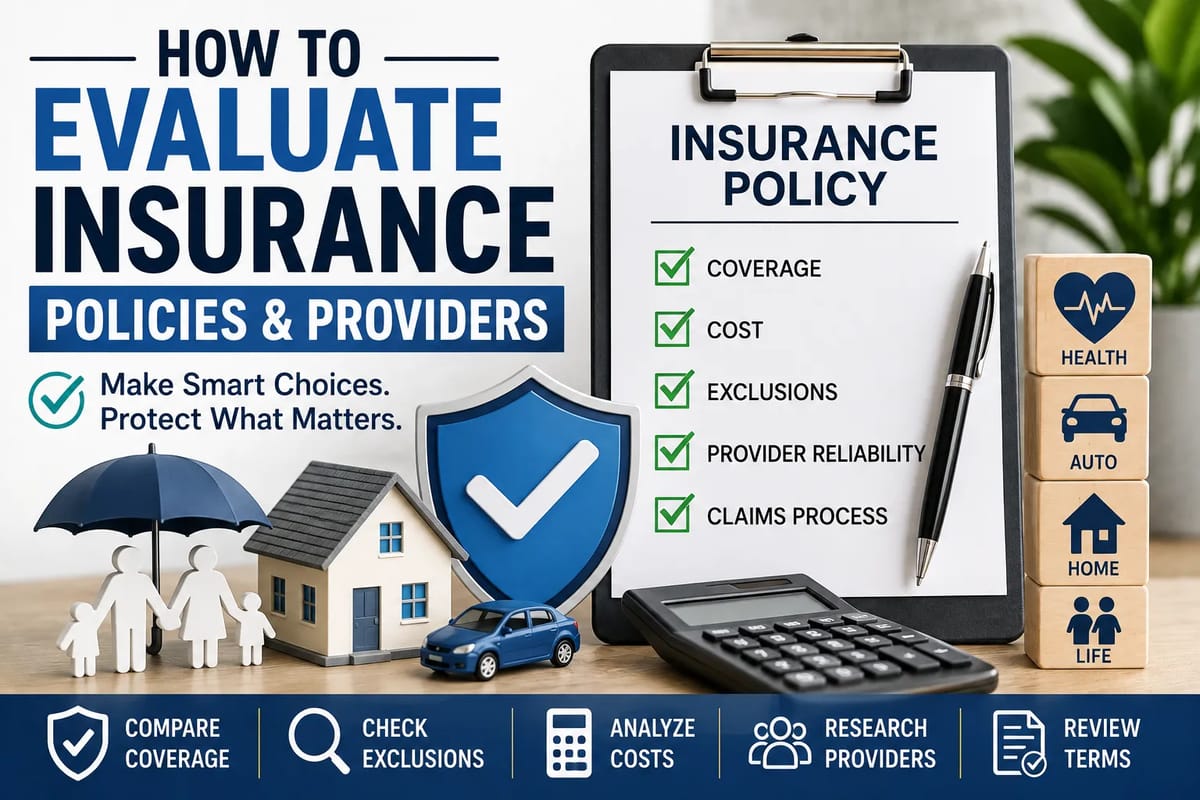
How to Evaluate Insurance Policies and Providers
Choosing insurance is rarely as simple as comparing monthly premiums.
Two policies can appear similar while offering very different levels of protection once deductibles, exclusions, coverage limits, claim procedures, provider networks, and renewal terms are taken into account. A policy with the lowest price may not necessarily provide the best value, while a more expensive policy may include coverage you do not actually need.
Evaluating insurance properly means looking beyond the headline price and understanding what you are paying for, what risks are covered, and how the insurer is likely to respond when you need to make a claim.
Whether you are comparing health, life, auto, home, travel, or business insurance, the same basic principles can help you make a more informed decision.
For a broader look at how insurance fits into a household’s overall financial strategy, see the complete guide to how insurance protects personal financial plans.
What Makes an Insurance Policy Valuable?
An insurance policy transfers certain financial risks from an individual or business to an insurance company in exchange for a premium.
The value of the policy depends on several factors:
- What risks are covered
- How much the insurer will pay
- What you must pay yourself
- Which situations are excluded
- How claims are handled
- How reliable the provider is
- Whether the policy remains suitable as your circumstances change
A low premium is useful only if the policy provides meaningful protection when you actually need it.
This is why insurance should be evaluated based on coverage, cost, exclusions, service, and financial reliability together.
Start by Identifying Your Actual Risks
Before comparing insurers, determine what you need to protect.
Different households and businesses face different risks.
For example, a homeowner may be concerned about property damage, theft, liability, or loss of personal possessions. A vehicle owner may prioritize accident damage, theft, liability, and roadside assistance.
Someone purchasing life insurance may instead be focused on replacing income, protecting dependents, or covering long-term financial obligations.
Make a list of the financial losses that would be difficult or impossible for you to absorb without insurance.
This helps prevent two common mistakes:
- Paying for coverage you do not need.
- Saving money on premiums by leaving important risks uninsured.
Understand the Main Types of Coverage
Insurance policies can contain several different types of protection.
For example, a home insurance policy might include coverage for the physical structure, personal belongings, liability, and additional living expenses under specified circumstances.
An auto policy might include liability, collision, comprehensive coverage, medical-related protection, or other optional features depending on the jurisdiction and policy.
The important point is to understand what each component actually protects.
Do not assume that because a policy is labeled “comprehensive” or “premium” it automatically covers every possible loss.
The detailed policy wording matters more than the marketing name.
Compare Coverage Before Comparing Prices
Price comparisons are useful, but only after policies are reasonably comparable.
Suppose one insurer quotes a premium of $500 per year and another quotes $700.
The cheaper policy might have:
- A higher deductible
- Lower coverage limits
- More exclusions
- Fewer included benefits
- A narrower provider network
- Less favorable claim conditions
In that situation, comparing the premiums alone gives an incomplete picture.
Start by asking:
“What am I receiving for this premium?”
Then compare the actual protection provided.
Understand Insurance Premiums
The premium is the amount you pay for insurance coverage.
Depending on the type of insurance, the price can be influenced by factors such as:
- Age
- Location
- Coverage amount
- Risk profile
- Claims history
- Vehicle characteristics
- Property characteristics
- Health information where legally applicable
- Deductible selection
- Policy features
- Discounts
A premium can be paid monthly, quarterly, annually, or according to another schedule.
When comparing policies, calculate the total annual cost rather than focusing only on a monthly figure.
A policy advertised as “$40 per month” may have additional fees or charges that affect its total cost.
Understand the Deductible
A deductible is an amount the policyholder may have to pay toward a covered loss before the insurer pays the remaining eligible amount, depending on the policy.
For example, suppose an eligible claim is worth $5,000 and the policy has a $1,000 deductible.
Subject to the policy terms, the insurer may pay $4,000 while the policyholder is responsible for the first $1,000.
Generally, policies with higher deductibles can have lower premiums, while lower deductibles may come with higher premiums.
The right choice depends on your financial situation.
A deductible should be an amount you could realistically afford if a covered event occurred.
Look Carefully at Coverage Limits
Coverage limits determine how much an insurer will pay for particular types of claims.
A policy might have:
- An overall limit
- Per-incident limits
- Per-person limits
- Property-specific limits
- Annual limits
- Sub-limits for particular types of losses
These details matter.
Imagine that you insure your household possessions for $50,000 but discover that certain categories of valuables have much lower individual limits.
The overall coverage amount may look adequate while specific possessions remain underinsured.
Always check whether the limits correspond to the value of what you are trying to protect.
Read the Exclusions
Exclusions are situations, circumstances, or losses that the policy does not cover.
They are among the most important sections to review.
A policy can provide extensive coverage while excluding certain events that are particularly relevant to you.
Depending on the type of insurance, exclusions may relate to:
- Specific types of damage
- Certain activities
- Pre-existing circumstances
- Negligence
- Unapproved modifications
- Geographic areas
- Particular causes of loss
- Intentional acts
Never assume that something is covered simply because it seems like a logical part of the policy.
If an important risk is excluded, ask whether additional coverage or a different policy can address it.
Pay Attention to Policy Conditions
Insurance contracts often contain conditions that policyholders must satisfy.
These can include requirements involving:
- Reporting claims within specified time periods
- Maintaining the insured property
- Providing documentation
- Cooperating with investigations
- Using approved providers
- Following specified procedures
- Paying premiums on time
Failure to follow applicable conditions can affect a claim.
This is one reason insurance documents should not simply be filed away after purchase.
Understand the responsibilities that come with the coverage.
Check Whether the Policy Has Special Limits
Some policies contain special limits for certain categories of property or services.
For example, a general property policy might have a separate limit for:
- Jewelry
- Electronics
- Cash
- Collectibles
- Business equipment
- Certain documents
Similarly, health insurance may impose specific limits, networks, or conditions on certain services.
If you own expensive items or regularly use particular services, check whether the standard policy provides sufficient protection.
Additional coverage may be necessary.
Evaluate the Insurer, Not Just the Policy
A good policy from an unreliable provider can still create problems.
When comparing insurance companies, consider:
- Financial strength
- Claims reputation
- Customer service
- Complaint history
- Regulatory standing
- Accessibility
- Digital tools
- Transparency
- Policy administration
The insurer’s ability and willingness to handle legitimate claims is an important part of the product.
Insurance is ultimately a promise to provide financial protection under specified circumstances.
The quality of that promise matters.
Research the Provider’s Claims Reputation
Claims are where insurance becomes most important.
Before choosing a provider, research how customers describe their claims experiences.
Look for patterns rather than relying on one review.
Consider whether customers frequently mention:
- Delayed communication
- Difficulty reaching representatives
- Confusing procedures
- Unexpected disputes
- Poor documentation
- Slow settlements
- Helpful claims representatives
- Clear communication
Online reviews should not be treated as definitive evidence because individual experiences vary.
However, repeated patterns across multiple credible sources can provide useful signals.
It is also important to distinguish legitimate provider research from suspicious insurance offers. If you are evaluating an insurer because of an unexpected message, online advertisement, or unsolicited offer, take additional care before sharing personal information or making a payment. For broader guidance on recognizing and avoiding financial deception, see how to protect your family from financial scams.
Check Regulatory and Licensing Information
Insurance is generally regulated at the national, state, provincial, or other jurisdictional level.
Before purchasing a policy, confirm that the insurer or intermediary is properly authorized to operate in your jurisdiction where applicable.
Regulatory authorities may also publish information about:
- Licensing
- Consumer complaints
- Enforcement actions
- Regulatory warnings
- Market conduct
These sources can provide more reliable information than promotional material or anonymous online reviews.
Consider Financial Strength
Insurance companies need sufficient financial resources to meet their obligations to policyholders.
Financial-strength ratings from recognized rating organizations can provide an additional perspective on an insurer’s financial condition.
The exact rating systems vary between agencies, so understand what a particular rating means rather than treating a letter grade as universally comparable.
Financial strength is particularly important for policies that may remain in force for many years, such as certain forms of life insurance.
Don’t Ignore Customer Service
Insurance is a service as well as a financial product.
You may need assistance when:
- Purchasing coverage
- Updating information
- Adding an insured item
- Reporting a claim
- Understanding a benefit
- Canceling a policy
- Resolving a billing issue
Test the provider’s communication channels before purchasing.
Consider whether you can easily reach the company through:
- Phone
- Online chat
- Mobile application
- Local offices
- Online account portals
A provider that is difficult to contact before you become a customer may not necessarily become easier to deal with afterward.
Compare Renewal Terms
The price you receive today may not be the price you pay indefinitely.
Insurance premiums can change at renewal depending on the policy, provider, claims history, market conditions, regulation, and other factors.
Before purchasing, find out:
- How frequently the policy renews
- How premiums can change
- Whether benefits can change
- How cancellation works
- Whether automatic renewal applies
- What notice you receive before renewal
This helps you evaluate the long-term cost rather than focusing exclusively on the initial quote.
Ask About Cancellation Rules
Understand how you can terminate the policy and whether cancellation fees or other conditions apply.
Also find out what happens if you stop paying premiums.
The consequences can differ substantially depending on the type of insurance.
For some policies, a missed payment may result in a grace period. Others can lapse after specified conditions are met.
Knowing the rules before an emergency occurs can prevent unpleasant surprises.
Consider the Total Cost of Ownership
The true cost of insurance includes more than premiums.
Depending on the policy, consider:
Premium + deductible exposure + fees + uncovered risks + potential out-of-pocket costs
For example, a cheaper policy with a very high deductible might require significantly more cash if you need to make a claim.
Likewise, a policy with low premiums but inadequate coverage could leave you responsible for a large loss.
The objective should be to find a sustainable balance between premium costs and financial protection.
Use the Right Amount of Coverage
Underinsurance can be dangerous, but excessive coverage can also waste money.
The appropriate amount depends on the risk and your circumstances.
For property insurance, consider the cost of rebuilding or replacing covered assets rather than simply using the property’s purchase price.
For life insurance, consider:
- Income replacement
- Debts
- Dependents
- Education costs
- Existing savings
- Long-term financial obligations
For other types of insurance, focus on the potential financial consequences of the risks being insured.
Coverage should be connected to your actual financial exposure.
Avoid Buying Based on Fear Alone
Insurance marketing can sometimes emphasize dramatic scenarios.
Fear can make people purchase coverage they do not understand.
Instead, use a structured process.
Ask:
- What could realistically happen?
- How much would it cost?
- Could I afford that loss myself?
- How likely is the event?
- What does the policy actually cover?
- What does it exclude?
- What would I pay before the insurer contributes?
- Is the premium reasonable for the protection provided?
This approach turns an emotional decision into a financial one.
Ask Questions Before Signing
Do not hesitate to ask an insurer or licensed insurance professional for clarification.
Useful questions include:
- What exactly does this policy cover?
- What are the most important exclusions?
- What are the coverage limits?
- What is the deductible?
- Are there additional fees?
- How are claims submitted?
- How long does the claims process typically take?
- Can premiums change at renewal?
- Can I change my coverage later?
- What happens if I cancel?
- What situations would cause a claim to be denied?
If an important answer is unclear, ask for the explanation in writing.
Be Careful With Insurance Comparisons
Comparison websites can be useful starting points, but automated comparisons may not capture every important policy detail.
Two products with similar names can have substantially different terms.
When comparing quotes, create a simple table.
| Feature | Policy A | Policy B | Policy C |
|---|---|---|---|
| Annual premium | — | — | — |
| Deductible | — | — | — |
| Coverage limit | — | — | — |
| Major exclusions | — | — | — |
| Additional benefits | — | — | — |
| Provider reputation | — | — | — |
| Claims process | — | — | — |
| Renewal terms | — | — | — |
This makes differences easier to identify.
Watch for Policies That Are Too Good to Be True
Extremely cheap insurance deserves additional scrutiny.
A surprisingly low premium might reflect:
- Lower coverage limits
- High deductibles
- Significant exclusions
- Limited benefits
- Narrow provider networks
- Promotional pricing
- Different assumptions in the quote
Price is not necessarily evidence of quality.
At the same time, expensive insurance is not automatically better.
The objective is to understand the relationship between price and protection.
Consider Bundling Carefully
Some insurers offer discounts when customers purchase multiple policies from the same provider.
For example, a household might combine home and auto insurance.
Bundling can simplify administration and potentially reduce costs.
But do not assume that a bundle is automatically the best option.
Compare the combined price and coverage against separate policies from other providers.
A small discount may not compensate for significantly weaker coverage or poor service.
Review Insurance After Major Life Changes
Insurance needs change as circumstances change.
Review your coverage after events such as:
- Marriage
- Divorce
- Having children
- Buying a home
- Selling a home
- Purchasing a vehicle
- Starting a business
- Changing employment
- Receiving a major inheritance
- Taking on significant debt
- Acquiring valuable property
- Retirement
A policy that was appropriate several years ago may no longer provide sufficient protection.
Keep Your Insurance Documents Organized
Store policy documents somewhere secure and accessible.
Maintain records of:
- Policy numbers
- Insurer contact details
- Coverage limits
- Renewal dates
- Premium amounts
- Deductibles
- Important endorsements
- Claims documentation
A digital backup can be useful, particularly if physical documents could be lost or damaged.
Family members should know where important insurance information can be found when appropriate.
Common Insurance Mistakes to Avoid
Choosing the Cheapest Policy
Low premiums can be attractive, but inadequate protection can cost much more later.
Ignoring Exclusions
The exclusions section can be just as important as the benefits section.
Failing to Review Coverage
Your financial circumstances can change significantly over time.
Assuming All Insurers Are Equal
Providers differ in financial strength, service, claims handling, and policy terms.
Selecting Excessive Deductibles
A deductible that is technically affordable but practically difficult to pay can create financial stress after a loss.
Relying Entirely on Online Reviews
Reviews provide useful clues but should be combined with regulatory, financial, and policy information.
Not Comparing Equivalent Policies
A premium comparison is meaningless if the coverage levels are substantially different.
A Practical Insurance Evaluation Framework
When evaluating a policy, use five broad categories:
1. Protection
Does the policy cover the risks that matter most to you?
2. Cost
Are the premiums, deductibles, and fees reasonable?
3. Conditions
What responsibilities must you meet to maintain coverage or receive benefits?
4. Provider Quality
Is the insurer financially stable, properly regulated, and reasonably responsive?
5. Long-Term Fit
Will the policy remain appropriate as your circumstances change?
A policy that performs well across all five areas is generally more compelling than one that wins on price alone.
Building a Better Insurance Decision
Insurance is ultimately about managing uncertainty.
You cannot predict every event that might affect your finances, but you can decide how much risk you are willing and able to carry yourself.
The best insurance decision is therefore not necessarily the policy with the lowest premium or the largest number of advertised benefits. It is the policy that provides appropriate protection for the risks you face, at a cost that fits your financial situation, from a provider you can reasonably trust to fulfill its obligations.
Before signing, read the important terms, compare equivalent coverage, investigate the provider, understand the exclusions and deductibles, and consider how the policy fits into your wider financial plan.
That process may take more time than choosing the first attractive quote, but it can make a significant difference when the moment comes to rely on the protection you paid for.