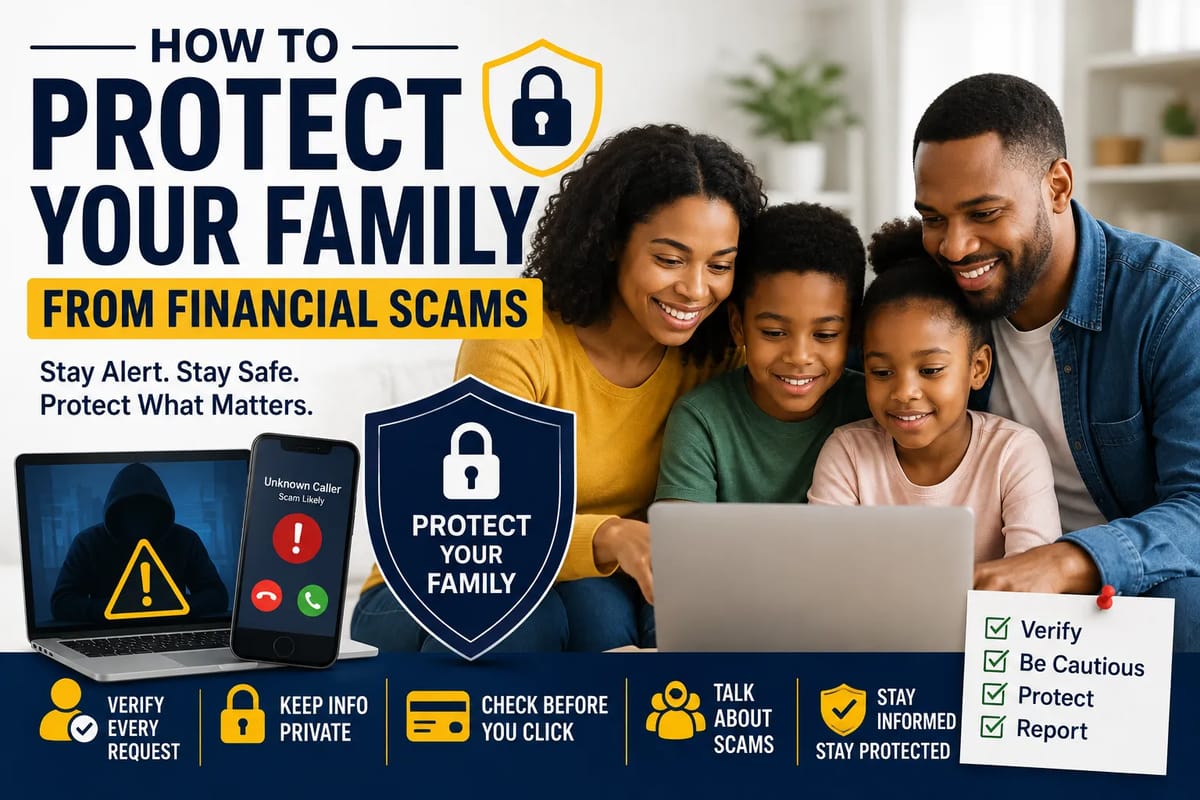
How to Protect Your Family From Financial Scams
Financial scams have become increasingly sophisticated. What once looked like an obvious fraudulent email can now appear as a convincing message from a bank, employer, delivery company, government agency, friend, or even a family member.
Scammers often rely less on complicated technology than on human psychology. They create urgency, fear, excitement, or trust to persuade people to make decisions before they have time to think.
For families, the risk can extend beyond one person’s bank account. A successful scam can affect household savings, credit, retirement plans, business finances, or money set aside for education and emergencies.
The good news is that many scams can be prevented by establishing simple financial-security habits and making sure everyone in the household understands how fraud works.
Protecting against scams is also one part of broader household financial protection. For a wider look at how insurance can help protect a family’s finances from major unexpected losses, see how insurance protects personal financial plans.
What Is a Financial Scam?
A financial scam is a deceptive scheme designed to obtain money, financial information, account access, or other valuable assets from a victim.
Scammers may target people through:
- Phone calls
- Text messages
- Social media
- Messaging applications
- Fake websites
- Online marketplaces
- Dating platforms
- Investment platforms
- In-person approaches
The methods vary, but the underlying objective is usually the same: persuade someone to provide money or information that they would not normally give to a stranger.
Why Families Are Attractive Targets
Scammers often look for opportunities to exploit trust.
Families can be particularly vulnerable because household members may share:
- Bank accounts
- Devices
- Passwords
- Financial responsibilities
- Personal information
- Credit cards
- Insurance information
- Important documents
A scammer who obtains information about one family member may use it to target another.
For example, someone could impersonate a child’s friend, a parent’s employer, a bank representative, or another relative. The more personal information a scammer has, the more convincing the deception can become.
Teach Everyone to Recognize Urgency
One of the most important scam-warning signs is pressure to act immediately.
A fraudulent message might claim:
- Your account will be closed today.
- You have won a prize.
- A payment is overdue.
- Your computer has been compromised.
- A family member is in trouble.
- You must verify your identity immediately.
- An investment opportunity expires soon.
- Your package cannot be delivered unless you pay now.
Urgency makes people less likely to stop and verify the request.
A useful family rule is simple:
If someone is pressuring you to make a financial decision immediately, stop before you pay.
Legitimate organizations generally provide ways to verify important requests independently.
Never Trust a Message Simply Because It Looks Professional
Modern scams can look remarkably convincing.
Fraudulent messages may contain:
- Official-looking logos
- Professional language
- Real company names
- Familiar branding
- Fake reference numbers
- Professional-looking websites
- Caller ID information
- Names of actual employees
These details do not prove that a communication is genuine.
Instead of judging a message by appearance, verify it through an independent channel.
If a message claims to come from your bank, for example, do not use the telephone number or link provided in the message. Open the bank’s official app, visit its known website, or use a trusted contact method.
Create a Family Verification Rule
Families can make scam prevention easier by establishing a standard procedure.
For example:
Stop → Question → Verify → Decide
Stop
Do not immediately click, transfer money, or provide information.
Question
Ask what the person is requesting and why.
Verify
Contact the organization or individual through a separate, trusted channel.
Decide
Only proceed after confirming that the request is legitimate.
This process is particularly useful for older relatives and children who may be unfamiliar with common financial scams.
Protect Bank Account Information
Banking information should be treated as highly sensitive.
Avoid casually sharing:
- Online banking passwords
- PINs
- One-time authentication codes
- Card security codes
- Full account credentials
- Recovery codes
- Security questions and answers
A legitimate financial institution should not require customers to disclose passwords or authentication codes through an unsolicited phone call, text, or email.
If someone unexpectedly asks for an authentication code, treat the request as suspicious.
Understand the Danger of One-Time Codes
Many people assume that a verification code is harmless because it is temporary.
That is not necessarily true.
One-time codes can be used to confirm account access, reset passwords, authorize transactions, or verify identity.
A scammer may claim:
“I’m sending you a security code to cancel the suspicious transaction.”
In reality, the scammer may be attempting to use the code to authorize their own activity.
The rule should be straightforward:
Never give an unexpected one-time authentication code to another person.
Use Strong, Unique Passwords
Reusing the same password across multiple accounts can create a serious security problem.
If one website suffers a data breach and the password becomes exposed, criminals may try the same credentials on:
- Email accounts
- Banking services
- Shopping accounts
- Social media
- Cloud storage
- Investment platforms
Using a unique password for every important account reduces the potential damage from a single compromised credential.
A password manager can help families create and securely store strong passwords without requiring everyone to memorize dozens of them.
Turn On Multi-Factor Authentication
Multi-factor authentication adds another layer of protection beyond a password.
Depending on the service, the second factor might involve:
- An authentication app
- A security key
- A biometric factor
- A one-time code
- Another trusted device
Even if someone obtains a password, additional authentication can make unauthorized access more difficult.
Families should prioritize multi-factor authentication for important accounts such as email, banking, cloud storage, and financial services whenever it is available.
Protect the Family Email Account
Email deserves special attention because it is often connected to other accounts.
Someone who gains access to an email account may attempt to reset passwords for other services.
A compromised email account can therefore become a gateway to:
- Banking accounts
- Shopping accounts
- Social media
- Cloud storage
- Subscription services
- Business accounts
Use a strong, unique password and multi-factor authentication for the primary email account.
Also review account-recovery information periodically.
Be Careful With Investment Opportunities
Investment scams can be particularly damaging because victims may transfer large amounts of money.
Common warning signs include:
- Guaranteed high returns
- Little or no risk
- Pressure to invest immediately
- Secret or exclusive opportunities
- Requests for cryptocurrency transfers
- Unclear investment strategies
- Unverified investment professionals
- Complicated explanations designed to discourage questions
A legitimate investment opportunity should withstand careful research and scrutiny.
Never invest simply because someone claims that an opportunity is “guaranteed.”
Higher potential returns generally come with higher risk, and legitimate investments do not eliminate that fundamental relationship.
Watch for Romance and Relationship Scams
Romance scams exploit emotional trust rather than simply technical vulnerabilities.
A scammer may develop a relationship with someone online and eventually claim to need money for:
- Medical expenses
- Travel
- Legal problems
- Emergency situations
- Business difficulties
- Family emergencies
The emotional connection can make victims reluctant to question the request.
Families can help protect one another by creating an environment where someone can discuss suspicious online relationships without fear of embarrassment or criticism.
The goal is to encourage verification, not shame.
Teach Children About Online Money Scams
Children and teenagers may encounter financial scams through gaming platforms, social media, messaging services, online marketplaces, and fake giveaways.
Teach young people never to share financial information without asking a trusted adult.
They should understand that strangers may use:
- Free gift offers
- Gaming rewards
- Fake contests
- In-game purchases
- Fake job opportunities
- Influencer impersonation
- Account warnings
to obtain money or personal information.
Children should also know that being asked to keep a financial transaction secret from their parents or guardians is a significant warning sign.
Help Older Family Members Recognize Common Scams
Older adults can be targeted by impersonation, investment, charity, healthcare, technical-support, and family-emergency scams.
Scammers may deliberately create situations that produce fear or confusion.
A caller might claim to be:
- A relative
- A police officer
- A bank employee
- A government official
- A technology-support worker
- A financial adviser
Families can reduce risk by discussing common scams before an incident happens.
It is also useful to establish a trusted contact procedure for unusual financial requests.
For example, if someone claims to be a family member needing emergency money, the recipient can independently call that person using a known phone number before taking action.
Create a Family Emergency Code Word
Families can establish a private verification phrase for genuine emergencies.
Suppose someone receives a message claiming that a relative has lost their phone and urgently needs money.
Instead of immediately sending money, the family member could ask for the agreed verification phrase.
This is not a substitute for independent verification, but it can add another layer of protection against impersonation.
The code word should never be publicly shared or stored somewhere that strangers can easily access.
Be Careful With Social Media Information
Oversharing can give scammers valuable information.
Public posts may reveal:
- Children’s names
- Birthdays
- Pet names
- Schools
- Employers
- Travel plans
- Family relationships
- Locations
- Major purchases
Some of these details may also be used in password-reset questions or social-engineering attacks.
Review privacy settings and consider whether information really needs to be publicly visible.
Don’t Click Unexpected Financial Links
Unexpected links involving money should be treated cautiously.
Instead of clicking a link in a message claiming to be from a financial institution, open the institution’s official app or type the known website address into your browser.
This helps avoid fake websites designed to steal:
- Login credentials
- Card details
- Personal information
- Authentication codes
The same principle applies to online shopping, payment requests, investment platforms, and government services.
Check Website Addresses Carefully
A website can look almost identical to a legitimate service while being controlled by criminals.
Before entering sensitive information, examine the website address carefully.
Look for:
- Misspellings
- Strange domains
- Unexpected subdomains
- Unfamiliar country-code domains
- Unusual characters
- URLs that do not match the organization
A padlock or encrypted connection alone does not prove that a website is legitimate. Fraudulent websites can also use encrypted connections.
The most reliable approach is to reach the organization through a known official website or application rather than an unsolicited link.
Don’t Allow Remote Access to Your Computer Without Verification
Technical-support scams often begin with an unexpected phone call, pop-up message, or email claiming that a computer has a serious problem.
The scammer may request remote access and then claim to have discovered dangerous files or security problems.
They may subsequently demand payment to “fix” the issue.
Do not give an unknown person remote access simply because they claim to be technical support.
If you are genuinely concerned about your device, contact the manufacturer, software provider, or trusted technician independently.
Be Suspicious of Unexpected Payment Requests
Different payment methods create different levels of protection.
Scammers may prefer payment methods that are difficult to reverse or trace, including certain forms of cryptocurrency, wire transfers, prepaid cards, or other hard-to-recover methods.
An unexpected request to use an unusual payment method should therefore raise questions.
Before sending money, ask:
- Who is receiving it?
- Why is it necessary?
- Can the recipient be independently verified?
- Why is this payment method required?
- Is there a safer alternative?
- Can the transaction be reversed if something goes wrong?
Review Bank and Card Statements Regularly
Fraud can sometimes be detected through small transactions before a larger loss occurs.
Families should regularly review:
- Bank statements
- Credit card transactions
- Digital payment accounts
- Investment accounts
- Subscription charges
Look for unfamiliar transactions, duplicate charges, unusual withdrawals, or changes that nobody in the household recognizes.
Early detection can make it easier to report suspicious activity and protect remaining funds.
Keep Financial Documents Secure
Physical documents can also expose sensitive information.
Store important documents securely and avoid leaving financial statements, identification documents, checks, or account information where visitors or unauthorized individuals can access them.
When disposing of documents containing sensitive financial information, use an appropriate method such as shredding rather than simply throwing them into household trash.
Digital copies should also be stored securely.
Teach the Family Not to Hide Mistakes
One of the most important financial-safety lessons is that reporting a mistake quickly is more important than feeling embarrassed about it.
People sometimes delay reporting scams because they are ashamed that they clicked a link, sent money, or shared information.
That delay can make the situation worse.
Families should create a culture where someone can say:
“I think I may have been scammed.”
without immediately being blamed.
The faster the problem is identified, the faster the family can begin protecting accounts and contacting the relevant financial institution or service provider.
What to Do If Someone in the Family Gets Scammed
If money or sensitive information has already been exposed, act quickly.
1. Stop Communication
Do not continue negotiating with the scammer.
2. Contact the Financial Institution
If money or account information is involved, contact the bank, card issuer, payment provider, or relevant financial institution using an official contact method.
3. Secure Compromised Accounts
Change passwords and review account-recovery settings.
Enable multi-factor authentication where available.
4. Check Other Accounts
If a reused password was exposed, change it anywhere else it was used.
5. Document What Happened
Save relevant messages, emails, transaction information, telephone numbers, usernames, and receipts.
6. Report the Fraud
Report the incident to the appropriate financial institution, platform, law-enforcement agency, consumer-protection authority, or other relevant organization in your country.
7. Watch for Follow-Up Scams
Victims may be targeted again by criminals claiming they can recover the lost money for an upfront fee.
Treat unsolicited “recovery” offers with extreme caution.
Build a Family Financial Safety Routine
Scam prevention works best when it becomes a routine rather than something people think about only after an incident.
A household can periodically:
- Review account security
- Update important passwords
- Check multi-factor authentication
- Review bank transactions
- Discuss new scam techniques
- Check device updates
- Review privacy settings
- Remove unused accounts
- Verify important contact information
- Discuss what to do during an emergency
Even a short monthly conversation can reinforce good habits.
A Simple Family Scam-Prevention Checklist
Use this as a household reminder:
- Pause when a financial request feels urgent.
- Verify unexpected messages independently.
- Never share passwords or authentication codes.
- Use unique passwords for important accounts.
- Enable multi-factor authentication.
- Review financial statements regularly.
- Be cautious with investment promises.
- Protect personal information online.
- Teach children and older relatives about scams.
- Never give strangers remote access to devices.
- Question unusual payment methods.
- Report suspected fraud quickly.
- Talk openly about mistakes.
Protecting Family Wealth Starts With Protecting Family Decisions
Financial security is not only about earning more, saving consistently, or investing wisely. It also involves protecting the money a household has already accumulated.
Scammers succeed when they can make people act before they have time to verify what is happening. Families can counter that strategy by building habits around patience, independent verification, strong account security, and open communication.
The most valuable rule may also be the simplest: when a financial request creates fear, urgency, secrecy, or unusually attractive promises, stop and verify it before sending money or information.
A household that makes verification a normal part of managing money becomes much harder for scammers to manipulate.