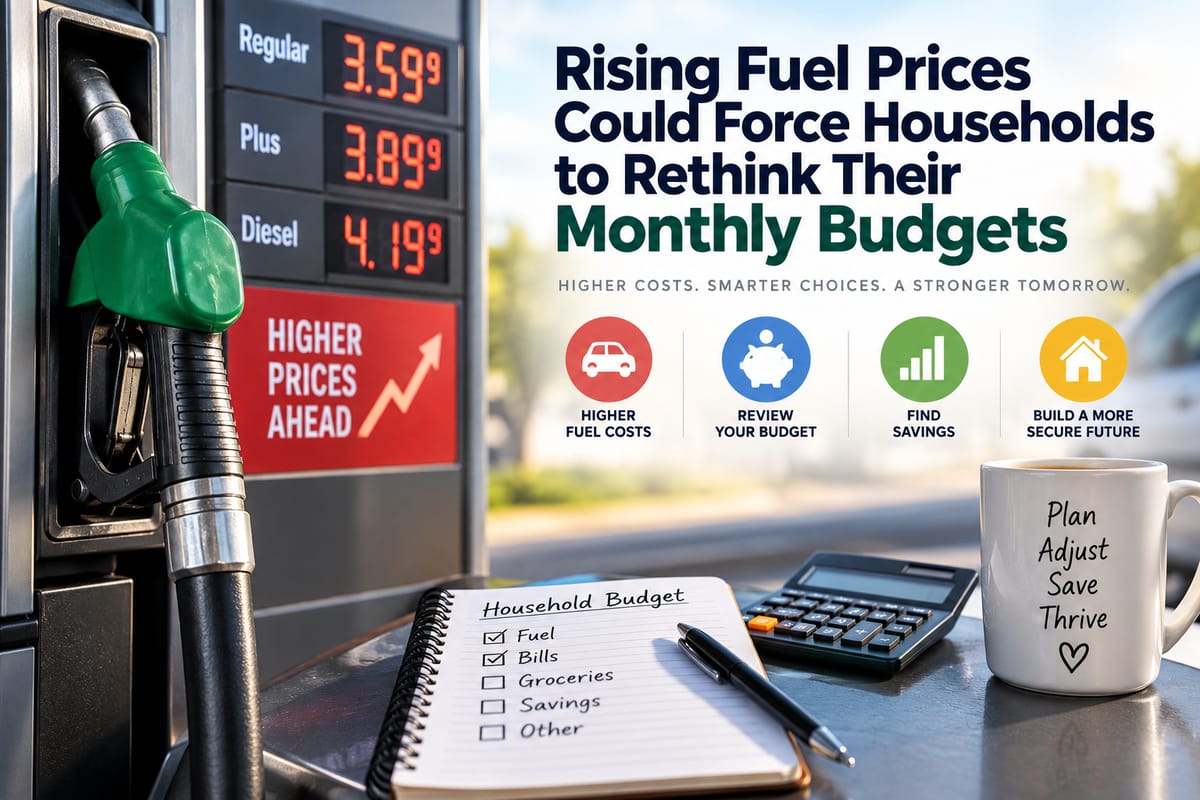
Rising Fuel Prices Could Force Households to Rethink Their Monthly Budgets
Fuel is one of those household expenses that can affect far more than the amount spent at the pump. When petrol, diesel or other transportation costs rise, the impact can spread through commuting, school runs, groceries, deliveries, household services and other everyday expenses.
For families already working with tight monthly budgets, even a modest increase in fuel costs can create pressure. A larger share of income may go toward transportation, leaving less available for savings, entertainment, debt payments or unexpected expenses.
That makes a period of higher fuel prices a useful reason for households to take another look at where their money is going and whether their current budget still reflects their circumstances.
Why Fuel Prices Affect More Than Transportation
The most immediate effect of higher fuel prices is usually seen in transportation.
People who drive to work may spend more on each commute. Families may also face higher costs for school transportation, shopping trips, medical appointments and other journeys.
But fuel is also an input into the wider economy.
Businesses use fuel to transport goods, operate vehicles and provide services. When transportation becomes more expensive, some of those costs can eventually appear elsewhere in the household budget.
This is one reason understanding How Inflation Affects Everyday Finances can help put changes in household spending into a broader context.
The Monthly Budget May Start to Shift
A household budget is essentially a plan for assigning income to different needs and goals.
When one essential expense becomes more expensive, the household has several choices. It can reduce spending elsewhere, increase income, use existing savings or accept a smaller amount of money going toward financial goals.
For example, a family that previously spent $250 a month on fuel may need to allocate significantly more when prices rise or driving requirements change.
The additional cost may appear manageable in isolation, but repeated increases across several categories can make the overall budget considerably tighter.
Transportation Costs Can Be Difficult to Avoid
Unlike some discretionary purchases, transportation can be difficult to eliminate.
Someone who depends on a car to reach work may not have the option of simply stopping driving. Parents may need to make regular school runs, while households in areas with limited public transportation may have few practical alternatives.
This makes fuel particularly important when reviewing a household budget.
Instead of asking whether the expense can be eliminated entirely, families may need to consider whether trips can be combined, routes can be changed or unnecessary journeys can be reduced.
Small Changes Can Add Up
Fuel savings do not always require a major lifestyle change.
Households can look for practical ways to reduce unnecessary driving, such as combining errands that would otherwise require separate trips.
Other possibilities include:
- Planning shopping trips in advance
- Combining school, work and household errands where practical
- Using public transportation when it is convenient and affordable
- Carpooling for regular commutes
- Avoiding unnecessary idling
- Keeping tires properly inflated
- Maintaining the vehicle according to the manufacturer’s recommendations
- Comparing routes when traffic and distance differ significantly
The savings from any single change may be modest, but repeated savings can become meaningful over several months.
Food and Household Costs May Also Feel the Pressure
Higher transportation costs can affect household spending indirectly.
Groceries and other consumer goods have to move through supply chains before reaching stores. Businesses also incur transportation expenses when delivering products or operating service vehicles.
Households should not assume that every increase in fuel prices will produce an identical increase in the cost of every product. Many factors influence consumer prices.
Still, when transportation becomes more expensive, families may notice pressure across several areas of their budgets.
That makes it particularly useful to distinguish between essential spending and purchases that can be postponed or reduced.
Review Fixed and Flexible Expenses
When a budget becomes tighter, households can divide expenses into categories based on how much control they have over them.
Fixed expenses may include rent or mortgage payments, insurance premiums and certain debt obligations.
Variable expenses can include fuel, groceries, entertainment, dining out and some household purchases.
Some variable expenses are essential, while others are more flexible.
Fuel may be necessary, but the amount spent can sometimes be influenced by driving habits. Grocery spending may also be necessary, while the choice of brands, meal planning and frequency of restaurant visits can provide more flexibility.
Understanding these differences can make it easier to decide where adjustments should be made.
Build a Routine for Reviewing Spending
A household does not necessarily need a complicated financial system to keep track of rising expenses.
A simple weekly or monthly review can reveal whether fuel costs are taking a larger share of income than expected.
Families can record:
- Total fuel spending
- Number of trips
- Work and school transportation costs
- Grocery spending
- Utility bills
- Debt payments
- Savings contributions
- Discretionary purchases
Creating consistent habits is often easier than waiting until the end of the year to discover that spending has gradually moved away from the original plan.
For households looking for a straightforward system, How Families Can Create Simple Routines for Managing Bills, Spending and Savings offers a useful framework for organizing recurring financial tasks.
Revisit Monthly Bills
When fuel costs rise, it can be tempting to focus exclusively on the price at the pump.
But a broader budget review may uncover other expenses that can be adjusted.
Households can examine subscriptions, insurance costs, telecommunications plans, recurring services and other monthly charges. Some expenses may no longer be necessary, while others may have cheaper alternatives.
A detailed review of recurring costs is covered in How to Manage Household Bills and Monthly Expenses.
The objective is not necessarily to cut everything. Instead, the goal is to make sure the money being spent each month still reflects the household’s current priorities.
Protect Emergency Savings Where Possible
When living costs rise, savings contributions can become one of the first areas households consider cutting.
That may provide short-term relief, but consistently reducing savings can leave a household more vulnerable to unexpected expenses.
An emergency fund can help cover situations such as vehicle repairs, medical expenses or temporary income disruptions.
If higher fuel costs make it impossible to maintain the previous savings rate, a household may choose to temporarily reduce its contribution rather than eliminate it altogether.
Even a smaller recurring contribution can maintain the habit of saving while the budget adjusts.
Look for Unnecessary Spending
Another way to create room for higher essential costs is to examine discretionary spending.
This does not necessarily mean eliminating every enjoyable purchase. Instead, households can identify expenses that provide relatively little value compared with their cost.
Examples might include unused subscriptions, frequent convenience purchases, impulse shopping or services that are rarely used.
A closer look at these categories can sometimes free up money without affecting essential needs.
For practical ideas, How to Reduce Unnecessary Household Spending explores ways to identify and reduce spending that may not be adding much value.
Avoid Making Every Adjustment Permanent
Fuel prices can change over time, which means a household budget should remain flexible.
If a family responds to a temporary increase by permanently cutting an important financial goal, it may later find that its budget no longer reflects its actual circumstances.
A better approach can be to review the budget periodically.
If fuel costs remain elevated for several months, the household can make more lasting adjustments. If transportation costs decline, the money that had been allocated to fuel can potentially be redirected toward savings, debt repayment or other priorities.
Consider the Bigger Financial Picture
Higher fuel prices can be frustrating because transportation is often difficult to avoid. But the effect on a household budget depends on more than the price displayed at a fuel station.
Commute distance, vehicle efficiency, household income, public transportation options and spending habits all influence the overall impact.
A family that drives long distances every day may experience a very different effect from a household that drives occasionally.
This is why copying another person’s budget is rarely useful. A household budget works best when it reflects the actual circumstances of the people using it.
When Fuel Costs Become a Budget Warning Sign
Rising fuel expenses can serve as an early warning that a household’s financial plan needs to be updated.
If transportation begins consuming money originally intended for groceries, savings or debt payments, the change should not be ignored.
A quick review can help determine whether the problem is temporary or whether the household needs a longer-term adjustment.
The most useful response is often not one dramatic cut, but a series of practical changes: fewer unnecessary trips, closer monitoring of recurring expenses, more deliberate shopping and regular reviews of savings and spending.
Turning Higher Costs Into a Budget Reset
Higher fuel prices can put pressure on household finances, but they can also prompt families to examine spending habits that may have gone unnoticed.
A stronger monthly budget does not have to predict every future price change. It needs to give the household enough flexibility to respond when essential expenses move.
By tracking transportation costs, reviewing recurring bills, limiting unnecessary spending and protecting savings where possible, households can create more room to adapt.
The goal is not simply to spend less on fuel. It is to build a household budget that can absorb changing costs without losing sight of longer-term financial priorities.