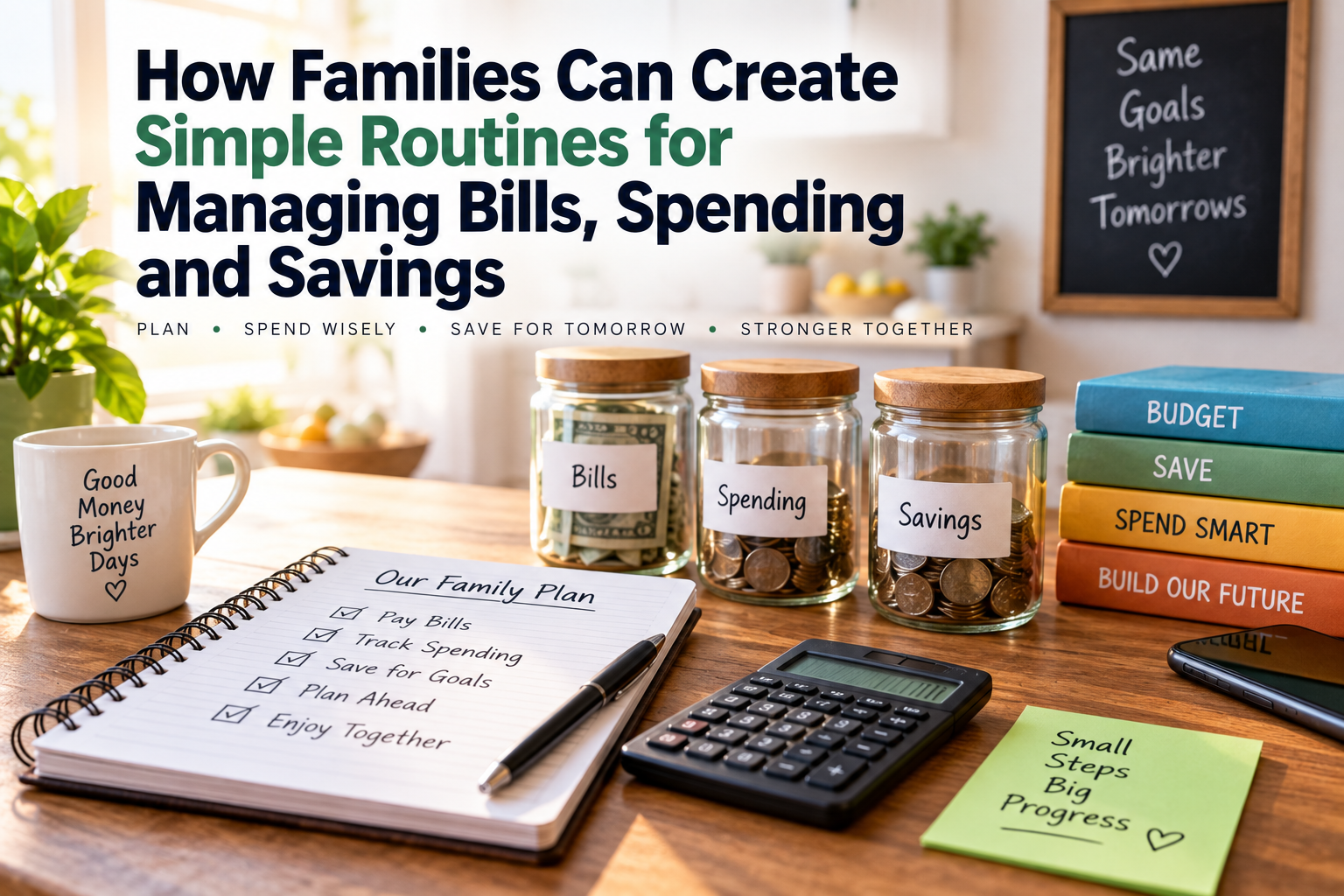
How Families Can Create Simple Routines for Managing Bills, Spending and Savings
Managing household money can become complicated when bills, everyday spending, savings goals, school costs, subscriptions, and unexpected expenses all compete for attention. Without a simple system, families may find themselves checking account balances at the last minute, forgetting payment dates, or wondering where their money went.
A financial routine can make these tasks much easier.
The goal is not to spend hours discussing money every day. Instead, families can create a few predictable habits that make it easier to know what needs to be paid, what can be spent, and what should be saved.
A good routine should be practical enough to maintain during busy weeks and flexible enough to accommodate changes in income and expenses.
Why Money Routines Matter
Household finances are often influenced by many small decisions. A single purchase may not seem significant, but regular spending on food, transportation, entertainment, subscriptions, takeout, and other necessities can add up over time.
At the same time, bills tend to arrive on different schedules. Rent or mortgage payments may be due once a month, utilities can vary, and some expenses may occur only every few months.
A routine creates a predictable process for handling these responsibilities.
Instead of relying on memory, families can establish specific times to:
- Review upcoming bills
- Check account balances
- Record recent spending
- Transfer money into savings
- Review financial goals
- Adjust the household budget
- Discuss upcoming large expenses
The system does not have to be complicated. Consistency is usually more valuable than complexity.
Start With a Family Budget
A useful financial routine begins with a clear picture of household income and expenses.
Families can list regular sources of income and then identify their major spending categories. These may include housing, utilities, groceries, transportation, insurance, education, debt payments, entertainment, and savings.
Families who need help organizing this information can start with how to build a family budget.
The purpose of a budget is not necessarily to restrict every purchase. It provides a framework for deciding how available money should be allocated.
A family budget can also make conversations about money less emotional because decisions are based on an agreed plan rather than whoever happens to notice a problem first.
Create a Weekly Money Check-In
A short weekly financial check-in can prevent small problems from becoming larger ones.
The family does not need to spend an entire evening reviewing every transaction. Fifteen to thirty minutes may be enough for a basic review.
During the check-in, families can ask:
- Which bills are due soon?
- What did we spend this week?
- Are any accounts running lower than expected?
- Are there unusual expenses coming up?
- Did we stay within our spending limits?
- Is there anything we need to change before next week?
The exact day matters less than choosing a time that the household can consistently maintain.
Set Up a Bill-Paying Routine
Bills are easier to manage when they are handled through a predictable system.
Families can create a simple bill calendar showing:
| Bill or Expense | Due Date | Typical Amount | Payment Method |
|---|---|---|---|
| Housing | Monthly date | Fixed amount | Automatic/manual |
| Electricity | Monthly date | Variable | Automatic/manual |
| Internet | Monthly date | Fixed amount | Automatic/manual |
| Insurance | Monthly/periodic | Varies | Automatic/manual |
| Subscriptions | Various dates | Fixed amounts | Automatic/manual |
A calendar can help the household see when multiple payments are scheduled close together.
Families can also consider consolidating bill-payment activities into one or two regular sessions rather than checking constantly.
For a more detailed approach, how to manage household bills and monthly expenses covers ways to organize recurring household obligations.
Separate Bills From Everyday Spending
One useful organizational strategy is to distinguish money needed for fixed obligations from money available for everyday spending.
For example, a family may first account for:
- Housing
- Utilities
- Insurance
- Debt payments
- Savings
- Essential household expenses
The remaining amount can then be allocated toward flexible categories such as entertainment, dining out, hobbies, and discretionary purchases.
This approach can reduce the risk of accidentally spending money that is needed for an upcoming bill.
Automate What Makes Sense
Automation can remove some repetitive tasks from a family’s financial routine.
Where appropriate, households can automate:
- Recurring bill payments
- Transfers to savings accounts
- Retirement contributions
- Debt payments
- Other predictable financial obligations
Automation can be particularly helpful for goals that might otherwise be forgotten.
However, automatic payments should still be monitored. Families need to ensure that sufficient funds are available and that recurring charges remain accurate and necessary.
Automation should simplify money management, not make financial activity invisible.
Give Every Family Member a Role
Money management does not necessarily need to be handled entirely by one person.
Depending on the family’s circumstances and the ages of household members, different people can have different responsibilities.
One person might manage bill dates, another might track grocery spending, while children can learn age-appropriate lessons about saving and making spending decisions.
Shared responsibility can also reduce the possibility that important financial information exists only in one person’s memory.
The goal is not to make every family member responsible for every financial decision. It is to create enough transparency that household finances do not depend entirely on one person.
Track Spending Without Making It Complicated
Expense tracking can reveal patterns that are difficult to notice when purchases happen individually.
Families can record spending manually in a spreadsheet, use a budgeting application, or review transaction histories through financial accounts.
The most important factor is whether the system is easy enough to use consistently.
How expense tracking and cash flow tools help manage household finances explores how these tools can help households understand where money is going and how cash moves through the month.
A simple system that is updated regularly is generally more useful than a sophisticated system that nobody wants to maintain.
Divide Spending Into Useful Categories
Categorizing expenses can make financial reviews easier.
A household might use categories such as:
- Housing
- Food
- Transportation
- Utilities
- Healthcare
- Education
- Debt
- Entertainment
- Personal spending
- Savings
- Miscellaneous
Categories should be detailed enough to reveal useful patterns without becoming so complicated that tracking becomes a chore.
If a family repeatedly exceeds its food budget, for example, that information is more useful than simply knowing that total spending was higher than expected.
Build a Routine for Reducing Unnecessary Spending
Families do not have to eliminate every enjoyable purchase to improve their finances.
Instead, they can periodically examine spending that provides little value.
This might include unused subscriptions, frequent convenience purchases, duplicate services, unnecessary fees, or products that are rarely used.
A monthly review can help identify these areas.
Families looking for practical ways to address them can explore how to reduce unnecessary household spending.
The purpose is to redirect money toward things the household actually values rather than cutting spending indiscriminately.
Create Separate Savings Goals
Saving becomes easier when the purpose of the money is clear.
Instead of treating all savings as one large, undefined amount, families can establish separate goals such as:
- Emergency savings
- Annual expenses
- Education
- Home repairs
- Travel
- Major purchases
- Long-term financial goals
The appropriate goals depend on the household’s circumstances.
Naming a goal can make saving more tangible because family members can see what the money is intended to accomplish.
Make Saving a Routine Rather Than a Leftover
One common approach to saving is to spend throughout the month and save whatever remains.
That can make saving unpredictable.
A more structured approach is to determine an appropriate savings amount as part of the household budget and transfer it regularly.
Even when the amount is modest, consistency can help establish the habit.
Families should also recognize that savings priorities can change. During months with unusually high expenses, the household may need to adjust contributions rather than treating the original amount as an inflexible requirement.
Prepare for Irregular Expenses
Some expenses are predictable even though they do not occur every month.
Examples include:
- Annual insurance payments
- School expenses
- Vehicle maintenance
- Property repairs
- Holiday spending
- Professional fees
- Periodic medical or household costs
Ignoring these expenses can make a monthly budget appear healthier than it really is.
A family can estimate annual or periodic costs and gradually set aside money for them. This transforms occasional large expenses into smaller, more manageable contributions.
Have a Monthly Financial Review
A weekly check-in can focus on immediate concerns, while a monthly review can look at the bigger picture.
At the end of each month, families can review:
- Total income
- Essential spending
- Discretionary spending
- Savings contributions
- Debt payments
- Unexpected expenses
- Progress toward financial goals
The family can then decide whether the budget needs to be adjusted.
For example, grocery costs may have increased, transportation expenses may have fallen, or a new recurring bill may have appeared.
A budget should reflect reality rather than forcing reality to fit an outdated plan.
Create Rules for Larger Purchases
Impulse spending can become particularly difficult when several family members make purchases independently.
A household can establish a simple rule for larger discretionary purchases. For example, purchases above an agreed amount might require a conversation before money is spent.
The exact threshold should reflect the family’s income and circumstances.
The purpose is not to control every purchase. It is to create a pause before significant spending decisions.
That pause can give family members an opportunity to consider whether the purchase fits the budget and current priorities.
Teach Children Through Everyday Decisions
Children can gradually learn about money through ordinary household activities.
Parents and caregivers can involve them in age-appropriate conversations about:
- Needs and wants
- Saving
- Comparing prices
- Planning purchases
- Delaying purchases
- Setting goals
A child does not need to understand the entire household budget to develop useful financial habits.
Simple experiences, such as saving toward a desired item or comparing two products at a store, can demonstrate how money decisions work in practical situations.
Make Financial Conversations Routine
Money conversations can become stressful when they happen only after a financial problem appears.
Regular, calm discussions can make them feel more normal.
Families can talk about upcoming expenses, changing priorities, savings goals, or spending decisions without treating every discussion as a crisis.
It is also important to recognize that different family members may have different attitudes toward money. One person may prefer saving aggressively, while another may prioritize experiences or convenience.
A routine creates an opportunity to discuss these differences and establish shared priorities.
Keep an Emergency Buffer
Unexpected costs are part of household life.
A vehicle may need repairs, an appliance may stop working, or an unexpected expense may arise.
An emergency fund or other accessible financial reserve can provide protection against these events.
The appropriate amount depends on factors such as household income, essential expenses, employment stability, existing savings, and financial obligations.
The important principle is to recognize that unexpected expenses should have a place in the family’s financial planning.
Avoid Making the Routine Too Complicated
A financial system can fail simply because it requires too much effort.
Families do not need dozens of categories, complicated spreadsheets, or daily financial meetings.
A basic routine might be enough:
Weekly: review spending and upcoming bills.
Monthly: review the budget, savings, and recurring expenses.
Periodically: review subscriptions, insurance, major expenses, and financial goals.
Whenever circumstances change: adjust the budget.
This structure provides regular checkpoints without turning household finances into a full-time activity.
Review the System as a Family
A money routine should evolve as the household changes.
Income can change. Children grow older. Housing costs can increase. New subscriptions can appear. Debt can be paid off. Savings goals can be completed.
Families should therefore periodically ask whether their current system still works.
A useful routine is one that answers three basic questions:
What needs to be paid?
What can we afford to spend?
What are we saving for?
If the household can answer those questions consistently, it has already built a strong foundation for managing everyday money.
Small Habits Can Create Financial Stability
Successful household money management does not necessarily require complicated financial strategies. Often, the biggest improvement comes from creating simple routines and following them consistently.
A weekly spending check, a reliable bill calendar, automatic savings where appropriate, regular budget reviews, and open family conversations can make financial responsibilities much easier to manage.
The objective is not perfect budgeting every month. It is creating a system that helps the family see what is happening with its money, make deliberate decisions, prepare for upcoming expenses, and steadily work toward its priorities.
When these habits become part of ordinary household life, managing bills, spending, and savings becomes less of a recurring crisis and more of a predictable family routine.