How to Plan Taxes Throughout the Year
Tax planning is often treated as something that happens once a year, usually when a tax deadline is approaching. But for many households, waiting until filing season is already too late to make some of the most useful decisions.
The choices you make throughout the year can affect how much tax you ultimately owe, whether you qualify for certain deductions or credits, how much money is withheld from your paycheck and whether you face an unexpected tax bill.
Tax systems generally require taxpayers to account for taxes as income is earned, whether through withholding, estimated payments or other mechanisms.
That makes tax planning less about finding a last-minute deduction and more about creating a year-round financial routine.
For a broader overview of how income, deductions, credits and other tax considerations fit together, see the complete guide to personal taxes and tax planning.
What Is Year-Round Tax Planning?
Year-round tax planning means regularly reviewing your income, withholding, deductions, credits, investments, retirement contributions and major life changes so you can make informed decisions before the tax year ends.
It doesn’t necessarily mean trying to reduce your tax bill at every opportunity.
Good tax planning is about understanding the relationship between:
- Income
- Taxable income
- Tax rates
- Withholding
- Estimated payments
- Deductions
- Tax credits
- Retirement accounts
- Investments
- Business income
- Major life events
A decision made in March can affect your tax return the following year.
A job change in July can alter your withholding.
A major investment transaction in October can affect your taxable income.
And a charitable contribution or qualifying retirement contribution made before the applicable deadline may affect your tax situation depending on the rules that apply.
The earlier you identify these issues, the more options you generally have.
Why Tax Planning Should Start Before Tax Season
Waiting until tax forms arrive can turn tax preparation into a simple exercise in reporting what already happened.
By then, many opportunities to change your situation may have passed.
Year-round planning can help you:
- Avoid an unexpectedly large tax bill
- Reduce the risk of underpayment penalties
- Identify potentially available tax benefits
- Keep better financial records
- Make informed retirement contributions
- Prepare for income that isn’t subject to withholding
- Respond to changes in your household
- Make tax-related decisions before deadlines arrive
It can also make filing season considerably less stressful.
Build a Simple Tax Planning Calendar
You don’t need to think about taxes every day.
Instead, divide the year into a handful of checkpoints.
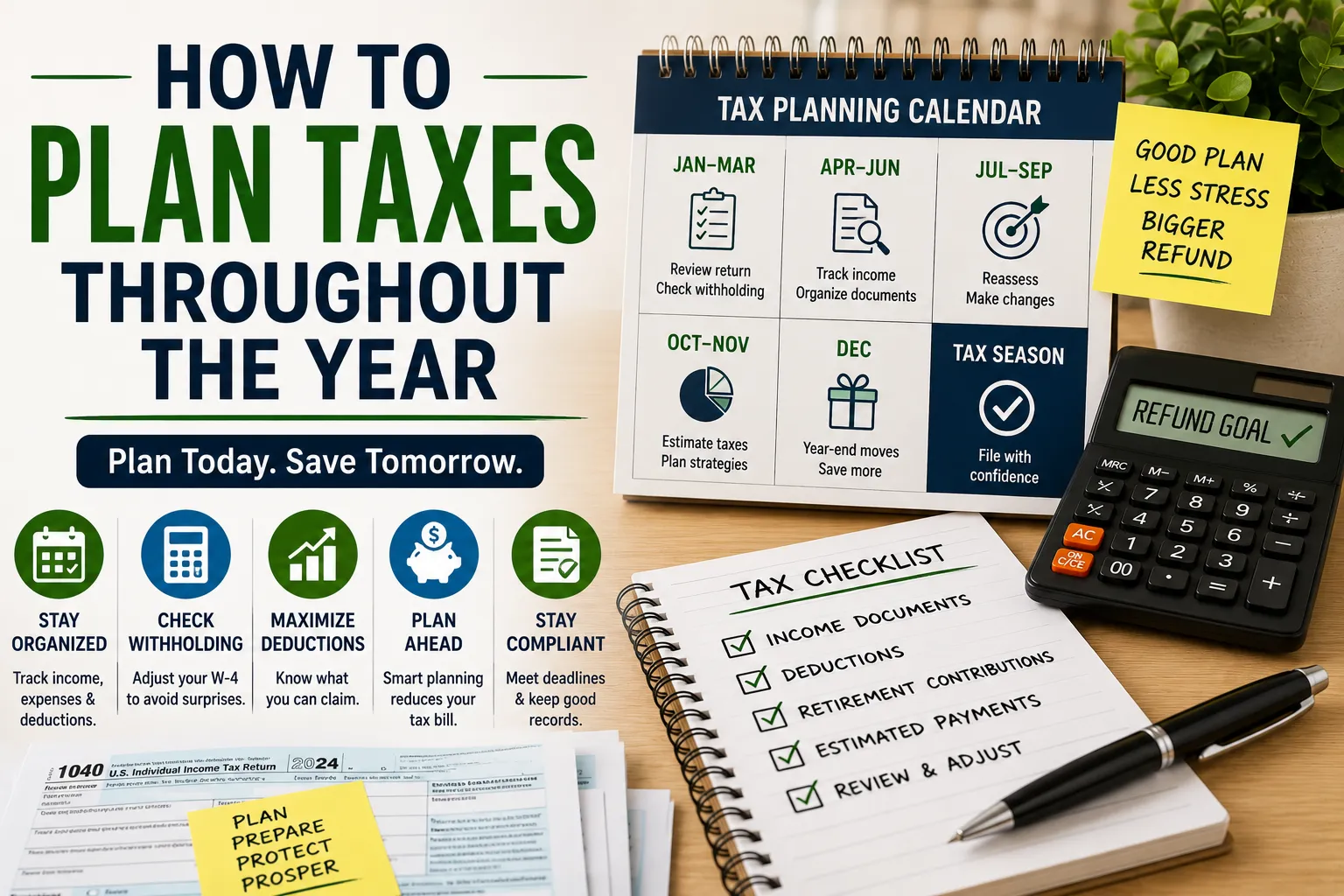
A simple schedule could look like this:
| Period | Main Focus |
|---|---|
| January–March | Review previous return and check withholding |
| April–June | Update income estimates and organize records |
| July–September | Reassess withholding, investments and major changes |
| October–November | Estimate year-end tax position |
| December | Complete eligible year-end planning |
| Filing season | Prepare and file the return |
The exact timing of specific tax actions depends on your circumstances and applicable tax rules.
The purpose of the calendar is to prevent tax planning from becoming a once-a-year surprise.
1. Start With Last Year’s Tax Return
Your previous tax return is one of the most useful starting points for planning the current year.
Look at:
- Total income
- Taxable income
- Federal tax withheld
- Estimated payments
- Deductions
- Tax credits
- Investment income
- Retirement contributions
- Business income
- Amount owed or refunded
If you received a large refund, ask why.
If you owed a substantial amount, ask what caused it.
A large refund may mean too much money was withheld during the year, although the appropriate withholding amount depends on your circumstances.
On the other hand, a large balance due could indicate that withholding was too low or that you received income that wasn’t subject to withholding.
Your previous return therefore isn’t just a document to file away.
It can be a planning tool.
For more information about how deductions and credits can affect your tax position, see the complete guide to tax deductions and credits.
2. Check Your Tax Withholding
Employees commonly have income tax withheld from their paychecks.
That withholding is sent to the relevant tax authority on their behalf.
But the amount being withheld may not always match what you ultimately owe.
Situations that can warrant a review include:
- Starting a new job
- Leaving a job
- Getting married
- Getting divorced
- Having or adopting a child
- Starting a second job
- Receiving a significant raise
- Beginning self-employment
- Receiving investment income
- Retiring
- Taking certain retirement distributions
- Changes in deductions or credits
If adjustments are appropriate, employees generally make changes through the withholding process provided by their employer and tax authority.
Why Withholding Matters
Consider two households with similar annual tax liabilities.
One has enough withheld throughout the year.
The other has too little withheld and discovers a large balance when filing.
The second household may suddenly need thousands of dollars that weren’t included in its monthly budget.
Good withholding management can make tax payments more predictable.
3. Watch Income That Isn’t Automatically Taxed
Not all income necessarily comes with tax withholding.
This is particularly important for:
- Freelancers
- Independent contractors
- Business owners
- Gig workers
- Investors
- Landlords
- People receiving certain retirement income
People receiving income such as dividends, interest, capital gains, rents, royalties or self-employment income may have additional tax-payment responsibilities depending on their jurisdiction.
If you’re earning additional income outside a regular paycheck, don’t wait until filing season to determine whether taxes need to be set aside.
Instead, create a separate tax reserve.
For example, someone earning freelance income might transfer a predetermined portion of each payment into a dedicated savings account.
That money isn’t necessarily “extra savings.”
It is money being reserved for a future tax obligation.
If you have several different types of income, the guide to managing taxes on different income sources can help put this process into a broader framework.
4. Understand Estimated Tax Payments
Estimated tax payments allow certain taxpayers to pay taxes during the year when withholding doesn’t adequately cover their expected liability.
Estimated payments can be particularly relevant for people with:
- Self-employment income
- Investment income
- Rental income
- Significant capital gains
- Other income without sufficient withholding
Failing to pay enough during the year can potentially result in an underpayment penalty, depending on the applicable tax rules.
Because the rules can become complicated, taxpayers with substantial or irregular income may benefit from professional tax advice.
5. Track Your Income Throughout the Year
Tax planning becomes much easier when you know how much money you’re actually making.
Employees can review pay statements.
Freelancers and business owners should maintain detailed income records.
Investors should keep track of taxable investment activity.
Your records should make it possible to answer questions such as:
- How much have I earned so far?
- How much tax has been withheld?
- How much additional income do I expect?
- Have my circumstances changed?
- Am I likely to owe additional tax?
Don’t wait until December to reconstruct an entire year’s finances.
A monthly review can take considerably less time.
6. Keep Tax Records Organized
Good recordkeeping is one of the least exciting parts of tax planning, but it can save significant time later.
Depending on your circumstances, records may include:
- Employment income documents
- Tax certificates
- Investment statements
- Receipts
- Business expenses
- Charitable contributions
- Education expenses
- Medical expense records
- Mortgage documents
- Retirement contribution records
- Rental-property records
- Digital-asset transaction records
A simple digital folder structure can work well.
For example:
Taxes
├── Income
├── Investments
├── Business
├── Donations
├── Medical
├── Education
├── Retirement
└── Property
The goal is to have supporting documentation available when you need it.
For taxpayers who use software to organize financial information, the guide to tax preparation and financial organization software provides additional context on digital recordkeeping and financial organization.
7. Monitor Major Life Changes
Some of the biggest tax-planning opportunities and complications arise from life changes.
A major life change should therefore trigger a tax review.
Marriage
Marriage can change filing status, withholding and eligibility for certain tax benefits.
Divorce
Divorce can affect filing status, dependents and other tax considerations.
Having a Child
A new child can potentially change dependent-related benefits and other aspects of your return, depending on eligibility.
Buying a Home
Homeownership can introduce new financial and tax considerations.
Starting a Business
Business income and expenses can create new recordkeeping and estimated-tax responsibilities.
Retirement
Retirement can change the types of income you receive and how taxes are paid.
For a more detailed look at these situations, see how major life changes can affect your taxes.
The important lesson is simple:
When your life changes, review your tax plan.
8. Review Retirement Contributions
Retirement accounts can play an important role in long-term financial planning as well as tax planning.
Depending on the account and your eligibility, contributions may affect your taxable income or provide other tax advantages.
But don’t contribute to an account solely because you want a tax benefit.
Consider the bigger picture:
- Retirement goals
- Employer matching opportunities
- Investment choices
- Contribution limits
- Cash-flow needs
- Account rules
- Current and future tax circumstances
Tax efficiency should support your financial plan rather than replace it.
9. Review Potential Deductions and Credits
Deductions and credits aren’t the same thing.
A deduction generally reduces the amount of income subject to tax.
A tax credit generally reduces the tax itself, subject to the rules governing that credit.
Potential tax benefits can depend on factors such as:
- Income
- Filing status
- Dependents
- Education
- Homeownership
- Retirement contributions
- Business activities
- Charitable giving
- Medical expenses
- Other qualifying circumstances
Organized documentation can make it easier to identify potentially overlooked deductions and credits.
Don’t spend money solely to obtain a deduction.
A $1,000 expense doesn’t make you $1,000 richer simply because it may qualify for a tax deduction.
The underlying financial decision should make sense first.
10. Be Strategic With Investment Taxes
Investments can introduce tax considerations that aren’t obvious from your regular paycheck.
Depending on the investment and transaction, you may encounter:
- Capital gains
- Capital losses
- Dividends
- Interest income
- Mutual-fund distributions
- Other taxable investment income
If you’re considering selling an investment, don’t look only at the investment’s current value.
Consider the potential tax consequences as part of the overall decision.
Investors with substantial portfolios may benefit from discussing tax-efficient investment strategies with a qualified tax professional and financial adviser.
For a deeper explanation of the tax treatment of investment income and gains, see how investment income and capital gains are taxed.
11. Review Your Tax Position Before Year-End
The final months of the year are an important checkpoint.
At this stage, estimate:
- Total annual income
- Federal withholding
- Estimated payments
- Potential deductions
- Potential credits
- Investment gains and losses
- Retirement contributions
- Major financial changes
Then ask:
If nothing changes, am I likely to receive a refund or owe money?
This isn’t an exact prediction unless all relevant information is available.
But even an approximate projection can reveal a potential problem while there is still time to respond.
A Simple Year-Round Tax Planning Checklist
You can turn the entire process into a recurring routine.
January–March
- Review your previous tax return.
- Check your current paycheck withholding.
- Gather tax documents as they arrive.
- Review retirement contributions.
- Update your household financial plan.
April–June
- Reassess income.
- Track freelance or business revenue.
- Review estimated tax payments if applicable.
- Organize receipts and supporting documents.
- Review any major life changes.
July–September
- Recheck withholding.
- Review investment activity.
- Update income projections.
- Revisit retirement contributions.
- Identify potential year-end tax considerations.
October–November
- Estimate your likely tax position.
- Review deductions and credits.
- Organize missing records.
- Discuss complex issues with a tax professional if necessary.
December
- Complete appropriate year-end planning.
- Make eligible contributions or payments where appropriate.
- Confirm estimated payments.
- Save documentation.
- Prepare a preliminary checklist for filing season.
Common Tax Planning Mistakes to Avoid
Waiting Until Filing Season
By filing time, many decisions have already been made.
Ignoring Side Income
Additional income can create tax obligations that aren’t reflected in a regular paycheck.
Treating a Refund as Free Money
A refund generally represents money that was paid toward your tax liability during the year and is now being returned because your payments exceeded your final liability.
Keeping Poor Records
Missing documentation can make tax preparation harder and can complicate your ability to substantiate certain claims.
Making Financial Decisions Only for Tax Reasons
Taxes are one consideration—not the entire financial decision.
Assuming Last Year’s Numbers Will Automatically Apply
Income, tax rules and personal circumstances can change.
When You Should Consider Professional Tax Advice
Simple tax situations can often be managed with good organization and reputable tax resources.
Professional advice becomes more valuable when your circumstances become complicated.
Consider consulting a qualified tax professional if you have:
- A business
- Significant investment income
- Rental properties
- International income
- Complex stock transactions
- Multiple income sources
- Major inheritance or estate issues
- A substantial change in income
- Complicated retirement distributions
- Significant tax debt
- Questions about a potentially large transaction
A professional can help you evaluate the tax implications before you make a major financial decision.
Tax Planning Is About Timing, Not Just Tax Savings
The most effective tax planning isn’t necessarily about finding a clever loophole or eliminating every dollar of tax.
It’s about timing, preparation and informed decisions.
Check your withholding before a problem develops. Track additional income as you earn it. Keep records while they’re easy to find. Review your finances when major life events occur. Reassess your position before year-end.
For most households, a simple monthly or quarterly review can make taxes much more predictable.
Making Tax Planning Part of Your Financial Routine
A tax plan doesn’t need to be complicated to be useful.
Set a recurring reminder to review your income, withholding, estimated payments, major financial changes and tax records. Then perform a more detailed review before the end of the tax year.
The objective is not simply to get a larger refund.
It’s to avoid unpleasant surprises, understand your obligations and make financial decisions with taxes already accounted for.
When tax planning becomes part of your regular financial routine, tax season becomes less about scrambling to understand what happened and more about documenting decisions you have been preparing for throughout the year.
This article is for general educational purposes and is not individualized tax, legal or financial advice. Tax rules can change, and eligibility for deductions, credits and other tax provisions depends on individual circumstances. Consider consulting a qualified tax professional for advice about your situation.