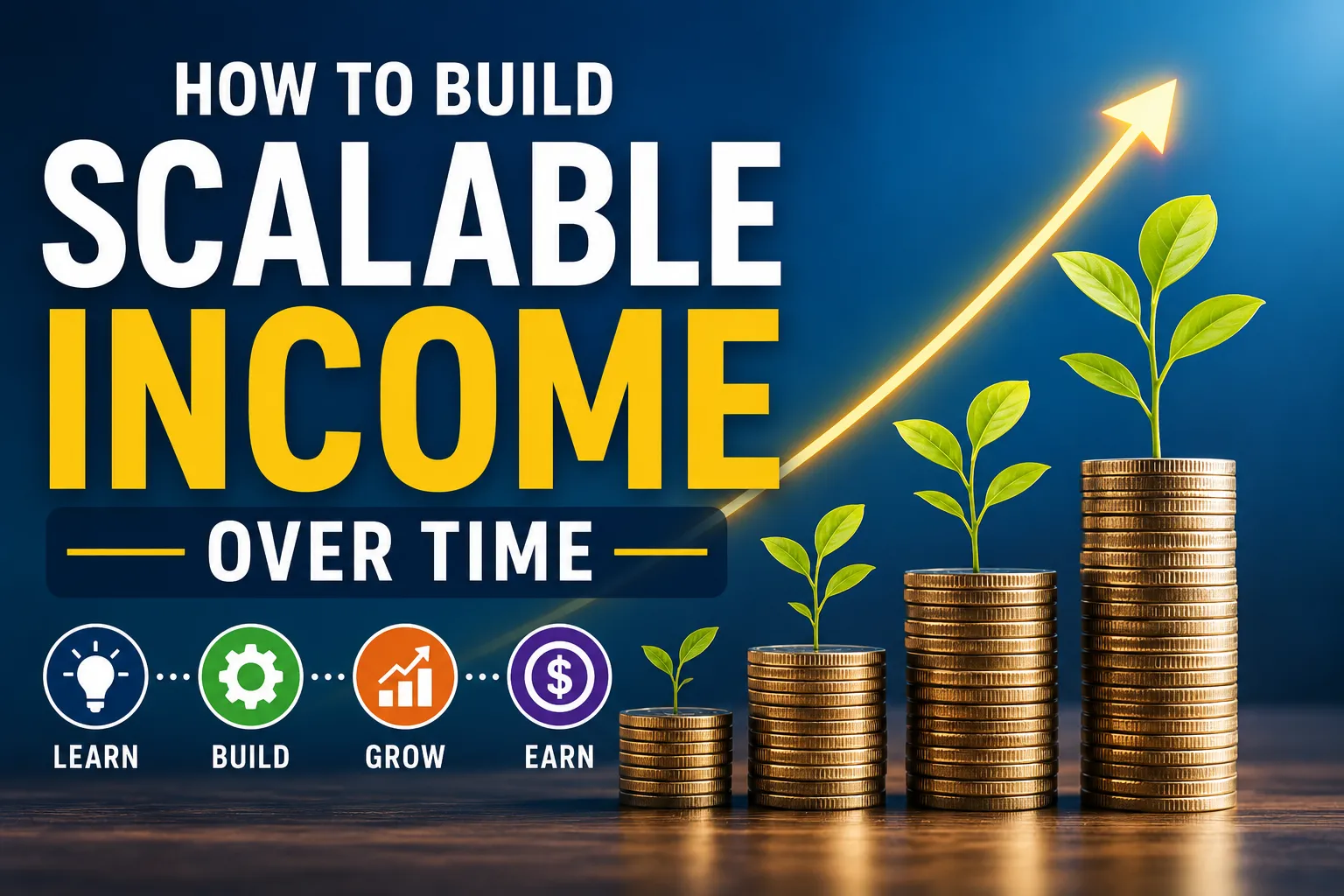
How to Build Scalable Income Over Time
Building income that can grow without requiring you to increase your working hours at the same rate is one of the most useful concepts in personal finance and entrepreneurship.
Traditional income is often closely tied to time. You work more hours, take on additional responsibilities or find a higher-paying job, and your earnings increase. Scalable income works differently. It relies on systems, assets, skills, products or businesses that can generate additional revenue without requiring a proportional increase in your personal effort.
That does not mean scalable income is effortless or passive from day one. Most scalable income streams require significant work to establish. The difference is that, once the underlying system is working, it can potentially serve more customers, generate more sales or produce more value without having to rebuild the entire operation each time.
For people looking to increase their earning potential over the long term, understanding how scalability works can be more valuable than chasing the latest side-hustle trend.
What Does Scalable Income Mean?
Scalable income is income that can grow faster than the resources required to produce it.
Consider two simplified examples.
A freelance designer charges $50 for an hour of work. If the designer wants to double their income, they may need to work twice as many hours.
A designer who creates a digital template for $50 can potentially sell that same template to hundreds of customers without recreating it for every transaction.
The second model has greater scalability.
In practice, the difference is rarely absolute. Digital products require customer support, marketing and maintenance. Businesses require employees, infrastructure and management. Investments require capital and carry risk.
Scalability is therefore better understood as a relationship between additional revenue and additional effort or cost.
Why Scalability Matters for Long-Term Income
There are only so many hours available in a day.
Even highly skilled professionals eventually encounter a ceiling when their income depends entirely on their personal time.
Scalable income creates another path.
Instead of asking:
“How can I work more?”
you can eventually ask:
“How can I create something that delivers value repeatedly?”
That shift can change how you approach your career, business and finances.
For a broader look at how independent work can create income beyond traditional employment, see the complete guide to freelancing and independent work.
Start With Active Income
Ironically, building scalable income often begins with income that is not scalable.
A job, freelance business or service-based business can provide the cash needed to develop scalable assets.
Active income can help you:
- Build savings
- Develop expertise
- Understand customer problems
- Invest in tools
- Fund experiments
- Pay down expensive debt
- Build an emergency reserve
- Invest in long-term assets
Trying to create a scalable business while struggling to cover basic expenses can create unnecessary financial pressure.
A stable foundation gives you more room to experiment.
Build Skills That Increase Your Earning Power
Before worrying about passive income, consider developing skills that businesses and customers are willing to pay for.
Examples include:
- Software development
- Data analysis
- Copywriting
- Sales
- Digital marketing
- Graphic design
- Video production
- Project management
- Financial analysis
- Technical writing
- Consulting
High-value skills can provide two benefits.
First, they can increase your immediate earning potential.
Second, they can become the foundation for a scalable business or product later.
For example, someone who develops expertise in accounting could eventually create financial templates, educational materials, software tools or a specialized consulting operation.
Developing marketable expertise can be a powerful starting point, particularly when combined with high-income skills that can be learned and monetized.
Find a Problem Worth Solving
Scalable income begins with value.
A product or business becomes easier to scale when it solves a problem that many people have.
Instead of starting with:
“What can I sell?”
start with:
“What problem do people repeatedly need solved?”
Look for problems that are:
- Frequent
- Expensive
- Time-consuming
- Frustrating
- Difficult to solve
- Common among a specific group of customers
The more clearly defined the problem, the easier it can be to design a useful solution.
Turn Knowledge Into Products
One of the simplest ways to create scalable income is to package knowledge into a product.
Possible formats include:
- E-books
- Online courses
- Templates
- Checklists
- Spreadsheets
- Guides
- Design assets
- Software tools
- Educational resources
The important distinction is that the customer purchases an existing asset rather than purchasing every minute of your time.
A useful product does not have to be complicated.
A well-designed spreadsheet that saves a business several hours every month can be more valuable than a 200-page book that nobody uses.
For a practical look at this model, explore how to create and sell digital products for sustainable income.
Digital Products Can Be Highly Scalable
Digital products have relatively low distribution costs.
Once created, a digital file can potentially be delivered to many customers without manufacturing, packaging or shipping another physical item.
That does not make digital products automatically profitable.
You still need:
- A useful product
- A defined audience
- Distribution
- Marketing
- Customer support
- Trust
- A reliable purchasing process
The challenge often shifts from production to finding and serving customers.
Build an Audience Before You Need to Sell
An audience can become an important business asset.
This could be an audience on:
- A website
- An email newsletter
- YouTube
- A podcast
- Social platforms
- A professional community
The advantage is not simply having followers.
The real value comes from building a relationship with people who are interested in a particular subject and trust your expertise.
For example, someone who consistently publishes useful information about home improvement may eventually have opportunities to sell guides, tools, courses, consultations or other products to that audience.
Content Can Become a Long-Term Asset
Content is another potentially scalable asset.
An article, video or tutorial can continue attracting people after it is published.
Search-oriented content can be particularly valuable because people actively look for answers to specific questions.
However, content should not be created solely for search engines.
Useful content needs to:
- Answer real questions
- Provide accurate information
- Be easy to understand
- Offer meaningful detail
- Solve a specific problem
A library of genuinely useful content can become a long-term distribution channel for products and services.
Build Systems Instead of Relying on Memory
A business becomes more scalable when its processes are repeatable.
Instead of personally remembering every task, create systems.
Document:
- How customers are acquired
- How orders are processed
- How products are delivered
- How customer questions are answered
- How invoices are sent
- How problems are resolved
- How marketing campaigns are launched
This turns individual knowledge into organizational knowledge.
A documented process can be improved, delegated and eventually automated.
Automation Can Increase Capacity
Technology can reduce repetitive work.
Depending on the business, automation might handle:
- Appointment scheduling
- Email sequences
- Invoicing
- Customer onboarding
- File delivery
- Reporting
- Inventory alerts
- Data collection
- Basic customer support
The objective should not be to automate everything.
Instead, automate repetitive tasks where automation improves efficiency without reducing the quality of the customer experience.
Software Has Significant Scaling Potential
Software is one of the clearest examples of a scalable product.
A piece of software can potentially serve thousands of customers without requiring the developer to manually perform the same task for each customer.
This is one reason software businesses can achieve significant operating leverage.
But software also requires substantial investment in:
- Development
- Security
- Infrastructure
- Customer support
- Updates
- Marketing
- Compliance
A scalable product can still be a difficult business to build.
Subscription Models Can Create Recurring Revenue
Some businesses generate revenue through subscriptions rather than one-time purchases.
Examples include:
- Software subscriptions
- Membership communities
- Newsletters
- Educational platforms
- Digital services
- Maintenance plans
Recurring revenue can make business income more predictable because customers continue paying as long as they perceive ongoing value.
The challenge is retention.
A subscription business must continually give customers a reason to remain subscribed.
Consider Licensing
Licensing allows someone else to use intellectual property in exchange for payment.
Depending on the industry, this could involve:
- Software
- Photography
- Music
- Designs
- Educational content
- Patents
- Written material
Instead of selling an asset only once, licensing can allow the creator to generate multiple revenue streams from the same underlying work.
The legal and contractual details matter, so licensing arrangements should be structured carefully.
Affiliate Income Can Scale With Content
Affiliate marketing involves earning a commission when someone purchases a product or service through a qualifying referral.
It can work particularly well when content helps people make purchasing decisions.
For example, a website that publishes detailed comparisons of technology products may generate affiliate revenue when readers purchase products through tracked links.
The model depends heavily on trust.
Recommending something solely because it pays a commission can damage credibility.
Long-term affiliate income is more likely to work when recommendations are genuinely useful to the audience.
Build an Investment Portfolio
Scalable income does not have to come from entrepreneurship.
Investing can also allow capital to generate returns without requiring you to sell additional hours of labor.
Potential investment income can come from:
- Dividends
- Interest
- Bond payments
- Rental income
- Business ownership
- Capital appreciation
The appropriate investment strategy depends on factors such as time horizon, risk tolerance, financial goals and available capital.
Unlike a business, investments do not require you to create a product or find customers, but they are exposed to market and other financial risks.
Reinvest Instead of Consuming Every Increase
One of the strongest ways to build income over time is to reinvest part of what you earn.
Suppose an additional $500 arrives each month.
You could spend all of it.
Or you could divide it among:
- Living expenses
- Emergency savings
- Investments
- Business development
- Education
- Tools and software
Reinvestment allows today’s additional income to contribute to tomorrow’s earning capacity.
This creates a compounding effect.
Understand the Difference Between Revenue and Profit
A business can generate substantial revenue and still produce little profit.
Imagine a product sells for $100.
If acquiring the customer costs $40, payment processing costs $5, fulfillment costs $25 and customer support costs another $10, only $20 remains before other overhead.
Scaling that business may simply scale the workload.
A scalable business needs economics that improve or remain healthy as sales increase.
Watch Customer Acquisition Costs
Customer acquisition is often one of the biggest barriers to scaling.
If it costs $50 to acquire a customer who generates only $40 in profit, growing the business can make the financial situation worse.
Businesses therefore need to understand metrics such as:
- Customer acquisition cost
- Customer lifetime value
- Conversion rate
- Retention rate
- Average order value
- Gross margin
These numbers help determine whether growth is actually creating value.
Increase Value Before Increasing Volume
One way to improve scalability is to make each customer more valuable.
This can involve:
- Better products
- Premium versions
- Bundled offerings
- Additional services
- Subscriptions
- Complementary products
If the average customer generates more revenue without requiring proportionally more acquisition or service costs, the economics of the business can improve.
Build Multiple Layers of Income
A strong financial system does not necessarily depend on one source of income.
Over time, someone might have:
- Employment income
- Freelance or consulting income
- Digital-product income
- Investment income
- Business ownership income
The goal is not to create five complicated side hustles simultaneously.
It is to gradually develop additional income streams that fit together.
If you are considering diversification, how to create multiple income streams provides a broader framework for thinking about different sources of earnings.
Avoid the “Passive Income” Trap
The phrase “passive income” can create unrealistic expectations.
Most income-producing assets require some combination of:
- Initial work
- Capital
- Maintenance
- Marketing
- Risk management
- Customer service
A rental property may require maintenance.
A website needs updates.
A course needs customer support.
A stock portfolio can decline in value.
A business requires management.
The better goal is often leveraged income, where systems and assets allow your effort to produce more output over time.
Use the Internet as Distribution Infrastructure
The internet has dramatically lowered the cost of reaching customers.
A small business can potentially sell products internationally without opening physical stores in every market.
Digital distribution can support:
- Online stores
- Courses
- Software
- Consulting
- Memberships
- Publications
- Digital downloads
But global reach also means global competition.
Distribution is an advantage only when combined with something people actually want.
Build an Email List
An email list can become an important owned business asset.
Unlike an audience that exists entirely on a third-party platform, an email list gives a business a more direct communication channel with people who have chosen to hear from it.
Email can be used for:
- Product launches
- Educational content
- Promotions
- Customer onboarding
- Updates
- Repeat purchases
The key is to provide value rather than constantly sending sales messages.
Create a Strong Reputation
Trust is difficult to build and easy to lose.
People are more likely to purchase from businesses and creators they believe are:
- Reliable
- Transparent
- Competent
- Consistent
- Honest about limitations
A reputation can become a powerful intangible asset.
It can reduce customer acquisition costs, increase referrals and make future products easier to launch.
Think in Assets, Not Just Tasks
A useful way to think about scalable income is to ask whether today’s work creates something that continues producing value tomorrow.
Examples of assets include:
- A useful website
- A software application
- An established brand
- An email audience
- A course
- A book
- A library of educational content
- An investment portfolio
- A documented business process
- A customer database
Tasks disappear when they are completed.
Assets can continue working after the task is finished.
Reinvest in the Bottleneck
As an income stream grows, identify the part of the system that is limiting growth.
It could be:
- Customer acquisition
- Production
- Delivery
- Technology
- Support
- Cash flow
- Your own time
Do not automatically spend money everywhere.
Find the bottleneck and invest where removing that constraint creates the greatest improvement.
Protect Cash Flow
Rapid growth can create financial stress.
A business may receive more orders but still struggle to pay expenses because cash arrives later than bills are due.
Keep track of:
- Revenue
- Expenses
- Taxes
- Accounts receivable
- Inventory
- Debt
- Operating cash
Scalability is useful only when the underlying financial system can support growth.
Don’t Scale a Broken System
This is one of the most important principles.
If customers are unhappy, scaling the business can create more unhappy customers.
If fulfillment is unreliable, increasing orders can make the problem worse.
If the product is poor, more marketing simply exposes more people to the problem.
Before scaling, make sure the fundamental product and customer experience work.
Build One Strong Income Engine First
Trying to launch multiple businesses simultaneously can spread your attention too thin.
A better approach is often:
Learn → Build → Test → Improve → Systemize → Scale.
Once one income engine becomes reasonably stable, you can use the cash flow, knowledge and systems it produces to develop another.
Give Compounding Time to Work
Scalable income rarely becomes significant overnight.
The early stages can feel slow because you are building the underlying infrastructure.
A website may initially attract very few visitors.
A product may initially have few customers.
An investment portfolio may initially produce modest returns.
A business system may initially save only a few hours each month.
Over time, however, improvements can compound.
More customers create more revenue.
More revenue creates more reinvestment capital.
Better systems increase capacity.
Greater capacity supports more customers.
That cycle can become increasingly powerful.
A Practical Long-Term Roadmap
Someone starting from scratch could approach scalable income in stages.
Stage One: Strengthen Your Financial Base
Focus on:
- Increasing active income
- Controlling unnecessary expenses
- Building emergency savings
- Paying attention to high-cost debt
- Developing valuable skills
Stage Two: Identify a Valuable Problem
Study your industry, profession or interests.
Look for recurring problems that people are willing to pay to solve.
Stage Three: Create a Small Solution
Build something simple.
It could be:
- A template
- A guide
- A service package
- A small software tool
- A digital product
The goal is to test demand rather than build a massive business immediately.
Stage Four: Find Repeatable Distribution
Determine how customers discover your product.
This might happen through:
- Search
- Referrals
- Partnerships
- Social media
- Advertising
- Communities
Stage Five: Systemize the Process
Document what works.
Automate repetitive tasks where appropriate.
Create standard operating procedures.
Stage Six: Reinvest
Use part of the additional income to improve the product, distribution and systems.
Stage Seven: Expand Carefully
Once the model works consistently, consider:
- New products
- New customer segments
- Higher-value offerings
- Subscription revenue
- Licensing
- New markets
Measure Progress With the Right Questions
Instead of asking only how much money you earned this month, consider asking:
- How much income did my assets generate?
- How much revenue can I generate without adding equivalent hours?
- Which activity produces the highest return on my time?
- What process can I automate?
- What problem do customers value most?
- What is preventing the business from growing?
- How much of my additional income am I reinvesting?
- Is my income becoming more diversified?
These questions focus attention on long-term capacity rather than short-term revenue.
Let Your Effort Build Something That Lasts
Building scalable income is ultimately about changing the relationship between time, value and money.
You start by developing valuable skills and generating active income. Then you use those skills, savings and experience to create assets, systems or investments that can continue producing value. As those assets grow, you reinvest in the parts of the system that work best.
There is no guarantee that every business, product or investment will succeed. Some experiments will fail. Markets will change. Customers will change their preferences.
But the underlying principle remains useful: instead of relying entirely on selling more hours, gradually build things that can serve more people, generate recurring value or grow without requiring a proportional increase in your time.
That is how income can become more resilient—and potentially much larger—over the years.