How to Create and Sell Digital Products for Sustainable Income
Digital products have become one of the most accessible ways for creators, freelancers, educators, and entrepreneurs to turn knowledge or skills into an income stream.
Unlike physical products, digital products can often be created once and sold repeatedly without manufacturing, warehousing, or shipping individual units. An ebook, spreadsheet template, online course, design asset, software tool, or digital planner can potentially reach customers in different markets without requiring a physical storefront.
But creating a digital product does not automatically produce sustainable income. The strongest businesses usually begin with a specific customer problem, develop a useful solution, validate demand, and build a repeatable system for attracting and serving customers.
## What Are Digital Products?
Digital products are goods or resources that customers can access electronically rather than receiving as physical items.
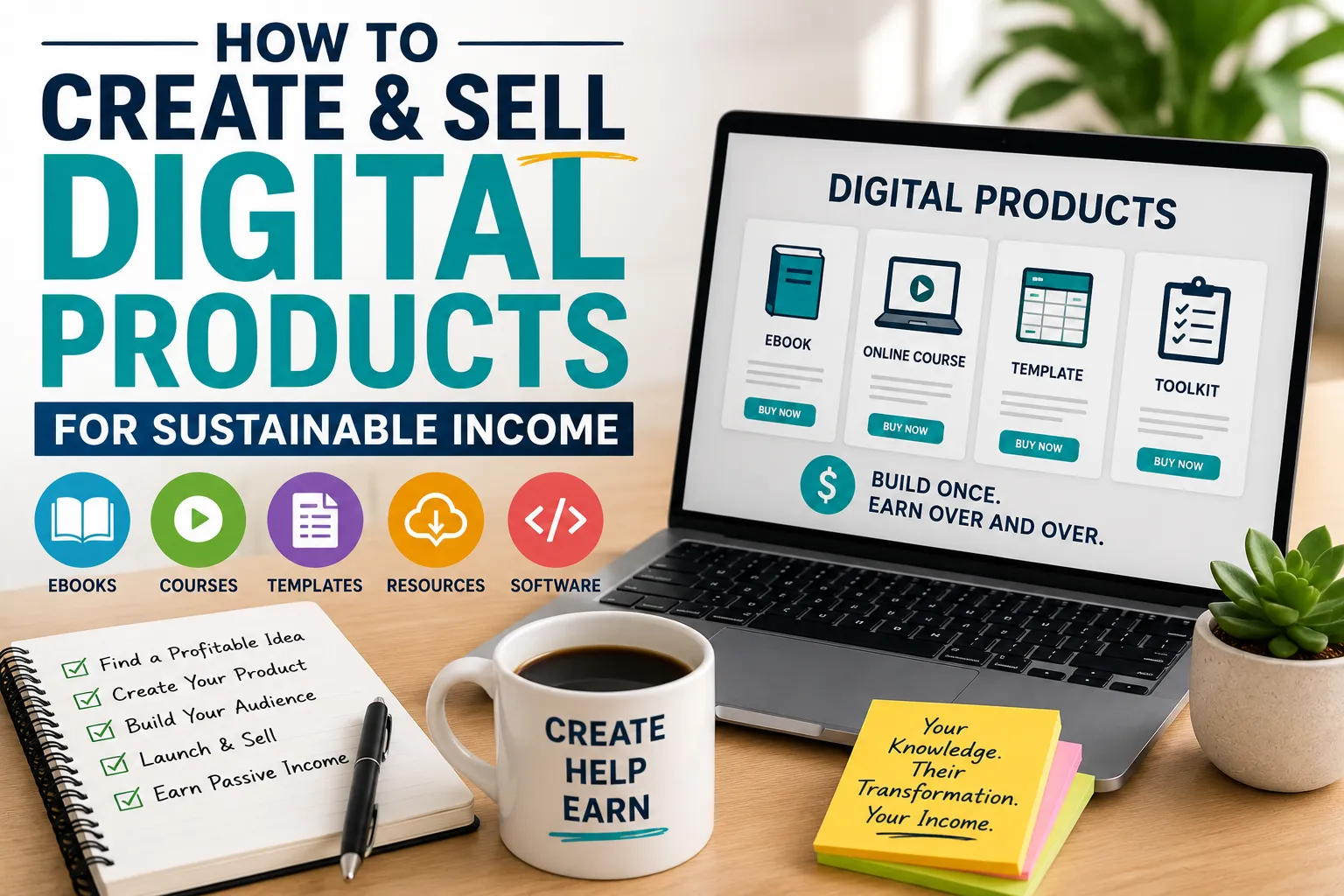
Common examples include:
- Ebooks
- Online courses
- Templates
- Spreadsheets
- Digital planners
- Checklists
- Design assets
- Photography and graphics
- Fonts
- Music and audio files
- Software applications
- Mobile applications
- Website themes
- Educational resources
- Membership content
- Research reports
- Digital toolkits
The defining characteristic is that the product is delivered digitally.
This makes digital products particularly attractive to small businesses because the cost of delivering an additional copy can be relatively low once the underlying product has been created.
## Why Digital Products Can Create Scalable Income
A physical business generally has to produce, store, package, and deliver additional products as sales increase.
Digital products can operate differently.
For example, a creator who develops a budgeting spreadsheet can potentially sell the same core file to hundreds or thousands of customers. The creator still has costs associated with marketing, payment processing, customer support, software, taxes, and product maintenance, but producing another copy does not necessarily require starting the manufacturing process again.
This creates the possibility of scalable revenue.
However, scalability should not be confused with passive income.
A successful digital-product business may require ongoing:
- Marketing
- Customer support
- Product updates
- Security maintenance
- Content creation
- Audience development
- Sales optimization
- Customer research
The product can be reusable, but the business surrounding it still needs attention.
For a broader look at building income systems that can grow without a proportional increase in working hours, see the complete guide to freelancing and independent work.
## Start With a Specific Problem
One of the most common mistakes new digital-product creators make is starting with the product instead of the customer.
They might think:
“I should create an ebook.”
A stronger question is:
“What specific problem can I help a particular group of people solve?”
The difference is important.
Customers rarely purchase a digital file simply because it exists. They purchase a solution to a problem, a shortcut to a desired outcome, information they need, or a tool that makes something easier.
For example, instead of creating a generic productivity ebook, a creator might develop a practical planning system specifically for freelancers who struggle to organize multiple client deadlines.
The narrower problem can make the product easier to position and market.
## Find a Market With Existing Demand
You do not necessarily need to invent a completely new category.
In many cases, a better opportunity exists in an established market where customers are already searching for solutions.
Research can reveal:
- Frequently asked questions
- Common complaints
- Existing product reviews
- Customer frustrations
- Popular educational topics
- Frequently requested templates
- Problems people repeatedly discuss
- Gaps in existing products
Online communities, search results, customer reviews, forums, social platforms, and competitor websites can all provide clues about what people are trying to accomplish.
The objective is not simply to copy existing products.
Instead, look for ways to make the solution:
- Easier to use
- More specific
- Better organized
- More comprehensive
- More accessible
- More practical
- Better suited to a particular audience
## Choose the Right Digital Product Format
The problem you want to solve should influence the type of product you create.
| Customer need | Possible digital product |
|---|---|
| Learn a skill | Online course |
| Understand a subject | Ebook |
| Complete a recurring task | Template |
| Organize information | Spreadsheet |
| Follow a process | Checklist |
| Create something visually | Design template |
| Automate a task | Software tool |
| Access continuing expertise | Membership |
| Make a decision | Calculator or assessment |
| Solve a specialized problem | Toolkit |
A product format should make the customer’s desired outcome easier to achieve.
If customers need step-by-step instruction, a course may be more useful than a static ebook. If they repeatedly perform calculations, a spreadsheet or calculator may provide more practical value.
## Validate the Idea Before Building Everything
Creating a product can take weeks or months.
Before investing that much time, test whether people actually want the solution.
One simple approach is to create a basic version of the offer and put it in front of potential customers.
You could:
- Publish educational content around the problem
- Create a landing page
- Collect email addresses
- Offer a small paid product
- Run a survey
- Talk directly with potential customers
- Pre-sell a course
- Offer a beta version
- Create a free sample
The goal is to gather evidence.
Positive feedback is useful, but actual behavior is generally more informative. Someone saying a product sounds interesting is different from someone signing up, requesting access, or paying for it.
## Build a Minimum Viable Product
You do not need to create the biggest possible version of a product immediately.
A minimum viable product, or MVP, is a functional version designed to solve the core customer problem without unnecessary features.
For an ebook, this might mean a focused book addressing one specific problem.
For a course, it could be a small curriculum covering the essential transformation.
For a spreadsheet, it might contain only the calculations customers actually need.
Starting smaller has several advantages.
You can:
- Launch sooner
- Collect real customer feedback
- Identify weaknesses
- Improve the product
- Reduce development costs
- Test pricing
- Understand customer behavior
A product can become more sophisticated after demand has been established.
## Focus on the Customer’s Desired Outcome
Customers are usually more interested in what a product helps them accomplish than in the product itself.
Consider the difference between these descriptions:
“A 75-page PDF about personal organization.”
and:
“A weekly planning system designed to help freelancers organize projects, deadlines, and client priorities.”
The second description communicates a clearer outcome and audience.
When developing a product, continually ask:
What will the customer be able to do after using this?
That answer should influence the product, sales page, marketing, and customer onboarding.
## Make the Product Easy to Use
A valuable product can still disappoint customers if it is difficult to understand.
Good digital products should generally have:
- Clear instructions
- Logical organization
- Simple navigation
- Consistent formatting
- Useful examples
- Appropriate file formats
- Accessible design
- Easy onboarding
If the product requires extensive explanation before a customer can use it, the experience can become frustrating.
Consider including a short “Start Here” section explaining what the customer has purchased and how to get the most from it.
## Create a Professional Product Experience
Customers judge digital products by more than their core content.
The overall experience matters.
For example, an online course should have organized lessons and clear navigation. A template should have understandable labels. An ebook should be readable on common devices. A software product should provide clear instructions and useful error messages.
Professional presentation can increase perceived value, but design should support usability rather than simply making the product look impressive.
## Set a Sustainable Price
Pricing a digital product can be challenging.
There is a temptation to make digital products extremely cheap because the marginal cost of delivery is low.
But price should reflect value, not simply the cost of delivering a file.
Factors that can influence pricing include:
- Customer problem being solved
- Depth of the solution
- Time saved
- Expertise required
- Alternatives available
- Product quality
- Audience purchasing power
- Customer support included
- Brand positioning
A $10 template and a $300 professional training program can both be legitimate digital products because they solve different problems for different customers.
## Use Different Product Levels
A product ecosystem can provide customers with different entry points.
For example:
### Free Resource
A checklist or short educational resource can attract potential customers.
### Entry-Level Product
A relatively inexpensive template, ebook, or toolkit can introduce customers to the business.
### Core Product
A more comprehensive course, system, or product can provide the primary revenue opportunity.
### Premium Offer
Advanced consulting, coaching, implementation, software, or specialized training can serve customers who need more support.
This structure can help a business avoid relying entirely on one product.
Creators who develop expertise around a particular subject can also explore how to turn knowledge and teaching skills into online education income.
## Build an Audience Before Depending on Advertising
A digital product needs distribution.
Creating something useful is only half the job.
Potential customers need a way to discover it.
One long-term approach is to build an audience through useful content.
Depending on the market, this could include:
- Search-optimized articles
- Email newsletters
- Educational videos
- Podcasts
- Social media posts
- Tutorials
- Case studies
- Webinars
- Free tools
- Community participation
The most effective content usually addresses the same problems the paid product solves.
For example, someone selling a bookkeeping template might publish educational content explaining how freelancers can organize income and expenses.
The free content attracts people with the problem. The paid product provides a deeper solution.
## Use Search Traffic for Long-Term Discovery
Search engines can be particularly valuable for digital-product businesses because people often search when they have a specific problem.
A useful content strategy can target questions related to the customer’s problem rather than publishing endless promotional articles.
For example, a business selling project-management templates could create content around topics such as:
- How to organize freelance projects
- How to track project deadlines
- What should a project tracker include?
- How to prioritize multiple client projects
- Common project-management mistakes
Each useful article can introduce potential customers to the business.
Over time, a strong library of genuinely helpful content can become an acquisition channel.
## Build an Email List
An email list can provide a direct relationship with potential customers.
Search rankings and social-media algorithms can change. An email list gives a business another way to communicate with people who have voluntarily expressed interest.
A basic funnel might look like this:
Useful content → Free resource → Email subscription → Educational emails → Product offer → Customer
The emails should not consist entirely of sales pitches.
Useful newsletters can include:
- Tutorials
- Practical advice
- Case studies
- New resources
- Product improvements
- Industry education
- Answers to common customer questions
Trust develops when subscribers consistently receive something useful.
## Create a Strong Product Sales Page
A sales page should answer the questions a potential customer is likely to have before purchasing.
It should explain:
### What is the product?
Clearly describe what the customer receives.
### Who is it for?
Identify the intended audience.
### What problem does it solve?
Explain the practical benefit.
### What is included?
List the important components.
### How does it work?
Show customers how they will use it.
### Why should they trust it?
Include relevant experience, credentials, demonstrations, customer feedback, examples, or other legitimate evidence.
### What happens after purchase?
Explain delivery and access.
A strong sales page reduces uncertainty.
## Demonstrate the Product Before Selling It
Showing is often more persuasive than simply describing.
Depending on the product, demonstrations could include:
- Screenshots
- Video walkthroughs
- Sample pages
- Before-and-after examples
- Short tutorials
- Product previews
- Demonstration projects
For example, someone selling a spreadsheet template could show how entering information automatically produces a useful summary.
This allows potential customers to understand the product before purchasing.
## Use Customer Feedback to Improve the Product
The first version should not necessarily be the final version.
Customer questions can reveal confusing instructions. Support requests can identify missing features. Reviews can highlight unexpected strengths or weaknesses.
Create a feedback loop:
Sell → Observe → Ask → Improve → Update → Sell again
This process can gradually increase product quality.
It also helps ensure the business remains connected to actual customer needs rather than assumptions.
## Protect the Product From Common Problems
Digital products introduce their own operational challenges.
Depending on the product, consider:
- Secure payment processing
- Appropriate file delivery
- Backup systems
- Access controls
- Software updates
- Data protection
- License terms
- Refund policies
- Copyright protection
- Customer-support procedures
Software products require particular attention to security and maintenance.
Educational products may require periodic updates as information changes.
A sustainable business needs systems that continue working as the customer base grows.
## Avoid Depending on One Sales Channel
A business becomes vulnerable when nearly all customers come from one source.
For example, depending entirely on one social-media platform means an algorithm change could dramatically reduce traffic.
A more resilient strategy can combine several channels:
- Search
- Social media
- Partnerships
- Referral programs
- Communities
- Direct sales
- Affiliate relationships
- Organic content
The goal is not to be everywhere.
It is to develop multiple reliable ways for the right customers to discover the product.
## Create Complementary Products
Once a product has established demand, related products can expand the business.
For example:
Product 1: Basic budgeting spreadsheet
Product 2: Advanced financial planning template
Product 3: Budgeting course
Product 4: Financial planning toolkit
The products should serve related customer needs without becoming meaningless variations designed only to increase the number of listings.
A coherent product ecosystem is more useful than a large catalog of unrelated products.
## Use Bundles Carefully
Bundles can increase perceived value by combining complementary products.
For example, a business-planning bundle might include:
- Business planning template
- Financial spreadsheet
- Marketing checklist
- Goal-setting worksheet
Bundling can also help customers who would otherwise have to purchase several resources separately.
However, the bundle should solve a coherent problem. Combining unrelated products simply to make a larger package can make the offer less compelling.
## Build Recurring Revenue Where It Makes Sense
Some digital products can generate recurring revenue.
Examples include:
- Membership communities
- Software subscriptions
- Premium newsletters
- Resource libraries
- Continuing education platforms
- Subscription-based tools
Recurring revenue can make income more predictable, but it creates an ongoing obligation to provide value.
A subscription should therefore have a clear reason for customers to remain subscribed.
If customers only need the product once, forcing it into a subscription model may create unnecessary friction.
## Track the Numbers That Matter
Revenue alone does not tell the entire story.
Digital-product businesses should consider tracking metrics such as:
- Website visitors
- Conversion rate
- Average order value
- Customer acquisition cost
- Refund rate
- Email subscriber growth
- Repeat purchase rate
- Customer lifetime value
- Product-specific revenue
- Traffic sources
For example, a product generating $10,000 in sales may look successful until you discover that acquiring those customers cost $9,500.
Sustainable income depends on the relationship between revenue, expenses, customer retention, and the time required to operate the business.
## Common Digital Product Mistakes
### Creating Before Validating
Spending months building something nobody wants is one of the most expensive mistakes.
### Trying to Serve Everyone
A product aimed at everyone often fails to communicate a compelling benefit to anyone.
### Competing Only on Price
Low prices do not automatically create high sales volumes.
### Overloading the Product
More features do not necessarily mean more value.
### Ignoring Customer Support
Customers may need help accessing or using digital products.
### Relying Entirely on Social Media
Audience ownership matters for long-term resilience.
### Stopping Marketing After Launch
A product cannot generate consistent sales if potential customers never discover it.
### Never Updating the Product
Information, software, customer expectations, and market conditions change.
## A Practical Digital Product Business Model
A simple model for getting started might look like this:
Step 1: Choose a specific audience.
Step 2: Identify a recurring problem.
Step 3: Research existing solutions.
Step 4: Find an opportunity to provide a better or more focused solution.
Step 5: Validate demand.
Step 6: Build a minimum viable product.
Step 7: Launch it to a small audience.
Step 8: Collect customer feedback.
Step 9: Improve the product.
Step 10: Build an evergreen marketing system.
Step 11: Introduce complementary products.
Step 12: Measure profitability and improve the business.
This approach reduces the risk of spending significant resources before learning whether customers actually value the solution.
## How to Make Digital Product Income More Sustainable
Sustainability comes from building systems rather than chasing individual sales.
A sustainable digital-product business typically combines several elements:
A specific audience provides a clear market.
A meaningful problem gives customers a reason to buy.
A useful product creates value.
Consistent distribution brings potential customers.
Customer trust improves conversion and retention.
Product improvements maintain relevance.
Multiple revenue sources reduce dependence on a single product.
Sound financial management keeps the business profitable.
For creators who want to combine several compatible earning sources rather than depend on one product, how to create multiple income streams offers a broader perspective.
The objective is not simply to create something once and hope it sells forever.
It is to build an asset that can continue producing value while the business develops better ways to reach customers.
## Turning Knowledge Into a Long-Term Digital Business
Creating and selling digital products can provide an attractive path for people who have useful knowledge, skills, systems, or creative assets they can package into practical solutions.
But sustainable income rarely comes from the product alone.
The strongest opportunity comes from combining customer research, genuinely useful products, trusted content, effective distribution, and continuous improvement.
Start with a real problem rather than a product idea. Build something focused enough to solve that problem well. Test it with real customers, listen carefully to their feedback, and develop marketing channels that can continue bringing qualified buyers over time.
A digital product may begin as a simple spreadsheet, ebook, course, template, or tool. With the right audience and business systems around it, that small product can become the foundation of a much larger and more durable source of income.