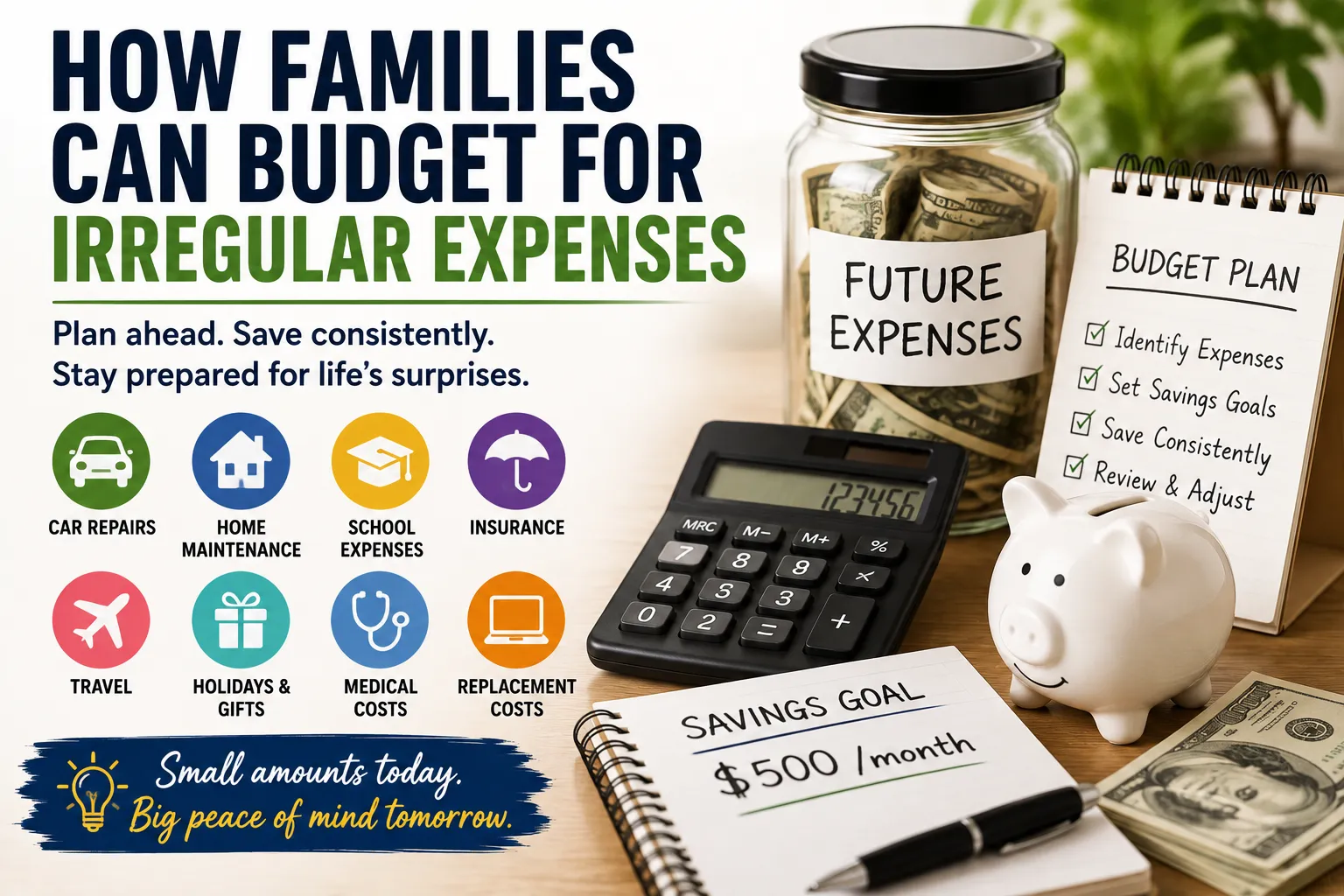
How Families Can Budget for Irregular Expenses
Most household budgets are built around expenses that arrive on a predictable schedule.
Rent is due every month. Electricity has a regular billing cycle. Groceries need to be purchased every week or two. Loan payments have fixed due dates.
Then reality happens.
A child needs new school shoes. The car requires a repair. An annual insurance bill arrives. A family member has a wedding. A water heater stops working. Holiday travel becomes necessary. Property taxes or annual fees come due.
These expenses aren’t necessarily unexpected. They’re simply irregular.
That distinction matters because many families treat irregular expenses as emergencies when they are actually predictable costs that happen at different intervals.
The solution isn’t to eliminate every surprise. It’s to build a household budgeting system that expects expenses outside the normal monthly routine.
What Are Irregular Expenses?
Irregular expenses are costs that don’t occur at the same frequency or amount every month.
They can happen:
- Once a year
- Twice a year
- Every few years
- Seasonally
- Occasionally
- Without a fixed date
Examples include:
- Car maintenance
- Home repairs
- School expenses
- Insurance premiums
- Property taxes
- Medical or dental costs
- Holiday spending
- Birthdays
- Weddings
- Annual memberships
- Professional fees
- Appliance replacement
- Clothing purchases
- Travel
- Pet expenses
- Technology replacement
Some irregular expenses are predictable.
Others are genuine emergencies.
A good family budget needs to prepare for both.
Why Irregular Expenses Cause Budget Problems
The biggest problem is timing.
A household may have enough annual income to cover its expenses but still experience cash-flow problems when several large bills arrive at once.
For example, imagine a family has three annual expenses:
- $600 for insurance
- $800 for school-related costs
- $1,200 for vehicle maintenance and registration
That’s $2,600 over the year.
The expense isn’t necessarily unaffordable.
But receiving several of those bills within a short period can create significant pressure if the family hasn’t set money aside beforehand.
This is why when you pay matters almost as much as how much you pay.
The Difference Between Irregular Expenses and Emergencies
These categories shouldn’t be treated exactly the same.
Irregular Expense
You can reasonably anticipate that it will happen.
Examples:
- Annual insurance
- School supplies
- Holiday gifts
- Vehicle servicing
- Property-related fees
Emergency Expense
You don’t know exactly when it will happen or how much it will cost.
Examples:
- Major unexpected medical expense
- Sudden job loss
- Major household repair
- Serious vehicle breakdown
Irregular expenses are usually handled with sinking funds.
Emergencies are generally handled with an emergency fund.
Keeping these concepts separate makes budgeting much clearer.
What Is a Sinking Fund?
A sinking fund is money you gradually set aside for a known future expense.
Suppose you expect to spend $1,200 on insurance and other annual costs in 12 months.
Instead of waiting until the bill arrives, you could set aside:
$1,200 ÷ 12 = $100 per month
When the expense arrives, the money is already available.
The key idea is simple:
Save a little before the expense instead of scrambling for a lot when the expense arrives.
Start With an Irregular Expense Inventory
Before creating sinking funds, identify what your family actually spends money on.
Look through:
- Bank statements
- Credit-card statements
- Receipts
- Insurance documents
- School records
- Vehicle maintenance records
- Subscription accounts
- Previous holiday spending
- Tax records
- Household repair history
Look back over at least the previous 12 months if possible.
You may discover expenses you forgot about.
Create an Annual Expense List
Make a simple table.
| Expense | Estimated Annual Cost | Due |
|---|---|---|
| Car maintenance | $800 | Throughout year |
| Insurance | $1,200 | June |
| School expenses | $700 | August |
| Holiday gifts | $600 | December |
| Home maintenance | $600 | Throughout year |
| Annual memberships | $240 | Various |
| Total | $4,140 |
The exact numbers will be different for every household.
The purpose is to see the annual financial picture rather than focusing only on monthly bills.
Convert Annual Costs Into Monthly Savings
Once you’ve estimated the annual total, divide it by the number of months until you need the money.
For a recurring annual expense:
Annual cost ÷ 12 = monthly contribution
For example:
- Insurance: $1,200 ÷ 12 = $100
- School expenses: $720 ÷ 12 = $60
- Holiday spending: $600 ÷ 12 = $50
- Car maintenance: $900 ÷ 12 = $75
Total monthly sinking-fund contribution:
$285
Instead of being hit with several large bills, the family incorporates $285 into its regular monthly budget.
Don’t Forget Expenses That Happen Every Few Years
Some costs don’t happen annually but are still predictable.
Examples include:
- Replacing a laptop
- Buying a new mattress
- Repainting a home
- Replacing tires
- Replacing major appliances
- Renewing certain licenses
- Replacing furniture
If you expect to spend $1,500 on a new laptop and other technology in three years, you could plan for:
$1,500 ÷ 36 months ≈ $42 per month
The goal isn’t to predict the exact future perfectly.
It’s to avoid being completely unprepared when the expense eventually arrives.
Build a “Future Replacement” Fund
Families often remember monthly bills but forget that many household possessions have limited lifespans.
Think about:
- Refrigerator
- Washing machine
- Television
- Laptop
- Phone
- Car tires
- Furniture
- Water heater
- Air conditioner
You don’t necessarily need a separate account for every item.
A general household replacement fund can be enough.
Use a Buffer for Uncertain Costs
Some irregular expenses are difficult to predict precisely.
For example, you may know your car will need maintenance but not know whether it will cost $500 or $1,000.
Instead of budgeting for the absolute minimum, use a reasonable estimate plus a margin.
If you typically spend around $700 annually on vehicle maintenance, setting aside $800 or $900 may provide useful breathing room.
Unused money can remain in the fund for the following year.
Track What You Actually Spend
Your first estimate won’t necessarily be accurate.
That’s normal.
Track actual expenses throughout the year.
If you budgeted $600 for holiday spending but actually spent $850, that tells you something important.
The following year’s budget can be adjusted accordingly.
Budgeting works best as a feedback system.
Estimate → Spend → Review → Adjust.
Don’t Rely on Memory
It’s easy to remember large expenses while forgetting smaller ones.
A $50 annual fee may not seem important.
But several small expenses can add up to hundreds of dollars.
Use a spreadsheet, budgeting app or simple notebook to record them.
The tool matters less than consistency.
Separate Monthly Bills From Irregular Expenses
Your regular monthly budget might include:
- Housing
- Utilities
- Food
- Transportation
- Debt payments
- Insurance
- Savings
Your sinking-fund category might include:
- Car maintenance
- School costs
- Holidays
- Home repairs
- Gifts
- Annual fees
- Technology replacement
Separating the two makes it easier to understand how much money is genuinely available for everyday spending.
Families looking to build the broader framework around these categories can also use a family budget to organize recurring and future household obligations.
Consider Multiple Sinking Funds
Families with many irregular expenses may benefit from several categories.
For example:
Home Fund
For:
- Repairs
- Maintenance
- Appliances
- Small improvements
Vehicle Fund
For:
- Maintenance
- Tires
- Registration
- Repairs
School Fund
For:
- Supplies
- Uniforms
- Activities
- Fees
Holiday Fund
For:
- Gifts
- Travel
- Food
- Decorations
Annual Bills Fund
For:
- Insurance
- Memberships
- Licenses
- Renewals
You don’t necessarily need separate bank accounts for each.
A spreadsheet with virtual categories can accomplish the same thing.
Keep Sinking-Fund Money Accessible
Unlike long-term investments, sinking-fund money is intended for relatively near-term spending.
That means accessibility matters.
The appropriate account depends on your circumstances and local financial products, but generally the money should be:
- Easy to access
- Low risk
- Separate from everyday spending
- Clearly tracked
The purpose isn’t to maximize investment returns.
The purpose is to have the money available when the bill arrives.
Don’t Treat Sinking Funds as Emergency Savings
This distinction is important.
If you’ve saved $1,000 for car maintenance, that money isn’t necessarily available for an unrelated vacation just because your car hasn’t needed repairs yet.
Likewise, your emergency fund shouldn’t routinely be used for predictable annual expenses.
Give each pool of money a job.
Build an Emergency Fund Separately
An emergency fund is designed for situations where the timing or size of an expense cannot reasonably be predicted.
Possible examples include:
- Loss of income
- Major unexpected repair
- Serious emergency expense
- Sudden necessary travel
The appropriate emergency-fund size depends on your household’s income stability, expenses and circumstances.
Even a small cash reserve can provide more flexibility than having nothing available.
Start With the Most Important Irregular Expenses
If your budget is tight, don’t create 15 sinking funds immediately.
Prioritize.
Start with expenses that are:
- Predictable
- Necessary
- Expensive
- Difficult to postpone
For example, housing-related repairs and essential transportation may deserve priority over optional holiday spending.
Prioritize Based on Consequences
Ask:
What happens if I don’t have the money when this expense arrives?
If the answer is:
“The family can’t safely function without it.”
it deserves a higher priority.
If the answer is:
“We can simply skip it this year.”
it may deserve less funding.
Budget for Children’s Expenses Throughout the Year
Children can create a large number of irregular expenses.
Consider:
- School supplies
- Clothing
- Shoes
- Sports
- School trips
- Birthdays
- Activities
- Technology
- Summer programs
Rather than treating every expense as a surprise, estimate the year’s total and spread the savings across the months.
For expenses such as school supplies, uniforms and technology, families can also plan ahead using a back-to-school budgeting strategy.
Plan for Holidays Before the Holiday Season
Holiday spending can be especially difficult because it often combines:
- Gifts
- Food
- Travel
- Decorations
- Events
- Entertainment
Instead of starting to think about these expenses shortly before the holidays, estimate the total earlier in the year.
If your household typically spends $1,200 during the holiday period, saving $100 per month over 12 months can make the season much easier to manage.
Budget for Birthdays
Birthdays are predictable.
The exact amount you spend may vary, but you generally know the dates in advance.
Create a simple annual birthday budget covering:
- Gifts
- Food
- Parties
- Decorations
- Activities
For multiple children, calculate the expected total for the entire year.
Don’t Forget Gifts for Other People
Gift-giving can extend beyond children’s birthdays.
You may have:
- Weddings
- Graduations
- Anniversaries
- Baby showers
- Family celebrations
- Workplace events
Create a general gift category if these expenses are common in your family.
Budget for Travel Separately
Travel expenses often include more than transportation.
Consider:
- Accommodation
- Food
- Transportation
- Activities
- Travel insurance
- Luggage
- Currency costs
- Emergency spending
If you know a trip is coming, start saving before booking everything.
Car Expenses Need Their Own Plan
Vehicle expenses are notorious for disrupting budgets.
A car may require:
- Oil changes
- Tires
- Batteries
- Brakes
- Registration
- Insurance
- Repairs
- Inspection
Even if the vehicle is currently running perfectly, maintenance costs will eventually appear.
Estimate Car Costs From Previous Years
Look at your previous maintenance records.
If you spent:
- $500 one year
- $900 the next
- $700 the year after
then budgeting only $300 for the next year probably isn’t realistic.
Use your own history as a starting point.
Home Maintenance Is Another Predictable Unknown
Homeowners often make the mistake of budgeting for the mortgage while ignoring maintenance.
Homes require:
- Plumbing repairs
- Electrical work
- Painting
- Roofing
- Landscaping
- Appliance replacement
- Pest control
- Cleaning
- General repairs
Not every expense occurs annually, but maintenance is a normal part of homeownership.
Housing costs can have a substantial effect on the overall household financial picture, so families should consider how housing costs affect family finances when setting long-term spending limits.
Renters Have Irregular Expenses Too
Renters don’t escape irregular costs.
They may face:
- Moving costs
- Security deposits
- Furniture
- Appliance purchases
- Transportation
- Insurance
- Repairs to personal belongings
- Utility deposits
A renter’s budget should also include future housing-related expenses.
Budget for Healthcare Costs
Healthcare expenses can be difficult because some costs are unpredictable.
But certain expenses can be anticipated:
- Dental checkups
- Eye exams
- Prescription refills
- Routine appointments
- Medical equipment
- Insurance deductibles or other out-of-pocket costs
Use your household’s history to estimate recurring healthcare expenses.
For genuinely unexpected medical costs, maintain an appropriate emergency reserve and insurance coverage where available.
Pets Have Irregular Expenses Too
Pet owners may encounter:
- Veterinary visits
- Vaccinations
- Medication
- Grooming
- Boarding
- Replacement equipment
- Emergency care
A dedicated pet fund can prevent routine animal-care costs from disrupting the rest of the household budget.
Budget for Annual Subscriptions
Review all annual payments.
These may include:
- Software
- Memberships
- Cloud storage
- Professional associations
- Streaming services
- Security services
- Online tools
Annual billing can create a surprisingly large expense when several renewals happen in the same month.
Spread Annual Renewals Across the Year
If possible, don’t let all annual subscriptions renew simultaneously.
For future subscriptions, you may be able to choose different billing dates or payment schedules.
The objective is to reduce the risk of several large withdrawals arriving at once.
Use a Calendar Alongside Your Budget
Money management isn’t only about amounts.
Timing matters.
Create a yearly calendar showing when major expenses are expected.
For example:
| Month | Expected Expense |
|---|---|
| January | Insurance renewal |
| March | School activity |
| May | Vehicle maintenance |
| August | School supplies |
| October | Home maintenance |
| December | Holiday spending |
Now you can see where the pressure points are likely to occur.
Create a Year-at-a-Glance Budget
A monthly budget can hide seasonal patterns.
A yearly overview reveals them.
For each month, list:
- Expected income
- Fixed bills
- Variable expenses
- Sinking-fund contributions
- Large upcoming expenses
- Planned savings
This helps you identify difficult months before they arrive.
What If Several Expenses Arrive at Once?
Sometimes timing cannot be avoided.
If multiple large expenses are approaching:
- Identify which are essential.
- Determine what can be postponed.
- Use the appropriate sinking funds.
- Reduce discretionary spending temporarily.
- Look for lower-cost alternatives.
- Avoid unnecessary high-interest borrowing.
Don’t treat every bill as equally urgent.
Avoid Using Credit to Solve Every Budget Gap
Credit can provide temporary flexibility, but repeatedly using debt to cover predictable expenses creates a cycle.
If you use a credit card for a $1,000 annual expense and then spend months repaying it with interest, the original expense becomes more expensive.
The better long-term solution is to identify the expense and build it into the budget.
If You’re Already Behind, Start Where You Are
Not every family has enough income to immediately fund every sinking category.
That’s okay.
Start with the most urgent expenses.
If you know that a $600 bill is due in six months, you could calculate:
$600 ÷ 6 = $100 per month
If $100 isn’t possible, determine what is realistic.
Even partial preparation can reduce the amount you’ll need to find later.
Use Windfalls Carefully
Occasional extra income can help fund irregular expenses.
Examples include:
- Bonuses
- Tax refunds
- Gifts
- Freelance income
- Side-business profits
- Asset sales
Instead of immediately spending all extra money, consider directing some toward upcoming known expenses.
Don’t Budget Every Dollar Into a Specific Category
A budget that leaves no flexibility can become difficult to maintain.
Life isn’t perfectly predictable.
Consider leaving some room for:
- Small surprises
- Price increases
- Family changes
- Minor repairs
- Unplanned opportunities
The exact amount depends on your household’s finances.
The principle is to avoid building a plan so tight that one unexpected $50 expense destroys it.
Review Your Budget Quarterly
A quarterly review can reveal whether your estimates are realistic.
Ask:
- Which categories were underestimated?
- Which expenses surprised us?
- Which sinking funds are growing too slowly?
- Which categories have unused money?
- Have our priorities changed?
Then adjust.
A budget is a living document.
Adjust for Inflation and Changing Costs
The price of many goods and services can change over time.
If your annual school expenses were $500 several years ago, don’t automatically assume they’ll remain $500 indefinitely.
Review historical spending and update estimates.
Give Every Irregular Expense a Funding Method
For each expense, decide how you’ll pay for it.
For example:
| Expense | Funding Method |
|---|---|
| School supplies | Monthly sinking fund |
| Annual insurance | Monthly sinking fund |
| Major emergency | Emergency fund |
| Holiday gifts | Monthly sinking fund |
| New laptop | Replacement fund |
| Optional vacation | Dedicated travel savings |
This prevents vague financial planning.
Use Separate Categories Even If You Use One Account
You don’t necessarily need multiple physical accounts.
A spreadsheet might show:
- Home: $450
- Car: $600
- School: $300
- Holidays: $250
Your bank account might hold the total.
The important thing is knowing what portion of the balance has already been committed.
Don’t Mistake a High Bank Balance for Available Money
Suppose your account contains $4,000.
That doesn’t necessarily mean you have $4,000 available to spend.
If:
- $1,000 is for insurance
- $500 is for school
- $600 is for vehicle maintenance
- $400 is for holiday spending
then only $1,500 may be genuinely unallocated.
Budget categories help you see the difference.
Automate Contributions Where Possible
If your bank allows it, automatic transfers can make sinking funds easier to maintain.
For example, immediately after payday:
- $100 → insurance fund
- $75 → vehicle fund
- $60 → school fund
- $50 → holiday fund
Automation reduces the temptation to spend the money first.
Coordinate the System With Your Pay Schedule
If you are paid:
- Weekly
- Biweekly
- Twice monthly
- Monthly
your savings contributions can be divided accordingly.
For example, a $240 annual expense could become approximately:
- $20 per month
- About $4.62 per week
- About $9.23 every two weeks
The exact approach can be adjusted to your pay schedule.
Include Irregular Expenses in Your Family Meeting
Money management works better when household members understand the plan.
A family budget discussion can cover:
- Upcoming major expenses
- Savings priorities
- Spending limits
- School costs
- Travel plans
- Holiday spending
Children don’t need to know every financial detail, but older children can benefit from learning how families plan for expenses.
Teach Children the Difference Between Planned and Unexpected Costs
This is an excellent financial lesson.
Explain that:
“We know your school expenses are coming, so we’re saving for them.”
versus:
“The washing machine suddenly broke, so we need to use emergency savings.”
Understanding this distinction helps children develop realistic expectations about money.
What If Your Income Is Irregular?
Families with variable income face an additional challenge.
If your income changes from month to month, consider building your budget around a conservative income estimate rather than your best month.
During higher-income periods, additional money can help build reserves for slower periods and upcoming irregular expenses.
A larger cash buffer may be especially valuable when income is unpredictable.
Budgeting for Irregular Expenses When Money Is Tight
If there’s little room in the budget, focus on the essentials.
Try:
- Reducing unnecessary subscriptions
- Delaying nonessential purchases
- Buying used where practical
- Repairing items
- Comparing insurance or service costs
- Shopping with lists
- Planning meals
- Using existing supplies
- Saving small amounts consistently
Small savings can accumulate into useful reserves.
Don’t Cut Everything at Once
Extreme budgeting can be difficult to sustain.
Instead of eliminating every enjoyable activity, identify the expenses that have the least value to your family.
A sustainable budget leaves some room for enjoyment.
The goal is financial resilience, not punishment.
Common Mistakes Families Make
Mistake 1: Treating Predictable Costs as Emergencies
If the expense happens every year, it probably belongs in a sinking fund.
Mistake 2: Ignoring Small Annual Expenses
Several $50 or $100 bills can add up quickly.
Mistake 3: Saving Only When Money Is Left Over
There may never be much left over.
Treat sinking-fund contributions as planned expenses.
Mistake 4: Underestimating
Use previous spending as evidence.
Mistake 5: Spending the Fund on Something Else
Give the money a specific purpose.
Mistake 6: Forgetting Maintenance
Cars, homes and appliances require ongoing care.
Mistake 7: Building a Budget That Is Too Complicated
If maintaining it takes hours every week, simplify it.
A Simple Irregular Expense Formula
For a recurring annual expense:
Estimated annual cost ÷ 12 = monthly sinking-fund contribution
For an expense due sooner:
Estimated cost ÷ months remaining = monthly contribution
For example:
A $900 expense is due in six months.
$900 ÷ 6 = $150 per month
If you can contribute $150 each month, you’ll have the full amount when the expense arrives.
A Family Irregular Expense Worksheet
Use a table like this:
| Expense | Expected Cost | Due Date | Already Saved | Remaining | Monthly Needed |
|---|---|---|---|---|---|
| Insurance | $1,200 | June | $400 | $800 | $200 |
| School | $800 | August | $200 | $600 | $150 |
| Vehicle | $900 | October | $300 | $600 | $100 |
| Holidays | $600 | December | $150 | $450 | $75 |
The “monthly needed” figure should be adjusted based on the number of months remaining.
What to Do When You Don’t Know the Exact Cost
Use a reasonable estimate based on:
- Previous spending
- Current prices
- Quotes
- Professional estimates
- Inflation
- Expected changes in family needs
Then build in a modest buffer.
It’s better to discover that you’ve saved slightly more than necessary than to discover you’re hundreds of dollars short.
Review Last Year’s Irregular Expenses
This is one of the most useful budgeting exercises a family can perform.
Look at the previous year and ask:
Where did our money go that wasn’t part of our normal monthly bills?
You’ll probably find several categories you hadn’t considered.
Those categories become next year’s sinking funds.
Build the System Before You Need It
The ideal time to start saving for an annual expense is before the expense becomes urgent.
But if the deadline is already approaching, don’t wait for the next calendar year.
Start now.
Even if you can’t fully fund the expense, whatever you save reduces the amount you’ll need to find elsewhere.
What a Good Irregular Expense System Looks Like
A practical household system doesn’t need to be complicated.
It might consist of:
One Annual List
Everything you expect to spend throughout the year.
A Few Sinking Funds
Grouped into logical categories.
An Emergency Fund
For genuinely unexpected events.
A Calendar
Showing when large expenses are due.
A Monthly Review
To adjust contributions and spending.
That’s enough for many families.
The Goal Is Financial Predictability
You cannot predict every expense.
You can, however, make many unpredictable-looking expenses more manageable.
A $1,200 annual insurance bill isn’t a crisis if you’ve been setting aside $100 each month.
A $700 school expense is easier to handle when you’ve been saving for it since the previous school year.
A vehicle repair is less disruptive when your maintenance fund already contains money.
This is what budgeting for irregular expenses really accomplishes:
It converts financial surprises into planned obligations.
Building a Budget That Can Handle Real Life
A household budget shouldn’t only work during a perfect month.
It should account for the fact that children grow, cars need repairs, appliances break, holidays arrive and annual bills come due.
Start by reviewing the previous year’s spending.
List every significant irregular expense.
Separate predictable costs from true emergencies.
Estimate annual amounts.
Divide them into manageable savings contributions.
Then review the system regularly and adjust it as your family’s circumstances change.
You don’t need to predict the future perfectly.
You simply need to stop treating every predictable expense as if it came out of nowhere.
Making Irregular Expenses Routine
The most powerful change is a shift in perspective.
Instead of saying:
“We suddenly need $800 for school.”
you can say:
“School costs us about $800 each year, so we’ve been setting aside money for it.”
Instead of:
“The car repair ruined this month’s budget.”
you can say:
“The repair came from the vehicle fund we’ve been building.”
That’s the difference between reacting to expenses and preparing for them.
A family that consistently plans for irregular costs gains more than a larger savings balance. It gains financial breathing room.
The bills may still arrive. The car may still break down. School may still get expensive. But when the money has already been given a job before the expense appears, those moments are far less likely to derail the entire household budget.