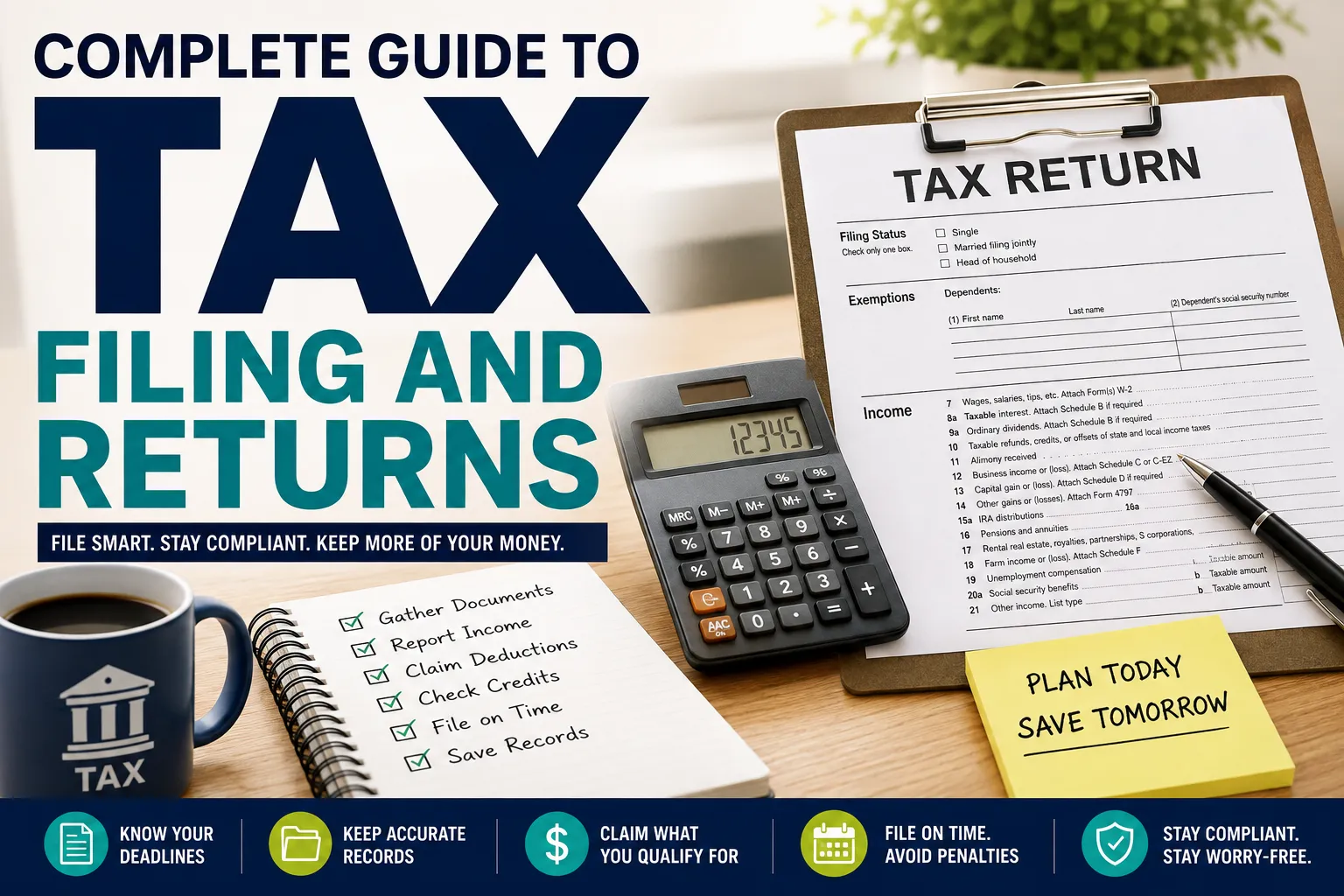
Complete Guide to Tax Filing and Returns
Tax filing can feel complicated, especially when income comes from multiple sources, tax rules change, or important documents are scattered across emails, bank accounts and paper files.
But at its core, filing a tax return is about something relatively straightforward: reporting the income and other information required by your tax authority, calculating the tax that applies, accounting for tax already paid or withheld, and settling any remaining amount or claiming a refund where applicable.
The exact rules, forms, deadlines, deductions and penalties depend heavily on the country and sometimes the state or province where you live. This guide therefore focuses on the general process while highlighting current examples from Kenya and the United States where the rules differ.
For a broader explanation of how personal taxation works, including taxable income, deductions, credits and tax-planning considerations, see the Complete Guide to Personal Taxes and Tax Planning.
For example, Kenya’s 2025 individual income-tax returns are filed between January 1 and June 30, 2026, while the U.S. federal deadline for most calendar-year individuals filing their 2025 return was April 15, 2026.
Important: Tax rules can change and individual circumstances can produce very different results. Use your local tax authority or a qualified tax professional for advice about your specific situation.
What Is a Tax Return?
A tax return is a formal declaration of financial information submitted to a tax authority.
Depending on the jurisdiction and taxpayer, it may contain information about:
- Employment income
- Business income
- Freelance income
- Rental income
- Investment income
- Interest
- Dividends
- Capital gains
- Tax already paid
- Tax withheld
- Allowable expenses
- Deductions
- Tax credits
- Dependents
- Other required information
The tax authority uses this information to determine whether the correct amount of tax has been paid.
A return can therefore result in:
- Additional tax to pay
- A refund
- No additional payment
- A nil tax liability
A return is not necessarily the same thing as a tax payment. In many systems, taxpayers may have taxes withheld or make payments during the year and then use the annual return to reconcile what was paid against what was actually due.
Tax Filing vs. Tax Payment
These two concepts are easy to confuse.
Filing means submitting the required return.
Paying means settling the tax liability.
You may need to do both.
In some cases, you may file a return showing that taxes have already been fully paid through withholding or other payments.
In other situations, the return may show that you owe additional tax.
This distinction is particularly important when requesting an extension.
For example, the U.S. Internal Revenue Service says an extension gives taxpayers additional time to file, but generally does not extend the time to pay taxes owed.
Why Filing a Tax Return Matters
Tax filing is more than an administrative obligation.
Accurate returns can help establish a reliable record of your financial and tax history.
Depending on the jurisdiction, tax records may be relevant when:
- Applying for financing
- Demonstrating income
- Claiming tax benefits
- Requesting refunds
- Obtaining tax-compliance documentation
- Managing business finances
- Responding to tax-authority inquiries
In Kenya, for example, the Kenya Revenue Authority provides Tax Compliance Certificates as official evidence relating to tax filing and payment compliance.
Who Needs to File?
There is no universal answer.
Filing requirements depend on factors such as:
- Country of residence
- Tax residency
- Income level
- Type of income
- Employment status
- Business activity
- Age
- Dependents
- Tax registration status
- Foreign income
- Capital gains
- Special tax obligations
Some people must file even when they ultimately owe no tax.
Kenya Example
KRA states that individuals with a KRA PIN and an Income Tax obligation are required to file annual income-tax returns, including a Nil return when they had no income.
United States Example
U.S. federal filing requirements depend on circumstances such as filing status, gross income, age and other factors.
The IRS provides tools and guidance to help taxpayers determine whether they need to file.
Because requirements differ significantly between countries, never assume that rules from another jurisdiction apply to you.
Understand Your Tax Year
Before preparing a return, determine which period you are reporting.
Many taxpayers use a calendar year:
January 1 → December 31
But some businesses and taxpayers may operate on a fiscal year.
The filing deadline usually comes after the end of the relevant tax year.
For Kenya’s current filing season, taxpayers are filing returns for income earned from January 1 through December 31, 2025, with the filing window running from January 1 through June 30, 2026.
In the U.S., most calendar-year individuals are filing their 2025 federal returns in 2026. The standard deadline was April 15, 2026.
Start by Gathering Your Documents
One of the most effective ways to make tax filing easier is to organize your documents before opening the tax return.
Create a folder—digital or physical—for the relevant tax year.
Potential records include:
- Employment statements
- Bank statements
- Investment statements
- Business records
- Rental income records
- Receipts
- Expense records
- Tax-withholding certificates
- Donation records
- Retirement contributions
- Education expenses
- Healthcare-related records
- Property records
- Loan interest records
- Previous tax returns
The exact documents required depend on your circumstances.
The IRS, for example, specifically recommends gathering income documents and records supporting deductions and credits, as well as records relating to self-employment, investment and other income.
Keep Records Throughout the Year
Do not wait until filing season to reconstruct an entire year’s finances.
A better system is to maintain records continuously.
For a small business, that might mean maintaining:
- Monthly income records
- Expense receipts
- Bank statements
- Invoices
- Payment records
- Tax payments
- Payroll records
- Asset purchases
At the end of the year, your tax return then becomes a reporting exercise rather than a detective project.
Report All Required Income
One of the most important principles of tax filing is completeness.
Do not assume that income does not need to be reported simply because:
- It was paid in cash.
- It came from a side business.
- It was earned online.
- No tax was withheld.
- The amount was relatively small.
- It came from another platform.
- You received it through a payment app.
- You earned it from more than one employer.
Tax rules differ, but taxpayers generally need to identify all income that the relevant tax law requires them to report.
KRA’s current guidance, for example, tells Kenyan taxpayers to declare income from employment and additional sources such as freelance work, consultancy, online services, farming and other income-generating activities where applicable.
For a deeper look at how different types of income can affect your tax position, see How to Manage Taxes on Different Income Sources.
Employment Income
Employees often have the simplest tax situation because their employers may withhold tax throughout the year.
But that does not necessarily mean the employee has nothing to do at filing time.
You may still need to:
- Report employment income
- Verify withholding
- Declare additional income
- Claim eligible tax benefits
- Reconcile tax already paid
In Kenya, KRA says employment details can be pre-populated on iTax for employees, while taxpayers with more than one employer should declare income from all employers in one return.
Multiple Jobs Require Extra Attention
Having more than one employer can make tax filing more complicated.
Keep documentation from every employer.
Check:
- Gross income
- Tax withheld
- Benefits
- Allowances
- Other taxable compensation
Do not assume that one employer’s tax withholding automatically accounts for income earned from another employer.
Freelancers and Side Hustles
The growth of freelancing, online businesses and digital platforms means more people earn money outside traditional employment.
Potential sources include:
- Freelance writing
- Graphic design
- Programming
- Consulting
- Photography
- Online teaching
- E-commerce
- Content creation
- Affiliate marketing
- Digital products
- Professional services
The tax treatment depends on the jurisdiction and nature of the activity.
Keep detailed records of both income and legitimate business expenses.
For U.S. taxpayers, the IRS specifically recommends keeping records such as payment-platform statements, checks, receipts, mileage logs, office expenses and estimated tax payments for self-employment activities.
Business Income Requires Better Record-Keeping
Business owners should avoid treating their personal and business finances as one large pool.
Where appropriate, maintain separate:
- Bank accounts
- Expense records
- Invoices
- Receipts
- Payment records
- Tax records
A clean accounting system makes tax filing considerably easier.
It also gives you a clearer picture of whether the business is actually profitable.
Understand Allowable Expenses
Businesses often incur legitimate expenses in the process of generating income.
Depending on local tax law, certain expenses may be deductible or otherwise recognized for tax purposes.
Examples can include:
- Business supplies
- Professional services
- Advertising
- Certain travel expenses
- Office costs
- Equipment
- Software
- Business-related communications
But an expense is not automatically deductible just because you spent money while running a business.
The rules vary by jurisdiction, business structure and type of expense.
Keep documentation and check the applicable tax rules before claiming an expense.
For a broader explanation of deductions and credits, see the Complete Guide to Tax Deductions and Credits.
Kenya’s 2025 Business-Expense Change
Kenyan taxpayers filing 2025 income-tax returns should pay particular attention to KRA’s current guidance.
KRA states that, for the 2025 Year of Income, taxpayers may declare valid business expenses that are not supported by eTIMS/TIMS invoices, subject to validation after submission.
KRA also says that from the 2026 Year of Income onward, declared income and expenses must be supported by valid electronic tax invoices generated and transmitted through eTIMS/TIMS.
This is a good example of why taxpayers should check current tax-authority guidance rather than relying on instructions from previous years.
Tax Deductions and Tax Credits Are Different
People often use these terms interchangeably, but they can work differently.
A deduction generally reduces the amount of income subject to tax.
A tax credit generally reduces the tax calculated.
The distinction can be significant.
For example, the IRS explains that deductions reduce taxable income, while credits reduce the amount of tax owed.
Not every taxpayer qualifies for every deduction or credit.
Eligibility can depend on:
- Income
- Filing status
- Expenses
- Family circumstances
- Type of investment
- Location
- Employment
- Other requirements
Keep Proof for Your Claims
A common mistake is treating tax deductions as free money.
Tax authorities may require evidence supporting the information in a return.
Keep relevant:
- Receipts
- Invoices
- Statements
- Certificates
- Contracts
- Mileage records
- Donation records
- Payment confirmations
- Business records
The IRS specifically advises taxpayers to keep records supporting eligibility for claimed credits and deductions.
The same general principle applies elsewhere: if you claim something important on your return, know what evidence supports it.
What Is a Tax Refund?
A refund generally occurs when the amount of tax you’ve already paid or had withheld is greater than the amount ultimately due.
For example:
Tax paid during the year: $8,000
Final tax liability: $6,500
Potential refund: $1,500
The exact calculation depends on the tax system.
A refund is not necessarily a financial bonus.
It may simply mean you paid more tax during the year than was ultimately required.
What If You Owe Tax?
Sometimes the completed return shows a balance due.
For example:
Final tax liability: $10,000
Tax already paid: $7,500
Balance: $2,500
The appropriate payment deadline depends on the jurisdiction.
Do not ignore a balance simply because you cannot pay it immediately.
Contact the relevant tax authority or qualified tax professional to understand available options.
Filing a Nil Return
A Nil return generally communicates that there was no income or tax liability to report under the applicable filing obligation.
But whether you need to file one depends on local rules.
In Kenya, KRA explicitly states that taxpayers with an Income Tax obligation who had no income for the year may still be required to file a Nil return.
This is an important distinction:
No income does not necessarily mean no filing obligation.
Filing Electronically
Electronic filing has become the standard in many tax systems.
Benefits can include:
- Faster submission
- Immediate confirmation
- Fewer calculation errors
- Easier record keeping
- Faster processing in some circumstances
In Kenya, individual income-tax returns are filed online through KRA’s iTax system.
Always use the official tax authority’s website or approved filing platform rather than an unfamiliar third-party site.
Review Your Return Before Submitting
Do not rush through the final submission.
Check:
- Your name
- Tax identification number
- Address
- Filing period
- Employment income
- Business income
- Investment income
- Rental income
- Withholding tax
- Tax credits
- Deductions
- Bank information
- Tax payable or refund
Also compare the return against your source documents.
A five-minute review can catch mistakes that would otherwise become much more difficult to correct later.
Verify Withholding Tax
If taxes were already withheld from your income, make sure the relevant information is reflected correctly.
This can be particularly important when you have:
- Multiple employers
- Contract income
- Investment income
- Professional fees
- Rental income
- Withholding certificates
KRA’s current filing guidance specifically advises taxpayers to verify that withholding-tax credits are correctly reflected before submitting their return.
What If You Make a Mistake?
Mistakes happen.
You may accidentally:
- Enter the wrong income
- Omit a source of income
- Enter an incorrect deduction
- Misreport a withholding credit
- Use the wrong filing period
Do not simply ignore the problem.
Check the tax authority’s procedure for correcting or amending a return.
KRA specifically advises taxpayers who identify an error after filing to submit an amended return promptly.
The exact amendment process varies by jurisdiction.
Keep Copies of Submitted Returns
After filing, save:
- Submitted return
- Confirmation receipt
- Payment receipt
- Supporting documents
- Correspondence with the tax authority
Do not rely entirely on the tax portal to store your history forever.
Maintain your own organized archive.
A useful file structure might look like:
Taxes/
  2025/
    Income/
    Expenses/
    Withholding/
    Deductions/
    Submitted Return/
    Payments/
    Correspondence/
Understand Tax Filing Deadlines
Deadlines are among the most important details in tax compliance.
Missing a deadline can result in:
- Penalties
- Interest
- Notices
- Additional administrative problems
- Loss of certain benefits in some jurisdictions
Kenya
KRA’s current guidance says 2025 income-tax returns must be filed by June 30, 2026.
United States
For most calendar-year individual taxpayers, the 2025 federal return deadline was April 15, 2026.
These examples demonstrate why taxpayers should always check the current deadline for their own jurisdiction and filing category.
Filing Extensions
Some tax systems allow extensions.
But an extension does not necessarily mean you can delay payment indefinitely.
In the United States, for example, taxpayers who request an extension generally receive additional time to file, but the IRS emphasizes that taxes owed should generally be paid by the original deadline.
Other countries use different systems.
Never assume that an extension automatically removes penalties or interest.
Late Filing Can Be Expensive
Tax authorities may impose penalties for:
- Filing late
- Paying late
- Failing to file
- Underreporting
- Incorrect information
- Failing to register
- Failing to maintain required records
The amount and structure vary significantly.
KRA’s current public notice warns that taxpayers who failed to file 2025 income-tax returns by June 30, 2026 may be subject to default assessments under the Tax Procedures Act.
If you are already late, filing sooner is generally better than allowing the situation to remain unresolved.
Don’t Ignore Tax Notices
If you receive a notice from your tax authority, read it carefully.
Determine:
- What tax period it concerns
- What issue is being raised
- Whether action is required
- The response deadline
- Whether supporting documents are requested
- Whether payment is required
Keep a copy of your response.
If the notice involves a significant assessment, dispute or potential penalty, consider getting professional tax advice.
Tax Filing for People With Investments
Investment income can introduce additional complexity.
Depending on local law, relevant income may include:
- Interest
- Dividends
- Capital gains
- Rental income
- Investment distributions
Keep:
- Brokerage statements
- Bank statements
- Purchase records
- Sale records
- Dividend statements
- Transaction costs
- Tax certificates
Do not assume that your investment platform’s statement automatically represents the exact figures required on your tax return.
For more detail on the taxation of investment-related income, see How Investment Income and Capital Gains Are Taxed.
Property and Rental Income
Property owners may have additional tax obligations.
Depending on jurisdiction, these can involve:
- Rental income
- Property-related expenses
- Capital gains
- Property taxes
- Depreciation or capital allowances
- Withholding requirements
Rental activity should generally be tracked separately from personal spending.
Keep documentation for:
- Rent received
- Repairs
- Management fees
- Insurance
- Utilities
- Financing
- Property improvements
The deductibility and treatment of each expense depend on local rules.
Tax Filing for Married Couples and Families
Family tax rules vary widely.
Depending on the country, taxpayers may have different rules concerning:
- Joint filing
- Separate filing
- Dependents
- Children
- Education
- Healthcare
- Family-related credits
- Spousal income
Do not automatically assume that a tax benefit available to one household applies to another.
Foreign Income Can Create Extra Obligations
People increasingly work and earn money across borders.
You might:
- Work remotely for a foreign company
- Own foreign investments
- Operate an international business
- Receive money from overseas clients
- Move between countries
- Maintain foreign bank accounts
Tax residency and source-of-income rules can become complicated.
Never assume that foreign income is automatically exempt from taxation in your country of residence.
International tax situations are a good reason to seek professional advice.
Digital Assets and Online Income
Cryptocurrency and other digital assets can create additional reporting obligations depending on the jurisdiction.
Keep records of:
- Purchases
- Sales
- Transfers
- Fees
- Dates
- Values
- Wallet activity
- Exchange statements
The tax treatment of digital assets varies considerably between countries.
The IRS, for example, specifically lists digital-asset transaction records among documents taxpayers may need when preparing returns.
Tax Filing for Self-Employed People
Self-employed taxpayers often need a more organized approach than employees.
Consider maintaining separate records for:
Revenue
Track every payment received.
Expenses
Record legitimate business costs.
Taxes Paid
Track withholding and estimated or advance payments.
Assets
Keep records for equipment and other significant purchases.
Mileage and Travel
Where relevant, maintain contemporaneous records rather than reconstructing them months later.
Invoices
Keep copies of invoices issued to customers.
Good records make tax filing easier and can also help you understand your actual business performance.
Don’t Mix Personal and Business Expenses
One of the most common accounting problems for small businesses is mixing personal and business spending.
For example, using one bank account for:
- Household groceries
- Business software
- Rent
- Client payments
- Entertainment
- Office supplies
can make financial reporting unnecessarily difficult.
Where appropriate, use dedicated business accounts and payment methods.
Keep Your Tax Records Secure
Tax documents contain sensitive financial information.
Protect them with:
- Strong passwords
- Multi-factor authentication
- Encrypted storage where appropriate
- Secure backups
- Limited access
- Trusted cloud services
Be particularly careful with tax-related phishing emails and messages.
Tax authorities generally have official channels for communication.
Beware of Tax Scams
Scammers may impersonate tax authorities and claim that:
- You owe an immediate payment
- Your tax account is about to be suspended
- You are entitled to a large refund
- Your identity has been compromised
- You must provide your password
- You need to click a link immediately
Do not panic.
Verify communications through the tax authority’s official website or contact channels.
Never provide passwords, PINs or financial information simply because someone claims to represent a tax agency.
When Should You Use a Tax Professional?
Not everyone needs an accountant or tax adviser.
A straightforward employment return may be manageable using official guidance.
Professional assistance becomes more valuable when your situation involves:
- Multiple businesses
- Complex investments
- Foreign income
- Rental properties
- Large capital gains
- Significant deductions
- Complex business structures
- Tax disputes
- Audits
- Multiple jurisdictions
- Major changes in financial circumstances
A qualified professional can potentially save you time and help identify issues you might overlook.
But remember that hiring a professional does not eliminate your responsibility to provide accurate information.
Questions to Ask a Tax Professional
Before hiring someone, ask:
- Are you qualified to handle my type of tax return?
- Do you understand my country’s current rules?
- Have you handled similar situations?
- What services are included?
- How are fees calculated?
- Will you review supporting documents?
- Who will actually prepare the return?
- How will you handle questions from the tax authority?
- How will my records be protected?
Avoid choosing a tax professional solely because they are the cheapest.
A Simple Tax-Filing Workflow
A repeatable process can make filing much less stressful.
Step 1: Identify the Tax Period
Determine which year’s income you are reporting.
Step 2: Confirm the Deadline
Check your tax authority’s current deadline.
Step 3: Gather Documents
Collect income, expense and tax-payment records.
Step 4: Organize Income
List every relevant income source.
Step 5: Organize Expenses
Identify potentially allowable expenses and supporting documentation.
Step 6: Check Deductions and Credits
Determine which benefits you may qualify for.
Step 7: Complete the Return
Enter the information carefully.
Step 8: Review Everything
Compare your entries against your records.
Step 9: Submit
File through the appropriate official channel.
Step 10: Save Confirmation
Keep proof of successful filing.
Step 11: Pay Any Balance
Follow the applicable payment deadline.
Step 12: Archive Your Records
Store the return and supporting documents securely.
A Tax-Filing Checklist
Before submitting your return, ask:
- Did I use the correct tax year?
- Did I confirm the filing deadline?
- Did I report all required income?
- Did I include income from side businesses?
- Did I account for investment income?
- Did I check rental income where applicable?
- Did I verify tax already withheld?
- Did I review eligible deductions?
- Did I review available tax credits?
- Do I have evidence supporting important claims?
- Did I check my personal details?
- Did I review the final tax calculation?
- Did I submit through an official channel?
- Did I save the confirmation?
- Did I pay any amount due by the applicable deadline?
How to Make Next Year’s Filing Easier
The best tax strategy is often better organization.
After filing this year’s return, immediately create a system for the next one.
Keep a Monthly Income Record
Record income as it arrives rather than reconstructing it later.
Save Receipts Immediately
Use a digital folder or accounting system.
Reconcile Bank Accounts
Compare your records against actual transactions.
Track Business Expenses
Do not rely on memory.
Save Tax Certificates
Store withholding and other tax documents as soon as you receive them.
Review Your Tax Position During the Year
If your income changes substantially, do not wait until filing season to discover that your tax situation has changed.
Common Tax-Filing Mistakes
Waiting Until the Deadline
Technical problems, missing documents or complicated questions become harder to solve at the last minute.
Forgetting Side Income
A second income stream can still have tax consequences.
Claiming Unsupported Expenses
A legitimate expense without appropriate evidence can create problems.
Using Old Tax Rules
Tax regulations change.
Ignoring Previous Returns
Past filings may contain useful information and unresolved issues.
Entering the Wrong Tax Year
Always verify the reporting period.
Forgetting to Save Confirmation
Keep evidence that your return was successfully submitted.
Ignoring Notices
A tax-authority letter should not automatically be treated as something that can wait.
Mixing Personal and Business Records
Poor bookkeeping makes filing harder and can obscure the true financial picture.
Tax Planning Should Happen Before Filing Season
Tax planning is different from simply filing a return.
Filing looks backward.
Planning looks forward.
Throughout the year, consider how financial decisions may affect your future tax position.
For a practical guide to making tax decisions throughout the year, see How to Plan Taxes Throughout the Year.
Depending on your jurisdiction and circumstances, relevant areas can include:
- Business structure
- Retirement contributions
- Investments
- Charitable giving
- Business expenses
- Asset purchases
- Income timing
- Record keeping
Tax planning should be based on actual laws and legitimate strategies—not attempts to hide income or manufacture deductions.
The Difference Between Tax Avoidance and Tax Evasion
These terms should not be confused.
Tax avoidance generally refers to arranging financial affairs within the law to reduce tax.
Tax evasion involves deliberately breaking tax laws, such as concealing income or falsifying information.
Legitimate tax planning is acceptable.
Falsifying records is not.
If a strategy sounds too good to be true or depends on hiding information from the tax authority, seek professional advice before proceeding.
Why Accurate Records Matter More Than Clever Tricks
A good tax system begins with accurate information.
Instead of focusing exclusively on finding deductions, concentrate on:
- Recording income accurately
- Keeping receipts
- Maintaining organized accounts
- Understanding applicable rules
- Filing on time
- Paying what is actually owed
- Correcting mistakes when discovered
Good records often produce more practical benefits than complicated tax strategies.
Tax Filing in Kenya: A Quick 2026 Reference
For Kenyan taxpayers, the current filing season covers the 2025 Year of Income.
KRA states that:
- The filing period runs from January 1 to June 30, 2026.
- Individuals with an Income Tax obligation generally need to file.
- People with no income may need to submit a Nil return.
- Employment details can be pre-populated on iTax.
- Additional income such as freelance and consultancy income should be declared where applicable.
- Withholding-tax credits should be verified.
- KRA validates declared income and expenses against available records.
- The authority has issued specific 2025 guidance concerning business expenses and eTIMS/TIMS documentation.
KRA also warns that taxpayers who fail to file their 2025 returns by June 30, 2026 may be subject to default assessments.
For current filing instructions, taxpayers should use KRA’s official filing resources rather than relying on outdated tutorials or social-media advice.
Tax Filing in the United States: A Quick 2026 Reference
For most U.S. calendar-year individual taxpayers, the 2025 federal income-tax return was due on April 15, 2026.
Taxpayers who requested the standard extension generally received until October 15, 2026 to file, but the IRS emphasizes that an extension to file does not generally extend the deadline for paying tax owed.
The IRS recommends gathering income documents, records for deductions and credits, and documentation for self-employment and other income before preparing a return.
Because U.S. federal and state tax rules can differ, taxpayers should verify both federal and applicable state requirements.
When Tax Filing Becomes More Complicated
A basic return can become substantially more complex when several financial activities overlap.
For example, someone who:
- Has a full-time job
- Runs a side business
- Owns rental property
- Trades investments
- Receives foreign income
may have several different tax rules operating at once.
This is where organized bookkeeping and professional advice become particularly valuable.
The Goal Is Compliance, Not Just Filing
Submitting a tax return does not automatically mean that everything is correct.
A good filing process involves:
Complete information + accurate calculations + supporting records + timely submission + appropriate payment.
That is the standard taxpayers should aim for.
A rushed return may technically be submitted on time but still create problems if important income is missing or unsupported deductions are included.
Building a Better Tax Habit
Tax filing becomes considerably easier when it stops being an annual crisis.
Instead of waiting until the deadline:
- Keep records throughout the year.
- Separate business and personal finances where appropriate.
- Save receipts and tax certificates.
- Review income regularly.
- Track deductible expenses.
- Watch for changes in tax rules.
- Set aside money for expected tax payments.
- Prepare early.
- Review the completed return carefully.
- Keep copies of everything submitted.
The result is a more predictable financial routine.
Make Tax Season a Record-Keeping Exercise, Not a Panic Exercise
Tax filing does not have to mean spending days searching through old emails and bank statements trying to reconstruct what happened twelve months ago.
The most effective approach is to build a simple system that runs throughout the year.
Keep track of income as you earn it. Save supporting documents when transactions happen. Separate business and personal records where appropriate. Check the rules that apply to your situation. Then, when filing season arrives, you are primarily organizing information you already have rather than trying to recreate your financial history.
Whether you are filing a straightforward employment return, managing freelance income, operating a business or dealing with investments, the fundamentals remain the same: know what you earned, know what you already paid, keep evidence for what you claim, file on time and correct mistakes when you discover them.
Tax rules will continue to change, but those habits remain useful year after year.