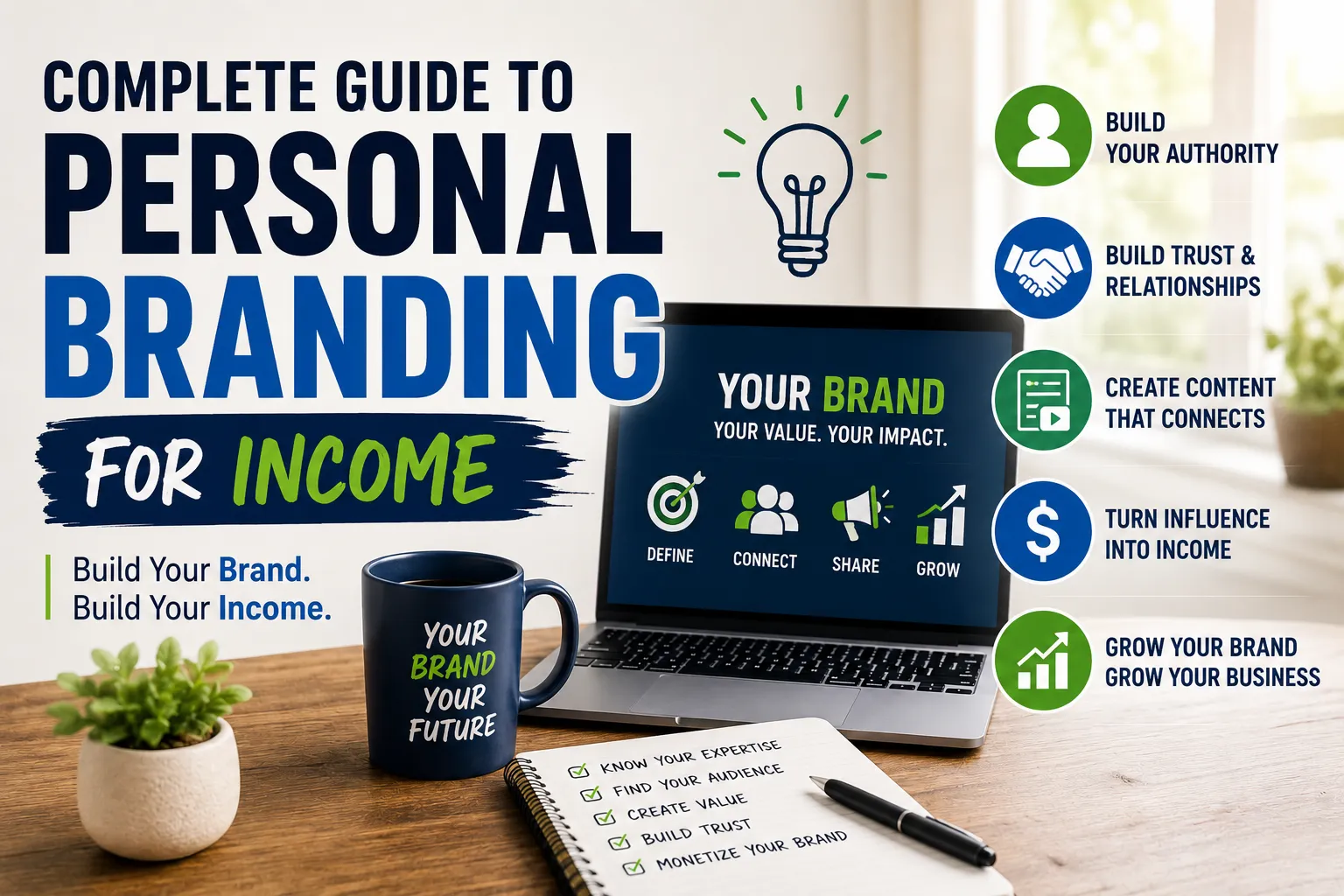
Complete Guide to Personal Branding for Income
Personal branding is no longer reserved for celebrities, influencers and corporate executives.
For freelancers, entrepreneurs, consultants, creators, professionals and people building side businesses, a strong personal brand can become a valuable business asset. It can help people understand what you do, why they should trust you and how they can work with you.
But personal branding is not simply posting photos on social media or trying to become famous.
A useful personal brand is built around expertise, trust, visibility and a clear connection between your reputation and the value you provide.
When those elements work together, personal branding can create opportunities for consulting, freelancing, digital products, partnerships, speaking, employment, affiliate income and other forms of business revenue.
This guide explains how to build a personal brand with income generation in mind without turning every online interaction into a sales pitch.
What Is Personal Branding?
Personal branding is the process of intentionally developing and communicating how you are perceived professionally or publicly.
Your personal brand is influenced by:
- What you know
- What you do
- What you say
- What you publish
- How you communicate
- The problems you solve
- The people you help
- Your reputation
- Your professional experiences
- The results you produce
In simple terms:
Your personal brand is the reputation you build around your knowledge, skills, personality and value.
You already have a personal brand whether you actively manage it or not.
The difference is whether you are building it intentionally.
Why Personal Branding Can Increase Income
A strong reputation can make it easier for potential customers or employers to understand your value.
Imagine two freelancers offering similar services.
The first has no visible portfolio, rarely publishes anything and has little information available online.
The second regularly shares useful insights, demonstrates expertise, publishes examples of their work and communicates clearly about the problems they solve.
The second person may have an easier time earning trust before the first sales conversation even begins.
Personal branding can potentially help with:
- Finding clients
- Increasing freelance rates
- Attracting job opportunities
- Selling digital products
- Building an audience
- Generating consulting leads
- Finding business partnerships
- Getting speaking opportunities
- Growing an online business
- Creating additional income streams
However, visibility alone does not create income.
Attention must eventually connect to an offer, service, product or opportunity that creates real value.
Personal Branding Is Not the Same as Being Famous
You do not need millions of followers.
A person with 2,000 highly relevant followers can potentially build a more profitable business than someone with 200,000 followers who has no clear audience or offer.
For example, a specialist who teaches businesses how to improve their accounting systems may only need a relatively small audience of business owners to generate consulting opportunities.
The objective should therefore be:
Become known by the right people for the right thing.
Not:
Become known by everyone.
Start With Your Expertise
Before creating content, determine what you want people to associate with your name.
Ask yourself:
- What am I good at?
- What do people regularly ask me for help with?
- What problems can I solve?
- What experience do I have?
- What subjects could I discuss consistently?
- What results have I achieved?
- What do I enjoy learning about?
- What type of work do I want more of?
You do not necessarily need to be the world’s leading expert.
You need to have something useful to contribute.
People building a monetizable personal brand should also think carefully about which capabilities are worth developing further. Identifying high-income skills to learn and monetize can help connect your reputation-building efforts to skills that have practical market value.
Choose a Clear Personal Brand Position
A vague personal brand can be difficult to monetize.
Compare:
“I help people succeed.”
with:
“I help small businesses create simple content systems that generate consistent leads.”
The second statement gives people a much clearer idea of what the person does.
A useful positioning formula is:
I help [specific audience] achieve [specific outcome] through [specific expertise or method].
For example:
I help independent restaurants attract more local customers through practical digital marketing strategies.
Or:
I help busy professionals improve their personal finances through simple budgeting systems.
Or:
I help startups turn complex technology topics into understandable educational content.
The more clearly people understand your value, the easier it becomes to connect your brand with an income opportunity.
Identify Your Target Audience
Your personal brand should not attempt to speak to everyone.
Identify the people most likely to benefit from your knowledge or services.
Your audience could be:
- Entrepreneurs
- Students
- Job seekers
- Parents
- Freelancers
- Small-business owners
- Developers
- Designers
- Investors
- Creators
- Corporate professionals
- Local consumers
- Other specialists
Then identify their problems.
Ask:
What are they struggling with?
What do they want to achieve?
What questions do they repeatedly ask?
What information do they find confusing?
Your content becomes much stronger when it answers real questions.
Build Around a Specific Problem
People rarely pay simply because someone is knowledgeable.
They pay because knowledge can help solve a problem.
For example:
A fitness professional does not simply sell exercise knowledge.
They may help clients become stronger, improve their fitness or develop sustainable routines.
A business consultant does not simply sell business knowledge.
They help businesses solve specific operational, financial or strategic problems.
A designer does not simply sell design skills.
They help organizations communicate visually.
Think about the outcome behind your expertise.
Create Your Personal Brand Story
People connect with people, not just credentials.
Your story can help explain:
- Where you started
- What you struggled with
- What you learned
- What changed
- Why you do what you do
- What you believe
- What you are trying to accomplish
Your story does not need to be dramatic.
It needs to be authentic and relevant.
For example:
“I started freelancing after repeatedly seeing small businesses struggle to create consistent online content. I began experimenting with simple content systems, and eventually turned those lessons into a service helping other businesses do the same.”
That gives people context.
Establish Your Core Topics
Choose several topics you can consistently discuss.
A useful personal brand might have three to five content pillars.
For example, a marketing consultant could focus on:
- Content marketing
- Customer acquisition
- Small-business strategy
- Personal lessons
- Marketing case studies
A developer might focus on:
- Programming
- Software architecture
- Career development
- Developer tools
- Lessons from projects
Having defined topics makes content creation easier.
Create Content That Demonstrates Expertise
Your content should prove that you understand your subject.
Useful content formats include:
- Tutorials
- Guides
- Case studies
- Opinions
- Checklists
- Mistake breakdowns
- Industry analysis
- Lessons learned
- Frequently asked questions
- Behind-the-scenes explanations
- Examples
- Comparisons
Instead of constantly saying:
“I’m an expert.”
Show your expertise through useful information.
Teach What You Know
Educational content is one of the most straightforward ways to demonstrate expertise.
If you are a photographer, teach people how to improve their photos.
If you are a developer, explain difficult programming concepts.
If you are a financial professional, explain basic financial concepts clearly.
If you are a designer, break down design decisions.
The more useful your explanations are, the more opportunities people have to understand your capabilities.
Share Your Process
You do not always need to teach completed results.
Your process can also become content.
Show:
- How you research
- How you plan
- How you solve problems
- How you evaluate options
- How you organize projects
- How you approach difficult decisions
This gives potential customers a glimpse into how you work.
Use Case Studies
Case studies are particularly valuable because they connect expertise with outcomes.
A simple case study can explain:
Problem → Process → Solution → Result → Lesson
For example:
A small business was receiving website traffic but generating few inquiries. We simplified the service pages, clarified the calls to action and reorganized the site’s navigation. The result was a clearer customer journey and a stronger conversion process.
Use real results whenever possible.
Do not invent numbers or exaggerate outcomes simply to make your brand appear more successful.
Share Lessons From Mistakes
Mistakes can become useful educational content.
You might discuss:
- A marketing campaign that failed
- A business decision you would handle differently
- A technical mistake
- A failed product launch
- A poor investment in your business
- A communication problem
- A project that took longer than expected
The key is to focus on the lesson.
A mistake becomes valuable when someone else can avoid making it.
Build a Professional Online Presence
Your online profiles should make it easy for someone to understand who you are.
At minimum, consider having:
- A clear profile photo
- A concise biography
- A description of your expertise
- A link to your website or portfolio
- Contact information where appropriate
- Examples of your work
Your profiles do not need to look identical across every platform.
But your basic positioning should be recognizable.
Choose the Right Social Platforms
You do not need to be everywhere.
Choose platforms based on where your target audience spends time and where your expertise can be communicated effectively.
For example:
LinkedIn can be useful for professional services, career-related content and B2B networking.
YouTube can be valuable for tutorials, demonstrations and long-form educational content.
Instagram can work well for visual businesses, creators and lifestyle-oriented brands.
TikTok can provide opportunities for short-form educational or entertainment content.
X can be useful for commentary, conversations and certain professional communities.
Newsletters provide a direct communication channel that does not depend entirely on social-media algorithms.
The best platform is usually the one you can use consistently while reaching the right people.
Don’t Build Your Entire Brand on One Platform
Social platforms can change their algorithms, policies and business models.
An account can also be restricted, hacked or unexpectedly lose reach.
That makes it wise to build assets you control.
Consider developing:
- A website
- An email list
- A portfolio
- A customer database
- Digital products
- Search-friendly content
Social media can help people discover you.
Your owned platforms can help you maintain the relationship.
Create a Personal Website
A website gives your personal brand a central home.
A simple personal website can include:
Homepage
Explain who you are and what you do.
About Page
Tell your story and explain your background.
Services
Describe what people can hire you to do.
Portfolio
Show examples of your work.
Testimonials
Display genuine feedback from customers or clients.
Contact Page
Make it easy to reach you.
Content
Publish useful articles, guides or resources.
A website does not have to be complicated.
Clarity is more important than excessive design.
Build a Portfolio
A portfolio is particularly important if your income depends on demonstrating skills.
Include your strongest examples rather than everything you have ever created.
For each project, explain:
- The client or project type
- The problem
- Your role
- What you did
- The result
- What you learned
If you do not have clients yet, create sample projects.
For example, a designer can redesign a fictional brand.
A developer can build a small application.
A writer can create sample articles.
A marketer can develop a mock campaign.
Demonstrated ability is often more persuasive than simply claiming experience.
Turn Attention Into an Offer
This is where personal branding becomes a business strategy.
Ask:
What can someone buy from me?
Your answer might be:
- Consulting
- Freelance services
- Coaching
- Courses
- E-books
- Templates
- Workshops
- Memberships
- Software
- Physical products
- Speaking
- Sponsorships
- Affiliate recommendations
You do not need ten income streams.
One clear offer is often a better starting point.
Start With Services
For many people, services are the fastest way to connect a personal brand to income because you can sell an existing skill directly.
Examples include:
- Writing
- Graphic design
- Web development
- Video editing
- Consulting
- Photography
- Marketing
- Accounting
- Career coaching
- Virtual assistance
- Social-media management
A service can also teach you what customers are actually willing to pay for.
That information can later inform products and other revenue streams.
For professionals whose expertise is especially valuable in solving business problems, consulting can become a natural extension of a visible reputation and specialized knowledge. A focused guide to consulting and advisory work can help show how expertise can be structured into a formal client service.
Productize Your Expertise
Once you understand a recurring customer problem, you can turn your knowledge into a more standardized offer.
Instead of:
“I provide marketing consulting.”
You might offer:
“30-Day Content Strategy Package for Small Businesses.”
A productized service has:
- Defined deliverables
- Defined scope
- Clear pricing
- Clear timeline
- Clear outcome
This makes the purchasing decision easier.
Create Digital Products
Digital products can allow you to package your expertise for repeated sales.
Examples include:
- E-books
- Templates
- Checklists
- Spreadsheets
- Design assets
- Online courses
- Tutorials
- Notion templates
- Business documents
- Educational resources
The best digital products usually solve a specific problem.
Instead of creating a 300-page general business book, you might create a practical template that helps a particular audience perform one task.
For people exploring this model in more detail, the guide to creating and selling digital products for sustainable income provides a natural next step from expertise-based content into scalable offers.
Consider Consulting
Consulting can be a natural extension of a strong personal brand.
If people regularly ask for your advice, that may indicate a potential consulting opportunity.
Consulting can involve:
- Strategy
- Technology
- Marketing
- Operations
- Finance
- Career development
- Design
- Communications
Be clear about what problem your consulting solves.
“Business advice” is vague.
“Helping small retailers improve their online customer-acquisition process” is much clearer.
Coaching Is Another Potential Revenue Stream
Coaching differs from consulting because the emphasis may be on helping the client develop their own capabilities rather than simply delivering a solution.
Potential areas include:
- Career development
- Leadership
- Business
- Productivity
- Fitness
- Creative skills
- Public speaking
- Professional development
Credentials, experience and appropriate boundaries matter greatly, particularly in specialized or regulated fields.
Avoid presenting yourself as qualified to provide professional services you are not legally or professionally qualified to provide.
Affiliate Marketing Can Complement a Personal Brand
Affiliate marketing involves earning a commission when someone purchases a product or service through a qualifying referral.
Personal branding can make affiliate recommendations more effective because trust is central to the model.
However, recommendations should be genuinely useful.
Do not promote a product simply because it offers a high commission.
A reputation can take years to build and only a few questionable recommendations to damage.
Always disclose relevant commercial relationships and follow applicable advertising and platform requirements.
Sponsorships Can Become an Income Stream
Brands may pay creators or professionals to reach a relevant audience.
Sponsorship opportunities are generally more valuable when there is strong alignment between:
- Your audience
- Your expertise
- Your values
- The sponsor’s product
A technology creator partnering with a relevant software company makes more sense than promoting an unrelated product simply because it pays.
Your audience should be able to understand why you accepted the partnership.
Speaking Can Strengthen Your Brand
Public speaking can generate income while increasing professional visibility.
Opportunities can include:
- Conferences
- Workshops
- Corporate events
- Webinars
- Industry panels
- Podcasts
- Community events
- Educational sessions
Speaking can also lead to consulting, partnerships and other opportunities.
Start by developing a few topics you can explain confidently.
Build an Email Newsletter
An email newsletter gives you a direct relationship with your audience.
A useful newsletter can provide:
- Weekly insights
- Industry analysis
- Practical tips
- Curated resources
- Case studies
- Tutorials
- Personal lessons
Avoid making every email a sales pitch.
People subscribe because they expect value.
Trust grows when the newsletter consistently delivers it.
Provide Value Before Asking for Money
One of the most effective principles in personal branding is simple:
Help people before asking them to buy.
This does not mean giving away everything for free.
It means demonstrating that you understand your audience’s problems.
Free content can provide:
- Education
- Inspiration
- Useful frameworks
- Practical examples
- Answers to common questions
Paid products or services can then provide deeper implementation, personalization or convenience.
Don’t Confuse Followers With Customers
Follower counts can be psychologically attractive.
But revenue is often a better business metric.
Imagine:
Brand A: 100,000 followers, few buyers.
Brand B: 5,000 followers, highly relevant audience and strong customer demand.
Brand B may have a much healthier business.
Track metrics such as:
- Qualified leads
- Email subscribers
- Website inquiries
- Sales
- Conversion rate
- Customer retention
- Average order value
- Repeat purchases
These tell you more about the commercial value of your brand.
Build Trust Through Consistency
People need repeated exposure before they fully understand and remember what you do.
Consistency does not necessarily mean posting every day.
It means maintaining a recognizable presence.
You might publish:
- Two useful posts each week
- One newsletter each week
- One detailed article each month
- One video every two weeks
Choose a schedule you can realistically maintain.
A sustainable publishing system is better than an intense schedule that lasts three weeks.
Develop a Recognizable Voice
Your personal brand should sound like you.
Your communication style could be:
- Analytical
- Friendly
- Direct
- Educational
- Humorous
- Inspirational
- Practical
- Technical
You do not need to imitate another creator.
Your personality can become part of your differentiation.
Don’t Try to Manufacture a Perfect Image
A personal brand does not require pretending that everything is going perfectly.
People can connect with:
- Learning
- Experimentation
- Mistakes
- Challenges
- Progress
- Honest observations
Authenticity does not mean sharing every private detail of your life.
It means avoiding a manufactured identity that you cannot maintain.
Protect Your Privacy
Building a personal brand does not mean giving the internet unrestricted access to your personal life.
Decide what you will and will not share.
Consider keeping private:
- Home address
- Personal phone number
- Financial account details
- Sensitive family information
- Private conversations
- Passwords
- Security information
You can be personable without becoming completely exposed.
Build Relationships, Not Just an Audience
Personal branding is partly about communication.
Engage with other people.
You can:
- Comment thoughtfully
- Answer questions
- Join industry discussions
- Collaborate
- Interview experts
- Attend events
- Participate in communities
- Send thoughtful messages
Networking becomes much more valuable when it is based on genuine relationships rather than immediate requests.
Collaborate With Other Creators
Collaboration can introduce your expertise to a new but relevant audience.
Potential collaborations include:
- Podcasts
- Interviews
- Webinars
- Joint articles
- Videos
- Workshops
- Community events
- Research projects
Look for complementary expertise.
A web designer might collaborate with a copywriter.
A financial educator might collaborate with a career specialist.
A fitness creator might collaborate with a nutrition professional where appropriate.
Use Search-Friendly Content
Social posts can disappear quickly.
Long-form educational content can continue attracting people through search.
Consider creating articles around questions your audience repeatedly asks.
For example:
- How to price freelance services
- How to create a business portfolio
- How to improve LinkedIn visibility
- How to start consulting
- How to build a professional website
Over time, a library of useful content can become an ongoing discovery channel.
Develop an Authority Flywheel
A strong personal brand can develop a useful cycle:
Learn → Create → Share → Help → Build Trust → Attract Opportunities → Gain Experience → Create Better Content
The process compounds.
As you gain experience, your content becomes stronger.
As your content improves, more people discover you.
As more people discover you, you can gain more opportunities.
Those opportunities create additional experience.
Use Testimonials Carefully
Testimonials can provide valuable social proof.
Good testimonials explain:
- What problem existed
- What you did
- What changed
- Why the customer recommends you
Avoid fake testimonials.
Do not manipulate clients into making exaggerated claims.
Authentic feedback is much more valuable.
Collect Proof of Results
Whenever you achieve a meaningful result, document it.
Depending on your field, proof might include:
- Revenue improvement
- Cost savings
- Traffic growth
- Project completion
- Customer satisfaction
- Improved performance
- Before-and-after examples
- Successful launches
- Published work
- Certifications
Make sure any statistics you publish are accurate and can be supported.
Raise Your Rates as Your Reputation Grows
A stronger personal brand can potentially support higher pricing, but reputation alone does not justify arbitrary price increases.
Your pricing should reflect:
- Expertise
- Experience
- Demand
- Results
- Scope
- Complexity
- Time
- Market conditions
- Value delivered
As you become more specialized and trusted, you may be able to compete less on price.
Create a Simple Sales Funnel
Your personal brand should provide a path from discovery to purchase.
A basic funnel might look like:
Social content → Website → Free resource → Email list → Consultation → Paid service
Or:
YouTube video → Digital product → Email follow-up → Higher-value offer
The exact funnel depends on the business.
The important thing is that people know what to do next.
Make Your Call to Action Clear
If you want people to take action, tell them what action to take.
Examples:
- Download the guide
- Join the newsletter
- Book a consultation
- View the portfolio
- Request a quote
- Buy the template
- Watch the full tutorial
- Contact me
Avoid making every piece of content end with a sales pitch.
Use calls to action where they naturally fit.
Don’t Monetize Too Early
Trying to sell immediately can undermine a new personal brand.
If nobody knows who you are, constant sales messages may create resistance.
A better sequence can be:
Build credibility → Understand the audience → Identify demand → Create an offer → Sell → Improve.
You do not need to wait years before making money.
But you should have enough value and trust for the offer to make sense.
Avoid These Personal Branding Mistakes
Trying to Appeal to Everyone
A broad audience makes positioning difficult.
Copying Another Creator
Learn from successful people without becoming a clone.
Posting Without a Purpose
More content is not necessarily better content.
Buying Followers
Fake audiences rarely create meaningful business opportunities and can damage credibility.
Chasing Every Trend
A trend is useful only when it connects to your audience or expertise.
Talking Only About Yourself
Your audience cares about their problems too.
Making Constant Sales Pitches
People need reasons to trust you before they buy.
Making Unsupported Claims
Do not exaggerate expertise, income, qualifications or results.
Ignoring Reputation
Everything you publish can contribute to how people perceive you.
Depending Entirely on One Platform
Build assets you control.
A Simple Content Formula
If you are unsure what to publish, try this structure:
Teach
Explain something useful.
Demonstrate
Show how you apply it.
Tell a Story
Share an experience or lesson.
Prove
Show evidence of your work or results.
Invite
Give people a relevant next step.
This creates a balanced content strategy without turning your profile into a constant advertisement.
The 70/20/10 Approach
Some creators find it useful to divide content roughly into:
70% educational or useful content
20% personal experiences, opinions or community content
10% promotional content
These percentages are not rules.
The important idea is maintaining a healthy balance between providing value and promoting your business.
Create Content in Batches
Content creation becomes easier when you stop treating every post as a completely new project.
For example, choose one major topic and turn it into several pieces.
A detailed article about freelance pricing could become:
- One LinkedIn post
- Three short social posts
- A video
- An email newsletter
- An infographic
- A checklist
- A short Q&A
This allows one idea to work much harder.
Build a Content Bank
Whenever you have an idea, save it.
Your content bank might include:
- Questions people ask
- Interesting statistics
- Personal lessons
- Industry observations
- Mistakes
- Client questions
- Book notes
- Useful tools
- Case-study ideas
When it is time to publish, you have a collection of potential topics instead of starting from zero.
Measure What Actually Works
After publishing consistently, look for patterns.
Ask:
- Which topics generate conversations?
- Which posts attract qualified leads?
- Which articles receive search traffic?
- Which products sell?
- Which questions keep appearing?
- Which audiences respond most strongly?
Use this information to improve your strategy.
Do not assume that the post with the most likes is automatically the most commercially valuable.
Build Multiple Layers of Income Carefully
Once your core business works, you can consider adding additional revenue streams.
For example:
Level 1: Freelance services
Level 2: Consulting
Level 3: Digital products
Level 4: Courses or workshops
Level 5: Sponsorships or partnerships
Level 6: Affiliate income
You do not need all six.
The objective is to create complementary income streams rather than a confusing collection of unrelated offers.
For a broader framework on combining complementary earning channels, see this guide to creating multiple income streams.
Adding revenue layers also works best when the underlying offer is already validated. The goal is not simply to accumulate income sources, but to build a business that can become more resilient and scalable over time.
Your Reputation Is an Asset
A personal brand can become more valuable over time because reputation compounds.
A person who has consistently demonstrated expertise for five years has a different market position from someone who started posting last week.
That reputation can create opportunities that are difficult to manufacture through advertising alone.
However, reputation also creates responsibility.
If people trust your recommendations, accuracy matters.
If customers trust your services, reliability matters.
If an audience trusts your expertise, honesty matters.
Don’t Promise Guaranteed Income
Personal branding can create opportunities, but it does not guarantee financial success.
Avoid claims such as:
- “This strategy will make you rich.”
- “Everyone can earn $10,000 a month.”
- “You are guaranteed to get clients.”
- “Followers automatically become income.”
Results depend on many factors, including:
- Skill
- Market demand
- Audience
- Offer quality
- Pricing
- Competition
- Execution
- Consistency
- Economic conditions
Responsible personal branding communicates possibilities without pretending that outcomes are guaranteed.
A 90-Day Personal Branding Plan
You do not need to spend years planning before you begin.
A focused 90-day approach can provide a useful starting point.
Days 1–30: Build the Foundation
Focus on:
- Choosing your niche
- Identifying your audience
- Defining your expertise
- Writing your positioning statement
- Updating your profiles
- Creating or improving your website
- Building a portfolio
- Choosing two or three content pillars
Your goal is clarity.
Days 31–60: Build Visibility
Start publishing consistently.
For example:
- Two educational posts per week
- One longer article every two weeks
- One newsletter each week
- Regular conversations with people in your industry
Focus on helping rather than selling.
Your goal is recognition.
Days 61–90: Test Monetization
Look for evidence of demand.
You might:
- Offer a consultation
- Launch a small service
- Sell a template
- Create a workshop
- Publish a paid guide
- Reach out to potential clients
- Test a product idea
Track what happens.
Your goal is to discover which problems people are willing to pay you to solve.
A Personal Branding Checklist
Use this checklist to evaluate your current brand:
- I know what I want to be known for.
- I understand my target audience.
- I can clearly explain what I do.
- My online profiles communicate my expertise.
- I have examples of my work.
- I publish useful content consistently.
- I have a website or portfolio.
- I have a clear offer.
- People know how to contact me.
- I collect legitimate testimonials.
- I document meaningful results.
- I have an email or other owned audience channel.
- I understand which content attracts potential customers.
- I protect my personal privacy.
- I avoid exaggerated claims.
- I have a realistic monetization strategy.
You do not need every box checked before starting.
Use the list to identify your next improvement.
The Real Value of a Personal Brand
Personal branding is sometimes presented as a shortcut to wealth.
It is better understood as a long-term trust-building system.
The brand itself does not create money.
The value comes from what the brand makes possible.
A strong reputation can make it easier for the right people to discover you, understand your expertise, trust your recommendations and consider buying something from you.
That something might be your time.
It might be your knowledge.
It might be a product you created.
It might be access to your expertise.
The most durable personal brands are therefore built around a simple principle:
Become genuinely useful to a specific group of people, communicate that usefulness consistently and create clear ways for people to work with you.
Turning Reputation Into a Sustainable Income Engine
The strongest personal brands are not built by chasing viral moments.
They are built through hundreds of small interactions: a useful article, a thoughtful answer, a successful project, a helpful video, an honest recommendation, a satisfied customer and a consistent reputation.
Over time, those interactions can create something more valuable than followers—a trusted professional identity.
If that identity is connected to a real skill, a genuine audience need and a well-designed offer, personal branding can become more than an exercise in online visibility. It can become a practical business asset that helps attract clients, open doors, support new products and create additional sources of income.
For someone using personal branding to support a side business, that reputation can also become a foundation for starting a side hustle while working full-time, particularly when the brand is built around a skill that can be offered independently.
As the business matures, the same reputation can support more repeatable and scalable opportunities rather than relying entirely on one-to-one work. A broader guide to building scalable income over time can help frame that transition.
The goal is not to make everyone know your name.
The goal is to make the right people remember your name when they need the value you provide.