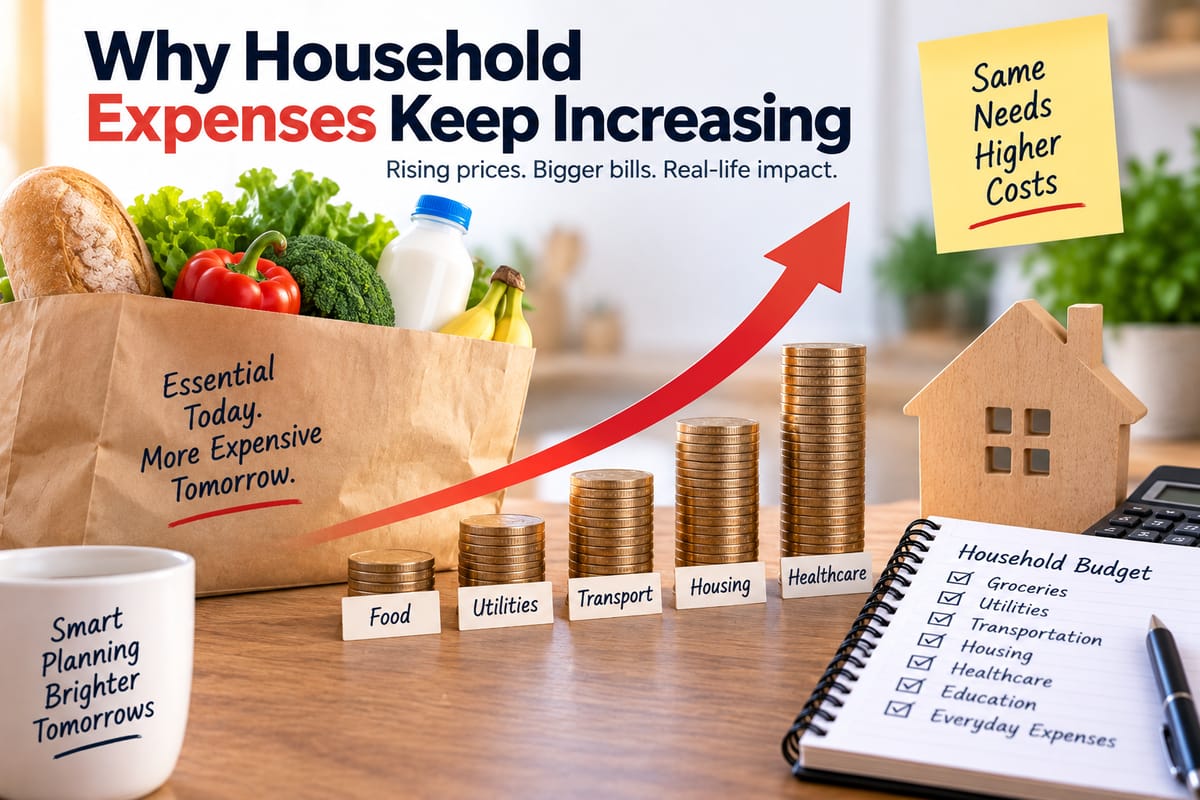
Why Household Expenses Keep Increasing
For many families, household expenses can seem to rise even when income has not changed much. Grocery trips cost more, utility bills fluctuate, transportation takes a larger share of the budget, and routine services can become increasingly expensive.
The reasons are rarely limited to one category.
Household spending is influenced by inflation, changes in prices, housing costs, energy expenses, transportation, insurance, childcare, healthcare, lifestyle choices, and changes in how families consume goods and services. Even small increases across several categories can create a noticeable difference in a household’s monthly finances.
Understanding why expenses increase can help families respond more effectively. Instead of simply trying to spend less everywhere, households can identify which costs are rising, which expenses are necessary, which purchases can be adjusted, and which changes may require longer-term planning.
What Causes Household Expenses to Increase?
Household expenses can increase for several different reasons.
Some increases happen because the prices of goods and services rise. Others occur because a household’s circumstances change.
Common causes include:
- Inflation.
- Higher housing costs.
- Rising utility expenses.
- Increased food prices.
- Transportation costs.
- Insurance premiums.
- Healthcare expenses.
- Childcare and education costs.
- Higher interest payments.
- Lifestyle changes.
- Increased consumption.
- Unexpected household repairs.
- New subscriptions and recurring charges.
These factors can overlap.
For example, a household might experience higher rent at the same time that groceries and transportation become more expensive. Individually, each increase may appear manageable, but together they can significantly affect disposable income.
How Inflation Affects Household Spending
Inflation means that prices across an economy generally rise over time, reducing the purchasing power of money.
When inflation affects everyday goods and services, households may find that the same amount of money buys fewer things than it did previously.
For example, a family that previously spent a certain amount on groceries may discover that the same shopping list now costs more.
Inflation can affect:
- Food.
- Housing.
- Transportation.
- Utilities.
- Clothing.
- Household supplies.
- Services.
- Recreation.
- Personal care.
Understanding how inflation affects everyday finances can help families see why their budgets may feel increasingly tight even when their spending habits have not changed dramatically.
Food Is a Major Source of Household Cost Changes
Groceries are one of the most visible household expenses because families purchase food frequently.
Food costs can change because of factors such as:
- Production costs.
- Transportation.
- Labor.
- Weather conditions.
- Energy prices.
- Supply disruptions.
- Seasonal availability.
- Changes in consumer demand.
- Packaging costs.
Families may also spend more on food because their own circumstances change.
A household may add another family member, begin purchasing more prepared foods, eat at home more frequently, or change dietary preferences.
This means a higher grocery bill does not necessarily mean that every food item has become more expensive. Both prices and household consumption patterns matter.
Housing Costs Can Put Pressure on the Entire Budget
Housing is often one of the largest household expenses.
For renters, housing costs can increase when landlords raise rents or when households move into more expensive areas.
For homeowners, costs can include:
- Mortgage payments.
- Property taxes.
- Home insurance.
- Repairs.
- Maintenance.
- Utilities.
- Home improvement.
- Association or service fees.
Mortgage payments can also change for households with certain types of loans when interest rates adjust.
Because housing is often a large fixed or semi-fixed expense, even a relatively modest increase can have a substantial effect on the household budget.
Utility Bills Can Fluctuate
Electricity, gas, water, heating, cooling, and other utilities can contribute significantly to monthly expenses.
Utility costs can rise because of higher rates, but consumption also matters.
For example, electricity use may increase when:
- A household spends more time at home.
- More appliances are used.
- Air conditioning or heating runs more frequently.
- A household adds new electronic devices.
- Older appliances operate inefficiently.
- The family expands.
Some utility expenses are therefore influenced by both prices and behavior.
Transportation Costs Can Rise in Several Ways
Transportation is another area where families can experience increasing costs.
Expenses may include:
- Fuel.
- Vehicle payments.
- Insurance.
- Repairs.
- Maintenance.
- Tires.
- Parking.
- Public transportation.
- Ride-hailing.
- Registration and licensing.
A vehicle that becomes older may require more frequent repairs even if its monthly payment has already ended.
Similarly, fuel price changes can quickly affect households that rely heavily on private transportation.
Longer commuting distances can also increase transportation expenses without any change in the price of fuel itself.
Insurance Costs Can Change Over Time
Insurance is often treated as a predictable expense, but premiums can change.
Households may pay for:
- Health insurance.
- Home insurance.
- Renters insurance.
- Vehicle insurance.
- Life insurance.
- Other forms of coverage.
Premium changes can result from changes in coverage, personal circumstances, claims history, insurer pricing, or broader market conditions.
Insurance is also an area where cutting costs needs to be approached carefully. Reducing coverage simply to lower a monthly payment can create significant financial exposure if an unexpected event occurs.
Healthcare Expenses Can Be Difficult to Predict
Healthcare spending can be particularly challenging to manage because some costs are unpredictable.
Depending on a family’s circumstances, expenses can include:
- Routine appointments.
- Prescription medications.
- Dental care.
- Vision care.
- Emergency treatment.
- Specialist visits.
- Health insurance premiums.
- Deductibles and other out-of-pocket costs.
A family can maintain a careful budget and still experience a sudden increase in healthcare spending.
This is one reason emergency savings and adequate financial protection can be important parts of household planning.
Childcare and Education Can Change the Household Budget
Families with children may experience significant changes in expenses as children grow.
Costs can include:
- Childcare.
- School fees.
- Transportation.
- School supplies.
- Clothing.
- Activities.
- Technology.
- Meals.
- Educational materials.
These expenses can change over time rather than remaining constant.
A child may move from childcare into school, begin participating in extracurricular activities, or require different educational resources.
Planning for these changes can make them easier to incorporate into the household budget.
Interest Rates Can Increase Borrowing Costs
Household expenses can also rise when the cost of borrowing increases.
This can affect households with:
- Mortgages.
- Credit cards.
- Personal loans.
- Vehicle financing.
- Other variable-rate debt.
When borrowing becomes more expensive, a larger portion of monthly income may go toward interest and debt payments.
That leaves less money available for savings, investments, discretionary purchases, and other financial goals.
Lifestyle Inflation Can Increase Spending
Not every increase in household expenses is caused by rising prices.
Sometimes spending increases because the household’s lifestyle changes as income grows.
This is commonly referred to as lifestyle inflation or lifestyle creep.
For example, a household may gradually begin:
- Eating at restaurants more often.
- Buying more expensive groceries.
- Upgrading vehicles.
- Subscribing to additional services.
- Taking more expensive vacations.
- Purchasing newer electronics.
- Choosing premium versions of everyday products.
Each decision may appear relatively small.
Over time, however, these choices can establish a higher baseline for monthly spending.
A household can therefore experience increasing expenses even when its income is also increasing.
Subscriptions Can Quietly Add Up
Recurring subscriptions are another source of household spending.
Examples include:
- Streaming services.
- Music services.
- Cloud storage.
- Software.
- Fitness memberships.
- Gaming services.
- Meal delivery programs.
- Online memberships.
The problem is not necessarily that subscriptions are expensive individually.
The issue is that recurring charges can continue automatically, making them easy to overlook.
A household might have several services that were useful when they were first purchased but are now rarely used.
Reviewing recurring expenses periodically can reveal opportunities to redirect money toward more important priorities.
Convenience Can Increase Household Costs
Convenience often has a price.
Families with busy schedules may spend more on:
- Food delivery.
- Takeout.
- Prepared meals.
- Ride-hailing.
- Cleaning services.
- Grocery delivery.
- Express shipping.
- Convenience stores.
These services can be valuable when they save time or reduce stress.
However, frequent use can substantially increase monthly spending.
The goal does not have to be eliminating convenience entirely. Families can decide which conveniences provide enough value to justify their cost.
Household Consumption Can Change Without Being Obvious
Sometimes expenses increase because a family simply uses more of something.
A household may consume more electricity, water, fuel, food, or mobile data without realizing how much its usage has changed.
For example, working from home can increase household electricity and internet consumption while reducing commuting expenses.
Having a new child can increase spending on food, clothing, healthcare, and household supplies.
A change in consumption patterns can therefore produce higher expenses even when prices remain relatively stable.
Unexpected Repairs Can Disrupt a Budget
Household budgets often focus on regular monthly expenses while underestimating irregular costs.
Examples include:
- Vehicle repairs.
- Appliance replacement.
- Plumbing problems.
- Electrical repairs.
- Roof maintenance.
- Home equipment replacement.
- Emergency travel.
- Unexpected medical expenses.
These costs may not occur every month, but they can be financially significant when they do appear.
A household that sets aside money for irregular expenses can reduce the need to rely on credit when something breaks.
Why Small Increases Matter
A single expense increase may not seem significant.
Suppose several household categories each increase by a relatively small amount:
- Groceries increase.
- Transportation increases.
- Utilities increase.
- Insurance increases.
- One subscription is added.
- Household maintenance becomes more expensive.
Together, these changes can create a substantial monthly difference.
This is why families may feel that their money is disappearing faster even when they cannot identify one major expense responsible for the change.
Fixed and Variable Expenses Behave Differently
Understanding the difference between fixed and variable expenses can make household spending easier to analyze.
Fixed Expenses
Fixed expenses generally remain relatively stable from month to month.
Examples can include:
- Rent.
- Certain loan payments.
- Some insurance premiums.
- School fees under a fixed arrangement.
- Certain subscription payments.
Variable Expenses
Variable expenses can change based on prices or household behavior.
Examples include:
- Groceries.
- Electricity.
- Fuel.
- Entertainment.
- Dining out.
- Clothing.
- Household supplies.
The distinction is useful because variable expenses often provide more immediate opportunities for adjustment, while fixed expenses may require larger decisions.
Review the Household Budget Regularly
A household budget should not necessarily be created once and forgotten.
Regular reviews help families understand where money is going and whether spending patterns have changed.
A useful family budget can show:
- Household income.
- Housing costs.
- Food expenses.
- Transportation.
- Utilities.
- Insurance.
- Debt payments.
- Savings.
- Entertainment.
- Children’s expenses.
- Irregular costs.
The purpose is not to monitor every purchase obsessively.
Instead, a budget provides a framework for understanding whether current spending is aligned with available income and financial priorities.
Compare Current Spending With Previous Spending
One way to identify rising household expenses is to compare spending over time.
Families can look at:
- This month’s grocery spending versus previous months.
- Current utility bills versus the same period last year.
- Transportation costs over several months.
- Recurring subscriptions.
- Insurance premiums.
- Debt payments.
- Discretionary spending.
Looking at trends can be more informative than examining one unusually expensive month.
A temporary increase may not require a major change, while a consistent upward trend may deserve closer attention.
Separate Price Increases From Spending Increases
When expenses rise, it helps to determine whether the increase comes from higher prices, greater consumption, or both.
For example, if a grocery bill increases by 15%, ask:
Are the same products costing more?
Or:
Is the household purchasing more products?
The answer affects the appropriate response.
If prices have increased, the family may consider substitutions, shopping strategies, or adjustments elsewhere.
If consumption has increased, the solution may involve changing habits or planning meals differently.
If both have changed, a combination of approaches may be necessary.
Look for Unnecessary Household Spending
Not every expense provides equal value.
Some purchases may be essential, while others are simply habits that have continued without much consideration.
Families can periodically review spending for:
- Unused subscriptions.
- Impulse purchases.
- Duplicate services.
- Frequent delivery fees.
- Unused memberships.
- Unplanned convenience spending.
- Purchases that are rarely used.
Learning how to reduce unnecessary household spending can help families identify these expenses without treating every discretionary purchase as a problem.
The goal is to spend intentionally rather than eliminate everything enjoyable.
Manage Bills With a Regular Routine
Household bills become easier to manage when they are reviewed consistently.
Families can create a routine for:
- Checking upcoming bills.
- Reviewing account balances.
- Confirming automatic payments.
- Comparing current bills with previous periods.
- Identifying unusual increases.
- Setting aside money for upcoming expenses.
- Reviewing recurring subscriptions.
A structured approach can prevent small increases from going unnoticed.
For households that want a more organized system, how to manage household bills and monthly expenses offers a framework for organizing recurring financial obligations.
Prioritize Expenses Instead of Cutting Everything
When household expenses rise, families may be tempted to cut spending across the board.
A better approach can be to categorize expenses according to their importance.
Essential Expenses
These are costs associated with basic needs and important obligations, such as housing, food, utilities, healthcare, and required debt payments.
Important Financial Goals
These may include:
- Emergency savings.
- Retirement contributions.
- Debt reduction.
- Education savings.
- Other long-term objectives.
Discretionary Expenses
These can include:
- Entertainment.
- Dining out.
- Hobbies.
- Premium products.
- Nonessential subscriptions.
Prioritization helps families make targeted adjustments instead of reducing spending indiscriminately.
Look for Substitutions Before Eliminating Purchases
Reducing costs does not always mean giving something up completely.
A family might:
- Choose a less expensive grocery brand.
- Cook certain meals at home.
- Compare insurance options.
- Cancel an unused subscription.
- Combine errands.
- Use public transportation when practical.
- Purchase used items when appropriate.
- Delay nonessential purchases.
Small substitutions can sometimes reduce spending while preserving much of the household’s existing lifestyle.
Be Careful With Extreme Cost-Cutting
Reducing household expenses can be useful, but extreme cost-cutting can create other problems.
For example, buying the cheapest possible food may not always produce the best overall value. Delaying necessary vehicle maintenance can lead to more expensive repairs later. Cutting important insurance coverage can increase financial risk.
The objective should be better value, not simply the lowest possible price.
A household can ask:
“Does this change reduce the cost without creating a larger problem later?”
That question can lead to more sustainable financial decisions.
Plan for Irregular Household Expenses
A monthly budget can become more realistic when it accounts for expenses that do not occur every month.
Families can estimate annual costs for items such as:
- Vehicle maintenance.
- School expenses.
- Insurance renewals.
- Home repairs.
- Holidays.
- Gifts.
- Medical costs.
- Annual memberships.
The annual amount can then be divided into monthly savings targets.
For example, if a household expects to spend $1,200 over a year on irregular expenses, setting aside approximately $100 per month can make those costs easier to manage.
The actual amount will depend on the family’s circumstances, but the principle is broadly useful.
Increase Income When Expense Cuts Are Not Enough
There is a limit to how much a household can reduce spending.
Housing, food, utilities, healthcare, and transportation can only be cut so far without affecting basic needs or quality of life.
When necessary expenses consume most available income, increasing income may need to become part of the financial strategy.
Potential approaches can include:
- Negotiating compensation.
- Developing additional skills.
- Taking on additional work.
- Starting a small business.
- Selling unused items.
- Developing a side income stream.
The appropriate approach depends on a household’s circumstances, available time, skills, and financial goals.
Household Expenses Change With Life Stages
Family spending naturally changes over time.
A young adult living alone may have a different cost structure from a couple buying a home.
A household with young children may face significant childcare and education expenses. Later, teenagers may introduce different costs related to transportation, activities, technology, and education.
Eventually, housing, healthcare, retirement, and support for aging family members may become more important.
This means a budget that worked perfectly in one stage of life may need to be redesigned later.
Technology Can Help Track Rising Expenses
Digital banking and budgeting tools can make it easier to identify changes in household spending.
Depending on the tools available, families may be able to:
- Categorize transactions.
- Track recurring payments.
- Set spending limits.
- Review monthly trends.
- Monitor account balances.
- Create savings goals.
However, technology is only useful when households actually review the information.
A budgeting application cannot replace financial decisions. It simply makes the underlying spending patterns easier to see.
Talk About Money as a Household
When multiple people contribute to household finances or share expenses, communication becomes important.
Families can periodically discuss:
- Which expenses have increased.
- Which costs are difficult to manage.
- Upcoming large expenses.
- Savings priorities.
- Changes in income.
- Financial goals.
- Areas where spending can be adjusted.
These conversations can make budgeting a shared process rather than something managed by only one person.
Focus on the Expenses That Matter Most
When household costs rise, families do not need to scrutinize every small purchase equally.
It can be more productive to identify the categories that have the largest impact.
For many households, these may include:
- Housing.
- Food.
- Transportation.
- Utilities.
- Insurance.
- Healthcare.
- Debt payments.
- Childcare or education.
Reducing a large recurring expense can have a much greater impact than eliminating several small purchases.
This does not make small savings irrelevant, but it helps families prioritize their efforts.
Build Flexibility Into the Household Budget
A rigid budget can become difficult to maintain when prices and circumstances change.
Instead, families can create categories that allow some flexibility.
For example, a household might maintain:
- A basic grocery target.
- A household maintenance fund.
- An emergency fund.
- A discretionary spending allowance.
- A savings contribution.
- A buffer for unexpected costs.
A financial buffer can prevent every unexpected bill from disrupting the entire monthly plan.
Household Expenses Will Not Always Move in One Direction
Although some costs may rise over time, individual household expenses can also fall.
A loan may eventually be paid off. A child may leave childcare. A household may move to a less expensive home. A vehicle may become more fuel-efficient. A subscription may be canceled.
This means families should periodically reassess the entire spending picture rather than assuming every category will continually increase.
Financial planning is about responding to changing circumstances, not simply cutting expenses forever.
Creating a More Sustainable Spending Plan
Rising household expenses are often the result of several forces working at the same time.
Inflation can raise prices. Housing and transportation can become more expensive. Utility consumption can change. Insurance and healthcare costs can fluctuate. Families can also gradually increase their own spending as lifestyles evolve.
The most useful response begins with understanding what is actually happening.
Track expenses, compare spending over time, distinguish price increases from increased consumption, prioritize essential costs, review recurring charges, prepare for irregular expenses, and make adjustments where they have the greatest effect.
A household does not necessarily need to eliminate everything enjoyable to regain control of its finances. In many cases, a clearer picture of where money is going can reveal which expenses deserve attention and which are worth keeping.
When families regularly review their spending and adapt their budgets to changing circumstances, rising household costs become easier to understand and manage as part of a broader long-term financial plan.