Understanding Investment Tools and Platforms
Investing has become easier to access than ever.
A person can research a company, compare investment funds, track a portfolio and place an order from a smartphone in minutes. Online brokerages, investment apps, robo-advisers, financial research websites and portfolio-management tools have transformed the way people interact with financial markets.
But convenience does not automatically mean simplicity.
Modern investment platforms can offer dozens of features, products and analytical tools, and understanding what each one does is important before putting money at risk. A platform may be excellent for long-term investors but unsuitable for frequent traders. Another may offer powerful research tools while charging higher fees or requiring a larger account balance.
The most useful investment platform is therefore not necessarily the one with the most features.
It is the one that **matches your goals, experience, time horizon, risk tolerance, investment strategy and need for support**.
For a broader explanation of how the different parts of the financial system fit together, see the complete guide to financial markets and how they work.
**## **What Are Investment Tools and Platforms?****
Investment tools are resources that help people research, evaluate, manage or monitor investments.
They can include:
-
Stock screeners
-
Portfolio trackers
-
Investment calculators
-
Financial research platforms
-
Fund comparison tools
-
Retirement calculators
-
Risk-assessment tools
-
Market-data services
-
Charting software
-
Tax-planning tools
Investment platforms are services that allow users to perform investment-related activities, such as buying and selling securities, managing portfolios or receiving investment advice.
Examples can include:
-
Online brokerages
-
Mobile investing apps
-
Robo-advisers
-
Retirement investment platforms
-
Mutual fund platforms
-
Digital wealth-management services
Some companies combine several of these functions into a single platform.
**## **Why Investment Platforms Matter****
An investment platform is effectively the infrastructure through which you manage investments.
It determines what products are available, how orders are placed, what information you can access and what fees you may pay.
A good platform can make investing easier to organize.
A poorly suited one can create unnecessary complexity.
Before choosing a platform, investors should therefore think beyond the headline claim of “commission-free investing” or a polished mobile interface.
The more important question is:
**Does this platform provide the tools and services I actually need?**
**## **Start With Your Investment Goal****
The right platform depends heavily on what you are trying to accomplish.
Your goal might be:
-
Building retirement savings
-
Investing for a child’s education
-
Creating long-term wealth
-
Generating income
-
Saving for a future property purchase
-
Investing in individual companies
-
Building a diversified portfolio
-
Managing an existing portfolio
Someone investing for retirement may prioritize low costs, diversified funds and automatic contributions.
Someone researching individual companies may care more about financial statements, analyst research and market data.
A frequent trader may need sophisticated order types and real-time information.
There is no single “best” platform for all three.
**## **Investment Platforms Are Not All the Same****
The term “investment platform” covers several different models.
**### **Traditional Online Brokerages****
These platforms generally provide access to a broad range of securities and investment products.
They may offer:
-
Stocks
-
Bonds
-
Exchange-traded funds
-
Mutual funds
-
Options
-
Retirement accounts
-
Research tools
They can be suitable for investors who want greater control over their portfolios.
**### **Mobile Investment Apps****
Mobile-first platforms focus on convenience and ease of use.
They may provide simple interfaces for buying investments, monitoring portfolios and setting recurring contributions.
Their simplicity can be helpful for beginners.
However, a simple interface can also hide the complexity and risk of the underlying investments.
**### **Robo-Advisers****
Robo-advisers generally use algorithms and predefined investment models to construct and manage portfolios.
A user typically answers questions about goals, time horizon and risk tolerance.
The platform then recommends or manages a portfolio according to its methodology.
This can be useful for people who want a relatively hands-off approach.
**### **Wealth-Management Platforms****
These platforms may combine technology with human financial advice.
They can provide services such as:
-
Investment management
-
Financial planning
-
Retirement planning
-
Tax planning
-
Estate planning
They may be more appropriate for investors with complex financial situations, although fees can be higher.
**## **What Is a Brokerage Account?****
A brokerage account is an account through which an investor can generally buy and sell investments.
Depending on the jurisdiction and brokerage, it may provide access to securities such as stocks, bonds, funds or other investments.
The brokerage acts as an intermediary between the investor and financial markets.
When opening an account, investors should understand:
-
What products are available
-
What fees apply
-
How orders are executed
-
What account protections exist
-
What minimum balances apply
-
How withdrawals work
-
What tax documents are provided
The specific rules depend on the country and regulatory framework.
**## **Investment Tools Can Help With Research****
Research tools are among the most useful features offered by investment platforms.
A research platform may allow you to examine:
-
Revenue
-
Earnings
-
Profit margins
-
Debt
-
Cash flow
-
Valuation
-
Dividend history
-
Historical prices
-
Industry comparisons
This information can help investors make more informed decisions.
But research tools do not eliminate investment risk.
A detailed chart or attractive valuation metric cannot guarantee that an investment will increase in value.
When researching individual companies, investors may also want to understand how corporate earnings affect stock prices and market valuations, since reported results and expectations can influence how markets value a business.
**## **Stock Screeners****
A stock screener allows investors to filter companies according to selected criteria.
For example, you might search for companies with:
-
A particular market capitalization
-
Positive earnings
-
Low debt
-
Strong revenue growth
-
A certain dividend yield
-
A specific price-to-earnings ratio
Screeners can reduce the number of companies you need to examine manually.
However, a screener is only as useful as the criteria you choose.
If you focus exclusively on one metric, you can easily overlook important factors.
**## **Understand Financial Ratios****
Investment research platforms often display financial ratios.
Common examples include:
**### **Price-to-Earnings Ratio****
The P/E ratio compares a company’s share price with its earnings per share.
It is often used as one way to assess valuation.
**### **Price-to-Sales Ratio****
This compares a company’s market value with its revenue.
It can sometimes be useful when earnings are low or negative.
**### **Debt-to-Equity Ratio****
This provides information about a company’s debt relative to shareholders’ equity.
**### **Return on Equity****
ROE measures profitability relative to shareholders’ equity.
**### **Operating Margin****
Operating margin indicates how much operating profit a company generates relative to revenue.
No individual ratio provides a complete picture.
The best analysis considers multiple financial measures alongside the company’s industry, competitive position and future prospects.
**## **Portfolio Trackers****
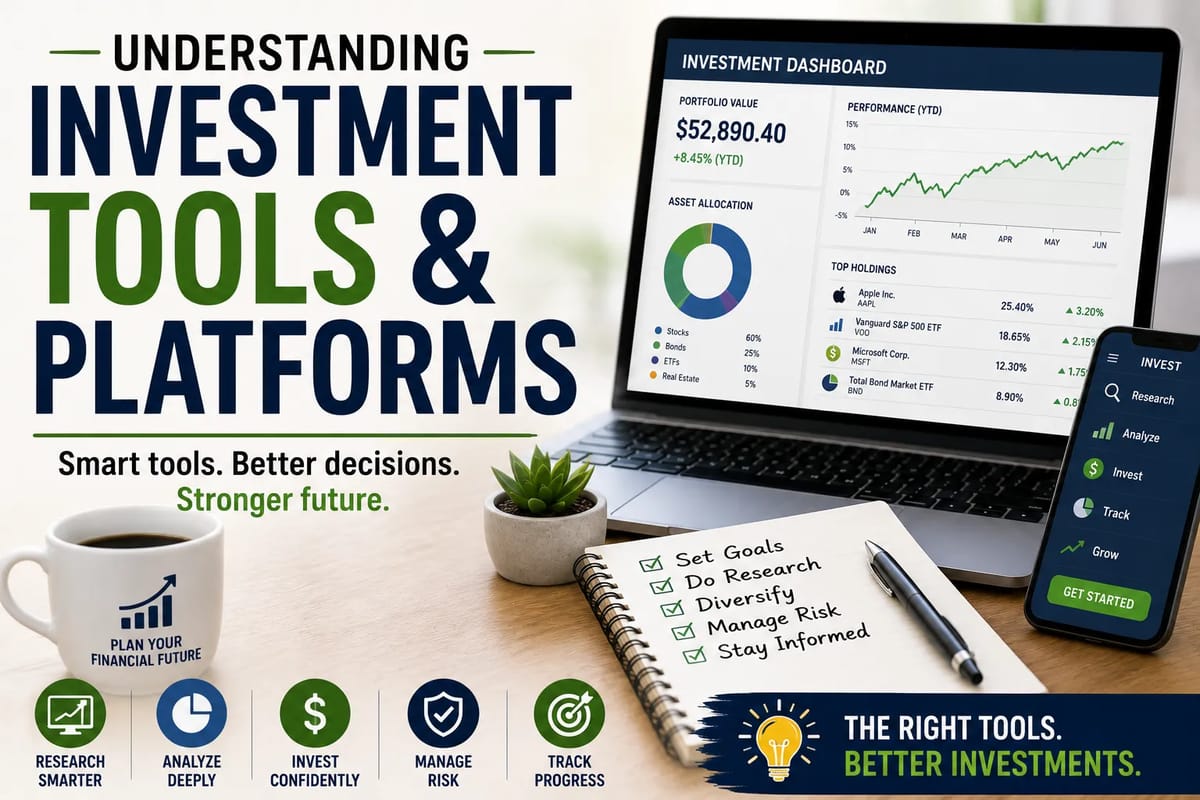
A portfolio tracker allows investors to monitor investments in one place.
It may show:
-
Current holdings
-
Portfolio value
-
Gains and losses
-
Asset allocation
-
Dividend income
-
Historical performance
Portfolio trackers can be especially useful when investments are spread across multiple accounts.
However, make sure you understand how the tracker calculates performance.
For example, returns can be presented differently depending on whether the calculation accounts for deposits, withdrawals, dividends and the timing of transactions.
**## **Asset Allocation Tools****
Asset allocation describes how a portfolio is divided among different asset categories.
Depending on the investor, those categories may include:
-
Stocks
-
Bonds
-
Cash
-
Real estate
-
Commodities
-
Other investments
Asset-allocation tools can help investors visualize how concentrated or diversified their portfolios are.
For example, someone may discover that what appears to be a diversified portfolio is heavily concentrated in technology companies.
This can happen when several funds hold many of the same underlying stocks.
**## **Diversification Tools****
Diversification involves spreading investments across different assets or exposures rather than relying heavily on one investment.
Investment platforms can help investors examine diversification by:
-
Company
-
Industry
-
Geography
-
Asset class
-
Market capitalization
-
Currency
Diversification does not eliminate risk.
But concentration can expose an investor to greater losses if a particular company, industry or market performs poorly.
**## **Investment Calculators****
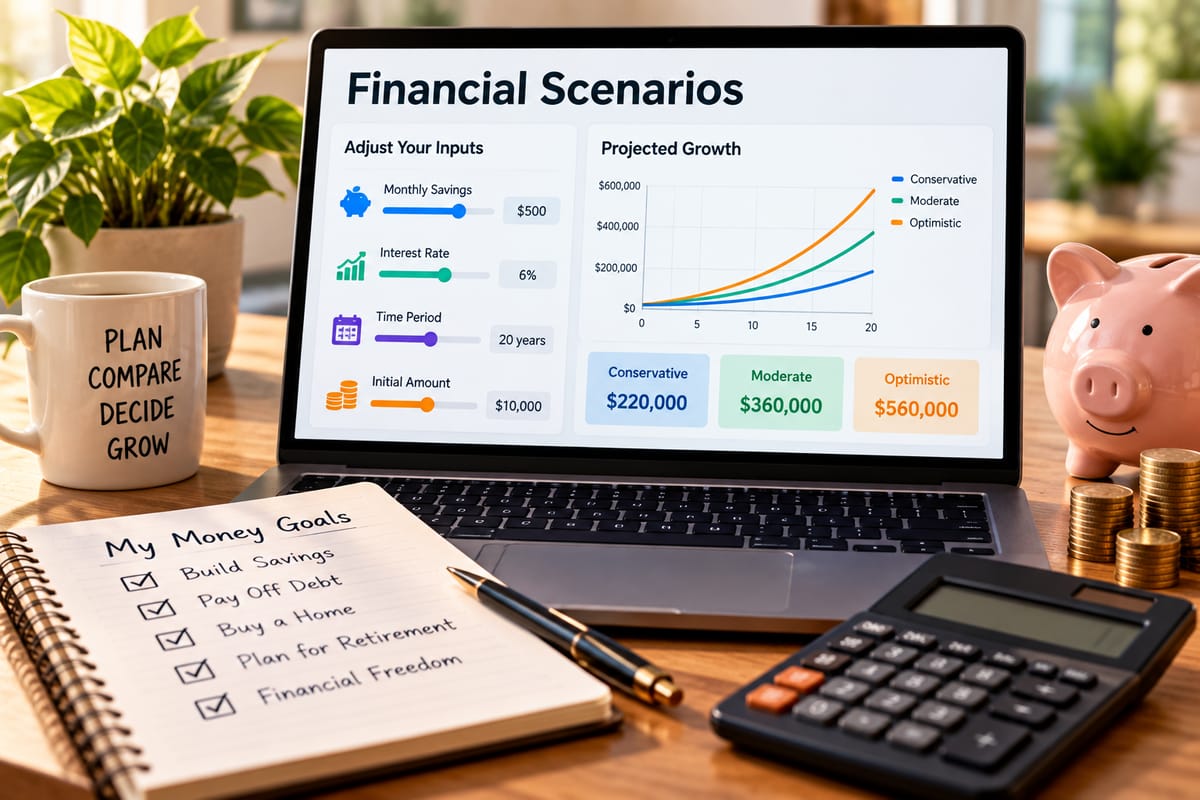
Calculators can help investors understand how different assumptions affect potential outcomes.
Common tools include:
-
Compound-interest calculators
-
Retirement calculators
-
Savings calculators
-
Investment-return calculators
-
Inflation calculators
-
Contribution calculators
For example, compound-growth calculations can illustrate why consistently investing over long periods can produce significant differences in outcomes.
But calculators are models, not predictions.
Changing the assumed return, inflation rate or contribution schedule can dramatically change the result.
**## **Be Careful With Return Assumptions****
An investment calculator might allow you to enter an expected annual return.
It can be tempting to enter a high historical return and assume the same result will continue.
That is risky.
Investment returns vary from year to year.
A diversified portfolio can experience both gains and losses.
Long-term planning should therefore use reasonable assumptions and consider different scenarios rather than relying on a single optimistic forecast.
**## **Retirement Planning Tools****
Retirement calculators can help estimate whether current savings and contributions may be sufficient for a future goal.
They may consider:
-
Current age
-
Retirement age
-
Current savings
-
Annual contributions
-
Expected returns
-
Inflation
-
Desired retirement income
-
Life expectancy assumptions
These tools can be useful for identifying gaps.
But retirement calculations involve considerable uncertainty.
Future investment returns, inflation, taxes, healthcare costs and lifespan cannot be known with certainty.
Treat the result as a planning estimate rather than a guarantee.
**## **Robo-Advisers and Automated Investing****
Robo-advisers have made automated portfolio management accessible to more investors.
Typically, the investor provides information about financial goals, risk tolerance and time horizon.
The platform then uses an algorithm to recommend or manage a portfolio.
Advantages can include:
-
Automated portfolio management
-
Automatic rebalancing
-
Easy account setup
-
Regular contributions
-
Lower minimum investments than some traditional advisers
Potential disadvantages include:
-
Management fees
-
Limited customization
-
Less human interaction
-
Standardized investment models
Whether a robo-adviser makes sense depends on how much control and guidance an investor wants.
**## **Human Financial Advisers Still Have a Role****
Technology has not eliminated the need for financial professionals.
Some financial decisions involve multiple considerations that cannot easily be reduced to a simple questionnaire.
A financial adviser may help with:
-
Retirement planning
-
Tax strategy
-
Estate planning
-
Business-owner finances
-
Insurance
-
Complex investment portfolios
-
Major financial transitions
Investors should understand how an adviser is compensated and what services are included.
Fee structures can vary considerably.
**## **Compare Fees Carefully****
Fees are one of the most important factors when evaluating investment platforms.
Possible costs include:
-
Trading commissions
-
Management fees
-
Fund expense ratios
-
Account fees
-
Withdrawal fees
-
Currency-conversion fees
-
Advisory fees
-
Inactivity fees
-
Data fees
Some platforms advertise zero commissions on certain transactions.
That does not necessarily mean investing is free.
The platform may earn revenue through other mechanisms, or the investment itself may carry costs.
**## **Expense Ratios Matter****
For fund investors, the expense ratio can be particularly important.
An expense ratio represents the annual operating expenses charged by a fund, expressed as a percentage of assets.
A difference of a fraction of a percentage point may appear small.
But over decades, costs can compound into a meaningful difference in wealth.
This is one reason long-term investors often pay close attention to the ongoing costs of funds.
**## **Look Beyond Trading Commissions****
A platform with zero trading commissions may still be expensive in other ways.
Consider the entire cost structure.
For example, a platform could have:
-
Low trading costs
-
Higher account fees
-
Expensive currency conversion
-
Limited low-cost fund choices
Another platform might charge a small transaction fee but offer lower ongoing investment expenses.
Compare the total cost rather than focusing on one advertised feature.
**## **Minimum Investment Requirements****
Some platforms require minimum deposits or account balances.
Others allow investors to start with relatively small amounts.
For beginners, a low minimum can make it easier to begin investing gradually.
But a platform’s minimum investment should not be the only selection criterion.
A service with a higher minimum may provide valuable features or professional advice that justify the requirement for some investors.
**## **Fractional Shares****
Some investment platforms allow investors to buy fractional shares.
Instead of purchasing one complete share, you can invest a smaller amount and receive a fraction of a share.
This can make expensive stocks more accessible.
However, investors should check how fractional ownership works.
There may be restrictions concerning:
-
Transfers
-
Voting rights
-
Dividend treatment
-
Selling
-
Corporate actions
The specific rules depend on the platform.
**## **Automatic Investing****
Automatic investing allows users to schedule recurring contributions.
For example, an investor might automatically transfer a set amount from a bank account into an investment portfolio each month.
This can make consistent investing easier.
It also reduces the need to remember to make contributions manually.
Automatic investing does not eliminate market risk.
But it can help investors develop a disciplined savings and investing routine.
For investors building a structured long-term strategy around goals, contributions, diversification and risk, how to build an investment plan for long-term goals offers a useful companion resource.
**## **Rebalancing Tools****
Over time, investment returns can cause a portfolio’s asset allocation to drift.
Suppose an investor initially allocates:
-
70% stocks
-
30% bonds
If stocks significantly outperform bonds, the portfolio might eventually become 80% stocks and 20% bonds.
A rebalancing tool can help identify this change.
Some platforms automatically rebalance portfolios according to predetermined rules.
Others simply provide alerts or allow investors to rebalance manually.
**## **Tax-Related Investment Tools****
Taxes can have a significant impact on investment returns.
Depending on the country and investment type, investors may encounter taxes on:
-
Dividends
-
Interest
-
Capital gains
-
Investment distributions
-
Foreign income
Some platforms provide tax reports or tools that help investors understand realized gains and losses.
However, an investment platform is not necessarily a substitute for professional tax advice.
Tax treatment can be complicated, particularly when multiple accounts, jurisdictions or asset types are involved.
**## **Security Should Be a Priority****
An investment account contains sensitive financial information and potentially significant amounts of money.
Security features should therefore be a major consideration.
Look for features such as:
-
Multifactor authentication
-
Strong login protections
-
Encryption
-
Account alerts
-
Device management
-
Fraud monitoring
-
Secure withdrawal procedures
Also consider whether the platform provides clear guidance when suspicious activity occurs.
Convenience should never come at the expense of basic account security.
**## **Understand Investor Protection****
Investors should distinguish between **investment risk** and protection against platform or institution failure.
The exact protection depends on the country, account type and financial institution.
In the United States, for example, eligible customers of member brokerage firms may receive protection through applicable investor-protection arrangements, subject to relevant limits and conditions. Such protection is not insurance against investment losses caused by market declines.
Other countries have their own regulatory and investor-protection frameworks.
Before depositing substantial amounts, understand what protections apply to your account.
**## **Don’t Confuse Investment Platforms With Bank Accounts****
An investment account and a bank savings account serve different purposes.
A bank savings account is generally designed for holding cash and may provide deposit protection under applicable rules.
An investment account is designed to hold investments that can rise or fall in value.
Stocks, funds and other securities can lose value.
Money invested for long-term growth should therefore generally be separated conceptually from cash reserved for emergencies and near-term expenses.
**## **Investment Platforms Can Encourage Overtrading****
Easy access to markets can be both a benefit and a risk.
A smartphone notification can make market movements feel urgent.
Investors may be tempted to check prices constantly or trade based on short-term movements.
Frequent trading can increase costs, taxes and the possibility of poor decisions.
A platform should be a tool for implementing an investment strategy, not a source of constant entertainment.
**## **Be Careful With Gamification****
Some investment apps use design elements that make financial activities feel more like games.
Celebrating trades, displaying constant price movements or emphasizing short-term performance can encourage frequent engagement.
That may be useful for keeping investors informed, but it can also encourage impulsive decisions.
Ask yourself whether a platform helps you follow your investment plan or encourages you to react emotionally to every market movement.
**## **Understand Order Types****
Investors who buy individual securities should understand the basics of order types.
A **market order** generally seeks immediate execution at the best available price.
A **limit order** specifies a maximum price for a purchase or minimum price for a sale.
Other order types can have more specialized purposes.
The availability and behavior of orders can vary between markets and platforms.
Beginners should understand what an order does before using it with real money.
**## **Market Data Can Be Delayed****
Some investment platforms provide real-time market data, while others may display delayed information depending on the market and service.
For long-term investors, a short delay may be largely irrelevant.
For active traders, timing can be much more important.
Check the platform’s market-data terms rather than assuming every price displayed is real-time.
**## **Research Tools Should Encourage Better Questions****
A good investment research platform should not simply give you numbers.
It should help you ask better questions.
For example:
-
Why is this company’s margin changing?
-
Why has its debt increased?
-
How does its valuation compare with competitors?
-
What percentage of revenue comes from one market?
-
How dependent is the company on a particular customer?
-
What could cause its earnings to decline?
Numbers are useful when they lead to deeper analysis.
**## **Avoid Relying on One Data Point****
An investment decision based solely on a stock’s P/E ratio, dividend yield or recent price performance can be misleading.
Consider multiple dimensions.
For a company, you might examine:
**Business quality**
What does the company actually do?
**Financial strength**
Does it generate sustainable cash flow?
**Valuation**
Is the current price reasonable relative to its prospects?
**Competition**
Does the company have a durable advantage?
**Risk**
What could cause the investment thesis to fail?
**Time horizon**
Are you investing for months, years or decades?
This broader framework is more useful than relying on one attractive statistic.
**## **Investment Comparison Tools****
Comparison tools can help investors evaluate different funds, stocks or investment products side by side.
Useful comparison categories can include:
| Factor | Why it matters |
| —– | —– |
| Fees | Lower costs can improve long-term returns |
| Performance | Shows historical results, not guaranteed future returns |
| Volatility | Helps illustrate how much prices have fluctuated |
| Holdings | Shows what the investment actually owns |
| Diversification | Helps identify concentration |
| Income | Useful for investors seeking dividends or distributions |
| Strategy | Explains how the investment is managed |
| Risk | Helps identify potential downside |
Historical performance should never be treated as a promise of future returns.
**## **Use Historical Performance Carefully****
A fund that performed exceptionally well over the past five years may attract attention.
But investors should ask why.
Was performance driven by a particular market environment?
Did the fund take more risk?
Was its success concentrated in a small number of investments?
Has its strategy changed?
Historical returns provide information, but they do not tell you what will happen next.
**## **Understand Benchmarking****
Many investment platforms compare portfolio performance with a benchmark.
A benchmark is a reference point used to evaluate performance.
For example, a fund investing primarily in large U.S. companies might be compared with a broad large-cap stock-market index.
Benchmark selection matters.
Comparing a conservative bond portfolio with an aggressive stock index can produce a misleading impression.
The benchmark should reflect the investment strategy being evaluated.
**## **Risk Assessment Tools****
Some platforms ask questions about your financial goals and tolerance for losses.
They may classify you as:
-
Conservative
-
Moderate
-
Aggressive
These labels can be useful, but they are not perfect.
Your actual risk capacity depends on factors such as:
-
Income
-
Savings
-
Debt
-
Emergency reserves
-
Investment horizon
-
Financial obligations
-
Dependents
-
Need for liquidity
Someone may be emotionally comfortable with market volatility but financially unable to withstand a large loss.
Risk tolerance and risk capacity are not the same thing.
**## **Consider the Platform’s Customer Support****
Technology cannot solve every problem.
If your account is locked, a transaction is disputed or you have a complicated question, customer support matters.
Evaluate:
-
Response times
-
Phone support
-
Email support
-
Live chat
-
Help documentation
-
Availability during market hours
-
Support for technical problems
Customer service may seem unimportant when everything works.
It becomes extremely important when something goes wrong.
**## **Check Whether the Platform Is Regulated****
Before depositing money, verify the platform’s regulatory status and the identity of the legal entity holding or managing your assets.
Do not rely solely on advertisements or social-media recommendations.
Check the relevant financial regulator in your jurisdiction.
Be particularly cautious about platforms promising:
-
Guaranteed high returns
-
Risk-free profits
-
Secret trading strategies
-
Extremely high daily returns
-
Urgent deposits
-
Guaranteed access to “exclusive” investments
Legitimate investments involve risk.
Promises that sound too good to be true deserve scrutiny.
**## **Watch Out for Investment Scams****
Technology has also made financial fraud easier to distribute.
Scammers can create professional-looking websites, fake investment dashboards and convincing social-media profiles.
Red flags can include:
-
Pressure to deposit immediately
-
Guaranteed returns
-
Requests to send money through unusual channels
-
Unclear ownership of the platform
-
No verifiable regulatory information
-
Difficulty withdrawing funds
-
Claims that losses can be recovered by paying another fee
Before transferring money, independently verify the company and its regulatory status.
Do not rely on contact information supplied solely by someone promoting the investment.
**## **Choose Tools Based on Your Strategy****
An investor following a simple long-term strategy may need only:
-
A reliable brokerage
-
Low-cost diversified investments
-
Automatic contributions
-
Basic portfolio tracking
An investor researching individual companies may need:
-
Financial statements
-
Screening tools
-
Market data
-
Analyst research
-
Valuation metrics
A more active investor may require:
-
Advanced charts
-
Order types
-
Real-time data
-
Trading tools
-
Risk-management features
The goal is to avoid paying for capabilities you will never use.
**## **Don’t Let Tools Replace a Strategy****
One of the biggest mistakes investors can make is believing that better software automatically produces better returns.
It does not.
A sophisticated charting platform cannot compensate for a poor investment strategy.
A premium research subscription cannot eliminate uncertainty.
An algorithm cannot predict every market event.
Tools should support a sound process.
They should not become a substitute for one.
**## **Keep Your Investment System Simple****
Complexity can create unnecessary mistakes.
If you have five different apps showing conflicting information, three brokerage accounts you rarely use and numerous subscriptions for financial research, managing your portfolio may become more difficult rather than easier.
Consolidating where practical can make financial management simpler.
You should still maintain appropriate diversification and account structures, but complexity should have a purpose.
**## **Review Your Platform Periodically****
Your financial needs can change.
A platform that worked when you were starting out may no longer be suitable after your portfolio grows.
Review your setup when:
-
Your income changes
-
You begin investing for retirement
-
You start a business
-
You move countries
-
Your portfolio becomes more complex
-
You begin receiving investment income
-
You need professional advice
-
Your investment strategy changes
You do not need to switch platforms constantly.
But you should know whether your current platform still fits your needs.
**## **A Practical Investment Platform Checklist****
Before opening an account, consider the following:
**### **1. What can I invest in?****
Check the available products.
**### **2. What does it cost?****
Look beyond headline commissions.
**### **3. Is the platform properly regulated?****
Verify independently.
**### **4. What protections apply?****
Understand the relevant investor or deposit-protection framework.
**### **5. Is the interface appropriate for my experience?****
Too little information can be frustrating, while too much can be overwhelming.
**### **6. Does it support my strategy?****
Make sure the platform offers the features you actually need.
**### **7. How secure is the account?****
Check authentication and fraud-prevention features.
**### **8. How good is customer support?****
Know how you would get help during a problem.
**### **9. What tax information does it provide?****
Useful reporting can simplify tax preparation.
**### **10. Can I transfer my investments later?****
Understand transfer rules and potential costs.
**## **A Beginner Does Not Need Every Investment Tool****
Someone starting their investment journey may see professional-grade research platforms and assume they need all of them.
Usually, they do not.
A beginner may be better served by learning:
-
How diversification works
-
What fees mean
-
How investment risk works
-
How compound growth works
-
How to evaluate basic funds
-
How to create an emergency fund
-
How to invest consistently
-
How taxes affect returns
Once those concepts are understood, additional tools can be added when they solve a specific problem.
**## **Technology Makes Investing Easier—but Judgment Still Matters****
Investment platforms have dramatically reduced the barriers to participating in financial markets.
Research that once required specialized financial databases can now be available through a browser or smartphone.
Portfolio management can be automated.
Recurring investments can be scheduled.
Investment costs have become more transparent in many markets.
But easier access also means investors can make mistakes faster.
The ability to buy an investment in seconds does not mean you should.
The ability to monitor a portfolio every minute does not mean you need to.
The best technology is often the technology that helps you **follow a sensible plan consistently without encouraging unnecessary activity**.
**## **Choosing the Right Investment Platform for Your Needs****
There is no universally perfect investment platform.
The right choice depends on what you are trying to accomplish.
A long-term investor may prioritize low costs, diversification and automation.
A self-directed investor may value research and flexibility.
Someone who wants professional guidance may prefer a wealth-management service.
A beginner may prioritize simplicity and education.
An active investor may require more sophisticated trading functionality.
Before opening an account, look beyond advertising and compare the platform’s **fees, investment choices, regulatory status, security, research tools, customer support, tax reporting and overall fit with your strategy**.
Most importantly, remember that an investment platform is only a tool.
It cannot eliminate market risk, guarantee returns or replace sound financial judgment.
The strongest investment setup is usually not the one with the most buttons, charts and features. It is the one that makes it easier to **save consistently, invest appropriately, understand what you own, control unnecessary costs and stay committed to a long-term financial plan**.