**Inflation Is Quietly Reducing the Buying Power of Emergency Savings
Emergency savings are designed to provide security when life becomes unpredictable. They can cover an unexpected medical bill, a major car repair, a period without income or a sudden household expense.
But there is another risk that is much less visible.
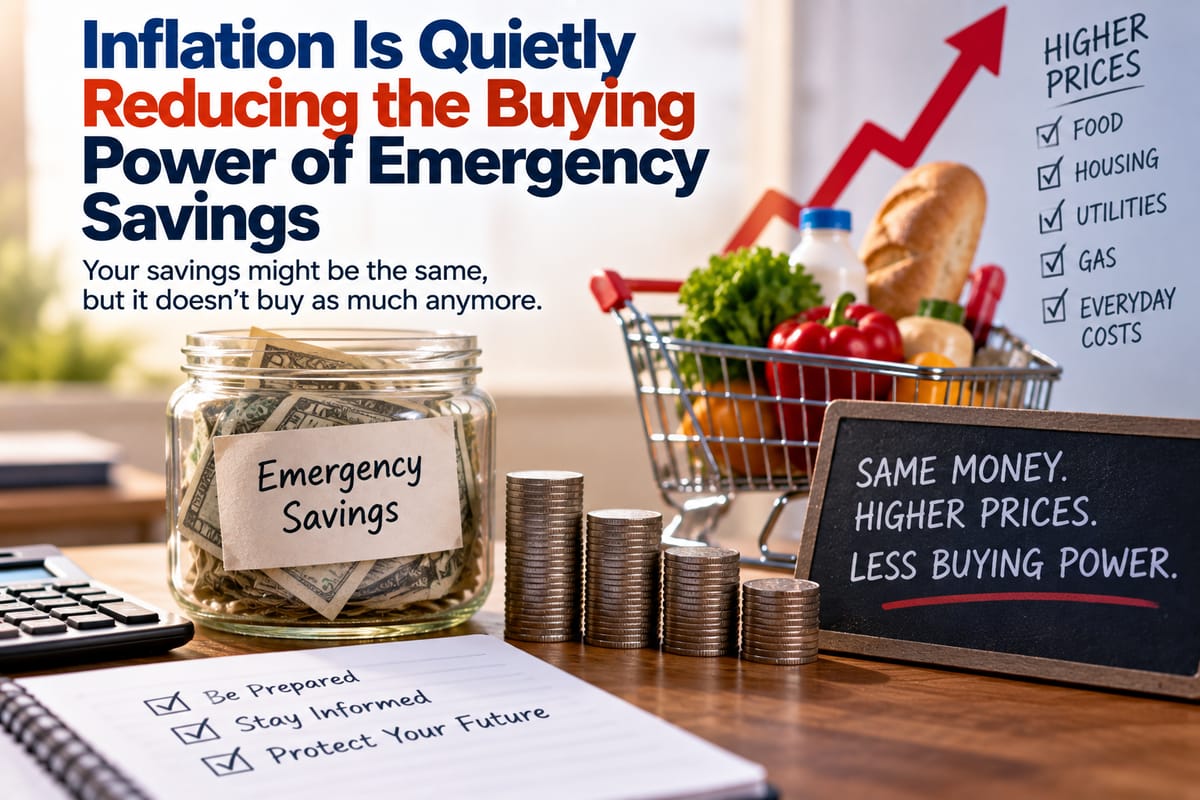
Even when the number displayed in a savings account stays exactly the same, inflation can gradually reduce what that money can buy.
This is why building an emergency fund is not only about reaching a particular dollar amount. It is also about understanding how purchasing power changes over time.
The Balance Can Stay the Same While Its Value Falls
Suppose someone has $20,000 sitting in an emergency savings account.
The account statement may continue to show $20,000 a year later. There has been no withdrawal, so it can feel as though the money has retained its value.
But if everyday prices have increased, that $20,000 will not necessarily buy as much as it did previously.
This is the basic effect of inflation.
Inflation measures the rate at which prices for goods and services increase over time. A dollar today can therefore purchase less than a dollar could purchase several years ago.
A broader understanding of inflation and other measures can be found in the complete guide to economic indicators.
Why Emergency Savings Are Especially Vulnerable
Emergency funds are different from long-term investment portfolios.
Their primary purpose is accessibility and stability.
Someone saving for retirement may accept short-term fluctuations in exchange for the possibility of long-term growth. Emergency savings generally need to be available immediately, which means people often keep them in cash or cash-like accounts.
That makes the interest rate earned on the money especially important.
If an emergency fund earns an interest rate below the rate of inflation, the account balance may increase while its purchasing power declines.
For example, imagine $10,000 earns 1% interest while prices rise by 3% over the same period. The account would contain slightly more than $10,000, but the money would still have less purchasing power than it had at the beginning.
The difference is easy to overlook because bank statements show nominal dollars rather than purchasing power.
Inflation Does Not Affect Every Household the Same Way
Inflation is measured using a broad basket of goods and services, but individual households have different spending patterns.
One family might spend a large portion of its income on housing. Another might spend more on transportation, groceries, childcare or medical expenses.
As a result, the inflation rate reported for the economy does not necessarily match the personal experience of every household.
This is one reason how inflation affects everyday finances matters when thinking about emergency savings.
If a household’s major expenses are rising faster than the overall inflation rate, its emergency fund may need to be larger simply to provide the same level of protection.
A Three-Month Emergency Fund May Not Stay a Three-Month Fund
Emergency savings are often discussed in terms of months of essential expenses.
A household might decide that it needs enough money to cover three, six or more months of necessary spending.
But the dollar amount required to maintain that target can change.
Imagine a household originally spends $4,000 a month on essential expenses and builds a six-month emergency fund of $24,000.
If essential expenses eventually rise to $4,500 a month, six months of expenses now requires $27,000.
The household has not necessarily become less financially responsible. Its target simply needs to reflect the higher cost of maintaining the same lifestyle and meeting the same essential obligations.
That is why how much emergency savings families should have is not a question with one permanent dollar answer.
The Interest Rate on Savings Matters
Inflation creates an important distinction between the interest rate on a savings account and the real return on that money.
The nominal interest rate is what the financial institution pays.
The inflation-adjusted return reflects how much purchasing power the money gains or loses after accounting for rising prices.
If a savings account earns 4% while inflation is 3%, the saver has a positive return before taxes, assuming the rates remain comparable over the relevant period.
If the account earns 2% while inflation is 4%, purchasing power is declining even though the account is generating interest.
The relationship can change over time because both savings rates and inflation rates can move.
Why “Safe” Money Still Needs Attention
Emergency savings are generally meant to be safe from the large day-to-day price swings that can affect stocks and other investments.
But safety from market volatility is not the same thing as protection from inflation.
Keeping money in cash can protect the principal balance from investment-market losses, but it does not guarantee that the money will maintain its purchasing power.
This creates a trade-off.
Emergency funds need to remain accessible and relatively stable, but savers also have an incentive to look for appropriate accounts that provide a competitive yield without taking on risks that undermine the purpose of the emergency fund.
The objective is not necessarily to maximize returns. It is to balance accessibility, stability and purchasing power.
Inflation Can Change the Cost of an Emergency
An emergency fund is ultimately designed to pay for real-world expenses.
Consider a household that expects an emergency car repair to cost around $1,500. If repair costs rise over several years, the same type of unexpected problem could require considerably more money.
The same applies to medical expenses, temporary housing, home repairs, insurance deductibles and other financial emergencies.
A fund that was adequate several years ago may therefore need to be reviewed periodically.
This is particularly important when inflation remains elevated for an extended period.
Higher Prices Can Make Existing Savings Goals Look Smaller Than They Are
Another problem is psychological.
People often set a savings goal, reach it and stop contributing.
Reaching $10,000 or $20,000 can feel like a major financial milestone. And it is.
But the goal was probably based on a particular cost structure.
If rent, groceries, insurance, transportation and other necessities become more expensive, the original emergency-fund target may no longer provide the same level of protection.
This does not mean households should constantly chase a larger number without considering their circumstances.
Instead, it means emergency savings should be reviewed when major expenses change.
Savers Do Not Need to Panic About Every Inflation Report
Inflation is a long-term purchasing-power issue, not necessarily a reason to make sudden financial decisions every time a monthly inflation report changes.
Monthly readings can move up or down because of temporary changes in fuel, food, travel and other categories.
What matters for emergency savings is the broader relationship between:
- The household’s essential expenses
- The size of its emergency fund
- The interest earned on that money
- The rate at which relevant expenses are increasing
- The household’s income stability
- How quickly the money may need to be accessed
Looking at those factors together provides a more useful picture than focusing on one inflation number.
How to Protect the Purchasing Power of Emergency Savings
There are several practical steps savers can consider.
Review the Account Where the Money Is Held
Not every savings account offers the same interest rate.
Savers can periodically compare the yield on their emergency fund with other accessible savings options.
The goal should be to find an appropriate combination of liquidity, security and yield rather than simply choosing the account with the highest advertised rate.
Recalculate Essential Expenses
An emergency fund should be based on current financial needs rather than an outdated household budget.
Review housing, food, utilities, transportation, insurance, debt payments and other essential costs periodically.
Increase the Emergency Fund When Necessary
If essential expenses rise substantially, increasing the emergency fund can help preserve its original purpose.
That does not necessarily mean making a huge contribution immediately.
Even small additions over time can help close the gap between an old savings target and today’s expenses.
Avoid Treating Emergency Savings as Long-Term Spending Money
Inflation can create pressure to seek higher returns, but the purpose of emergency savings remains important.
Money that might be needed next month should generally be approached differently from money intended for a financial goal decades away.
The appropriate strategy depends heavily on when the money may be needed and how much risk the household can tolerate.
The Difference Between Saving More and Earning More
There are two broad ways to respond when inflation reduces purchasing power.
A household can save more money, or it can seek a better return on money it has already saved.
Often, both approaches can play a role.
Increasing contributions helps build a larger nominal balance. Improving the interest earned on accessible savings can help reduce the erosion caused by inflation.
But neither approach completely eliminates inflation risk.
Prices can continue changing, and interest rates can change as well.
Emergency Savings Still Serve an Important Purpose
It can be tempting to focus so heavily on inflation that the basic purpose of emergency savings gets lost.
An emergency fund is not primarily an investment designed to generate the highest possible return.
Its value comes from being available when something goes wrong.
A strong emergency fund can prevent an unexpected expense from immediately turning into expensive credit-card debt, a forced investment sale or a missed bill.
That financial flexibility has value even when inflation is reducing the purchasing power of the money.
Why Cooling Inflation Does Not Reverse Earlier Price Increases
One of the most important concepts for savers is the difference between lower inflation and lower prices.
When inflation falls, prices can still continue increasing. They are simply increasing more slowly.
For example, if prices rise 5% one year and 2% the next, the second year has lower inflation. But prices are still higher than they were before.
This distinction explains why emergency funds can continue needing attention even after inflation begins to cool.
The purchasing-power challenge does not automatically disappear simply because the inflation rate moves lower.
A previous analysis on inflation cooling while savers still need to protect their purchasing power explores this issue in greater detail.
A Better Way to Think About the Emergency Fund
Instead of asking only, “Have I saved enough?”, households can periodically ask a few additional questions:
- How much do my essential expenses cost today?
- How many months would my current savings cover?
- Is my savings account earning a competitive rate?
- Have my housing, transportation or insurance costs changed?
- Would the fund still be adequate after a major unexpected expense?
- Has inflation changed the amount I realistically need?
These questions turn an emergency fund from a static savings target into an ongoing part of household financial planning.
The Quiet Cost of Leaving Savings Unreviewed
Inflation rarely produces a dramatic moment when a savings account suddenly loses value.
That is what makes its effect so easy to overlook.
The balance remains visible. Interest may continue to arrive. The account can appear completely healthy.
Meanwhile, the prices of the things that emergency savings are intended to pay for may gradually rise.
For households, the practical response is not necessarily to abandon cash savings or take excessive investment risk. It is to recognize that an emergency fund needs periodic maintenance just like a household budget.
Reviewing the target, accounting for changing expenses and paying attention to the return earned on accessible savings can help ensure that the fund continues to provide the protection it was created to deliver.
When inflation changes the cost of everyday life, the right emergency-fund target can change with it.