How Global Interest Rates Affect Countries
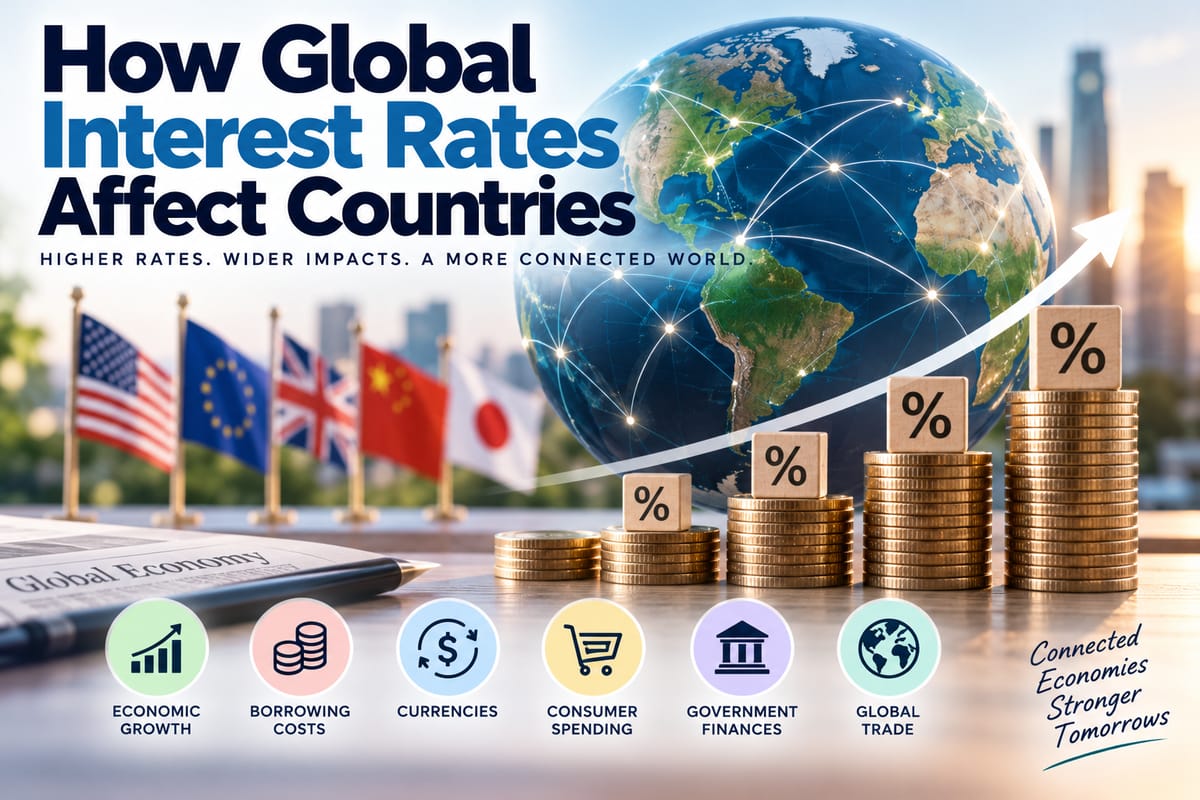
Interest rates influence economies in ways that extend far beyond the cost of borrowing money. When central banks raise or lower policy rates, the effects can spread through commercial banks, households, businesses, financial markets, currencies, investment flows, and government finances.
Because countries are connected through global trade and financial markets, changes in interest rates in one major economy can also affect other countries. A rate increase in a large economy can influence exchange rates, capital flows, borrowing costs, commodity prices, and investment decisions elsewhere.
The effects are not identical everywhere. Countries respond differently depending on their monetary policies, exchange-rate systems, debt levels, economic structures, inflation conditions, and relationships with international financial markets.
What Are Interest Rates?
An interest rate represents the cost of borrowing money or the return earned for lending or saving it.
Central banks generally influence short-term interest rates through monetary policy. These rates then affect other interest rates throughout the financial system.
For example, changes in a central bank’s policy rate can influence:
- Commercial bank lending rates
- Mortgage rates
- Business borrowing costs
- Savings rates
- Government bond yields
- Consumer credit costs
- Currency values
- Investment decisions
The relationship between rates, borrowing, saving, spending, and investment is explored in Understanding Interest Rates and Their Effects.
Why Global Interest Rates Matter
Countries do not operate in isolation.
Investors can move capital between countries in search of attractive returns, lower risks, or greater opportunities. Businesses may borrow in international markets, while governments may issue bonds to foreign investors.
As a result, changes in interest rates can influence decisions far beyond the country where the policy change occurs.
For example, if interest rates rise significantly in one major economy, international investors may find assets denominated in that country’s currency more attractive. Capital can flow toward those assets, potentially affecting currencies and financial markets in other countries.
How Central Banks Set Interest Rates
Central banks use monetary policy to influence economic conditions.
When inflation is considered too high, a central bank may raise interest rates to make borrowing more expensive and reduce demand.
When economic activity is weak and inflation pressures are limited, a central bank may lower rates to encourage borrowing, investment, and spending.
Central banks do not control every interest rate directly. Instead, their policy decisions influence financial conditions throughout the economy.
The relationship between central banks and the banking system is explained in How Central Banks Affect Commercial Banks.
How Interest Rates Spread Through an Economy
A change in policy rates can affect an economy through several channels.
A simplified process might look like this:
Central bank changes rates → borrowing costs change → spending and investment respond → economic activity changes → inflation pressures may change
The strength and speed of this process depend on economic conditions.
Banks may adjust lending rates, businesses may reconsider investment plans, households may change spending decisions, and investors may reassess the value of financial assets.
Higher Interest Rates Can Reduce Borrowing
When interest rates rise, borrowing generally becomes more expensive.
Households may face higher costs for mortgages, personal loans, credit cards, or other forms of borrowing.
Businesses may also face higher financing costs.
This can discourage some households from making large purchases and cause businesses to delay investments that depend heavily on borrowed money.
Lower demand can eventually reduce pressure on prices.
Higher Rates Can Encourage Saving
Interest rates also affect the incentive to save.
When banks offer higher deposit rates, households and businesses may receive greater returns for keeping money in savings accounts or other interest-bearing assets.
This can encourage some people to save more and spend less.
The effect depends on individual circumstances, however. Some households may have little capacity to increase savings, while others may benefit significantly from higher returns on deposits and fixed-income investments.
Lower Interest Rates Can Encourage Economic Activity
Lower interest rates can make borrowing less expensive.
Businesses may find it easier to finance new equipment, expand operations, hire workers, or develop new products.
Households may find mortgages and other loans more affordable, potentially increasing demand for homes, vehicles, and other goods.
Lower rates can therefore support economic activity when borrowing and investment respond to improved financial conditions.
However, lower rates can also contribute to inflation if demand grows faster than the economy’s ability to produce goods and services.
Interest Rates and Inflation
One of the central reasons monetary authorities adjust interest rates is to influence inflation.
When demand is stronger than an economy’s productive capacity, businesses may raise prices.
Higher interest rates can moderate demand by increasing borrowing costs and encouraging saving.
This can reduce spending and investment, potentially easing inflationary pressure.
The relationship is not immediate. Monetary policy often affects the economy with a delay, meaning central banks must consider how current decisions could influence future economic conditions.
How Interest Rates Affect Currency Values
Interest-rate differences between countries can influence exchange rates.
Suppose investors can choose between two countries with similar levels of perceived risk but substantially different interest rates. The country offering higher yields may become more attractive to some international investors.
Increased demand for assets denominated in that country’s currency can contribute to currency appreciation.
However, exchange rates are influenced by many factors, including inflation, economic growth, trade balances, political conditions, investor expectations, and global risk sentiment.
Interest-rate differences are therefore one influence rather than a complete explanation of currency movements.
Why Currency Changes Matter
Currency movements can have significant economic consequences.
When a country’s currency strengthens, imported goods may become cheaper in domestic currency terms. This can reduce the cost of imported energy, food, machinery, technology, and other products.
However, a stronger currency can make exports more expensive for foreign buyers, potentially affecting exporters.
A weaker currency can have the opposite effects.
Imported goods may become more expensive, while exporters may become more competitive in international markets.
Emerging Economies Can Be Particularly Sensitive
Countries with emerging or developing financial markets can be especially sensitive to changes in global interest rates.
International investors often consider expected returns alongside currency risk and perceived economic or political risk.
When interest rates rise in major global financial centers, some investors may shift capital toward those markets.
This can place pressure on the currencies and financial assets of other countries.
The resulting effects can include higher domestic borrowing costs, exchange-rate volatility, and changes in investment flows.
Foreign-Currency Debt Can Increase the Impact
The effects of global interest rates can become more significant when governments or companies have substantial debt denominated in foreign currencies.
If the domestic currency weakens against the currency in which the debt is denominated, the cost of servicing that debt can increase when measured in domestic currency.
Higher global interest rates can compound the problem when new borrowing or refinanced debt becomes more expensive.
This is one reason countries and companies pay close attention to the currency composition and maturity structure of their debt.
Government Borrowing Costs Can Change
Governments borrow money by issuing bonds and other debt instruments.
When interest rates rise, newly issued government debt may carry higher yields.
If a government needs to refinance existing debt at higher rates, its interest expenses can increase over time.
Higher debt-servicing costs can place pressure on government budgets.
Governments may then have to balance interest payments against spending on infrastructure, healthcare, education, social programs, and other priorities.
The effect depends heavily on the country’s existing debt structure and the maturity of its outstanding obligations.
Interest Rates and Government Bonds
Government bond yields are influenced by central bank policy rates, inflation expectations, economic conditions, investor demand, and perceptions of credit risk.
When market interest rates rise, the prices of existing fixed-rate bonds generally fall because newly issued bonds can offer higher yields.
When market rates fall, existing bonds with higher fixed coupons can become more attractive, potentially increasing their market prices.
These changes can affect pension funds, banks, investment funds, insurance companies, and individual investors.
Interest Rates Can Affect Stock Markets
Interest rates can also influence equity markets.
Higher rates can increase the cost of borrowing for companies and reduce the present value investors place on future corporate earnings.
Some companies may therefore face greater financial pressure when borrowing costs rise.
Lower interest rates can have the opposite effect by reducing financing costs and making future earnings comparatively more valuable under common valuation approaches.
The broader relationship between monetary policy and financial assets is explored in How Monetary Policy Affects Financial Markets.
Different Industries Respond Differently
Interest-rate changes do not affect every industry in the same way.
Businesses that rely heavily on borrowing may be particularly sensitive to higher rates.
Industries connected to housing, construction, automobiles, consumer finance, and capital-intensive investment can experience changes in demand when financing costs move.
Banks can have more complicated responses because they earn interest on loans while also paying interest on deposits and other funding sources.
Some financial institutions may benefit from higher rates under certain conditions, while others may face pressure depending on their balance sheets and lending environments.
Housing Markets Can Respond Strongly
Housing is particularly sensitive to interest rates in countries where home purchases depend heavily on mortgages.
Higher mortgage rates can increase monthly borrowing costs, potentially reducing the amount buyers are willing or able to borrow.
This can weaken housing demand.
However, housing markets also depend on property supply, employment, population growth, construction costs, household incomes, and local regulations.
Lower interest rates can make mortgages more affordable and stimulate housing demand, but if housing supply is constrained, stronger demand can also contribute to higher property prices.
Interest Rates and Consumer Spending
Households respond to interest rates in different ways.
Borrowers may reduce spending when loan payments increase. Savers may receive more income from deposits and other interest-bearing assets.
Consumers with significant debt may therefore feel higher rates differently from households with substantial savings.
The overall effect on consumer spending depends on the distribution of debt and savings throughout the economy.
Businesses May Delay Investment
Investment decisions often involve large amounts of capital and long time horizons.
When financing becomes more expensive, a business may reconsider whether a new factory, office, technology system, vehicle fleet, or expansion project will generate sufficient returns.
Some investments may still make financial sense, while others may be delayed.
This can affect future economic growth if higher borrowing costs persist for an extended period.
Interest Rates and Economic Growth
Interest rates can influence economic growth by affecting consumption, investment, credit availability, housing activity, and financial conditions.
Higher rates can slow economic activity when they reduce borrowing and spending.
Lower rates can support activity when they encourage investment and consumption.
However, interest rates are only one factor affecting growth.
Productivity, population changes, technological development, government policy, trade, infrastructure, and business confidence also matter.
Global Trade Can Transmit Interest-Rate Effects
Interest rates can indirectly affect international trade through currencies and economic activity.
If higher interest rates reduce domestic demand in a major economy, its imports may decline.
Companies in other countries that depend on exports to that market can then experience weaker demand.
Currency changes can create another transmission channel.
A stronger currency can reduce the competitiveness of exports, while a weaker currency can make exports more attractive to foreign buyers.
Commodity Markets Can Be Affected
Interest rates can also influence commodity markets.
Higher rates can reduce demand for certain commodities if economic activity slows.
Currency movements matter as well because many commodities are priced internationally in U.S. dollars.
A stronger dollar can make dollar-denominated commodities more expensive for buyers using other currencies, potentially influencing demand.
Commodity prices are also heavily influenced by supply conditions, weather, geopolitical developments, inventories, and production decisions.
Global Interest Rates and Financial Flows
International capital flows are closely connected to relative returns and risk.
Investors compare opportunities across countries based on factors such as:
- Interest rates
- Inflation
- Currency expectations
- Economic growth
- Political stability
- Credit risk
- Market liquidity
When the relative attractiveness of one market changes, international investment flows can change as well.
These flows can influence exchange rates, bond markets, stock markets, and domestic financial conditions.
Why Countries Do Not Always Move Rates Together
Countries have their own economic conditions and monetary-policy objectives.
One country may raise rates because inflation is persistent, while another may lower rates because economic activity is weak.
Even countries facing similar global conditions can make different policy choices.
Central banks consider domestic inflation, employment, economic growth, currency conditions, financial stability, and other factors when setting monetary policy.
As a result, global interest rates can diverge significantly.
Exchange-Rate Regimes Matter
The effect of international interest-rate changes also depends on a country’s exchange-rate system.
Some countries allow their currencies to move relatively freely according to market conditions.
Others maintain fixed or managed exchange-rate arrangements.
A country attempting to maintain a particular exchange-rate relationship may face different monetary-policy constraints than a country with a freely floating currency.
This can influence how domestic interest rates respond to changes in global financial conditions.
Economic Indicators Help Explain Rate Effects
Analysts use a broad range of economic indicators to understand how interest rates are affecting an economy.
These can include:
- Inflation
- GDP growth
- Employment
- Unemployment
- Wage growth
- Retail sales
- Industrial production
- Consumer confidence
- Housing activity
- Business investment
- Exchange rates
- Government bond yields
The Complete Guide to Economic Indicators provides broader context on how these measures help describe economic conditions.
No single indicator can explain the full effect of changing interest rates.
Why Timing Matters
Interest-rate changes do not necessarily affect the economy immediately.
A household with a fixed-rate mortgage may not experience higher payments when a central bank raises rates.
A business with long-term fixed-rate debt may also be insulated temporarily.
The impact may become more visible when loans mature and need to be refinanced or when new borrowing takes place.
This creates a gradual transmission process that can extend over months or years.
Interest Rates Can Affect Savings and Investment Decisions
Higher interest rates can change the relative attractiveness of different financial assets.
Investors may reassess the balance between stocks, bonds, cash, and other investments.
Savers may place more money into interest-bearing accounts or fixed-income securities when yields become more attractive.
At the same time, companies may change their investment plans because the cost of capital has changed.
These individual decisions can collectively influence financial markets and economic activity.
The Role of Inflation Expectations
Expectations about future inflation can influence interest rates and financial markets.
If households and businesses expect inflation to remain high, they may adjust wages, prices, contracts, and spending decisions accordingly.
Investors may also demand higher yields on bonds if they expect future purchasing power to decline.
Central banks therefore pay attention not only to current inflation but also to whether inflation expectations appear to be becoming entrenched.
Why the Global Economy Is Closely Connected
Modern economies are connected through trade, banking, investment, supply chains, currencies, and financial markets.
A change in interest rates in one major economy can therefore affect countries that have no direct control over that decision.
The effects can move through several channels at once:
Interest rates → capital flows → exchange rates → borrowing costs → spending and investment → economic activity
The strength of each channel varies from country to country.
How Countries Can Respond
Governments and central banks have several tools for responding to changes in global financial conditions.
Central banks can adjust domestic interest rates and use other monetary-policy instruments.
Governments can use fiscal policy, debt-management strategies, foreign-exchange reserves, and structural policies.
Businesses can respond by managing debt carefully, diversifying funding sources, and adjusting investment plans.
Households can also be affected differently depending on whether they are primarily borrowers, savers, investors, or consumers.
Why There Is No Single Global Interest Rate
Although financial markets are increasingly interconnected, there is no single interest rate that determines economic conditions everywhere.
Each central bank operates within a specific national or regional economy.
Interest rates reflect domestic economic conditions as well as international influences.
A country experiencing high inflation may need tighter monetary policy even if another country is cutting rates to support economic growth.
This difference is an important reason global interest-rate conditions can become complicated.
Reading the Global Interest-Rate Environment
Understanding global interest rates requires looking beyond the headline policy rate.
Useful questions include:
- Which central banks are changing rates?
- Why are they changing them?
- How persistent is inflation?
- What is happening to economic growth?
- Are currencies strengthening or weakening?
- How are government bond yields moving?
- Are international capital flows changing?
- How exposed are local borrowers to foreign-currency debt?
- How quickly are financial conditions being transmitted to households and businesses?
These questions provide a more complete picture of how monetary policy is affecting individual economies.
The Wider Impact of Interest-Rate Changes
Global interest rates influence much more than borrowing costs. They can affect currencies, trade, investment, housing, government finances, consumer spending, corporate decisions, and financial markets.
The impact is also uneven. Countries with different economic structures, debt profiles, exchange-rate systems, inflation rates, and financial-market characteristics can experience very different consequences from the same global interest-rate movement.
For households, businesses, investors, and policymakers, understanding these connections provides a clearer view of how monetary decisions made in one part of the world can eventually influence economic conditions elsewhere.
Global interest rates are therefore not simply numbers set by central banks. They are part of a much larger financial network through which changes in borrowing costs, investment incentives, currencies, and economic expectations move across national borders.