Complete Guide to Income Taxes and Taxable Income
Income taxes affect salaries, business profits, investment returns, retirement planning and many other parts of personal finance. Yet the basic question—how much of your income is actually taxable?—can quickly become complicated.
Earning $60,000 during a year does not necessarily mean you pay income tax on the entire $60,000. Tax systems typically distinguish between gross income, taxable income, deductions, exemptions, credits and different categories of income. The rules also vary substantially from one country to another.
Understanding those concepts can help you read a payslip, estimate your tax liability, organize financial records and make better decisions throughout the year.
This guide explains how income taxes and taxable income generally work, why your tax rate is not necessarily the percentage you pay on every dollar you earn, and which details deserve particular attention when planning your finances.
Important: Tax laws vary by jurisdiction and change over time. This guide provides general educational information rather than individualized tax or legal advice. Always check the current rules of the tax authority where you live or earn income.
For a broader look at how income taxes fit into an overall strategy, see the Complete Guide to Personal Taxes and Tax Planning.
What Is Income Tax?
Income tax is a tax imposed on income earned by individuals, businesses or other entities.
Depending on the jurisdiction, taxable income can come from sources such as:
- Employment
- Self-employment
- Business activities
- Investments
- Rental property
- Interest
- Dividends
- Capital gains
- Pensions
- Royalties
- Other taxable payments
Not every type of income is necessarily taxed in the same way.
Some income may be exempt. Some may qualify for deductions or allowances. Certain investments may receive special treatment, while capital gains can operate under rules different from ordinary employment income.
That is why understanding what counts as taxable income is essential.
Gross Income vs. Taxable Income
One of the most important distinctions in taxation is the difference between gross income and taxable income.
Gross Income
Gross income generally refers to income before applicable deductions and adjustments.
Suppose you earn:
- Salary: $50,000
- Freelance income: $8,000
- Taxable interest: $1,000
- Other taxable income: $1,000
Your gross income for this simplified example would be:
$60,000
But that does not automatically mean income tax will be calculated on all $60,000.
Taxable Income
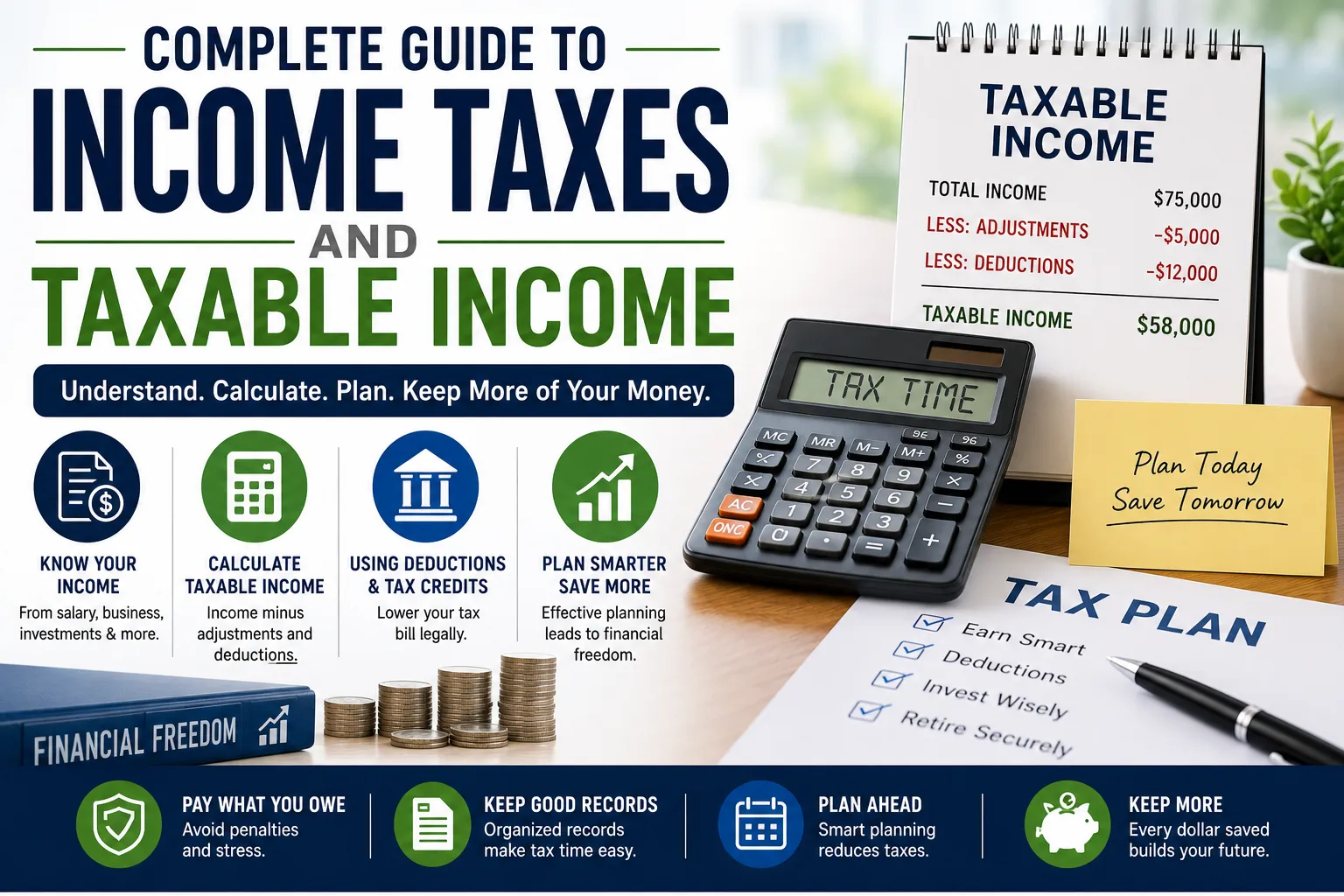
Taxable income is the amount remaining after applying the deductions, allowances or other adjustments permitted under the relevant tax system.
A simplified formula might look like:
Gross income − allowable deductions = taxable income
Actual tax calculations can be considerably more complicated.
Why Taxable Income Matters
Your taxable income is important because it is generally the figure to which applicable income-tax rules and rates are applied.
Imagine two people each receive $70,000 during a year.
One may have:
- Deductible retirement contributions
- Eligible business expenses
- Other permitted deductions
The other may have few or no deductions.
Although their gross income is identical, their taxable incomes could differ.
As a result, their final tax liabilities could also be different.
Earned and Unearned Income
Income is often divided into broad categories.
Earned Income
This generally comes from performing work or operating a business.
Examples include:
- Wages
- Salaries
- Tips
- Commissions
- Bonuses
- Freelance income
- Self-employment income
Unearned or Investment Income
This can include:
- Interest
- Dividends
- Investment distributions
- Certain capital gains
- Rental income
- Royalties
The terminology and tax treatment vary by jurisdiction.
The important point is that different sources of income may be taxed differently.
Employment Income
For many people, employment is their largest source of taxable income.
Employment compensation can potentially include more than base salary.
Depending on local rules, taxable employment income may include:
- Salary
- Hourly wages
- Overtime
- Bonuses
- Commissions
- Tips
- Certain allowances
- Certain employer-provided benefits
Employers often deduct or withhold income taxes before paying employees.
That does not necessarily mean the amount withheld is exactly equal to the employee’s final tax liability.
How Tax Withholding Works
Tax withholding is essentially a system for collecting some income tax throughout the year instead of requiring taxpayers to pay the entire amount at once.
Suppose your monthly gross salary is $5,000.
Your employer may withhold amounts for:
- Income tax
- Social insurance or payroll contributions
- Retirement contributions
- Other required deductions
You then receive the remaining amount as your net pay.
At the end of the tax period, your actual liability may be reconciled against what has already been paid.
Depending on the system and your circumstances, you could:
- Owe additional tax.
- Have paid approximately the correct amount.
- Be entitled to a refund.
Gross Pay vs. Net Pay
These terms are easy to confuse.
Gross pay is your compensation before applicable deductions.
Net pay is the amount you actually receive after deductions.
For example:
| Item | Amount |
|---|---|
| Gross monthly pay | $5,000 |
| Taxes and other deductions | $1,200 |
| Net pay | $3,800 |
The $3,800 reaching your bank account is not necessarily the figure used to determine taxable income.
Tax calculations begin with the applicable definitions under the relevant tax law.
Self-Employment Income
Taxes can become more complicated when you work for yourself.
Self-employed people may include:
- Freelancers
- Consultants
- Contractors
- Sole proprietors
- Gig workers
- Independent professionals
Instead of receiving a salary with taxes automatically withheld, you may need to calculate and pay taxes yourself.
A simplified calculation might be:
Business revenue − allowable business expenses = business profit
That profit may then form part of taxable income, subject to local rules.
For a broader look at how different income sources can be handled as part of a household tax strategy, see how to manage taxes on different income sources.
Revenue Is Not the Same as Profit
This distinction is particularly important for business owners.
Suppose a consultant invoices clients for $100,000 during a year.
The consultant also incurs $30,000 in legitimate deductible business expenses.
Ignoring other adjustments, the business profit would be:
$100,000 − $30,000 = $70,000
The $100,000 is revenue.
The $70,000 is profit.
Tax treatment depends on the jurisdiction, legal structure of the business and nature of the expenses.
What Is a Tax Deduction?
A tax deduction generally reduces the amount of income subject to tax.
Suppose:
Income: $80,000
Allowable deductions: $10,000
A simplified taxable-income calculation would be:
$80,000 − $10,000 = $70,000
A deduction does not ordinarily mean that you receive the entire $10,000 back.
It reduces the amount of income used in the tax calculation.
This distinction is critical.
For a deeper explanation of deductions and how they differ from credits, see the Complete Guide to Tax Deductions and Credits.
Tax Deduction vs. Tax Credit
Tax deductions and tax credits are not the same.
Tax Deduction
Reduces taxable income.
Tax Credit
Generally reduces the amount of tax owed, subject to the rules governing that credit.
Consider a simplified example.
Suppose your calculated tax is $8,000 and you qualify for a $1,000 tax credit.
Your tax after the credit could become:
$8,000 − $1,000 = $7,000
By comparison, a $1,000 deduction would usually reduce taxable income by $1,000 rather than directly reducing tax by $1,000.
Refundable and Nonrefundable Credits
Some tax systems distinguish between refundable and nonrefundable tax credits.
A nonrefundable credit may reduce tax liability to zero but generally cannot create a refund beyond certain limits.
A refundable credit may potentially result in a payment to the taxpayer even after tax liability has been reduced to zero.
The exact rules vary widely.
Always verify the conditions attached to a particular credit rather than assuming all credits work the same way.
What Is a Tax Exemption?
An exemption generally means certain income, people, transactions or entities receive special treatment that removes or reduces a tax obligation.
For example, a tax system may exempt:
- Certain categories of income
- Particular benefits
- Qualifying organizations
- Income below certain thresholds
Exemptions are highly jurisdiction-specific.
Something exempt in one country can be fully taxable in another.
What Is a Tax Allowance?
A tax allowance generally permits a taxpayer to receive or deduct a certain amount before tax applies.
Some jurisdictions provide personal allowances, employment-related allowances or specialized allowances.
Suppose a simplified system allows the first $15,000 of qualifying income to be received tax-free.
Someone earning $50,000 might then have only part of that amount exposed to income tax, depending on the remaining rules.
Again, real tax systems can contain additional conditions and phaseouts.
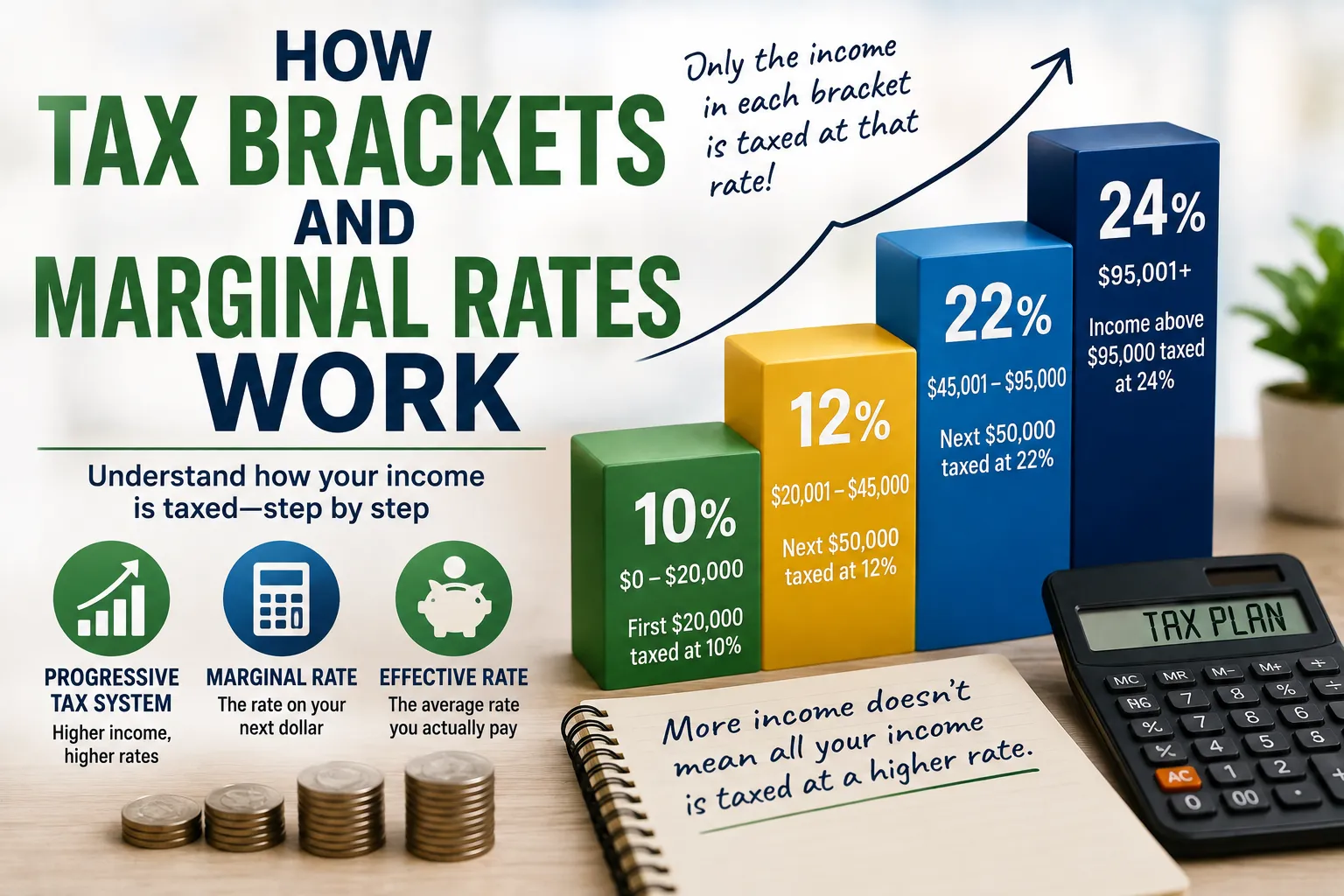
How Progressive Income Taxes Work
Many countries use progressive tax systems.
That means different portions of taxable income can be taxed at different rates.
Consider this hypothetical tax schedule:
| Taxable income | Rate |
|---|---|
| First $20,000 | 10% |
| $20,001–$50,000 | 20% |
| Above $50,000 | 30% |
Suppose your taxable income is $60,000.
It would be incorrect to simply calculate:
$60,000 × 30% = $18,000
Under this simplified progressive system:
- First $20,000 × 10% = $2,000
- Next $30,000 × 20% = $6,000
- Remaining $10,000 × 30% = $3,000
Total:
$11,000
Your highest marginal rate is 30%, but you did not pay 30% on every dollar.
Marginal Tax Rate Explained
Your marginal tax rate is generally the rate applying to your next unit of taxable income within a progressive system.
If you are in a 30% marginal bracket, that does not necessarily mean 30% of all your income goes to income tax.
This misunderstanding frequently creates unnecessary concern about moving into a higher tax bracket.
For a more detailed explanation of brackets and marginal rates, see how tax brackets and marginal rates work.
Moving Into a Higher Tax Bracket
Suppose earning one additional dollar pushes part of your income into the next bracket.
You generally do not suddenly pay the higher rate on all the income below that threshold in a marginal tax system.
Only the portion falling within the higher bracket receives the higher rate.
That means earning more gross income normally does not leave you worse off solely because you entered a higher marginal income-tax bracket, although interactions with benefits, credits, deductions or other rules can sometimes create more complicated outcomes.
Effective Tax Rate
Your effective tax rate measures your tax burden relative to an income measure.
A simplified calculation is:
Total income tax ÷ income × 100
Using the earlier example:
$11,000 ÷ $60,000 × 100 ≈ 18.3%
Although the person’s highest marginal rate was 30%, their simplified effective rate was about 18.3%.
This is why marginal and effective rates should not be confused.
Taxable Interest Income
Interest earned from certain financial accounts may be taxable.
Potential sources include:
- Savings accounts
- Fixed deposits
- Certificates of deposit
- Bonds
- Other interest-bearing products
However, some countries offer tax-advantaged savings products where interest receives special treatment.
Check the rules applying to both the account and your jurisdiction.
Dividend Income
Companies may distribute part of their profits to shareholders through dividends.
Dividend taxation varies considerably.
A jurisdiction may:
- Tax dividends as ordinary income.
- Apply a special dividend rate.
- Provide credits for taxes already paid by the company.
- Exempt certain dividends.
- Apply withholding before payment.
Investors should understand after-tax returns rather than looking only at the dividend yield.
Capital Gains and Taxes
A capital gain can occur when an asset is sold for more than its applicable tax basis or acquisition cost, subject to local rules.
For example:
Purchase price: $10,000
Sale price: $14,000
Simplified gain:
$4,000
Potentially taxable assets can include:
- Stocks
- Investment funds
- Property
- Businesses
- Certain digital assets
- Collectibles
Capital-gains rules vary widely, including differences based on how long an asset was owned.
For a broader discussion of investment taxation, see how investment income and capital gains are taxed.
Unrealized vs. Realized Gains
Suppose you purchase shares for $10,000 and they rise in value to $15,000.
You have a $5,000 unrealized gain because you still own the investment.
If you sell it for $15,000, the gain becomes realized.
Many tax systems generally focus capital-gains taxation on realization events, although exceptions and specialized rules can apply.
Understanding this distinction is important when planning investment sales.
Rental Income
Income from rental property may be taxable.
Depending on local rules, landlords may potentially deduct qualifying expenses such as:
- Certain repairs
- Property management costs
- Insurance
- Financing expenses
- Property-related taxes
- Depreciation or capital allowances
- Professional fees
Not every property expense is immediately deductible.
Some improvements may need to be treated differently from routine repairs.
Maintain detailed records.
Retirement Income
Retirement income can have different tax treatments depending on where the money came from and how the retirement system operates.
Potential sources include:
- Government pensions
- Employer pensions
- Private retirement accounts
- Annuities
- Investment withdrawals
Some contributions may receive tax benefits when made, with withdrawals taxed later.
Other accounts may use a different structure.
Understanding future taxation is an important part of retirement planning.
Tax-Deferred Accounts
A tax-deferred account generally postpones certain taxes until a future event, often withdrawal.
The potential advantage is that money that otherwise might have been paid immediately in tax can remain invested.
However:
Tax deferred does not necessarily mean tax free.
Future withdrawals may be taxable.
The eventual benefit depends on contribution rules, investment performance, withdrawal rules and future tax circumstances.
Tax-Free and Tax-Advantaged Accounts
Some jurisdictions provide accounts offering preferential tax treatment to encourage saving for goals such as:
- Retirement
- Education
- Healthcare
- Homeownership
- General long-term savings
These products may offer:
- Tax-deductible contributions
- Tax-deferred growth
- Tax-free growth
- Tax-free qualifying withdrawals
The specific combination depends entirely on the program.
Other Income You Should Not Automatically Ignore
People sometimes assume income is not taxable simply because it did not come from an employer.
Potentially relevant income can include:
- Freelance payments
- Online business revenue
- Creator income
- Affiliate commissions
- Rental income
- Royalties
- Consulting fees
- Gig-economy income
- Investment income
Whether these amounts are taxable depends on applicable law.
The absence of automatic withholding does not necessarily mean the income is tax-free.
Gifts and Inheritances
Gifts and inheritances can be treated differently from employment or business income.
Depending on the country:
- The recipient may owe no income tax.
- The donor or estate may have separate tax obligations.
- Inheritance or estate taxes may apply.
- Capital-gains consequences may arise later.
- Reporting may still be required.
Because the rules vary dramatically, large gifts and inheritances are situations where professional tax advice can be particularly valuable.
Foreign Income
Working, investing or owning property internationally can create additional tax complexity.
Questions can include:
- Where are you considered tax resident?
- Where was the income earned?
- Was foreign tax already paid?
- Is there a tax treaty?
- Are foreign assets reportable?
- Is foreign income eligible for credits or exemptions?
Never assume that receiving money into a foreign bank account means it does not need to be reported in your country of tax residence.
Tax Residency Matters
Tax residency can determine which country has the right to tax various forms of income.
Residency rules may consider factors such as:
- Number of days present
- Permanent home
- Employment
- Family connections
- Economic interests
- Immigration or residency status
Citizenship and tax residency are not always the same concept.
People living or working across borders should pay particular attention to residency rules.
Payroll Taxes vs. Income Taxes
Income tax is not necessarily the only deduction associated with employment.
Workers and employers may also pay payroll-related contributions that fund programs such as:
- Social security
- Healthcare
- Unemployment systems
- Pensions
These are distinct from income taxes even when they appear together on a payslip.
When evaluating your total tax burden, understand what each deduction represents.
Estimated Tax Payments
Self-employed workers, investors and others without sufficient withholding may need to make tax payments during the year.
These are often known as estimated or provisional payments.
Failing to make required payments can potentially result in:
- Interest
- Penalties
- A large year-end tax bill
If your income changes significantly, review whether your payment strategy still makes sense.
Tax Filing vs. Tax Payment
Filing a tax return and paying tax are related but separate concepts.
Filing means reporting the required financial information to the relevant tax authority.
Payment means settling the tax liability.
You may have already paid much of your tax through withholding or estimated payments before filing the return.
Likewise, someone can have a filing requirement even when little or no additional tax is due.
Why People Receive Tax Refunds
A tax refund generally means more money was paid or credited toward the tax obligation than the final amount owed, subject to refundable credits and other rules.
Suppose:
Tax already withheld: $8,000
Final tax liability: $6,500
Simplified refund:
$1,500
A refund is therefore not automatically “free money.”
In many situations, it represents your own money being returned after excess withholding.
Why People End Up Owing Tax
A taxpayer may owe additional tax because:
- Too little was withheld.
- Self-employment income increased.
- Investment income increased.
- A deduction was unavailable.
- Eligibility for a credit changed.
- Multiple income sources were not accounted for.
- Estimated payments were insufficient.
Unexpected tax bills often result from a mismatch between taxes paid during the year and actual liability.
Record Keeping Is Essential
Good records make tax preparation significantly easier.
Depending on your circumstances, retain appropriate documentation for:
- Income
- Business expenses
- Investments
- Property purchases and sales
- Charitable contributions
- Retirement contributions
- Tax payments
- Foreign income
- Deductible expenses
The required retention period varies by jurisdiction.
Do not discard important documents simply because a tax return has been filed.
Keep Business Receipts Organized
Business owners should establish a system for recording expenses throughout the year.
Useful categories might include:
- Advertising
- Software
- Equipment
- Professional services
- Travel
- Office costs
- Insurance
- Communications
- Education
Do not wait until tax-filing season to reconstruct an entire year from memory.
Digital bookkeeping tools can simplify the process considerably.
Tax Planning vs. Tax Preparation
These concepts are related but different.
Tax Preparation
Primarily involves preparing and filing the required tax returns for a period that has already occurred.
Tax Planning
Looks ahead and considers how financial decisions could affect future tax obligations.
Tax planning might involve:
- Retirement contributions
- Investment timing
- Business structure
- Charitable giving
- Capital gains and losses
- Income timing
Effective tax planning happens throughout the year, not only immediately before a filing deadline.
Tax Avoidance vs. Tax Evasion
This distinction is extremely important.
Lawful Tax Planning
Using legitimate deductions, credits, exemptions and structures permitted by law to manage tax liability.
Tax Evasion
Illegally concealing income, falsifying records or otherwise attempting to avoid taxes that are legally due.
Examples of potentially illegal behavior can include:
- Hiding income
- Creating false expenses
- Maintaining fraudulent records
- Deliberately failing to report taxable transactions
Good tax planning works within the law.
Common Tax Mistakes
Forgetting Smaller Income Sources
Side jobs and investment income can be easy to overlook.
Assuming No Tax Form Means No Tax
Taxability generally depends on law, not merely whether a document was issued.
Mixing Business and Personal Expenses
This makes record keeping much harder.
Claiming Expenses Without Documentation
Maintain evidence supporting legitimate deductions.
Missing Deadlines
Late filing or payment can result in penalties or interest.
Ignoring Foreign Income
Cross-border income can create reporting obligations.
Confusing Deductions With Credits
They generally affect tax calculations differently.
Assuming a Refund Means the Return Is Correct
Receiving a refund does not automatically confirm that every item was reported correctly.
How Life Changes Can Affect Taxes
Major life events can alter your tax position.
Examples include:
- Starting a new job
- Losing a job
- Getting married
- Getting divorced
- Having a child
- Starting a business
- Buying property
- Selling investments
- Moving internationally
- Retiring
- Receiving an inheritance
When a major financial event occurs, consider its tax consequences before the end of the year.
The broader relationship between these events and tax planning is covered in how major life changes can affect your taxes.
Taxes and Investment Decisions
Taxes matter when evaluating investment returns.
Suppose Investment A returns 7% and Investment B returns 6%.
Investment A appears superior.
But if the two investments receive different tax treatment, the after-tax result may be closer—or even reversed.
Investors should therefore consider:
After-tax return, not just headline return.
Taxes should not necessarily determine every investment decision, but they should not be ignored either.
Tax-Loss Harvesting
In jurisdictions where the rules permit it, investors may sometimes realize investment losses to offset certain taxable gains.
For example:
Realized gain: $5,000
Realized qualifying loss: $3,000
The loss may potentially offset some of the gain.
However, rules can restrict how losses are used, including transactions involving repurchasing substantially identical or similar investments.
Professional advice may be appropriate before implementing advanced tax strategies.
Taxes and Retirement Planning
Retirement planning should consider more than how much money you accumulate.
It should also consider how withdrawals may eventually be taxed.
Someone might enter retirement with assets spread across:
- Taxable accounts
- Tax-deferred accounts
- Tax-advantaged accounts
- Cash savings
- Property
The order and timing of withdrawals can affect tax liability.
Long-term tax diversification can therefore be an important component of retirement planning.
Tax Planning for Self-Employed Workers
Self-employed professionals should consider creating a tax routine.
For example:
- Record income.
- Categorize legitimate expenses.
- Separate business money.
- Set aside money for taxes.
- Make required periodic payments.
- Reconcile accounts monthly.
- Review expected annual profit.
- Consult a professional when necessary.
Setting aside tax money as income arrives can reduce the risk of spending funds that will later be needed for tax payments.
Should You Hire a Tax Professional?
Many straightforward tax situations can be managed without extensive professional assistance.
However, professional advice may be particularly valuable when you have:
- Business income
- Multiple businesses
- Complex investments
- Significant capital gains
- Rental property
- Foreign income
- Cross-border residency
- Trusts
- Large inheritances
- Complicated retirement arrangements
- A dispute with a tax authority
The cost of advice can sometimes be small compared with the financial consequences of a significant mistake.
Choosing a Tax Professional
Before hiring someone, investigate:
- Qualifications
- Professional registration where applicable
- Experience
- Specialization
- Fees
- Reputation
- Data-security practices
Be cautious of anyone who:
- Guarantees unusually large refunds.
- Encourages you to hide income.
- Suggests inventing deductions.
- Refuses to explain their work.
- Asks you to sign incomplete documents.
You remain responsible for understanding what is submitted in your name.
A Simple Example of Taxable Income
Consider a fictional taxpayer.
Income
Salary: $70,000
Freelance profit: $10,000
Taxable interest: $1,000
Total applicable income: $81,000
Suppose the taxpayer qualifies for $11,000 in permitted deductions and adjustments.
Simplified taxable income:
$81,000 − $11,000 = $70,000
The relevant tax rates would then be applied according to the jurisdiction’s rules.
After calculating tax, applicable credits could potentially reduce the amount owed.
This demonstrates the general flow:
Income → adjustments/deductions → taxable income → tax rates → credits → final tax liability
Real returns may contain many additional steps.
A Practical Annual Tax Checklist
Income
- Employment income recorded
- Business income recorded
- Investment income reviewed
- Rental income reviewed
- Foreign income considered
- Other potentially taxable income identified
Deductions and Credits
- Eligible deductions reviewed
- Eligible credits reviewed
- Supporting documents retained
Investments
- Asset sales recorded
- Cost basis information retained
- Dividends recorded
- Interest recorded
Business
- Revenue reconciled
- Expenses categorized
- Receipts retained
- Estimated payments reviewed
Filing
- Correct filing deadline confirmed
- Tax already paid reconciled
- Return reviewed before submission
- Payment or refund details confirmed
- Copies of records retained
Questions to Ask Before Making a Major Financial Decision
Before selling an investment, changing jobs, withdrawing retirement money or making another significant financial move, ask:
- Will this create taxable income?
- When will the tax become due?
- Does timing matter?
- Are deductions available?
- Are there penalties?
- Could it affect another tax benefit?
- Does it change my marginal tax rate?
- Should I speak with a tax professional first?
The tax consequences should rarely be the only consideration, but knowing them beforehand can prevent surprises.
Build Taxes Into Your Financial Plan
Taxes should be treated as part of financial planning rather than an annual administrative inconvenience.
If you earn $100,000, you cannot necessarily spend or invest all $100,000.
Some portion may need to cover:
- Income taxes
- Payroll contributions
- Business taxes
- Investment taxes
- Property-related taxes
- Other obligations
Budgeting with after-tax money creates a more realistic picture of what you can actually afford.
For self-employed workers especially, treating tax money as available spending money can create serious cash-flow problems.
Don’t Make Financial Decisions Based Only on Taxes
Tax efficiency is useful, but it should not override fundamental financial reasoning.
Avoid keeping a poor investment solely because selling it creates a tax bill.
Avoid making unnecessary purchases merely because they might be deductible.
Spending $1 purely to save a fraction of that amount in tax generally leaves you with less money.
The better question is:
Would this financial decision still make sense before considering the tax benefit?
Then evaluate whether legitimate tax advantages make it even more attractive.
Understanding Your Taxable Income Gives You More Control
Income tax becomes much easier to understand once you separate the major concepts.
Your gross income is not necessarily your taxable income. Your marginal tax rate is not necessarily your effective tax rate. A deduction is not the same as a credit, and a large tax refund does not necessarily mean you earned additional money.
The exact calculations will always depend on the rules where you live, the types of income you receive and the deductions, allowances or credits for which you qualify.
But the underlying process is relatively straightforward: identify your income, determine which amounts are taxable, apply legitimate deductions and adjustments, calculate tax under the applicable rates, account for credits and compare the resulting liability with what has already been paid.
Most importantly, don’t wait until filing season to think about taxes. Keep accurate records, review your position after major financial changes and plan ahead when making investments, running a business or earning income from multiple sources.
Understanding how taxable income is calculated does more than help you file a return—it helps you understand how much of the money you earn is truly available to save, spend and invest.